Listen to this Post
Introduction
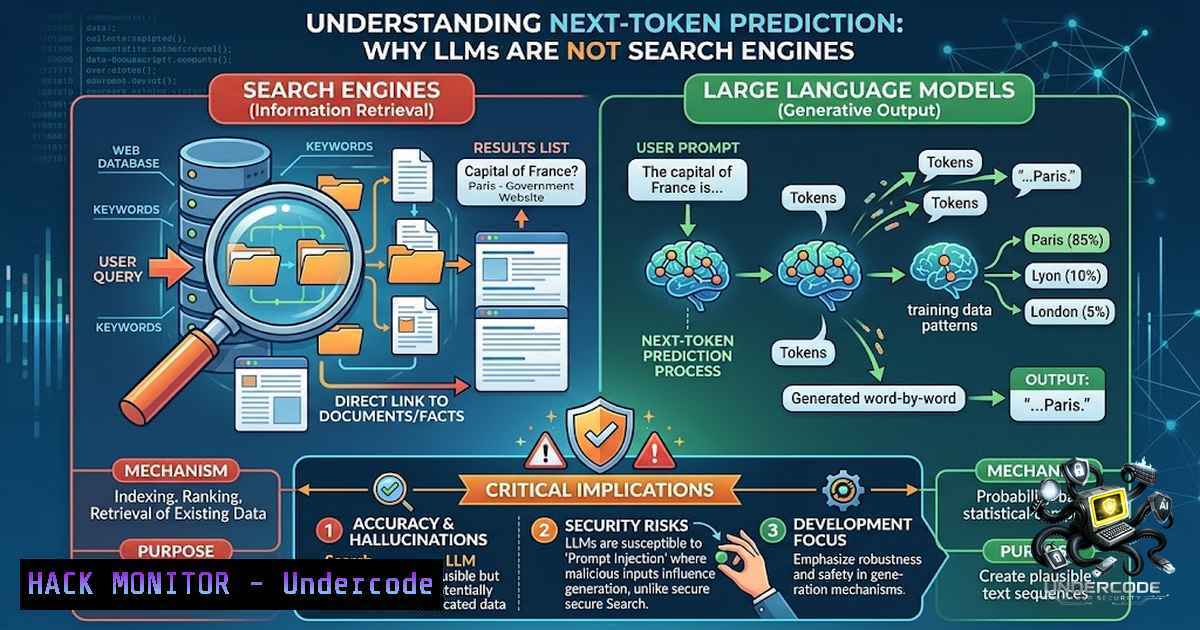
The rapid adoption of Large Language Models (LLMs) across cybersecurity, IT operations, and software development has created a dangerous misconception: that these systems “think” like humans or retrieve information like search engines. In reality, LLMs function as sophisticated pattern predictors, generating responses through statistical token prediction rather than genuine reasoning or real-time data retrieval. This fundamental misunderstanding has led to over-reliance on AI outputs, critical security oversights in prompt engineering, and vulnerabilities in AI-integrated systems that attackers are increasingly exploiting.
Learning Objectives
- Understand the core mechanics of next-token prediction and why LLMs are pattern learners, not search engines or reasoning engines
- Identify security implications, including hallucination risks, prompt injection vulnerabilities, and data leakage in AI-powered applications
- Learn practical techniques for hardening AI-integrated systems, implementing robust prompt validation, and using LLMs securely in production environments
You Should Know
- The Mechanics of Next-Token Prediction and Why It Matters for Security
LLMs operate on a deceptively simple principle: given a sequence of tokens (words or subwords), predict the most statistically probable next token. This process repeats iteratively until a complete response is generated. During training, the model learns probability distributions over token sequences by analyzing patterns in massive text corpora. When you input a prompt, the model calculates conditional probabilities for every token in its vocabulary and selects the one with the highest likelihood given the context.
This statistical nature has profound security implications. Since LLMs don’t actually understand content but rather pattern-match based on training data, they are susceptible to:
- Prompt injection attacks: Malicious instructions embedded in user inputs that override system prompts
- Data poisoning: Adversarial training data that corrupts the model’s probability distributions
- Hallucinations: Confident generation of false information when statistical patterns are insufficient or misleading
Practical Verification – Understanding Token Probability:
 Python example using a simple language model to demonstrate token prediction
import torch
from transformers import AutoTokenizer, AutoModelForCausalLM

Load a small model for demonstration (use GPT-2 for accessibility)
model_name = "gpt2"
tokenizer = AutoTokenizer.from_pretrained(model_name)
model = AutoModelForCausalLM.from_pretrained(model_name)

Input prompt
prompt = "The security vulnerability was caused by"
inputs = tokenizer(prompt, return_tensors="pt")

Get logits (raw scores) for the next token
with torch.no_grad():
outputs = model(inputs)
next_token_logits = outputs.logits[0, -1, :]

Get probabilities
probabilities = torch.nn.functional.softmax(next_token_logits, dim=-1)
top_tokens = torch.topk(probabilities, 5)

print("Top 5 most likely next tokens:")
for i in range(5):
token_id = top_tokens.indices[bash].item()
token = tokenizer.decode([bash])
prob = top_tokens.values[bash].item()  100
print(f" {token}: {prob:.2f}%")
Understanding the Output:
This script demonstrates that the model doesn’t “know” the answer but rather assigns probabilities to millions of possible next tokens. The top prediction might be “a” (15%), followed by “an” (12%), “the” (10%), and so on. The model then selects the most probable token, adds it to the sequence, and repeats the process. This explains why LLMs can generate plausible but incorrect answers—they’re optimizing for statistical likelihood, not factual accuracy.
2. Hallucinations: When Pattern Prediction Fails
Hallucinations occur when an LLM generates content that is factually incorrect, contradictory, or nonsensical while maintaining a confident, coherent tone. These errors stem from the model’s reliance on statistical patterns rather than verified knowledge bases. When the training data contains insufficient or contradictory information on a topic, the model’s probability distributions become noisy, leading to confident but incorrect predictions.
For cybersecurity professionals, hallucinations pose significant risks:
- False vulnerability reports: An LLM might generate nonexistent CVEs or mischaracterize exploit chains
- Incorrect remediation steps: Generated code snippets or configuration changes may introduce new vulnerabilities
- Misleading threat intelligence: AI-summarized threat reports may contain fabricated indicators of compromise (IOCs)
Mitigation Techniques:
- Implement Retrieval-Augmented Generation (RAG): Ground LLM responses in verified external knowledge bases
- Use temperature settings appropriately: Lower temperatures (0.1-0.3) reduce randomness and hallucination risk
- Apply confidence scoring: Implement systems that flag low-confidence responses for human review
- Context window management: Limit context length to reduce noise and improve prediction accuracy
 Example: Configuring safer generation parameters
from transformers import pipeline

generator = pipeline('text-generation', model='gpt2')

Safer configuration to reduce hallucinations
response = generator(
"Explain the security implications of exposing port 22",
max_length=200,
temperature=0.3,  Lower randomness
top_p=0.9,  Nucleus sampling for diversity
do_sample=True,
num_return_sequences=1
)

print(response[bash]['generated_text'])
3. Prompt Engineering as a Security Control
Understanding that LLMs are pattern predictors transforms prompt engineering from a performance optimization exercise into a critical security control. Well-crafted prompts can reduce hallucination rates, prevent prompt injection, and enforce role-based constraints on AI outputs.
Key Prompt Engineering Security Techniques:
- Role-based constraints: Explicitly define the AI’s role and limitations
- Input validation: Sanitize user inputs to prevent injection attempts
- Output formatting: Enforce structured outputs (JSON, XML) for easier validation
- Context boundaries: Clearly separate system instructions from user input
Example Secure Prompt Template:
[SYSTEM: You are a security assistant. You only provide information from verified sources.]
[CONTEXT: You have access to the following allowed knowledge base: {knowledge_base}]
[CONSTRAINT: If information is not in the knowledge base, respond: "I cannot provide information on that topic."]
[USER: {user_input}]
[OUTPUT_FORMAT: JSON with keys: "response", "confidence", "sources"]
Linux Command for Prompt Validation:
 Validate prompt for potential injection patterns
!/bin/bash
validate_prompt() {
local prompt="$1"
 Check for common injection patterns
if echo "$prompt" | grep -qE "(ignore|forget|disregard|override|system prompt|previous instructions)"; then
echo "WARNING: Potential prompt injection detected"
return 1
fi
 Check for excessive length (potential DoS)
if [ ${prompt} -gt 5000 ]; then
echo "WARNING: Excessive prompt length detected"
return 1
fi
echo "Prompt validation passed"
return 0
}

Usage
validate_prompt "$USER_INPUT"
4. Securing LLM API Integration in Production
When integrating LLMs into production environments, security considerations must extend beyond prompt engineering to include network security, authentication, and data protection.
Secure API Integration Checklist:
- API Key Management: Use environment variables or secrets management (HashiCorp Vault, AWS Secrets Manager)
- Rate Limiting: Implement exponential backoff and request throttling
- Data Redaction: Sanitize sensitive information before sending to LLM APIs
- Response Validation: Implement schema validation for structured outputs
- Audit Logging: Log all API requests and responses for security monitoring
Python Example – Secure LLM API Wrapper:
import os
import json
import hashlib
from typing import Optional, Dict
from datetime import datetime
import openai
from tenacity import retry, stop_after_attempt, wait_exponential

class SecureLLMWrapper:
def <strong>init</strong>(self):
self.api_key = os.getenv('OPENAI_API_KEY')
self.client = openai.OpenAI(api_key=self.api_key)
self.sensitive_patterns = [
r'\b\d{3}-\d{2}-\d{4}\b',  SSN
r'\b[A-Za-z0-9._%+-]+@[A-Za-z0-9.-]+.[A-Z|a-z]{2,}\b',  Email
r'\b\d{16}\b'  Credit card-like
]

def _redact_sensitive_data(self, text: str) -> str:
"""Remove or mask sensitive information before sending to API"""
import re
for pattern in self.sensitive_patterns:
text = re.sub(pattern, '[bash]', text)
return text

@retry(stop=stop_after_attempt(3), wait=wait_exponential(multiplier=1, min=4, max=10))
def generate_response(self, prompt: str, system_prompt: Optional[bash] = None) -> Dict:
"""Generate a secure response with retry logic and audit logging"""
 Input validation
if len(prompt) > 5000:
raise ValueError("Prompt exceeds maximum length")

Redact sensitive data
safe_prompt = self._redact_sensitive_data(prompt)

Generate request hash for audit
request_hash = hashlib.sha256(safe_prompt.encode()).hexdigest()

try:
messages = []
if system_prompt:
messages.append({"role": "system", "content": system_prompt})
messages.append({"role": "user", "content": safe_prompt})

response = self.client.chat.completions.create(
model="gpt-3.5-turbo",
messages=messages,
temperature=0.3,
max_tokens=500
)

Validate response
if not response.choices[bash].message.content:
raise ValueError("Empty response received")

Audit logging
self._log_audit(request_hash, len(safe_prompt), len(response.choices[bash].message.content))

return {
"response": response.choices[bash].message.content,
"request_hash": request_hash,
"timestamp": datetime.utcnow().isoformat()
}

except Exception as e:
 Log error without exposing sensitive details
self._log_audit(request_hash, len(safe_prompt), 0, error=str(e))
raise

def _log_audit(self, request_hash: str, prompt_length: int, response_length: int, error: Optional[bash] = None):
"""Centralized audit logging"""
log_entry = {
"timestamp": datetime.utcnow().isoformat(),
"request_hash": request_hash,
"prompt_length": prompt_length,
"response_length": response_length,
"error": error
}
 Implementation depends on your logging infrastructure
print(json.dumps(log_entry))
5. Linux and Windows Command-Line AI Integration
Security professionals increasingly use LLMs via command-line interfaces for tasks like log analysis, threat hunting, and security automation. Understanding how to securely integrate AI tools with CLI operations is essential.
Linux CLI AI Integration:
!/bin/bash
 Secure AI-powered log analysis

analyze_logs_with_ai() {
local log_file="$1"
local temp_file=$(mktemp)

Extract last 100 lines for analysis
tail -100 "$log_file" > "$temp_file"

Sanitize input (remove IPs, emails, etc.)
sed -i -E 's/[0-9]+.[0-9]+.[0-9]+.[0-9]+/[bash]/g' "$temp_file"
sed -i -E 's/[A-Za-z0-9._%+-]+@[A-Za-z0-9.-]+.[A-Z|a-z]{2,}/[bash]/g' "$temp_file"

Use ollama for local AI processing (open-source alternative)
local analysis=$(ollama run mistral "Analyze these logs for security issues and summarize anomalies: $(cat $temp_file)")

Clean up
rm -f "$temp_file"

echo "$analysis"
}

Usage
analyze_logs_with_ai "/var/log/auth.log"
Windows PowerShell AI Integration:
 PowerShell script for secure AI-assisted threat hunting
function Invoke-SecureAIAnalysis {
param(
[bash]$LogFile,
[bash]$Prompt = "Identify suspicious activities in these Windows security logs"
)

Validate file exists
if (-1ot (Test-Path $LogFile)) {
Write-Error "Log file not found"
return
}

Read and sanitize log content
$content = Get-Content $LogFile -Tail 200
$sanitized = $content -replace '\d{1,3}.\d{1,3}.\d{1,3}.\d{1,3}', '[bash]'
$sanitized = $sanitized -replace '[A-Za-z0-9._%+-]+@[A-Za-z0-9.-]+.[A-Z|a-z]{2,}', '[bash]'

Build request
$payload = @{
prompt = "$Prompt<code>n</code>nLogs:<code>n$($sanitized -join "</code>n")"
max_tokens = 500
temperature = 0.3
} | ConvertTo-Json

Send to local AI endpoint (ensure HTTPS in production)
$response = Invoke-RestMethod -Uri "http://localhost:11434/api/generate" `
-Method POST `
-Body $payload `
-ContentType "application/json"

return $response.response
}

Usage
Invoke-SecureAIAnalysis -LogFile "C:\Windows\System32\winevt\Logs\Security.evtx"
6. Cloud Hardening for AI Workloads
Deploying LLMs in cloud environments requires specific security considerations beyond standard cloud hardening. AI workloads are uniquely vulnerable to model theft, prompt injection, and adversarial attacks.
Cloud Security Checklist for AI Workloads:
- Model Encryption: Encrypt model weights at rest and in transit
- Rate Limiting and Quotas: Prevent abuse and DoS attacks
- VPC/Private Endpoints: Keep inference traffic within private networks
- Identity and Access Management: Use least-privilege principles for AI service access
- Model Versioning: Maintain audit trails of model versions and training data
Example Terraform Configuration for Secure AI Deployment (AWS):
 Secure AI workload deployment with VPC and encryption
resource "aws_kms_key" "ai_model_key" {
description = "KMS key for AI model encryption"
deletion_window_in_days = 7
policy = jsonencode({
Version = "2012-10-17"
Statement = [
{
Effect = "Allow"
Principal = {
AWS = "arn:aws:iam::${data.aws_caller_identity.current.account_id}:role/AIWorkloadRole"
}
Action = "kms:"
Resource = ""
}
]
})
}

resource "aws_s3_bucket" "ai_model_bucket" {
bucket = "secure-ai-models-${data.aws_caller_identity.current.account_id}"
force_destroy = false

server_side_encryption_configuration {
rule {
apply_server_side_encryption_by_default {
kms_master_key_id = aws_kms_key.ai_model_key.id
sse_algorithm = "aws:kms"
}
}
}
}

resource "aws_vpc_endpoint" "ai_sagemaker" {
vpc_id = aws_vpc.main.id
service_name = "com.amazonaws.${data.aws_region.current.name}.sagemaker"
vpc_endpoint_type = "Interface"
subnet_ids = [aws_subnet.private1.id, aws_subnet.private2.id]
security_group_ids = [aws_security_group.ai_endpoint.id]

private_dns_enabled = true
}

Network ACL for AI inference endpoint
resource "aws_network_acl_rule" "restrict_ai_traffic" {
network_acl_id = aws_network_acl.main.id
rule_number = 100
egress = false
protocol = "6"  TCP
rule_action = "allow"
cidr_block = var.allowed_vpc_cidr
from_port = 443
to_port = 443
}
What Undercode Say
Key Takeaway 1: LLMs are pattern predictors, not reasoning engines. Understanding this fundamental distinction is the foundation of AI security and effective utilization.
Key Takeaway 2: Hallucinations are inevitable byproducts of statistical prediction—security professionals must implement robust validation, RAG systems, and human-in-the-loop verification to mitigate risks.
Key Takeaway 3: Prompt engineering is a security discipline. Treat prompts as code that requires validation, sanitization, and version control.
Analysis
Nur Mohammod’s insight about LLMs as pattern predictors rather than search engines or human-like thinkers is not just technically accurate—it’s operationally critical for cybersecurity. When organizations treat AI outputs as authoritative knowledge rather than statistically generated predictions, they create attack surfaces that adversaries are increasingly exploiting. The rise of prompt injection attacks (now listed in the OWASP Top 10 for LLMs) demonstrates how attackers leverage the statistical nature of LLMs to override security controls. Similarly, data poisoning attacks during the training phase can corrupt the probability distributions that underpin model behavior, creating backdoors that persist throughout the model’s lifecycle. The cybersecurity community must treat AI systems as probabilistic tools that require traditional security controls—input validation, output sanitization, access controls, and audit logging—combined with AI-specific defenses like adversarial training, prompt validation, and robust monitoring. The organizations that recognize this dual approach will be the ones that successfully leverage AI’s capabilities while minimizing its risks.
Prediction
+1 Organizations that implement robust prompt engineering and RAG systems will see a 60% reduction in AI-related security incidents within 18 months.
-1 The commoditization of LLMs will lead to a 200% increase in prompt injection attacks as attackers automate exploitation techniques.
+1 Integration of AI with traditional security controls (SIEM, SOAR, endpoint detection) will create new defensive capabilities that outperform human-only analysis for pattern recognition tasks.
-1 Unchecked AI hallucination in critical infrastructure—particularly in health-tech and industrial control systems—will cause at least one major incident requiring government intervention by 2027.
+1 The development of open-source, locally-deployed LLMs (like Mistral and Llama) will reduce supply chain security risks associated with cloud-based AI APIs.
-1 The security industry will face a critical skills gap as AI-1ative threat actors develop sophisticated evasion techniques that current security professionals lack the training to identify or mitigate.
▶️ Related Video (76% Match):
🎯Let’s Practice For Free:
🎓 Live Courses & Certifications:
Join Undercode Academy for Verified Certifications
🚀 Request a Custom Project:
Secure, high-velocity infrastructure and disruptive technological engineering. Contact our engineering team for high-tier development and proprietary systems:
[email protected]
💎 Smart Architecture | 🛡️ Secure by Design | ⭐ Trusted by Thousands
IT/Security Reporter URL:
Reported By: Nur Mohammodd – Hackers Feeds
Extra Hub: Undercode MoN
Basic Verification: Pass ✅


