Listen to this Post
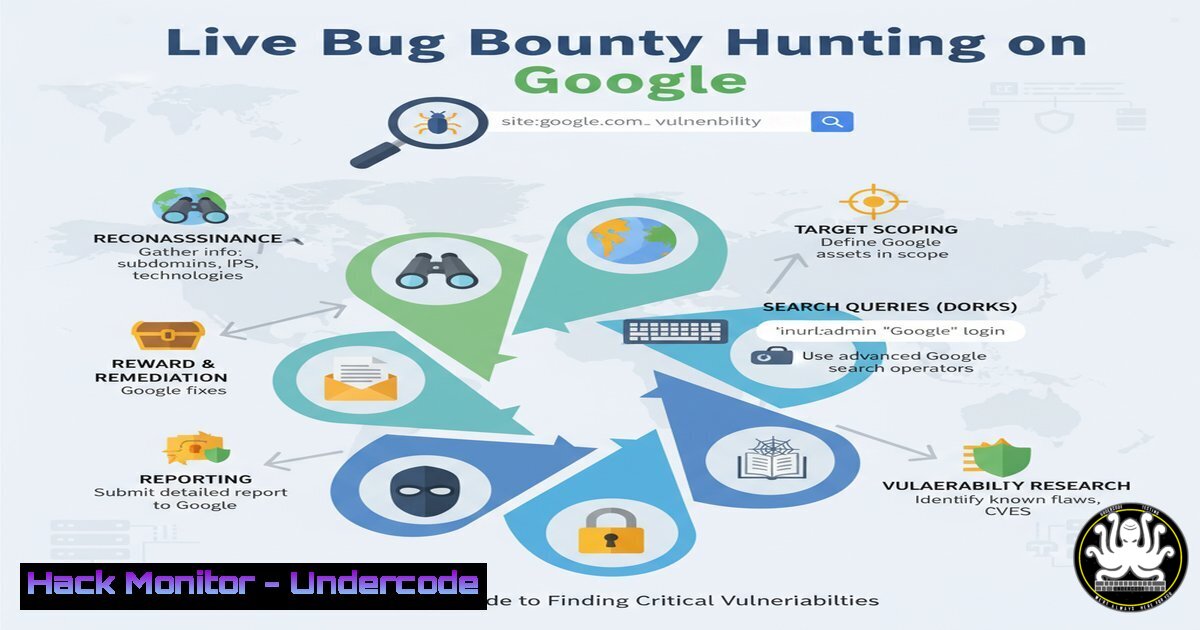
Introduction:
Bug bounty hunting has evolved from a niche hobby into a professional cybersecurity discipline, with platforms like Bugcrowd facilitating crowdsourced security testing. Live hunting sessions, such as those demonstrated by researchers on targets like Google via wiz.io, provide a real-time glimpse into the methodologies used to uncover critical vulnerabilities before malicious actors can exploit them. This article deconstructs the core techniques and commands essential for replicating this success in your own security assessments.
Learning Objectives:
- Master the initial reconnaissance and attack surface mapping process for a large-scale target.
- Utilize advanced Google Dorking techniques to uncover hidden endpoints and sensitive data.
- Apply practical command-line tools for vulnerability validation and proof-of-concept development.
You Should Know:
- Mastering Attack Surface Enumeration with Subfinder and Amass
Before launching any attack, you must understand the target’s digital footprint. Passive and active reconnaissance tools are indispensable for this phase.
 Passive Enumeration with Subfinder
subfinder -d google.com -silent | tee subdomains.txt

Active Enumeration with Amass
amass enum -active -d google.com -src -o amass_results.txt

Combining and sorting results
cat subdomains.txt amass_results.txt | sort -u > final_subdomains.txt
Step-by-step guide:
- Subfinder performs passive subdomain discovery, meaning it queries various sources without directly interacting with the target. The `-silent` flag provides clean output.
- Amass with the `-active` flag performs more intensive enumeration, including DNS zone transfers and brute-forcing. This can yield subdomains not found passively.
- The final command merges the results from both tools, removes duplicates with
sort -u, and saves them to a single file. This consolidated list is your initial attack surface. -
Probing for Live Hosts and HTTP Services with HTTPx
With a list of subdomains, the next step is to identify which are live and running accessible web services.
 Check for live hosts and identify technologies
cat final_subdomains.txt | httpx -silent -tech-detect -status-code -title > live_hosts.txt

Example output snippet
 [https://dev.google.com] [bash] [Moved Permanently] [Tomcat,Java]
 [https://api-staging.google.com] [bash] [Google API Portal] [Golang,JSON]
Step-by-step guide:
- The `httpx` tool takes the list of subdomains as input.
- The `-silent` flag suppresses extra output. `-status-code` and `-title` provide the HTTP response code and page title.
- Crucially, `-tech-detect` fingerprints the technologies running on the server (e.g., WordPress, React, Nginx). This information is vital for selecting the right exploitation techniques.
3. Uncovering Hidden Assets with Google Dorking
Google’s advanced search operators, or “Dorks,” can expose publicly accessible but unlinked sensitive files and information.
 Not a CLI command, but a search query for Google
site:google.com ext:log | ext:txt | ext:bak

Find exposed configuration files
site:google.com inurl:"wp-config" | inurl:"config.php"

Locate exposed administrative panels
site:google.com intitle:"index of" "admin"
Step-by-step guide:
- The `site:` operator restricts the search to the specified domain.
2. `ext:` searches for specific file extensions. `inurl:` and `intitle:` look for keywords in the URL and page title, respectively. - Combine these operators to create powerful queries. For instance, `site:google.com ext:pdf “confidential”` can find confidential PDF documents.
4. Automated Vulnerability Scanning with Nuclei
Nuclei uses a vast community-driven database of templates to scan for thousands of known vulnerabilities.
 Scan live hosts for common vulnerabilities
cat live_hosts.txt | nuclei -t /nuclei-templates/ -severity low,medium,high,critical -o nuclei_scan_results.txt

Run only the newest and most critical templates
cat live_hosts.txt | nuclei -nt -severity high,critical -o critical_findings.txt
Step-by-step guide:
1. Feed your list of `live_hosts` into `nuclei`.
- The `-t` flag specifies the template directory. The `-severity` filter allows you to focus on the most important issues.
- The `-nt` flag (new templates) is useful for finding the latest published vulnerabilities. Always review the results manually to eliminate false positives.
5. Analyzing JavaScript for API Endpoints and Secrets
Modern web applications heavily rely on JavaScript, which often contains hidden API endpoints, keys, and other sensitive information.
 Using Katana to crawl and extract JS files
cat live_hosts.txt | katana -js-crawl -o js_files.txt

Using Subjs to extract all JavaScript file paths
cat live_hosts.txt | subjs | tee js_paths.txt

Searching for high-entropy strings (potential API keys) in JS files
cat js_files.txt | while read url; do
curl -s $url | grep -E "api_key|apikey|password|token" >> secrets_scan.txt
done
Step-by-step guide:
- Katana is used as a crawler with the `-js-crawl` flag specifically to discover JavaScript files linked from the page.
- Subjs is a simpler tool that extracts JavaScript file paths from a list of URLs.
- The final loop uses `curl` to fetch each JS file and `grep` to search for common patterns of secrets. For more advanced analysis, tools like `LinkFinder` are recommended.
6. Fuzzing for Hidden Directories and Parameters
Fuzzing involves systematically bombarding an application with requests to discover unlinked content and functional parameters.
 Directory Fuzzing with FFUF
ffuf -w /usr/share/wordlists/dirb/common.txt -u https://target.google.com/FUZZ -mc 200,301,302 -o dir_scan.json

Parameter Fuzzing
ffuf -w /usr/share/wordlists/SecLists/Discovery/Parameters/params.txt -u https://target.google.com/endpoint?FUZZ=test -fs 0
Step-by-step guide:
- For directory fuzzing, `FFUF` replaces the `FUZZ` keyword with words from the specified wordlist (
-w). The `-mc` flag filters for “interesting” HTTP status codes. - For parameter fuzzing, the wordlist contains common parameter names (e.g.,
id,user,file). The `-fs 0` filter hides responses with a size of 0, which are typically “not found” errors, making it easier to see valid parameters.
7. Validating and Exploiting a Simple IDOR Vulnerability
Insecure Direct Object Reference (IDOR) is a common logic flaw where an application provides direct access to objects based on user-supplied input.
 Curl command to test for IDOR
curl -H "Authorization: Bearer <USER_A_TOKEN>" https://api.google.com/v1/user/12345
curl -H "Authorization: Bearer <USER_B_TOKEN>" https://api.google.com/v1/user/12345

Automated testing with a list of IDs
for id in $(seq 10000 10010); do
curl -s -H "Authorization: Bearer $TOKEN" "https://api.google.com/v1/user/$id" | grep -q "not found" || echo "Potential IDOR on ID: $id"
done
Step-by-step guide:
- The core test is to access the same object (e.g., user ID
12345) with two different authenticated user sessions. - If User B can retrieve the sensitive data of User A (ID
12345), a critical IDOR vulnerability is confirmed. - The bash script automates this for a range of object IDs, quickly identifying which ones are accessible and should not be.
What Undercode Say:
- Methodology Over Tools: The most critical asset for a bug bounty hunter is a rigorous, repeatable methodology. The tools are merely enablers.
- Context is King: Automated tools generate noise. The hunter’s value lies in understanding the application’s business logic, architecture, and context to separate false positives from critical, exploitable vulnerabilities.
The live stream from Bugcrowd researcher Bhagirath S. underscores a fundamental shift: the barrier to entry is lowering through education, but the ceiling for high-impact findings is rising. Success is no longer about who can run the most tools, but who can think like both a developer and an attacker. The provided commands form a pipeline, but without a deep understanding of web protocols, authentication mechanisms, and common development mistakes, this pipeline is just a noisy hammer looking for a nail. The real skill is knowing where to point it and how to interpret the results to build a valid, impactful exploit.
Prediction:
The public dissemination of advanced bug bounty methodologies, as seen in live streams and dedicated training platforms like KrazePlanetTraining, will force a rapid evolution in defensive security. Organizations will be compelled to integrate automated security testing earlier in the development lifecycle (Shift-Left) and adopt more sophisticated bug bounty triage processes. Concurrently, we will see a rise in AI-powered offensive security tools that can mimic these human-like hunting methodologies at scale, finding complex logical flaws that traditional scanners miss. This will create an AI-augmented arms race between defenders and attackers, pushing the entire industry towards more resilient, security-by-design software architecture.
🎯Let’s Practice For Free:
IT/Security Reporter URL:
Reported By: Rix4uni Bugbounty – Hackers Feeds
Extra Hub: Undercode MoN
Basic Verification: Pass ✅


