Listen to this Post
Introduction:
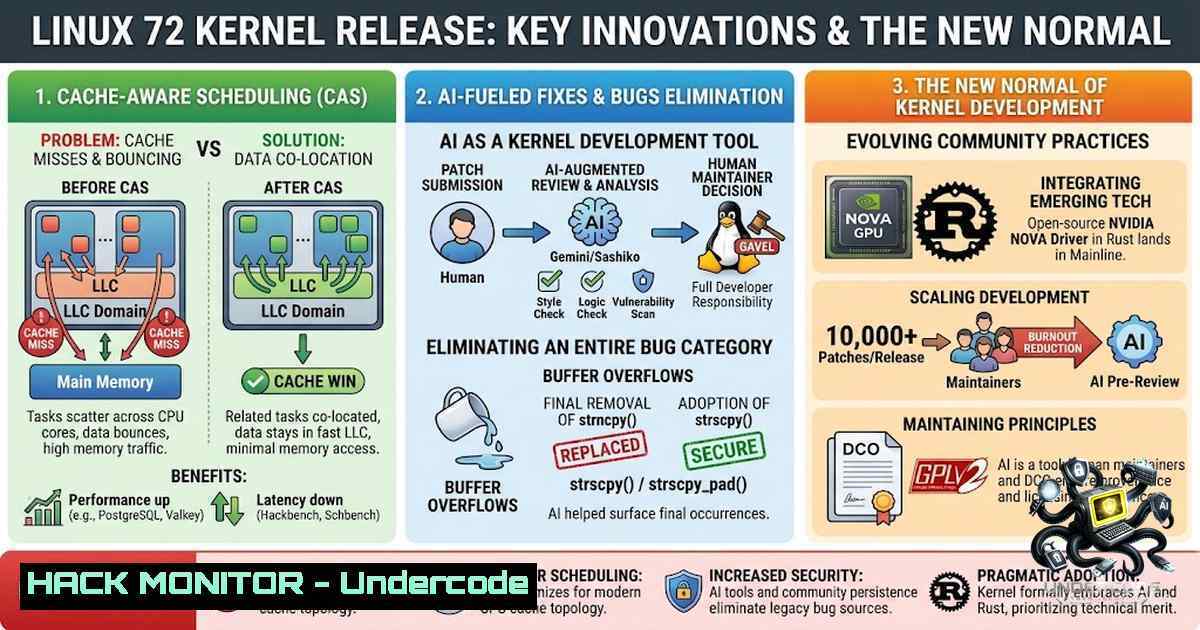
The Linux 7.2 kernel, expected for stable release on August 16, 2026, represents a watershed moment in open-source operating system development. At its core, this release introduces Cache Aware Scheduling—a long-awaited feature that optimizes task placement across modern CPUs with multiple last-level cache (LLC) domains, delivering significant performance gains for data-intensive workloads. Perhaps more telling, however, is what Linux 7.2 reveals about the evolving nature of kernel development itself: AI and LLM coding agents have fundamentally transformed the patch submission and bug-fixing process, creating what Linus Torvalds has termed the “new normal” of relentless, AI-fueled fix cycles. With a codebase exceeding 43 million lines, this release balances groundbreaking performance optimizations against the challenges of maintaining stability in an era of automated code review.
Learning Objectives:
- Understand the mechanics and performance implications of Cache Aware Scheduling in Linux 7.2
- Analyze the impact of AI/LLM-driven bug discovery on kernel development workflows
- Master practical commands for verifying, enabling, and benchmarking new kernel features
- Evaluate security and hardening improvements across filesystems, virtualization, and system calls
- Implement monitoring and upgrade strategies for production environments
You Should Know:
- Cache Aware Scheduling: Performance at the LLC Level
Cache Aware Scheduling represents the most significant scheduler enhancement in recent Linux history. The feature modifies the task scheduler to be more cache-aware, co-locating tasks that share data—such as threads of the same process—within the same Last Level Cache (LLC) domain. By improving cache locality, the scheduler reduces cache bouncing and cache misses, ultimately improving data access efficiency.
For systems with multiple LLC domains—typical in modern AMD EPYC, Intel Xeon, and high-end desktop processors—this optimization can yield substantial performance improvements. Early benchmarks demonstrate up to 44% throughput gains on AMD EPYC systems, 30% faster completion times on Intel Xeon, and remarkable 360% improvements in MySQL workloads under specific multi-domain topologies. Even MongoDB throughput has been shown to climb 30 to 100 percent in targeted tests.
The feature is configurable via `CONFIG_SCHED_CACHE` in the kernel configuration. To verify whether Cache Aware Scheduling is enabled on your system:
 Check if CONFIG_SCHED_CACHE is enabled in the running kernel
zcat /proc/config.gz | grep CONFIG_SCHED_CACHE

Alternative method if config.gz is not available
grep CONFIG_SCHED_CACHE /boot/config-$(uname -r)

View scheduler cache-related kernel parameters
cat /sys/kernel/debug/sched/cache_aware

Monitor cache-aware scheduling statistics
cat /proc/schedstat | grep cache
To disable Cache Aware Scheduling at runtime (useful for comparative benchmarking):
 Disable cache-aware scheduling (requires root)
echo 0 > /proc/sys/kernel/sched_cache_aware_enabled

Re-enable
echo 1 > /proc/sys/kernel/sched_cache_aware_enabled

View current cache domain topology
lstopo --of txt | grep -i cache
For performance validation, consider using the Phoronix Test Suite to benchmark workloads before and after enabling the feature:
 Install Phoronix Test Suite
sudo apt-get install phoronix-test-suite  Debian/Ubuntu
sudo dnf install phoronix-test-suite  Fedora/RHEL

Run a cache-sensitive benchmark
phoronix-test-suite benchmark pts/context-switching
phoronix-test-suite benchmark pts/openssl
phoronix-test-suite benchmark pts/sqlite
2. The AI Revolution in Kernel Bug Hunting
Perhaps the most controversial aspect of Linux 7.2 is the unprecedented volume of AI-generated patches and AI-discovered bugs. The ARM64 architecture saw no new KVM features this cycle, with developers attributing this to being swamped by “so many AI-fueled fixes”. The KVM pull request for Linux 7.2 noted: “This is a bit of an odd merge window… It is purely fixes, because it is simply becoming too hard to review new stuff when so many AI-fuelled fixes hit the list”.
The Sashiko AI bot has been particularly active, uncovering critical and high-severity bugs across subsystems. Hardware monitoring (HWMON) fixes included race conditions, calculation errors, possible out-of-bounds accesses, and potential overflows—all identified by the bot’s C code analysis. The networking subsystem has similarly been “bombarded with AI patches” throughout the development cycle.
Linus Torvalds addressed the phenomenon candidly in the rc7 announcement: “I can’t say that I’m exactly thrilled about the size of this all, but it is what it is: the new normal with a lot of fixes, many of them due to review by various AI tools”. Linux 7.2-rc7 alone contained over four hundred fixes in a single week, with more than two hundred developers signing off.
For system administrators and security professionals, this trend has dual implications. On one hand, AI-driven bug discovery accelerates vulnerability identification and remediation. On the other, the sheer volume of patches increases regression risk and places unprecedented strain on human reviewers.
To stay informed about AI-discovered vulnerabilities:
 Monitor the Sashiko bot discoveries
curl -s https://sashiko.dev/api/recent | jq .

Track AI-generated patches in the Linux kernel mailing list
 Subscribe to LKML and filter for AI-related discussions
echo "subscribe lkml" | mail [email protected]

Use Git to view AI-contributed commits in Linux 7.2
git log --grep="AI" --grep="LLM" --grep="Sashiko" --since="2026-06-01" v7.1..v7.2
- Hardware Enablement: AMD Zen 6, Apple M3, and Beyond
Linux 7.2 brings substantial hardware enablement across multiple architectures. AMD Zen 6 processors—recently launched with the EPYC 9006 “Venice” series—now enjoy robust mainline kernel support. The AMDGPU driver has merged initial HDMI 2.1 FRL (Fixed Refresh Rate) support, though it remains disabled by default in this release. A new DC power module better matches AMD Radeon graphics power behavior under Linux.
The AMD ISP4 driver has finally been merged, enabling web camera support on the HP ZBook Ultra G1a and other upcoming high-end AMD Ryzen laptops. This represents the culmination of significant work on AMD’s image signal processing stack.
Apple M3 devices can now boot on the mainline kernel, though support remains in its infancy—functional for booting to a console but not yet practical for end users. M3 Pro, Max, and Ultra support is expected in Linux 7.3.
Intel sees initial support for the rugged Panther Lake SoC (“Panther Lake R”), along with Diamond Rapids and Nova Lake H preparations. TDX runtime updates enable applying security updates to Trusted Domain Extensions without rebooting. The Intel IWLWIFI driver is preparing for WiFi 8 support.
To verify hardware support on your system:
 Check CPU architecture and microarchitecture
lscpu | grep -E "Model name|Architecture|CPU(s)"

Verify AMDGPU driver status
dmesg | grep -i amdgpu
cat /sys/module/amdgpu/parameters/

Check for ISP4 driver support
lsmod | grep -i isp4
dmesg | grep -i isp4

Verify Apple M3 support (if on Apple Silicon)
dmesg | grep -i apple

Check Intel TDX support
dmesg | grep -i tdx
cat /proc/cpuinfo | grep -i tdx
4. Storage, Filesystems, and Security Hardening
Linux 7.2 introduces several significant storage and filesystem improvements. Btrfs now enables large folios by default, improving memory management efficiency. The XFS zone allocator is no longer experimental. F2FS sees reduced memory footprint and FSERROR integration for better error reporting. exFAT benefits from IOmaps conversion for performance gains.
A notable security enhancement is the `OPENAT2_REGULAR` flag, which limits programs to opening only regular files, preventing applications from being tricked into opening special files or devices. This provides protection against certain classes of file-based attacks.
The integrity subsystem now supports IMA and EVM post-quantum ML-DSA signatures, preparing Linux for a post-quantum cryptographic future. Protection against maliciously crafted or corrupted perf data helps prevent denial-of-service attacks through performance monitoring interfaces. New protections also guard against “stupid or malicious” denial-of-service attempts around timer arming.
Practical security hardening commands:
 Verify OPENAT2_REGULAR support
echo "include <fcntl.h>" | gcc -E -dM - | grep OPENAT2_REGULAR

Check IMA/EVM status
cat /sys/kernel/security/ima/ascii_runtime_measurements | head -20
cat /proc/cmdline | grep -i ima

Monitor timer-related security events
auditctl -a always,exit -F arch=b64 -S timer_create -S timer_settime -k timer_security

Check for Btrfs large folios
sudo btrfs filesystem show
cat /sys/fs/btrfs/features/large_folios

Verify F2FS FSERROR support
dmesg | grep -i f2fs | grep -i error
5. Networking Innovations: USB4STREAM and WiFi 8
USB4STREAM, developed by Intel, enables rapid data packet transfers between USB4/Thunderbolt-connected systems without requiring a network stack. This represents a significant advancement for high-speed peer-to-peer data transfers and could reshape how administrators handle large-scale data movement between servers.
On the wireless front, the Intel IWLWIFI driver is actively preparing for WiFi 8 (UHR – Ultra High Reliability) support. Linux WiFi infrastructure is also seeing updates around WiFi Aware and UHR capabilities.
Network-related commands and verification:
 Check for USB4STREAM support
dmesg | grep -i usb4stream
ls /sys/bus/usb/drivers/usb4stream/

Verify Thunderbolt/USB4 device connections
boltctl list
sudo tbtadm topology

Check Intel WiFi driver version
modinfo iwlwifi | grep -E "version|description"
iw dev wlan0 info

Monitor WiFi 8/UHR preparation patches
git log --grep="UHR" --grep="WiFi 8" --since="2026-01-01" --oneline

Network performance benchmarking
iperf3 -c <server_ip> -P 8 -t 30
netperf -H <server_ip> -l 30 -- -m 65536
6. Performance Optimizations: MGLRU, Slab Allocator, and More
Beyond Cache Aware Scheduling, Linux 7.2 delivers a suite of performance optimizations. The Multi-Generation LRU (MGLRU) implementation shows striking gains for MongoDB, with throughput increases of 30 to 100 percent in targeted tests. Poll performance improves significantly, container exit latency drops, and reading `/proc/filesystems` accelerates by up to 444 percent in certain workloads.
The slab allocator received general optimization passes, and anonymous/unnamed pipe performance improved—benefiting shell workflows and inter-process communication. The fairer GPU scheduler, modeled after the CFS task scheduler, improves fairness and interactive client scheduling when running alongside heavy GPU loads.
Performance tuning and monitoring commands:
 Monitor MGLRU effectiveness
cat /sys/kernel/mm/lru_gen/enabled
cat /sys/kernel/mm/lru_gen/min_ttl_ms

View slab allocator statistics
cat /proc/slabinfo | head -20
sudo slabtop -o

Monitor scheduler performance
perf sched record -- sleep 10
perf sched latency --sort max

Benchmark pipe performance
time bash -c "for i in {1..10000}; do echo test | cat > /dev/null; done"

Monitor container exit latency (requires cgroup v2)
cat /sys/fs/cgroup/system.slice//cpu.stat

Comprehensive system performance overview
sudo perf stat -a -- sleep 5
7. Legacy Code Removal and Kernel Cleanup
Linux 7.2 continues the aggressive cleanup of legacy code. The strncpy API has been permanently retired after six years and over 362 patches to replace it throughout the kernel. The phase-out of i486 CPU support, initially dropped in Linux 7.1, continues. Various ancient drivers—including Profibus, Hercules monochrome ISA graphics, and ARCnet for PCMCIA/ISA—have been removed or deprecated.
For organizations still running legacy hardware, these removals warrant careful upgrade planning:
 Check if your system uses any removed drivers
dmesg | grep -E "profibus|hercules|arcnet|i486"
lsmod | grep -E "profibus|hercules|arcnet"

Review kernel configuration for deprecated options
zcat /proc/config.gz | grep -E "I486|PROFIBUS|HERCULES|ARCNET"

Verify strncpy removal (no usage should appear)
git grep strncpy v7.1..v7.2 -- ".c" | wc -l
What Undercode Say:
- Key Takeaway 1: Cache Aware Scheduling is a game-changer for multi-LLC systems, delivering up to 44% throughput gains on EPYC and 360% on MySQL workloads—but benefits are topology-dependent and may not manifest on single-LLC consumer hardware.
-
Key Takeaway 2: The AI-driven bug discovery trend is reshaping kernel development with unprecedented patch volumes, creating a “new normal” that strains human reviewers while accelerating vulnerability identification. Security teams must adapt monitoring strategies to track this accelerated patch cadence.
-
Key Takeaway 3: Linux 7.2’s hardware enablement—from Zen 6 to Apple M3 to USB4STREAM—positions the kernel for next-generation infrastructure, though some features (HDMI 2.1 FRL, Apple M3 full support) remain immature and require cautious adoption.
-
Key Takeaway 4: The removal of legacy code (strncpy, i486 support, ancient drivers) signals a deliberate move toward modernization, but organizations running older hardware must evaluate upgrade paths carefully.
-
Key Takeaway 5: Performance optimizations across MGLRU, slab allocator, and pipe handling yield measurable improvements for database workloads and containerized environments—up to 100% MongoDB throughput gains and 444% faster /proc reads.
Analysis: Linux 7.2 represents a dual-edged sword for enterprise adopters. The performance enhancements are genuinely transformative for data-intensive workloads, particularly those running on modern multi-LLC server architectures. However, the AI-fueled patch explosion introduces new operational risks: more frequent updates, higher regression potential, and increased pressure on IT teams to validate kernel stability. Organizations should consider a cautious rollout strategy—testing in non-production environments, implementing robust rollback procedures, and closely monitoring the LKML for post-release fixes. The “new normal” demands new operational practices: automated regression testing, CI/CD pipelines for kernel validation, and enhanced monitoring of AI-discovered vulnerabilities. For security teams, the silver lining is accelerated vulnerability remediation; the challenge is keeping pace with the patch volume without introducing instability. The retirement of legacy code, while disruptive, ultimately strengthens the kernel’s security posture by eliminating attack surfaces in outdated subsystems.
Prediction:
- +1 Cache Aware Scheduling will become the default scheduler optimization for cloud and data center workloads within 12-18 months, with major distributions backporting the feature to LTS kernels.
-
+1 AI-driven bug discovery will reduce average vulnerability lifespan from weeks to days, fundamentally changing the economics of zero-day exploitation.
-
-1 The volume of AI-generated patches may introduce subtle regression vectors that human reviewers miss, potentially leading to rare but impactful stability issues in production environments.
-
+1 USB4STREAM will catalyze new high-speed data transfer protocols between bare-metal servers, reducing reliance on traditional networking for large-scale data migration.
-
-1 Legacy hardware support erosion will accelerate, forcing organizations with older infrastructure to either upgrade hardware or maintain custom kernel forks.
-
+1 The MGLRU improvements will make Linux more competitive with specialized database appliances, potentially reducing total cost of ownership for MongoDB and PostgreSQL deployments.
-
+1 Post-quantum cryptographic readiness (IMA/EVM ML-DSA) positions Linux ahead of competitors in preparing for the eventual transition to quantum-resistant security.
-
-1 The increased patch cadence may widen the gap between kernel release and distribution adoption, as distros struggle to validate AI-fueled fix volumes.
-
+1 The retirement of strncpy and legacy drivers will reduce the kernel’s attack surface, eliminating classes of memory corruption vulnerabilities.
-
+1 Linux 7.2 will serve as the foundation for Ubuntu 26.10 and other major distributions, cementing its role as the reference implementation for next-generation operating system security and performance.
▶️ Related Video (78% Match):
https://www.youtube.com/watch?v=2I0Ehj-y304
🎯Let’s Practice For Free:
🎓 Live Courses & Certifications:
Join Undercode Academy for Verified Certifications
🚀 Request a Custom Project:
Secure, high-velocity infrastructure and disruptive technological engineering. Contact our engineering team for high-tier development and proprietary systems:
[email protected]
💎 Smart Architecture | 🛡️ Secure by Design | ⭐ Trusted by Thousands
IT/Security Reporter URL:
Reported By: https://lnkd.in/p/e2n3dY-Q – Hackers Feeds
Extra Hub: Undercode MoN
Basic Verification: Pass ✅


