Listen to this Post
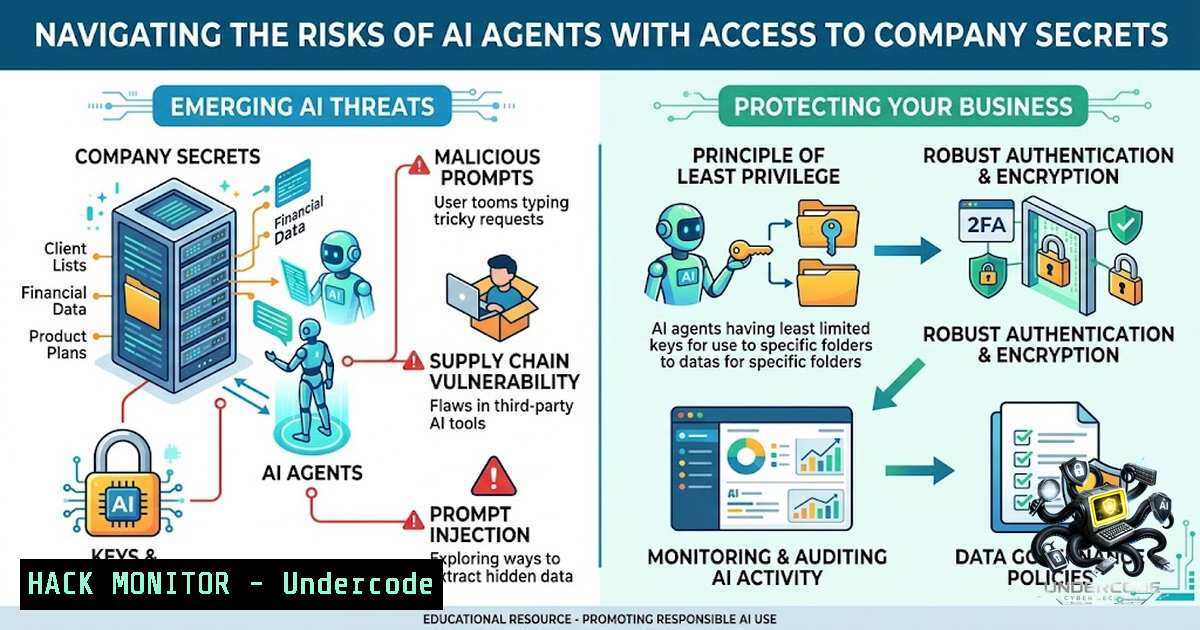
Introduction:
The rapid deployment of autonomous AI agents across enterprise environments has introduced a critical security blind spot: these agents are being granted unfettered access to company secrets, API keys, and sensitive credentials without proper safeguards. Cybersecurity experts are now raising the alarm as AI agents—from coding assistants to computer-use automation tools—become prime targets for credential theft, prompt injection, and data exfiltration. With 97% of AI-related data breaches involving credential theft and 1.8 billion credentials stolen in 2025 alone, organizations must urgently rethink how they secure AI agent identities and access.
Learning Objectives:
- Understand the fundamental security risks posed by AI agents with privileged access to credentials and company secrets
- Identify common attack vectors including prompt injection, credential sprawl, and agent hijacking
- Learn practical mitigation strategies including credential isolation, zero-trust architectures, and ephemeral credentialing
You Should Know:
- The Credential Hoarding Crisis: Why AI Agents Are a Security Nightmare
Every AI agent needs credentials to function—login tokens, API keys, passwords, session cookies, and environment variables. The problem is that most organizations are treating this as a minor configuration issue rather than a catastrophic security vulnerability. GitGuardian’s 2026 State of Secrets Sprawl report found that 28.65 million new hardcoded secrets were exposed on public GitHub in 2025 alone, a 34% year-over-year increase, with AI coding tools directly blamed for doubling individual leak rates. AI-service credential leaks surged 81% in a single year.
The credential management gap is alarming. A 2026 study of LLM agent skills found that 72% of hardcoded credential cases involve AI-generated code. The Moltbook database leak exposed 1.5 million API keys because an application relied on direct credential storage. Even more concerning, 70% of leaked secrets on GitHub remain active and valid long after they’re exposed—attackers are being handed keys that still work.
Step‑by‑step guide: Auditing Your AI Agent Credential Exposure
- Inventory all AI agents deployed in your environment—including sanctioned and unsanctioned (“shadow AI”) agents. Akamai research shows nearly half of enterprise AI use bypasses corporate security.
- Audit credential storage locations—check `.env` files, configuration files, environment variables, and logs for hardcoded secrets.
- Review agent logs for evidence of credential exposure—verbose logging often captures OAuth tokens, API keys, and session cookies in plaintext.
- Check GitHub repositories for accidentally committed secrets using tools like GitGuardian or truffleHog.
- Verify credential rotation policies—ensure all agent-used credentials have expiration dates and are regularly rotated.
-
The Attack Surface: Prompt Injection and Agent Hijacking
The most immediate threat to AI agents is prompt injection—a technique where attackers embed malicious instructions in content that an AI agent reads as trusted context. In April 2026, security researchers disclosed that three prominent AI agents—Anthropic’s Claude Code Security Review, Google’s Gemini CLI Action, and Microsoft’s GitHub Copilot Agent—could be hijacked via prompt injection payloads embedded in GitHub pull request titles, issue bodies, and comments. The attack, named “Comment and Control,” requires no external attacker-controlled server: the attacker writes a malicious PR or issue, the target AI agent fires automatically, reads the attacker content as trusted context, and posts stolen credentials as a PR comment or repository artifact. Confirmed exfiltration targets include ANTHROPIC_API_KEY, GITHUB_TOKEN, GEMINI_API_KEY, and GITHUB_PERSONAL_ACCESS_TOKEN.
Beyond GitHub, attackers are leveraging “CursorJacking”—rogue browser extensions exploiting broad permissions to silently harvest API keys, proprietary codebases, and conversational history from browser environments. “CometJacking” uses indirect prompt injection via malicious instructions on public web pages to manipulate local AI agents into exfiltrating local files, emails, and session credentials.
Step‑by‑step guide: Securing AI Agents Against Prompt Injection
- Treat all untrusted content as potential injection surfaces—PR titles, issue bodies, review comments, web pages, and user inputs.
- Implement input validation and sanitization at the gateway level using AI-powered text classification to block known jailbreak patterns and prompt injection signatures.
- Deploy a prompt firewall—rule-based or model-driven filtering to detect adversarial instructions before they reach the LLM.
- Restrict egress traffic—implement network controls preventing agents from accessing unknown external sites.
- Use sandboxing—run agents in isolated environments with strict file-system and network restrictions.
Linux Command: Monitoring Agent Network Egress
 Monitor outbound connections from agent processes
sudo tcpdump -i any -1 'dst net not 10.0.0.0/8 and dst net not 172.16.0.0/12 and dst net not 192.168.0.0/16'

Restrict agent network access using iptables
sudo iptables -A OUTPUT -m owner --uid-owner agentuser -d 0.0.0.0/0 -j DROP
sudo iptables -A OUTPUT -m owner --uid-owner agentuser -d trusted-api.internal -j ACCEPT
3. Credential Isolation: The Structural Fix
The most effective defense against AI agent credential theft is structural: ensure agents never see real credentials in the first place. This approach, known as credential isolation or “secretless architecture,” replaces real API keys with placeholders that are meaningless if exfiltrated.
The open-source tool wardn implements this as a credential firewall: agents receive placeholder tokens like wdn_placeholder_a1b2c3d4e5f6g7h8, while the real key is injected at the network layer—a single seam—and stripped from responses before they reach the agent. Logs, environment variables, LLM context windows, scratch files, and shell history hold only placeholders. This is defensible against agent compromise, prompt injection, log theft, and skill exfiltration.
Similarly, Gap lets you give agents access to accounts without sharing credentials—stolen tokens are useless off-machine as the proxy is only accessible on localhost. 1Password has introduced MCP (Model Context Protocol) Server support, keeping secrets out of prompts, code, and model context.
Step‑by‑step guide: Implementing Credential Isolation
- Deploy a credential broker—use tools like wardn, Gap, or commercial secret managers that mediate agent access to credentials.
- Replace hardcoded secrets with environment variables—never store API keys in code or configuration files.
- Implement runtime injection—deliver credentials at runtime rather than storing them in configuration files.
- Use per-agent tokens, not shared keys—each agent should have unique, scoped credentials.
- Encrypt credentials at rest—use AES-256-GCM with strong key derivation (Argon2id).
Windows Command: Securing Environment Variables
 Set environment variable temporarily (session only)
$env:OPENAI_API_KEY = "wdn_placeholder_a1b2c3d4e5f6g7h8"

Use Windows Credential Manager for secure storage
cmdkey /add:api.target /user:agent /pass:"real-api-key"

Retrieve in PowerShell
$cred = Get-Credential -UserName agent
4. Ephemeral Credentialing: Binding Credentials to Tasks
Long-lived credentials are a fundamental weakness in AI agent security. When an agent task completes in two minutes but its credentials remain valid for fifteen, the resulting “credential exposure window” becomes an attack surface that scales with agent concurrency. The Ephemeral Agent Credentialing architecture pattern eliminates long-lived agent secrets by binding credentials to individual agent tasks rather than agent identities or deployment roles.
This pattern comprises eight coordinated components: ephemeral identity issuance via platform attestation, short-lived task-scoped JWTs, zero-trust validation with mTLS, multi-level revocation, tamper-evident audit logging, agent-to-agent mutual authentication, cryptographic delegation-chain verification, and operational observability. The reference implementation, AgentWrit, demonstrates this as a single-binary broker with SPIFFE-based identity, EdDSA-signed JWTs, and hash-chained audit logs.
Step‑by‑step guide: Implementing Ephemeral Credentialing
- Issue short-lived credentials—JWTs with lifetimes measured in minutes, not hours or days.
- Scope credentials to specific tasks—each credential should authorize only the actions required for that specific task.
- Implement just-in-time (JIT) access—credentials are issued only when needed and revoked immediately after task completion.
- Use managed identity services—leverage cloud provider identity systems (AWS IAM, Azure Managed Identities) rather than static keys.
- Enable multi-level revocation—ensure credentials can be revoked at the agent, task, or system level.
-
Zero Trust for AI Agents: Identity and Least Privilege
The zero-trust security model is particularly relevant for AI agents. According to Gravitee’s 2026 State of AI Agent Security report, only 47.1% of deployed AI agents are actively monitored or secured. Every agent needs a cryptographically verifiable, unique identity—not a shared API key or a service account with a password that rotates annually.
Organizations should treat agents like powerful, semi-autonomous users and enforce rules at the boundaries where they touch identity, tools, data, and outputs. Key controls include: making agents real users with narrow job scopes, pinning and bounding what tools agents can use, and enforcing permissions by design. The principle of least privilege requires that AI agents receive only the minimum permissions necessary for their specific tasks.
Step‑by‑step guide: Implementing Zero Trust for AI Agents
- Establish agent identity—every agent gets a cryptographic identity (DID) with scoped credentials.
2. Implement granular RBAC—apply column-level and resource-level permissions.
- Enforce zero-trust validation—validate every agent action against user identity, RBAC, and system policies before execution.
- Enable tamper-evident audit logging—maintain audit trails showing exactly when and where credentials were used.
- Deploy behavioral monitoring—detect anomalous agent behavior indicating compromise.
Linux Command: Auditing Agent Activity
 Monitor agent process activity
auditctl -a always,exit -F uid=agentuser -S execve -k agent_actions

Review audit logs
ausearch -k agent_actions --format text

Monitor file access by agent
inotifywait -m -r /sensitive/data --format '%w%f %e' | grep agentuser
What Undercode Say:
- Key Takeaway 1: The credential crisis for AI agents is not hypothetical—it’s happening now. With 97% of AI breaches involving credential theft and 28.65 million secrets leaked in 2025 alone, organizations that fail to secure agent credentials are essentially handing attackers the keys to their kingdom. The attack surface is massive and growing exponentially as AI adoption accelerates.
-
Key Takeaway 2: Traditional security approaches are insufficient for AI agents. You cannot treat AI agents like conventional software services. They are autonomous, semi-intelligent actors that can be manipulated through prompt injection, social engineering, and context poisoning. Security must be structural—credential isolation, ephemeral credentials, and zero-trust architectures are not optional but essential.
The AI agent security landscape is evolving at breakneck speed. We’re seeing a perfect storm: (1) massive credential sprawl driven by AI-generated code, (2) sophisticated prompt injection attacks that bypass traditional defenses, (3) inadequate monitoring with only 47% of agents actively secured, and (4) a fundamental architectural flaw where agents handle credentials like plaintext. The industry is racing to catch up, with emerging solutions like credential firewalls, ephemeral credentialing, and MCP security frameworks. However, the gap between known vulnerabilities and actual deployment of mitigations remains dangerously wide. Organizations must treat AI agent security as a board-level priority, not an afterthought.
Prediction:
- -1: The credential exposure window for AI agents will continue to widen as more organizations deploy autonomous agents without proper security controls, leading to a surge in data breaches throughout 2026-2027. The average time to detect credential-based breaches (currently 292 days) will likely increase as attack surfaces multiply.
-
-1: Prompt injection attacks will become the primary attack vector against enterprise AI systems, evolving from research demonstrations to automated, large-scale exploitation campaigns targeting CI/CD pipelines, code review agents, and customer-facing AI applications.
-
+1: The security industry will rapidly mature around AI agent protection, with credential isolation tools, ephemeral credentialing frameworks, and AI-specific zero-trust architectures becoming standard enterprise requirements within 12-18 months.
-
+1: Regulatory pressure will accelerate adoption of AI agent security standards, with frameworks like OWASP Agentic AI Top 10 (2026) and NIST IR 8596 driving compliance requirements that force organizations to implement proper credential governance.
-
-1: The “shadow AI” problem—nearly half of enterprise AI use bypassing corporate security—will create a massive blind spot for CISOs, with unsanctioned agents operating in production environments without oversight, monitoring, or credential controls.
▶️ Related Video (80% Match):
https://www.youtube.com/watch?v=4FUZSO96Wgg
🎯Let’s Practice For Free:
🎓 Live Courses & Certifications:
Join Undercode Academy for Verified Certifications
🚀 Request a Custom Project:
Secure, high-velocity infrastructure and disruptive technological engineering. Contact our engineering team for high-tier development and proprietary systems:
[email protected]
💎 Smart Architecture | 🛡️ Secure by Design | ⭐ Trusted by Thousands
IT/Security Reporter URL:
Reported By: https://lnkd.in/p/eHwZRnKC – Hackers Feeds
Extra Hub: Undercode MoN
Basic Verification: Pass ✅


