Listen to this Post
Introduction:
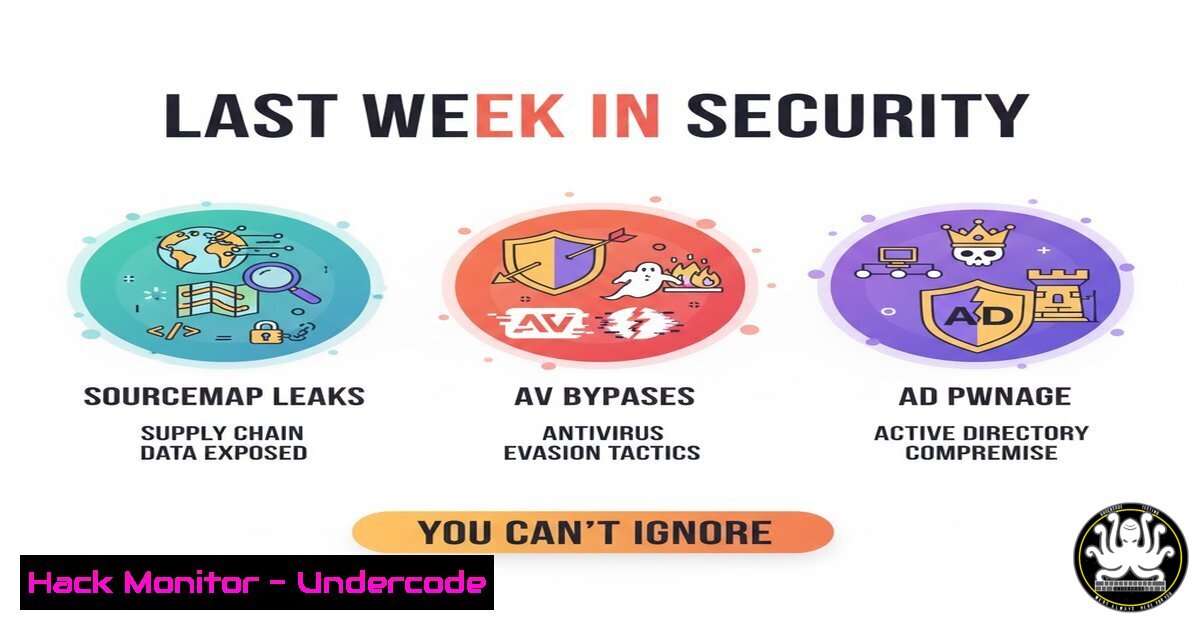
The cybersecurity landscape is a perpetual arms race, where defenders patch vulnerabilities as quickly as offensive security researchers uncover novel exploitation techniques. The latest edition of Last Week in Security highlights critical advancements in this field, from the exposure of sensitive data through developer artifacts to sophisticated bypasses of core security controls in both Windows and Linux environments. Understanding these techniques is paramount for building resilient defenses.
Learning Objectives:
- Understand the risks associated with exposed sourcemaps and how to exploit and defend against them.
- Learn the mechanics of a call stack-based antivirus signature bypass.
- Master the techniques for Active Directory site-based exploitation and a sneaky Linux remapping attack.
You Should Know:
1. Apple’s Sourcemaps Takedown: Exposing Original Code
A sourcemap is a file that maps transformed, minified code (like the JavaScript served to a web browser) back to the original, human-readable source code. When these `.map` files are deployed alongside the production code, attackers can download them to reconstruct the entire original codebase, complete with comments, variable names, and un-minified logic. This can reveal API keys, hardcoded credentials, internal endpoints, and proprietary business logic.
Step‑by‑step guide explaining what this does and how to use it.
Step 1: Reconnaissance
Use a tool like `gobuster` or `dirb` to search for common sourcemap filenames.
gobuster dir -u https://target-app.com/ -w /usr/share/wordlists/dirb/common.txt -x js.map
Step 2: Retrieval
If a file like `app.min.js.map` is found, download it.
wget https://target-app.com/static/js/app.min.js.map
Step 3: Reconstruction
Use the `source-map` NPM library to reverse the minification. Create a simple Node.js script.
const sourceMap = require('source-map');
const fs = require('fs');

const rawSourceMap = JSON.parse(fs.readFileSync('./app.min.js.map', 'utf8'));

const consumer = await new sourceMap.SourceMapConsumer(rawSourceMap);

// This will generate the original source files
consumer.sources.forEach(source => {
const content = consumer.sourceContentFor(source);
fs.writeFileSync(<code>./reconstructed/${source}</code>, content);
});
Mitigation: The fix is simple: never deploy `.map` files to your production web servers. Ensure your build process excludes them and that your CI/CD pipeline is configured correctly.
2. Call Stack Antivirus Signature Bypass
Traditional antivirus (AV) software often relies on static signatures—unique identifiers for known malicious code. A sophisticated bypass involves manipulating the call stack to obfuscate these signatures. By breaking the malicious code into benign-looking fragments and using techniques like return-oriented programming (ROP) or custom stack frame manipulation, the malicious payload never appears as a contiguous block in memory, evading signature-based detection.
Step‑by‑step guide explaining what this does and how to use it.
Step 1: Code Fragmentation
Instead of a single malicious function, split the logic into multiple small, seemingly harmless functions.
Step 2: Stack Manipulation
Use assembly or a language like C to carefully craft the stack frames, pushing return addresses that chain the small functions together to achieve the full malicious outcome.
// Conceptual Example - not a full exploit
void benignHelperA() { / Part 1 of shellcode setup / }
void benignHelperB() { / Part 2 of shellcode execution / }

int main() {
// Overwrite the return address on the stack to first jump to A, then B.
char buffer[bash];
// ... buffer overflow exploit that manipulates the return address ...
return 0;
}
Mitigation: Defend against this by deploying security solutions that use behavioral analysis, heuristic detection, and EDR (Endpoint Detection and Response) tools that monitor for suspicious process execution chains rather than just static code.
3. Active Directory Site Pwnage (Quentin Roland)
Active Directory (AD) uses “sites” to manage replication and authentication traffic based on physical network topology. If an attacker compromises a domain controller (DC) in a remote, less-secure site, they can often leverage this to attack the entire forest. Replication links between sites can be abused to perform a DCSync attack, pulling password hashes for all domain users from a central DC.
Step‑by‑step guide explaining what this does and how to use it.
Step 1: Initial Compromise
Gain initial access to a workstation or server joined to the AD domain in a remote site.
Step 2: Reconnaissance
Use PowerView to enumerate sites and domain controllers.
Get-ADReplicationSite -Identity  | Select-Object Name
Get-ADDomainController -Filter  | Select-Object Name, Site
Step 3: Privilege Escalation and DCSync
Escalate privileges on the local machine to gain Domain Admin or equivalent rights (e.g., by exploiting a vulnerable service). Then, use Mimikatz from the compromised remote site DC to perform a DCSync.
 On a compromised Domain Controller
mimikatz  lsadump::dcsync /domain:badSectorLabs.local /all
Mitigation: Harden security on all domain controllers, regardless of site location. Implement strict network segmentation, monitor for replication traffic anomalies, and use tools like Microsoft’s Attack Surface Analysis Toolkit to identify misconfigurations.
4. Sneaky Remap Linux Technique
This technique involves abusing the `remap` operation in container runtimes or the `mount` command with the `remount` option to alter the properties of a filesystem, potentially breaking out of restricted environments or making files immutable to hide malware. For instance, remounting a filesystem as `read-only` can disrupt security tools that need to write logs or quarantine files.
Step‑by‑step guide explaining what this does and how to use it.
Step 1: Identify Mount Points
Use the `mount` command to list all current filesystem mount points and their options.
mount | grep -i " / "
Step 2: Remount with Altered Permissions
An attacker who has gained root access could remount the root filesystem as read-only. This is often a destructive attack meant to cause a denial-of-service.
 This command can crash a system or disrupt security agents.
mount -o remount,ro /
A more subtle attack could involve remounting a specific directory like `/tmp` with the `noexec` option removed, allowing execution of binaries from that location.
mount -o remount,exec /tmp
Mitigation: Use security profiles like AppArmor or SELinux to restrict the `mount` syscall. In containerized environments, run containers with the least privileges necessary, dropping the `SYS_ADMIN` capability.
5. DeceptIQ Launch: The Future of Deception Technology
DeceptIQ is a platform designed to automate the deployment of honeypots and deception networks. It allows security teams to create realistic, interactive baits that mimic real services (SSH, RDP, databases) across their infrastructure. When an attacker interacts with these decoys, DeceptIQ alerts the security team and provides rich intelligence about the attacker’s methods, tools, and intentions.
Step‑by‑step guide explaining what this does and how to use it.
Step 1: Deployment
Deploy the DeceptIQ platform within your network, ideally in segments that hold valuable assets.
Step 2: Configuring Decoys
Use the web interface to create decoy services. For example, create a fake Windows server offering RDP.
Step 3: Integration
Integrate DeceptIQ alerts with your SIEM (e.g., Splunk, Elasticsearch) and SOAR platforms to automate incident response. When a decoy is triggered, it can automatically create a ticket and block the source IP at the firewall.
Step 4: Analysis
Use the data collected—command lines, exploited vulnerabilities, lateral movement paths—to harden your actual production systems against the observed TTPs (Tactics, Techniques, and Procedures).
What Undercode Say:
- The Perimeter is Everywhere: An exposed sourcemap is a perimeter failure, demonstrating that security must extend fully into the DevOps pipeline. A single misconfiguration can nullify the security of the entire application layer.
- Detection Evasion is the New Norm: The call stack bypass and Linux remap technique are not just exploits; they are methods to operate silently. This signals a shift towards attacks that are designed from the ground up to avoid triggering traditional alerts, making behavioral and anomaly-based detection no longer a luxury but a necessity.
The common thread in this week’s disclosures is the exploitation of trust and process. Attackers are not just finding bugs in code; they are manipulating the fundamental building blocks of systems—the way code is mapped, the way memory is executed, the way networks are logically organized, and the way filesystems are managed. Defenders must adopt an assume-breach mentality, where layers of security control, rigorous configuration management, and proactive threat hunting are integrated into a cohesive defense-in-depth strategy. Deception technology, as seen with DeceptIQ, represents a powerful shift from passive defense to active adversary engagement.
Prediction:
The techniques highlighted, particularly the AV bypass and AD site exploitation, will be rapidly weaponized into automated penetration testing frameworks like Metasploit and Cobalt Strike. Within the next 12-18 months, we predict a significant rise in attacks that leverage trust relationships within distributed AD environments, as they offer a high return on investment for attackers. Furthermore, the blending of container escape techniques (like remap) with software supply chain attacks will create a new wave of cloud-centric compromises, forcing a industry-wide reevaluation of container security defaults and IAM policies. The era of siloed security is over; the future belongs to integrated, intelligent defense platforms.
🎯Let’s Practice For Free:
IT/Security Reporter URL:
Reported By: Activity 7394092955029917696 – Hackers Feeds
Extra Hub: Undercode MoN
Basic Verification: Pass ✅


