Listen to this Post
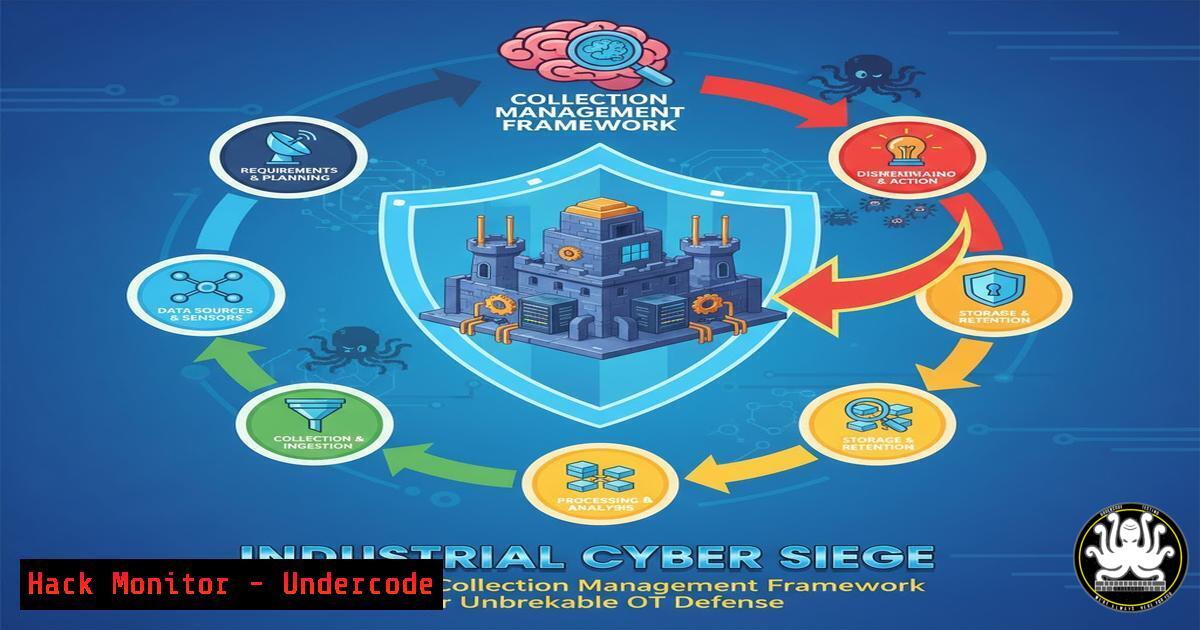
Introduction:
In the high-stakes world of Operational Technology (OT) and Industrial Control Systems (ICS), cybersecurity is not merely about building digital walls; it’s about achieving intelligent, non-intrusive visibility. A single misconfigured active scan can halt production, while a missed passive alert can lead to catastrophic physical consequences. This article deconstructs a proven Collection Management Framework (CMF), providing a strategic blueprint for security professionals to build a monitoring program that protects both data and the physical processes it controls.
Learning Objectives:
- Architect a non-intrusive data collection strategy for critical industrial environments.
- Identify and leverage key OT data sources, from PLC logs to industrial network protocols.
- Implement analysis and detection techniques tailored for ICS/OT threat landscapes.
You Should Know:
1. Planning: The Strategic Foundation of OT Monitoring
Effective OT security monitoring begins not with tools, but with strategy. The planning phase is about building a foundation of knowledge to guide all subsequent actions, ensuring that data collection is purposeful, safe, and aligned with operational realities.
Step-by-step guide explaining what this does and how to use it.
1. Asset Identification & Criticality Assessment: Create a comprehensive asset inventory of all ICS/OT components (PLCs, RTUs, DCS, HMIs). Use tools like `Rapid7 Nexpose` or `Tenable.ot` with extreme caution, or better yet, rely on passive network discovery. Tag each asset with a criticality score based on its function in the process (e.g., PLC controlling a turbine shutdown = Critical).
2. Threat Modeling: For your most critical assets, conduct structured threat modeling sessions (e.g., using PASTA or OCTAVE). Ask: “Who would want to disrupt this process?” and “How could they achieve it?” This defines your collection requirements. For instance, if unauthorized ladder logic modification is a threat, you need to collect and monitor for program changes on those specific PLCs.
3. Compliance Mapping: Cross-reference your collection requirements against relevant standards. If you operate under NERC CIP, you are legally obligated to collect specific logs. IEC 62443 provides broader guidelines for security zones and conduits, informing where you should place collection points.
- Data Sources: Tapping into the Industrial Telemetry Stream
OT environments are rich with data, but it speaks in specialized languages. Knowing where to listen and what to listen for is crucial to building a coherent security picture without creating network noise.
Step-by-step guide explaining what this does and how to use it.
1. Network Traffic: This is the primary source. Deploy network TAPs or SPAN ports on key network segments, especially between Levels 2 (Supervisory) and 3 (Site Operations). Use a tool like Wireshark with ICS-specific dissectors to passively analyze traffic.
Command Example (Linux): `tshark -i eth0 -f “host 192.168.1.10” -w plc_capture.pcap` This captures all traffic to/from a specific PLC for later, offline analysis.
2. Device Logs: Many modern controllers and HMIs can generate event logs. Configure syslog forwarding from these devices to a central, OT-specific log collector like Graylog or an Elastic Stack instance. Ensure log levels are set to capture security-relevant events (e.g., program mode changes, firmware updates).
3. Asset Inventory & Management Systems: Integrate with existing engineering workstations and asset management platforms. They often contain golden records of device configurations, network diagrams, and approved firmware versions, providing essential baseline context.
- Collection: The Art of Safe and Passive Signal Capture
The cardinal rule of OT data collection is “First, do no harm.” Active scanning is a calculated risk; passive monitoring is the gold standard. This phase is about capturing the signal without introducing any noise into the operational process.
Step-by-step guide explaining what this does and how to use it.
1. Passive Network Monitoring: Deploy a dedicated sensor (e.g., a Corelight sensor running Zeek) connected to a network TAP. This sensor will reconstruct protocols and generate rich, structured logs without sending a single packet onto the wire.
Zeek Command (Linux): Zeek runs as a service. Its output includes `conn.log` (connection data) and, crucially, application-layer logs for protocols like Modbus (modbus.log) and DNP3 (dnp3.log), detailing every function code and request.
2. Protocol Analysis: Use specialized OT security platforms (e.g., Nozomi Networks, Dragos, Claroty) or open-source tools to decode industrial protocols. The goal is to understand the “command and control” traffic—is a programmer downloading new logic to a PLC? Is an HMI writing a setpoint outside a normal range?
3. Scheduled & Approved Active Scanning: If active scanning is unavoidable, use tools designed for OT, like `Nmap` with NSE scripts that have safety checks.
Nmap Command (Linux – Use with Caution): `nmap -sU -p 161 –script snmp-info 192.168.1.0/24` This carefully queries SNMP information from a subnet. Always conduct this during a planned maintenance window with explicit approval from operations staff.
4. Analysis: Building Contextualized Detection and Response
Raw data is a liability; contextualized information is an asset. The analysis layer is where you fuse diverse data streams to create high-fidelity detections that separate malicious activity from normal operational noise.
Step-by-step guide explaining what this does and how to use it.
1. Data Enrichment: In your SIEM or data lake, enrich raw events. Combine a Modbus function code from Zeek with the asset criticality tag from your inventory. An event is no longer “Write to coil 4001”; it becomes “Write to coil 4001 on CRITICAL PLC-101 by engineering workstation ENG-WS-02”.
2. Behavioral Baselining & Anomaly Detection: Let the system learn normal operational behavior. Tools can model periodic traffic, standard source/destination pairs, and normal value ranges. Any deviation (e.g., a new device talking to a PLC, a setpoint written far outside its normal range) triggers an alert.
3. Threat Intelligence Correlation: Integrate OT-specific threat intelligence (e.g., from Dragos, Mandiant) to hunt for Indicators of Compromise (IoCs) related to known ICS malware like Industroyer2 or TRITON. Create automated correlation rules in your SOAR platform to match internal events with external threat feeds.
5. Supporting Layers: Storage, Response, and Governance
A CMF is not complete without the supporting pillars that ensure its longevity, effectiveness, and compliance. These layers transform a tactical project into a sustainable program.
Step-by-step guide explaining what this does and how to use it.
1. Storage & Retention: Implement a hot/warm/cold storage strategy. Recent data (“hot”) is readily available for analysts. Older data (“cold”) is compressed and archived in a cost-effective data lake for long-term forensics, often required by regulations like NERC CIP.
2. Response & Action: Develop and automate playbooks. For example, if a high-criticality alert is generated, the SOAR platform can automatically query the asset database for the responsible operator and open a ticket in the OT ticketing system, all within seconds.
3. Governance & Continuous Improvement: Anchor your program in the IEC 62443 standard. Regularly review key metrics: Mean Time to Detect (MTTD), False Positive Rate, and Coverage of Critical Assets. Use tabletop exercises to test and refine your framework continuously.
What Undercode Say:
- Visibility Without Strategy is Noise. Deploying sensors without a prior plan based on asset criticality and threat modeling will overwhelm your team with irrelevant data while missing critical threats.
- Safety and Reliability are Non-Negotiable Prerequisites. Every tool, command, and action taken in an OT environment must be vetted against its potential impact on operational continuity and human safety. Passive collection is paramount.
The framework presented is less a technology problem and more a discipline of process and respect for the physical world. The most sophisticated detection algorithm is worthless if its deployment causes a plant shutdown. Success in OT security hinges on this delicate balance: leveraging deep technical expertise to gain defensive insights, while exercising the operational restraint to never disrupt the process you are tasked with protecting. This CMF provides the structure to walk that tightrope, transforming raw industrial data into genuine, resilient defense.
Prediction:
The future of OT security will be dominated by the convergence of IT and OT data lakes, powered by AI-driven behavioral analytics that can predict failures and attacks simultaneously. However, the foundational principles of the Collection Management Framework will become even more critical. As AI models require vast, high-quality, and context-rich data for training, organizations with a mature CMF will be positioned to rapidly operationalize these advanced tools, moving from reactive detection to predictive prevention of cyber-physical incidents. The divide will grow between organizations that have mastered disciplined, safe data collection and those that have not, with the latter facing increasing operational and financial risks.
🎯Let’s Practice For Free:
IT/Security Reporter URL:
Reported By: Mohamed Atta – Hackers Feeds
Extra Hub: Undercode MoN
Basic Verification: Pass ✅


