
Listen to this Post
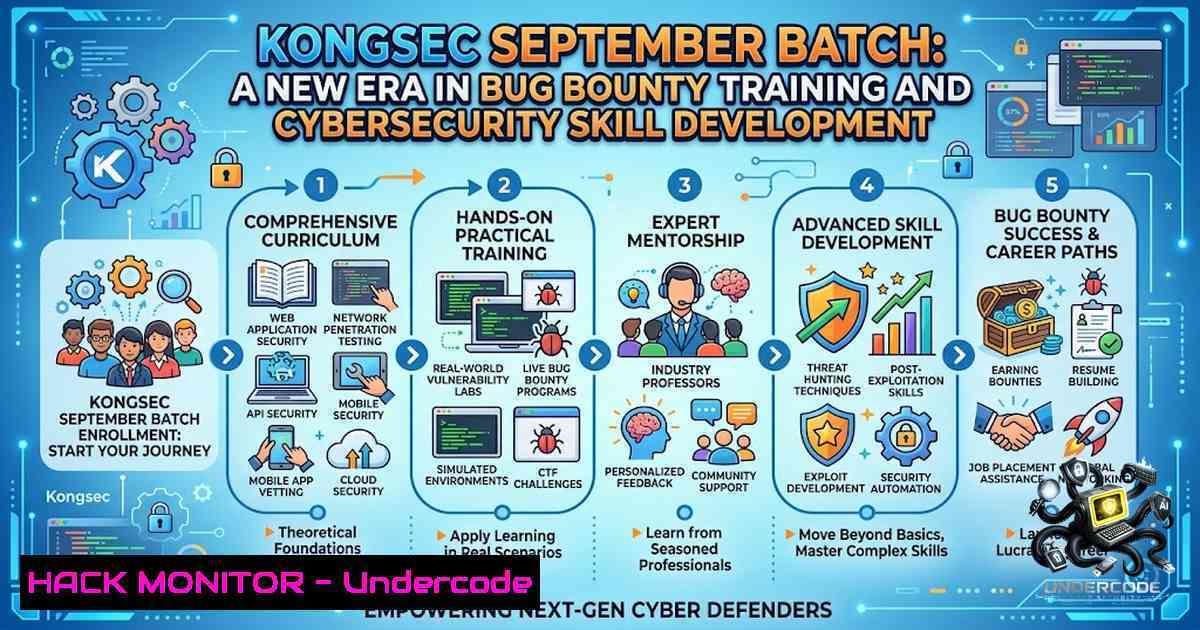
Introduction:
The cybersecurity landscape is evolving at an unprecedented pace, and bug bounty hunting has become a critical pillar of modern application security (AppSec). However, many aspiring hunters struggle not because of the technical complexity, but due to the lack of a structured system, access to real-world resources, and proper direction. The upcoming Kongsec September Batch, launching September 5, is designed to bridge this gap by offering comprehensive tools, enhanced training notes, and specialized tracks to transform beginners into professional bug hunters. This initiative represents a significant leap forward in cybersecurity education, combining AI-powered insights with practical, hands-on experience to address the growing demand for skilled security researchers.
Learning Objectives & Secrets:
- Objective 1: Mastering Reconnaissance and Attack Surface Mapping – Learn to systematically discover hidden endpoints, subdomains, and APIs using advanced automation tools, reducing the time between target acquisition and vulnerability discovery.
- Objective 2 Secret Tip: Contextual Vulnerability Validation – Instead of blindly running scanners, use hybrid analysis by correlating output from tools like Nuclei and Burp Suite with business logic context to identify high-impact, report-worthy bugs that automated tools often miss.
- Objective 3 Secret Tip: Effective Report Writing for Maximum Bounty – Structure reports to clearly articulate security impact, reproduction steps, and potential business damage, increasing your acceptance rate and payout by up to 40%. Use the “Impact First” approach: state the business risk before diving into technical details.
You Should Know:
1. Essential Reconnaissance Tools and Automation Workflow
Modern bug bounty hunting requires a robust reconnaissance setup. Start with subdomain enumeration using tools like Amass and Sublist3r, then filter live hosts with HTTPx. Utilize Gau for URL collection and parameter discovery. For automation, create a bash script that chains these tools to run sequentially, saving output for later analysis. On Linux, install these tools via `apt-get install amass` or from GitHub releases. Use `findomain` for rapid subdomain discovery. After collecting subdomains, use `httpx -l subdomains.txt -o live_hosts.txt` to filter live hosts. This streamlined workflow ensures you don’t miss any potential entry points. Additionally, use `waybackurls` to extract historical URLs from the Wayback Machine, which often reveal forgotten endpoints.
2. API Security Testing and Configuration Hardening
APIs are the backbone of modern applications and a prime target for attackers. Begin by intercepting traffic using Burp Suite or OWASP ZAP. Focus on identifying misconfigurations in GraphQL endpoints by using introspection queries to map out the entire schema. Tools like InQL can automate this. For REST APIs, use Postman to manually test endpoints, paying close attention to authorization headers and CORS policies. A critical step is to test for IDOR (Insecure Direct Object References) by manipulating user IDs in requests. Example: change `user_id=1` to `user_id=2` in a GET request to access another user’s data. On Windows, use PowerShell to send custom requests: Invoke-RestMethod -Method Get -Uri "https://api.target.com/user/2" -Headers @{Authorization="Bearer token"}. Mitigate by implementing strict role-based access controls and validating user permissions on every request.
3. Cloud Security Hardening (AWS, Azure, GCP)
Misconfigured cloud storage and permissions remain a top vulnerability. For AWS, use `aws s3 ls` to list buckets and `aws s3 cp` to download data. Check for public buckets using tools like S3Scanner. In Azure, use Az PowerShell module: Get-AzStorageAccount. For GCP, use gsutil ls. A common mistake is allowing public read/write permissions. Ensure IAM policies follow the principle of least privilege. Additionally, review CloudTrail logs for unauthorized access attempts: aws cloudtrail lookup-events --lookup-attributes AttributeKey=Username,AttributeValue=admin --max-results 10. Enforce bucket policies that explicitly deny public access. Use `aws s3api put-bucket-policy –bucket example –policy file://policy.json` to apply a strict policy. Always enable versioning to recover from accidental deletions or ransomware attacks.
- Vulnerability Exploitation and Mitigation: XSS, SQLi, and SSRF
Cross-Site Scripting (XSS) can be tested by injecting payloads like `` into input fields. Use Burp Suite’s Intruder to fuzz for XSS with the XSS Polyglot list. For SQLi, use `sqlmap -u “http://target.com/page?id=1” –batch –level 5` to automate detection. Server-Side Request Forgery (SSRF) is particularly dangerous. Test by entering an internal IP like `http://169.254.169.254/latest/meta-data/` in a URL parameter to retrieve AWS metadata. Mitigate SSRF by whitelisting allowed domains and blocking internal IP ranges. Implement input sanitization, parameterized queries, and use Web Application Firewalls (WAF) like Cloudflare or AWS WAF to block common exploit patterns. Keep software patched to prevent known exploits.
5. Advanced Vulnerability Research and 0-Day Discovery
Staying ahead requires continuous research. Monitor security mailing lists, Twitter, and GitHub for new CVEs and exploit techniques. Set up a lab environment using Docker to replicate and test vulnerabilities. For instance, to test log4j, spin up a vulnerable Apache server and send a JNDI payload. Use Metasploit to automate exploitation. In a lab, `msfconsole` with the `exploit/multi/http/log4shell` module. This hands-on approach helps you understand the root cause, enabling you to find similar bugs in live targets. Additionally, fuzzing tools like AFL (American Fuzzy Lop) can be used to find memory corruption vulnerabilities in binary applications. For web apps, use OWASP ZAP’s active scan to discover new injection points.
6. AI-Powered Security and Tool Integration
The Kongsec batch integrates AI for smarter vulnerability detection. Learn to use machine learning models to classify HTTP traffic and identify anomalies. Tools like `mobsf` for mobile security can be enhanced with custom scripts. For example, automate the detection of insecure file permissions in Android APKs. Use Python with `scikit-learn` to build a classifier for phishing URLs. A simple script: import pickle; model = pickle.load(open('model.pkl','rb')); print(model.predict(['https://evil.com'])). This approach reduces false positives and increases efficiency. Also, explore leveraging large language models (LLMs) to parse and summarize long security reports, quickly extracting key exploit details.
7. Bug Bounty Reporting and Communication Best Practices
Writing a clear, concise, and impactful report is as important as finding the vulnerability. Structure reports: , Severity, Description, Steps to Reproduce, Impact, and Suggested Mitigation. Use screenshots and videos (GIFs) for proof. Avoid jargon; explain issues to a non-technical audience. For example, instead of saying “RCE via file upload,” say “An attacker can upload a malicious file that allows them to take control of the server.” Leverage templates provided in the Kongsec training notes. Additionally, communicate professionally with the triage team; be open to clarification questions and provide additional logs or details promptly. This professionalism increases your reputation and trust with the program.
What Undercode Say:
- Key Takeaway 1: The Kongsec September Batch offers a dual-track system that democratizes bug bounty hunting, ensuring both novices and seasoned professionals receive tailored guidance. The integration of AI and real-world reports is crucial for understanding business logic flaws, which are often ignored by automated scanners.
- Key Takeaway 2: Success in bug bounty is not solely about technical prowess but about having a methodical approach, leveraging the right tools, and effectively communicating vulnerabilities to maximize payout and impact. The emphasis on report writing and impact articulation sets this training apart from generic courses.
Analysis: The cybersecurity industry is shifting towards proactive threat hunting and vulnerability research. Programs like Kongsec address the critical skills gap by providing hands-on training with current tools and real-world scenarios. The inclusion of AI and career guides indicates a forward-thinking approach, preparing hunters for the evolving threat landscape. As organizations increasingly rely on bug bounty programs to complement their internal security, trained hunters become indispensable. However, the challenge remains in maintaining ethical standards and continuous learning, given the rapid pace of technological change. The Kongsec batch appears well-positioned to produce high-caliber security researchers capable of safeguarding tomorrow’s digital infrastructure.
Prediction:
- +1 The Kongsec initiative will likely raise the average quality of bug bounty reports, leading to faster remediation cycles and more secure applications globally.
- +1 Increased accessibility to structured training will democratize cybersecurity careers, bringing diverse talent into the industry.
- -1 As more hunters adopt advanced tools, the competition for high-severity bugs will intensify, potentially leading to burnout and frustration among less-experienced individuals.
- -1 The rise of AI-powered attack tools may outpace defensive training, requiring constant curriculum updates to stay relevant.
- N The market may see a commoditization of bug hunting skills, potentially reducing average payouts as more hunters enter the field, though high-impact finds will always command premium rewards.
▶️ Related Video (80% Match):
🎯Let’s Practice For Free:
🎓 Live Courses & Certifications:
Join Undercode Academy for Verified Certifications
🚀 Request a Custom Project:
Secure, high-velocity infrastructure and disruptive technological engineering. Contact our engineering team for high-tier development and proprietary systems:
[email protected]
💎 Smart Architecture | 🛡️ Secure by Design | ⭐ Trusted by Thousands
IT/Security Reporter URL:
Reported By: https://lnkd.in/p/epuaeErT – Hackers Feeds
Extra Hub: Undercode MoN
Basic Verification: Pass ✅


