
Listen to this Post
Introduction:
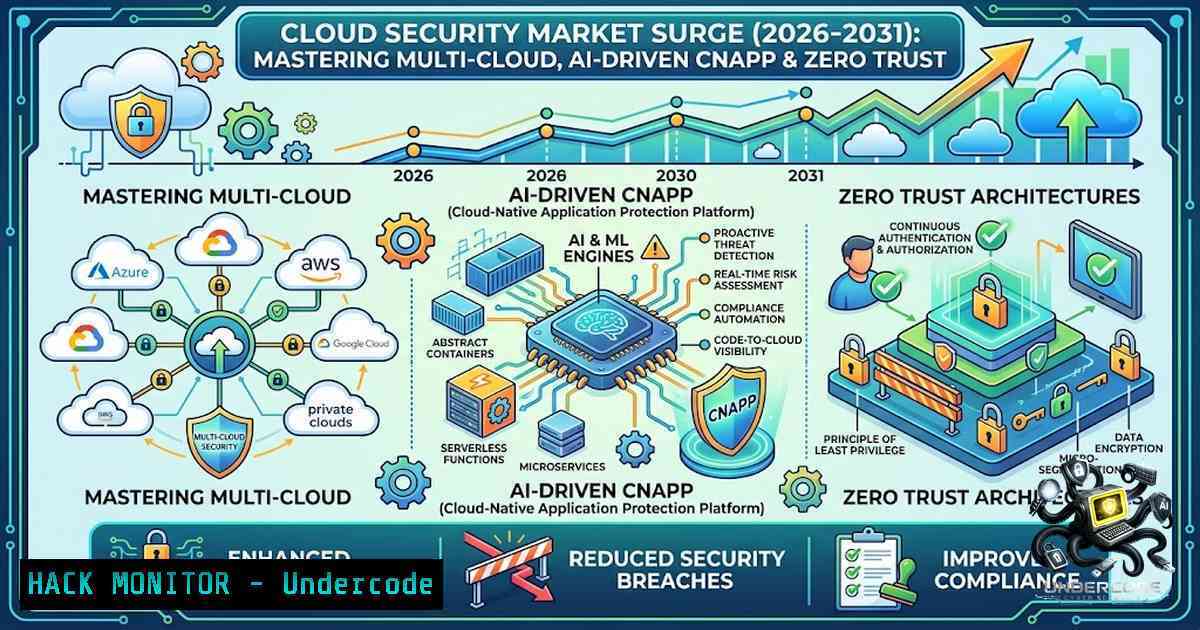
The cloud security landscape is undergoing a seismic shift, driven by the rapid adoption of multi-cloud and hybrid environments. As organizations migrate critical workloads, the attack surface expands exponentially, necessitating a move from traditional perimeter defense to integrated, AI-powered solutions. This evolution, projected to grow the cloud security market to USD 59.34 billion by 2031, demands a proactive, multi-layered strategy encompassing everything from application security to cloud-1ative application protection platforms (CNAPP).
Learning Objectives & Secrets:
- Objective 1: Architecting a Multi-Layered Defense. Master the integration of network, data, and identity security to create a cohesive defense system. The secret is not just deploying tools but ensuring they share telemetry for correlated threat detection.
- Objective 2: Automating DevSecOps with CNAPP. Learn to embed security into the CI/CD pipeline using Cloud-1ative Application Protection Platforms. The secret tip is to prioritize runtime threat detection over static scanning, using AI to spot anomalous behavior in production workloads.
- Objective 3: Implementing Zero Trust for Hybrid Clouds. Understand how to enforce granular access controls across diverse environments. The secret is to assume breach and continuously validate every access request, leveraging micro-segmentation to contain potential lateral movement.
You Should Know:
- Modernizing Threat Detection with AI and Automated Response
The post highlights a significant driver: the increased utilization of AI and ML for cloud security. This is not just about automating alerts; it’s about creating predictive defense mechanisms. AI algorithms can analyze massive datasets from logs, network flows, and user behavior to identify subtle indicators of compromise (IoCs) that traditional rule-based systems miss. For instance, an AI model might flag an IAM role assuming unusual permissions at an odd hour, signaling a potential identity compromise.
Step‑by‑step guide to set up basic threat detection using AI:
– Step 1: Ingest cloud logs (e.g., AWS CloudTrail, Azure Activity Logs) into a centralized data lake.
– Step 2: Utilize a managed ML service like Amazon SageMaker or Azure Machine Learning to train a model on historical ‘normal’ activity.
– Step 3: Deploy the model to score live events in near real-time.
– Step 4: Configure a SIEM or SOAR platform to trigger an automated response (e.g., isolating an EC2 instance) when the anomaly score exceeds a defined threshold.
Command Snippet (Linux for Log Analysis):
To quickly parse high-volume logs for failed login attempts, which can feed into an AI model, use:
`grep “Failed password” /var/log/auth.log | awk ‘{print $11}’ | sort | uniq -c | sort -1r`
2. Securing Hybrid Cloud Deployments with CNAPP
The post explicitly states that CNAPP is expected to register the highest CAGR of 14.6%. CNAPP integrates capabilities like CWPP, CSPM, and CIEM into a single platform. For hybrid clouds, this means unified visibility across on-premise data centers and public cloud providers. This helps enforce consistent security policies, identifying misconfigurations like open storage buckets or overly permissive security groups that could lead to data breaches.
Step‑by‑step guide for implementing CNAPP in a hybrid environment:
– Step 1: Select a CNAPP vendor (e.g., Palo Alto Prisma Cloud, Microsoft Defender for Cloud) that supports your specific cloud providers and on-premise infrastructure.
– Step 2: Deploy agents on your VMs and containers for workload protection.
– Step 3: Use the platform’s CSPM module to scan for misconfigurations against industry benchmarks (CIS, NIST).
– Step 4: Set up automated remediation policies to auto-remediate non-compliant resources (e.g., automatically blocking public access to an S3 bucket).
Command Snippet (Linux for Container Scanning):
To check a Docker image for vulnerabilities before deployment, use Trivy:
`trivy image –severity HIGH,CRITICAL –ignore-unfixed your-image:latest`
3. Enhancing Application and API Security
Application security is a cornerstone of the cloud strategy. With the rise of microservices, APIs have become a primary attack vector. Securing APIs requires a multi-pronged approach: strict authentication (using OAuth2/OIDC), input validation, rate limiting, and employing a Web Application Firewall (WAF). The OWASP API Security Top 10 provides a critical checklist for developers and security teams, focusing on broken object-level authorization, which is a frequent and critical flaw.
Step‑by‑step guide to harden API security:
- Step 1: Implement API Gateway to enforce rate limiting and authentication checks.
- Step 2: Deploy a WAF (e.g., AWS WAF, Azure WAF) to inspect incoming traffic for malicious payloads like SQL injection or XSS.
- Step 3: Conduct regular penetration testing focused on the OWASP API Top 10.
- Step 4: Ensure all API communication is encrypted using TLS 1.2 or higher.
Command Snippet (Windows for Testing API Authentication):
To test an API endpoint’s authentication, use `curl` in PowerShell:
`curl -X GET “https://api.yourapp.com/v1/user” -H “Authorization: Bearer YOUR_ACCESS_TOKEN”`
4. Vulnerability Exploitation and Mitigation in the Cloud
The sophistication of cybercriminals is a key opportunity driver for the market. A major threat is exploiting publicly known vulnerabilities (CVEs) in cloud workloads. Automated scanning is essential to identify and patch these vulnerabilities before they are weaponized by attackers. This process is a critical component of system security, as highlighted in the post’s list of security layers.
Step‑by‑step guide for automated vulnerability management:
- Step 1: Integrate a vulnerability scanner (e.g., Qualys, Tenable) with your CI/CD pipeline.
- Step 2: Configure scans to run on all new images and running instances.
- Step 3: Set a policy to block deployments that contain vulnerabilities with a CVSS score above a critical threshold (e.g., 7.0).
- Step 4: Establish a weekly patching cadence for all non-production and production environments, prioritizing critical and high-severity vulnerabilities.
Command Snippet (Linux to Check for Kernel Vulnerabilities):
To check for missing kernel security patches, use:
`sudo apt list –upgradable | grep linux-image` (Debian/Ubuntu)
`sudo yum check-update kernel` (RHEL/CentOS)
5. Implementing Zero Trust Architecture
Zero Trust is no longer a buzzword but a necessity, as it directly combats the risks of lateral movement in a compromised cloud environment. This architecture assumes that no user or device, whether inside or outside the network, should be trusted by default. Verification is required from every request. By enforcing strict identity-based access control and micro-segmentation, organizations can minimize the impact of a breach. This aligns perfectly with the post’s mention of the shift toward Zero Trust.
Step‑by‑step guide to begin a Zero Trust journey:
- Step 1: Implement Multi-Factor Authentication (MFA) for all users, including privileged accounts.
- Step 2: Enforce the principle of least privilege using Identity and Access Management (IAM) policies.
- Step 3: Use micro-segmentation tools (e.g., VMware NSX, Illumio) to divide the network into isolated zones.
- Step 4: Monitor and log all network traffic, using analytics to identify anomalous connections.
Command Snippet (Linux for Network Traffic Monitoring):
To monitor network connections to identify unapproved east-west traffic, use:
`sudo tcpdump -i any -1 ‘net 10.0.0.0/8’`
What Undercode Say:
- Key Takeaway 1: The future of cloud security is autonomous. The market is shifting rapidly from reactive alerts to proactive, AI-driven threat hunting and automated incident response.
- Key Takeaway 2: A siloed approach is obsolete. Organizations must adopt integrated platforms like CNAPP to manage the complexity of multi-cloud and hybrid environments, ensuring seamless security across the entire stack.
Analysis:
This market analysis underscores a pivotal moment in cybersecurity. The convergence of DevSecOps, AI, and cloud-1ative architectures is creating a more resilient, automated defense posture. However, this also presents a steep learning curve and a critical skills gap. The focus on CNAPP and Zero Trust signals that the industry is moving toward a proactive, identity-centric security model, shifting budget and resources away from traditional firewall solutions. For security teams, this evolution requires a deep understanding of cloud APIs, container orchestration (Kubernetes), and infrastructure as code (IaC). The success of these technologies ultimately hinges on their ability to not just detect, but to predict and neutralize sophisticated, automated attacks.
Prediction:
- +1 By 2030, AI-driven predictive security models will become the standard, reducing the mean time to detect (MTTD) and respond (MTTR) by up to 70%.
- -1 The complexity of managing a multi-layered, AI-powered security stack will exacerbate the global cybersecurity skills shortage, potentially leaving many organizations vulnerable to misconfigurations.
- +1 The integration of security into the entire software development lifecycle (Shift-Left) will become mandatory, reducing the cost of fixing vulnerabilities in production by a factor of 10.
- -1 As AI becomes more prevalent in defense, cybercriminals will increasingly use generative AI to create sophisticated, polymorphic malware capable of evading traditional signature-based detection.
▶️ Related Video (82% Match):
🎯Let’s Practice For Free:
🎓 Live Courses & Certifications:
Join Undercode Academy for Verified Certifications
🚀 Request a Custom Project:
Secure, high-velocity infrastructure and disruptive technological engineering. Contact our engineering team for high-tier development and proprietary systems:
[email protected]
💎 Smart Architecture | 🛡️ Secure by Design | ⭐ Trusted by Thousands
IT/Security Reporter URL:
Reported By: https://lnkd.in/p/eruXu42x – Hackers Feeds
Extra Hub: Undercode MoN
Basic Verification: Pass ✅


