Listen to this Post
Introduction
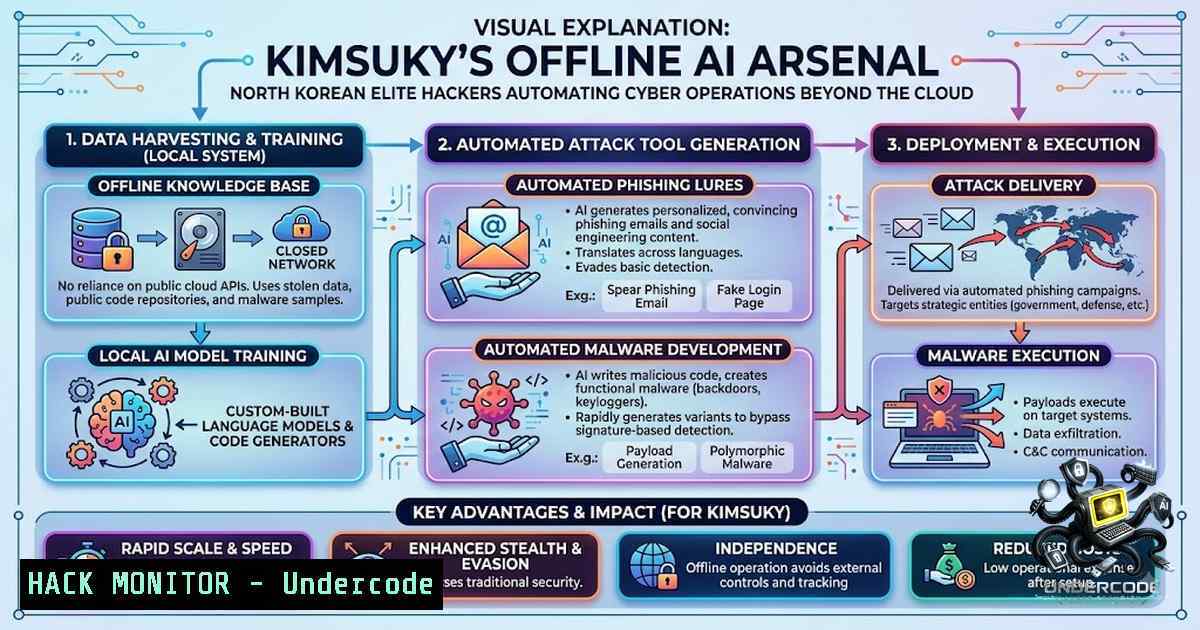
North Korea’s state-sponsored hacking unit Kimsuky has crossed a critical threshold in offensive cyber operations. According to a comprehensive report from South Korean cybersecurity firm Genians, the group has abandoned reliance on public cloud-based AI chatbots and is now running artificial intelligence tools entirely offline on its own infrastructure. This strategic pivot—encompassing local large language model (LLM) environments, retrieval-augmented generation (RAG) for document search, speech-to-text tools, and AI-powered coding libraries—marks a fundamental escalation in how nation-state adversaries integrate AI into the full attack lifecycle, from phishing lure generation to automated malware development. While Genians found no evidence that Kimsuky has trained a proprietary AI model, the group is clearly in an intensive “research and knowledge acquisition” phase, assembling and testing existing open-source tools with the explicit aim of embedding AI throughout its operations. For defenders, this represents a paradigm shift: there is no patch to install, because nothing has been exploited yet—the weight now falls entirely on detection, behavioral analytics, and proactive threat hunting.
Learning Objectives
- Understand the technical architecture of Kimsuky’s offline AI stack, including the specific tools (Ollama, GPT4All, Msty) and frameworks (Semantic Kernel, LLaMaSharp) deployed for local LLM operations.
- Analyze the complete Operation GitPower attack chain, from AI-generated decoy documents and LNK file delivery to GitHub-based C2 infrastructure and AsyncRAT payload deployment.
- Master behavioral detection techniques, including PowerShell logging, Sysmon configuration, and network traffic analysis to identify AI-assisted phishing and post-exploitation activity.
- Implement practical defensive measures across Linux and Windows environments to detect, block, and respond to Kimsuky-style AI-enhanced attacks.
You Should Know
- Understanding Kimsuky’s Offline AI Infrastructure: Tools, Architecture, and Operational Security
The core of Kimsuky’s new capability is an offline AI stack that eliminates the operational security risks associated with public chatbots. Genians’ months-long investigation uncovered that the group built and operated local LLM environments using three primary open-source tools: Ollama, GPT4All, and Msty. Each serves a distinct purpose in the attack workflow.
Ollama is a lightweight framework for running LLMs locally. On Kimsuky-controlled infrastructure, researchers observed that Ollama generated the cryptographic keys created on first launch—a definitive indicator of active execution rather than mere download. This allows the group to query models for coding assistance, phishing template generation, and data analysis without ever transmitting sensitive queries to external services.
GPT4All, another local LLM solution, was found with a configured `localdocs_v3.db` database—the storage backend for its LocalDocs retrieval-augmented generation (RAG) feature. RAG enables an LLM to answer questions based on a private collection of documents. The presence of this configured database is evidence that Kimsuky attempted to connect documents in its possession to an AI system, enabling rapid search and analysis of stolen intelligence. This capability is particularly dangerous for espionage operations: an operator can upload gigabytes of exfiltrated material and use natural language queries to extract specific information—wallet addresses, Gmail credentials, site-registration history—with unprecedented speed.
Msty rounds out the trio, providing another local LLM interface that supports offline operation. All three tools share a critical feature: they prevent conversation data from being transmitted to external AI services, drastically reducing the risk of exposure and making them “particularly attractive” for a state-sponsored threat actor.
Beyond these ready-made applications, Genians recovered developer libraries including LLaMaSharp (a C binding for Meta’s LLaMA models), Microsoft’s Semantic Kernel, and Microsoft.Agents.AI—components specifically designed for building AI functions into custom C and .NET software. The group also collected OpenAI’s Whisper speech-to-text files with extraction guides, and active traces of Cursor, an AI-powered coding editor. This assembly of tools—none of which are exotic on their own—represents a deliberate, purpose-built AI integration stack designed to push AI capabilities deeper into every phase of the attack workflow.
For Defenders: Monitoring for the presence and execution of these tools (Ollama, GPT4All, Msty, Cursor) on endpoints, particularly on servers with outbound internet access, should be incorporated into threat-hunting playbooks. The presence of `localdocs_v3.db` files or Semantic Kernel libraries in unexpected locations may indicate adversarial AI experimentation.
- The Attack Chain: From AI-Generated Lures to GitHub C2 and AsyncRAT Deployment
Kimsuky’s AI integration does not exist in isolation—it is layered onto an already sophisticated attack chain that Genians tracks as Operation GitPower. This campaign inherits the PowerShell-based execution framework from the 2023 “FlowerPower” operation while incorporating Git-based command-and-control (C2) infrastructure.
Phase 1: AI-Generated Decoy Documents
The attack begins with spear-phishing emails containing ZIP archives. The lure documents—often themed around virtual assets, investment strategies, fintech services, or international research reports—are now being generated with AI. Genians noted that these documents “use natural language, a highly polished structure, and formats similar to actual business materials to increase user trust”. This marks a departure from traditional phishing, where stilted translation, clumsy formatting, and spelling mistakes served as reliable tells. With AI-generated content, “convincing content is no longer a useful safety test by itself”.
Phase 2: LNK File Execution and PowerShell Loader
When a target opens the ZIP archive and executes the malicious Windows shortcut (LNK) file, obfuscated command-line arguments trigger an embedded PowerShell loader. One analyzed sample contained a roughly 3,800-character PowerShell command with a long string of spaces designed to obscure the malicious portion in Windows file properties. The PowerShell script employs multiple obfuscation techniques: Base64 encoding, string splitting, and custom decoding routines to hide its true behavior.
Phase 3: GitHub as C2 Infrastructure
The PowerShell script retrieves a decoy PDF through GitHub Raw Content (presenting a harmless document to the user while malicious code executes in the background). It then creates additional scripts in temporary and AppData locations and registers a hidden scheduled task for persistence. Throughout the operation, GitHub repositories serve as both C2 channels and payload distribution points. Genians identified multiple public GitHub repositories operated by the threat actor, containing configuration files, PowerShell scripts, and various payloads.
Phase 4: AsyncRAT Payload Delivery
The repositories host files with innocent-sounding names—apple.png, fox.png, lion.png, rabbit.png, wolf.png—but these are encrypted .NET AsyncRAT payloads disguised as image files. AsyncRAT is a remote-access trojan that provides attackers with full remote control over compromised Windows systems. The campaign uses string splitting, custom Base64 decoding, and altered file headers—small evasions that collectively complicate simple signature-based detection.
For Defenders: Treat any ZIP-delivered LNK file that launches `cmd.exe` or PowerShell as a high-priority signal, especially when accompanied by unusually long command-line arguments. Detection teams should correlate LNK execution with hidden PowerShell activity, new script creation in Temp or AppData, scheduled-task registration, and subsequent GitHub traffic.
- Detecting AI-Assisted Kimsuky Activity: Practical Commands and Configurations
Given that there is no patch to apply, detection falls entirely on behavioral monitoring. Below are practical commands and configurations for hunting Kimsuky-style AI-enhanced attacks across Windows and Linux environments.
Windows: PowerShell Logging and LNK File Analysis
Enable deep PowerShell logging to capture the obfuscated command-line arguments that are the hallmark of Operation GitPower:
 Enable PowerShell script block logging (Group Policy or locally)
Set-ItemProperty -Path "HKLM:\SOFTWARE\Policies\Microsoft\Windows\PowerShell\ScriptBlockLogging" -1ame "EnableScriptBlockLogging" -Value 1

Enable module logging
Set-ItemProperty -Path "HKLM:\SOFTWARE\Policies\Microsoft\Windows\PowerShell\ModuleLogging" -1ame "EnableModuleLogging" -Value 1

Enable transcription
Set-ItemProperty -Path "HKLM:\SOFTWARE\Policies\Microsoft\Windows\PowerShell\Transcription" -1ame "EnableTranscripting" -Value 1
Monitor for LNK file execution with suspicious command lines using Sysmon (Event ID 1—Process Creation):
 Install Sysmon with a configuration that captures command-line arguments
Sysmon.exe -accepteula -i

Query for PowerShell launched from LNK files with long argument strings
Get-WinEvent -FilterHashtable @{LogName='Microsoft-Windows-Sysmon/Operational'; ID=1} | Where-Object { $<em>.Message -match "powershell" -and $</em>.Message -match "cmd.exe /c" } | Format-Table TimeCreated, Message
Search for the presence of AI tool artifacts that may indicate adversarial AI experimentation:
 Check for Ollama installation
Get-ChildItem -Path "C:\Program Files\Ollama", "$env:USERPROFILE.ollama" -ErrorAction SilentlyContinue

Check for GPT4All localdocs database
Get-ChildItem -Path "C:\Users\AppData\Local\GPT4All\localdocs_v3.db" -ErrorAction SilentlyContinue

Check for Msty installation
Get-ChildItem -Path "C:\Users\AppData\Local\Programs\Msty" -ErrorAction SilentlyContinue

Check for Cursor IDE
Get-ChildItem -Path "C:\Users\AppData\Local\Programs\cursor" -ErrorAction SilentlyContinue
Windows: Scheduled Task and Persistence Detection
Kimsuky registers hidden scheduled tasks for persistence. Hunt for these using:
 List all scheduled tasks with hidden flags
Get-ScheduledTask | Where-Object { $<em>.State -1e "Disabled" } | ForEach-Object {
$task = $</em>; $info = (Get-ScheduledTaskInfo -TaskName $task.TaskName -TaskPath $task.TaskPath)
if ($info.LastTaskResult -1e 0 -or $info.NumberOfMissedRuns -gt 0) {
Write-Output "Suspicious task: $($task.TaskPath)$($task.TaskName)"
}
}

Check for tasks running PowerShell from unusual locations
Get-ScheduledTask | Where-Object { $<em>.Actions -match "powershell" } | ForEach-Object {
$action = $</em>.Actions
Write-Output "Task: $($_.TaskName) - Command: $($action.Arguments)"
}
Linux: Network Traffic Analysis for GitHub C2
Kimsuky’s abuse of GitHub as C2 infrastructure means that outbound HTTPS traffic to GitHub repositories, particularly those with suspicious naming patterns or frequent updates, should be scrutinized:
 Monitor outbound connections to GitHub over port 443
sudo tcpdump -i any -1 "dst port 443 and (host github.com or host raw.githubusercontent.com)" -c 100

Analyze DNS queries for GitHub-related domains
sudo tcpdump -i any -1 "udp port 53 and (host github.com or host raw.githubusercontent.com)"

Use Zeek (formerly Bro) to log all HTTP/HTTPS requests to GitHub
 In zeek/local.zeek:
 @load protocols/http
 @load protocols/ssl
Linux: Detecting Local LLM Installation and Execution
For Linux-based systems that may be targeted or used as staging servers:
 Check for Ollama installation and running processes
ps aux | grep -E "ollama|gpt4all|msty" | grep -v grep
sudo find / -1ame "ollama" -type f 2>/dev/null
sudo find / -1ame "localdocs_v3.db" 2>/dev/null

Check for outbound connections from LLM processes
sudo netstat -tunap | grep -E "ollama|gpt4all"

Audit installed packages for AI-related tools
dpkg -l | grep -E "ollama|gpt4all|python3-llama|llama-cpp"
4. Advanced Threat Hunting: Correlating Behavioral Indicators
Genians emphasizes that defenders must “correlate LNK execution, PowerShell, hidden scheduled tasks, GitHub traffic, and later payload activity instead of judging a lure mainly by how polished it looks”. Below is a practical hunting query for SIEM platforms that correlates these indicators:
// KQL-style query for Microsoft Sentinel or similar
// Hunt for Kimsuky Operation GitPower pattern
let TimeRange = timeframe(7d);
// Find LNK file executions launching PowerShell
let LNK_Exec = Event
| where EventID == 4688 // Process creation
| where Process contains "powershell.exe" and ParentProcess contains ".lnk"
| project TimeGenerated, Computer, Account, Process, ParentProcess, CommandLine;
// Find PowerShell with long obfuscated arguments
let PS_Obfuscated = Event
| where EventID == 4104 // PowerShell script block
| where strlen(CommandLine) > 1000
| project TimeGenerated, Computer, Account, CommandLine;
// Find new script creation in Temp or AppData
let Script_Creation = FileCreation
| where FolderPath contains "Temp" or FolderPath contains "AppData"
| where FileExtension in (".ps1", ".psm1", ".bat", ".cmd")
| project TimeGenerated, Computer, Account, FilePath;
// Find GitHub C2 traffic
let GitHub_Traffic = NetworkConnection
| where RemoteIP in ("140.82.112.0/20", "185.199.108.0/22") // GitHub IP ranges
| project TimeGenerated, Computer, Account, RemoteIP, RemotePort;
// Correlate all indicators within 5-minute windows
LNK_Exec
| join (PS_Obfuscated) on Computer, $left.TimeGenerated == $right.TimeGenerated
| join (Script_Creation) on Computer
| join (GitHub_Traffic) on Computer
| project TimeGenerated, Computer, Account, CommandLine, FilePath, RemoteIP
5. AI-Powered Defense: Leveraging Machine Learning for Detection
Just as Kimsuky uses AI to enhance its attacks, defenders can deploy AI and machine learning for detection. Consider implementing:
NLP-Based Phishing Detection: Train models to detect AI-generated phishing content by analyzing linguistic patterns, coherence scores, and stylistic markers that differentiate human from AI-written text.
Behavioral Anomaly Detection: Use unsupervised learning to establish baselines for normal PowerShell usage, scheduled task creation, and network connections. Kimsuky’s use of long, obfuscated command lines and GitHub-based C2 will deviate from these baselines.
YARA Rules for AI Tool Artifacts:
rule Kimsuky_AI_Ollama_Artifact {
meta:
description = "Detects Ollama installation artifacts potentially linked to Kimsuky activity"
author = "Threat Hunter"
date = "2026-08-11"
strings:
$ollama_db = "ollama" nocase
$localdocs = "localdocs_v3.db" nocase
$semantic_kernel = "Semantic.Kernel" nocase
$llamasharp = "LLaMaSharp" nocase
condition:
uint16(0) == 0x5A4D and any of them
}

rule Kimsuky_AsyncRAT_Disguised_Payload {
meta:
description = "Detects AsyncRAT payload disguised as image files used in Operation GitPower"
author = "Threat Hunter"
date = "2026-08-11"
strings:
$png_header = "PNG" at 1
$asyncrat_string = "AsyncRAT" nocase
$encrypted_payload = { 00 00 00 00 00 00 00 00 } // Placeholder for encrypted payload signature
condition:
($png_header and asyncrat_string > 0) or $encrypted_payload
}
- What This Means for Organizations: Practical Mitigation Steps
While Kimsuky’s AI integration is a strategic escalation, organizations can take concrete steps to reduce risk:
- Restrict LNK File Execution: Use Windows AppLocker or WDAC (Windows Defender Application Control) to block execution of LNK files from untrusted locations, particularly from email attachments or ZIP archives.
-
Enable PowerShell Constrained Language Mode: This restricts PowerShell to a subset of its full capabilities, breaking many obfuscated loader scripts:
Set-ItemProperty -Path "HKLM:\SOFTWARE\Policies\Microsoft\Windows\PowerShell" -1ame "PowerShellScriptBlockLogging" -Value 1
Set-ItemProperty -Path "HKLM:\SOFTWARE\Microsoft\PowerShell\1\ShellIds\Microsoft.PowerShell" -1ame "ExecutionPolicy" -Value "Restricted"
- Implement GitHub C2 Blocking: While blocking GitHub entirely is impractical for development teams, implement DNS sinkholing or web filtering for suspicious GitHub repositories and raw.githubusercontent.com content that does not originate from known, approved repositories.
-
Deploy EDR with Behavioral Analytics: Genians explicitly recommends strengthening “behavior-based EDR detection and threat hunting against the abuse of LNK files, PowerShell, and GitHub”. Ensure your EDR solution monitors process chains, not just individual events.
-
Conduct Regular AI Tool Audits: Inventory all endpoints and servers for unauthorized AI tools (Ollama, GPT4All, Msty, Cursor, Semantic Kernel libraries). The presence of these tools in unexpected locations should trigger an immediate investigation.
What Undercode Say
-
AI is the new force multiplier for nation-state espionage. Kimsuky’s offline AI stack demonstrates that advanced adversaries are moving beyond experimental use of public chatbots to purpose-built, operationally secure AI infrastructure. The barrier to entry for sophisticated, AI-enhanced phishing and malware development has never been lower.
-
The death of the “tells” in phishing defense is imminent. Traditional phishing training that relies on spotting spelling mistakes or awkward phrasing is becoming obsolete. Organizations must shift to behavioral and technical controls—monitoring what the malicious code does on the machine, not how polished the lure looks.
-
Offline AI represents a significant operational security upgrade for adversaries. By running LLMs locally, Kimsuky eliminates the risk of exposing sensitive queries or exfiltrated data to cloud providers who might detect or share intelligence on their activities. This trend will likely be adopted by other APT groups, making AI-assisted attacks harder to attribute and disrupt.
-
Defenders must adopt AI themselves to keep pace. The asymmetric advantage Kimsuky gains through AI automation requires a corresponding investment in AI-powered defense—behavioral analytics, NLP-based phishing detection, and automated threat hunting. The playing field has shifted; manual analysis at scale is no longer sufficient.
-
Operation GitPower is a blueprint for the future of cyberattacks. The integration of AI-generated lures, GitHub-based C2, obfuscated PowerShell loaders, and encrypted payloads represents a modular, repeatable attack framework that can be adapted to any target. This is not a one-off campaign; it is a productionized attack pipeline.
Prediction
-
+1 Kimsuky’s offline AI investment will accelerate the development of autonomous AI agents capable of conducting end-to-end cyberattacks—from reconnaissance and phishing to data exfiltration—without human intervention, dramatically scaling offensive operations.
-
-1 The use of AI to generate highly convincing phishing lures will render traditional user awareness training largely ineffective, forcing organizations to invest heavily in technical controls and zero-trust architectures that assume all emails are potentially malicious.
-
-1 As more APT groups adopt offline AI stacks, the volume and sophistication of spear-phishing attacks will increase exponentially, overwhelming many organizations’ ability to manually triage and respond, leading to a rise in successful breaches.
-
+1 The cybersecurity industry will respond with AI-powered defensive tools that can detect AI-generated content, behavioral anomalies, and adversarial AI activity, creating a new arms race between offensive and defensive AI capabilities.
-
-1 Kimsuky’s integration of RAG for document search—enabling rapid analysis of stolen intelligence—will shorten the window between data exfiltration and actionable intelligence extraction, giving defenders less time to detect and respond to breaches.
▶️ Related Video (72% Match):
https://www.youtube.com/watch?v=BNcvtQuIQgc
🎯Let’s Practice For Free:
🎓 Live Courses & Certifications:
Join Undercode Academy for Verified Certifications
🚀 Request a Custom Project:
Secure, high-velocity infrastructure and disruptive technological engineering. Contact our engineering team for high-tier development and proprietary systems:
[email protected]
💎 Smart Architecture | 🛡️ Secure by Design | ⭐ Trusted by Thousands
IT/Security Reporter URL:
Reported By: Kimsuky Builds – Hackers Feeds
Extra Hub: Undercode MoN
Basic Verification: Pass ✅


