Listen to this Post
Introduction:
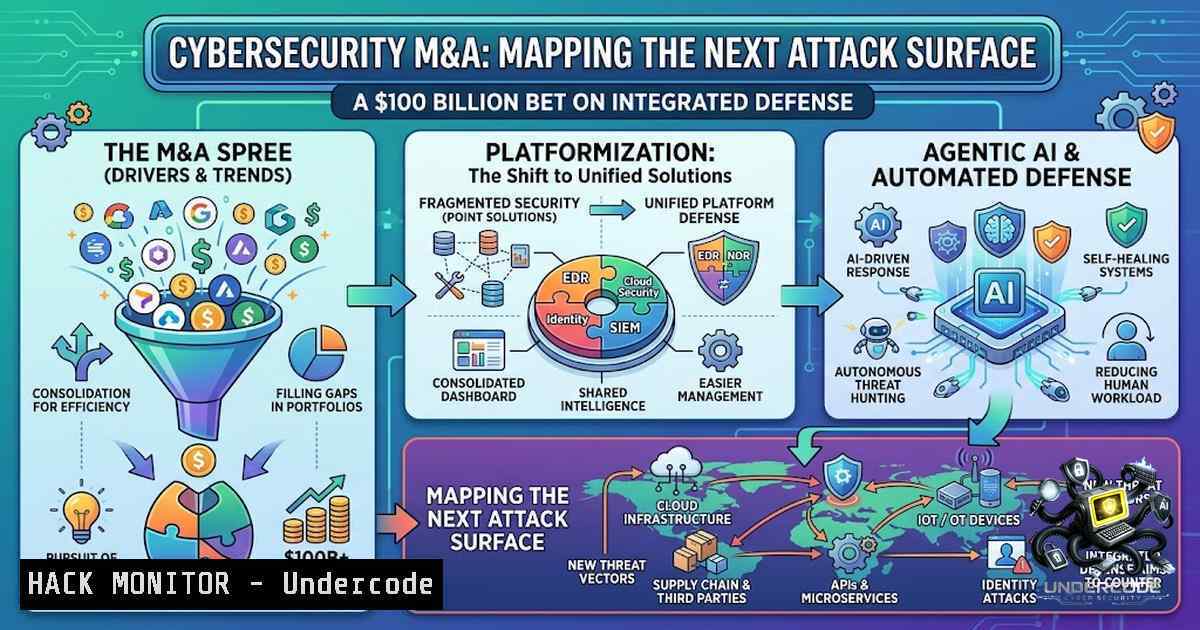
The cybersecurity industry is undergoing its most aggressive consolidation wave in history, with over 215 mergers and acquisitions (M&A) collectively worth more than $100 billion recorded in the first half of 2026 alone. Beneath the transaction count lies a more consequential signal: AI security, machine identity, industrial infrastructure, browser protection, behavioral fraud detection, and automated remediation are increasingly appearing on buyers’ shopping lists. This M&A spree is not merely about market share—it is a strategic response to an enterprise attack surface expanding to AI agents, industrial equipment, cloud applications, browsers, APIs, and automated software.
Learning Objectives:
- Understand the structural drivers behind the 2026 cybersecurity M&A wave and its implications for enterprise defense
- Master the technical capabilities being acquired—from browser runtime protection to non-human identity detection and automated remediation
- Learn practical commands and configurations for securing AI agents, machine identities, and API-driven infrastructure
- Develop a platform-centric security strategy that reduces vendor fatigue while closing visibility gaps
You Should Know:
- The $100 Billion Consolidation Wave: Why Platforms Are Eating Point Solutions
The numbers are staggering. In 2025, disclosed M&A deal value hit $96 billion across 400+ transactions—a 270% year-over-year surge—and 2026 is already outpacing that trajectory with $47 billion in Q1 alone. Strategic buyers (Google, Palo Alto Networks, CrowdStrike, ServiceNow, Accenture) accounted for 92% of all M&A capital deployed. The defining transactions include Google’s $32 billion acquisition of Wiz, Palo Alto Networks’ $25 billion purchase of CyberArk, and ServiceNow’s $7.75 billion Armis play.
Why this matters to you: The average enterprise now manages between 45 and 76 distinct security tools, with CISOs spending more time on integration and alert triage than on actual threat response. Attackers exploit the seams between tools, betting that visibility gaps remain undetected. Platform consolidation is the industry’s answer: integrated telemetry at scale is the only way to detect sub-minute adversary breakout times, which have dropped to 29 minutes on average and 27 seconds at the fastest observed case.
Step-by-Step: Auditing Your Vendor Sprawl
 Linux: List all security tools installed and their running services
dpkg -l | grep -E "security|firewall|ids|ips|siem|edr|av|endpoint" | wc -l
systemctl list-units --type=service | grep -E "security|firewall|ids"

Windows (PowerShell): Enumerate installed security software
Get-WmiObject -Class Win32_Product | Where-Object {$_.Name -match "security|firewall|antivirus|endpoint|siem"} | Select-Object Name, Vendor, Version

Network mapping: Identify API endpoints and service dependencies
nmap -sV --script=http-enum -p 80,443,8080,8443 <target-ip> | grep -E "open|http-title"

API discovery: Find exposed API routes (requires Burp Suite or OWASP ZAP)
 Passive reconnaissance with Subfinder and httpx
subfinder -d example.com -silent | httpx -silent -mc 200 -path "/api" | tee api-endpoints.txt
- Identity Is the New Perimeter: Securing Non-Human and Machine Identities
Palo Alto Networks’ $25 billion acquisition of CyberArk signals a fundamental shift: identity is now the primary attack surface. Machine identities now outnumber human employees by a ratio of nearly 80-to-1 at large enterprises, making legacy identity management tools obsolete. CrowdStrike’s acquisition of SGNL ($740M) and Seraphic Security ($420M) further underscores this trend, bringing dynamic identity context and browser runtime telemetry into unified XDR platforms.
Why this matters to you: Agentic AI systems—autonomous software agents with elevated permissions—create a massive new attack surface that traditional IAM was never designed to govern. Attackers are already exploiting this gap through prompt injection payloads in production agentic workflows and architectural RCE affecting an estimated 200,000+ servers.
Step-by-Step: Securing Non-Human Identities
 Linux: Audit all service accounts and their permissions
cat /etc/passwd | grep -E "/bin/false|/usr/sbin/nologin" | cut -d: -f1 > service_accounts.txt
for account in $(cat service_accounts.txt); do
sudo -l -U $account 2>/dev/null | grep -E "ALL|NOPASSWD"
done

List all systemd services running with elevated privileges
systemctl list-units --type=service --state=running | grep -E "root|privileged"

Windows (PowerShell): Enumerate service accounts with high privileges
Get-WmiObject Win32_Service | Where-Object {$_.StartName -match "LocalSystem|NetworkService|LocalService"} | Select-Object Name, StartName, State

Azure: List all service principals and their API permissions
az ad sp list --all --query "[].{appId:appId, displayName:displayName, type:servicePrincipalType}" --output table
az ad sp list --all --query "[?appRoleAssignmentRequired==`true`]" > sp-require-assignment.json

AWS: Audit IAM roles used by EC2 instances and Lambda functions
aws iam list-roles --query "Roles[?AssumeRolePolicyDocument.Statement[?Principal.Service=='ec2.amazonaws.com' || Principal.Service=='lambda.amazonaws.com']]" --output table
aws iam list-policies --only-attached --query "Policies[?AttachmentCount>0].[PolicyName,AttachmentCount]" --output table
3. Browser Security Becomes the New Endpoint
With 68% of financial institutions increasing fraud-detection budgets year-over-year and employees increasingly interacting with corporate information through SaaS, cloud services, and web interfaces, browsers have become the new battleground. Akamai’s $205 million acquisition of LayerX and CrowdStrike’s $420 million deal for Seraphic Security expand security controls directly into browsers—protecting against shadow AI, GenAI data exfiltration, and in-session Zero Trust enforcement.
Why this matters to you: Browser-level AI usage is now a critical control point. Seraphic delivers live behavioral telemetry from inside the browser runtime, while LayerX provides telemetry around user behavior inside browser sessions that can be integrated into access control systems.
Step-by-Step: Hardening Browser Security
 Linux: Enforce browser security policies via Group Policy or local policies
 For Firefox: Create a policies.json file
cat > /usr/lib/firefox/distribution/policies.json << 'EOF'
{
"policies": {
"DisableFirefoxStudies": true,
"DisablePocket": true,
"DisableTelemetry": true,
"EnableTrackingProtection": {
"Value": true,
"Locked": true
},
"Extensions": {
"Install": [
"https://addons.mozilla.org/firefox/downloads/latest/ublock-origin/latest.xpi",
"https://addons.mozilla.org/firefox/downloads/latest/https-everywhere/latest.xpi"
]
}
}
}
EOF

Windows: Configure Edge/Chrome via Group Policy
 Export current Chrome policies
reg query "HKLM\Software\Policies\Google\Chrome" /s > chrome_policies.txt

PowerShell: Set Chrome extension installation whitelist
$policyPath = "HKLM:\Software\Policies\Google\Chrome\ExtensionInstallAllowlist"
New-Item -Path $policyPath -Force
New-ItemProperty -Path $policyPath -1ame "1" -Value "cjpalhdlnbpafiamejdnhcphjbkeiagm" -PropertyType String  uBlock Origin

Browser extension security audit: List all installed extensions
 Chrome
ls ~/.config/google-chrome/Default/Extensions/ | while read ext; do
cat ~/.config/google-chrome/Default/Extensions/$ext//manifest.json | grep -E '"name"|"version"|"permissions"' | head -3
done

Firefox
ls ~/.mozilla/firefox/.default/extensions/ | while read ext; do
cat $ext/manifest.json 2>/dev/null | grep -E '"name"|"version"|"permissions"' | head -3
done
4. Behavioral Fraud Detection and Automated Remediation Converge
Visa’s planned $2.4 billion acquisition of BioCatch makes the convergence of fraud and cybersecurity impossible to ignore. BioCatch serves more than 350 banks across 21 countries, analyzing thousands of behavioral signals—keystrokes, device handling, application, and network patterns—to separate legitimate users from fraudsters. Meanwhile, SailPoint’s acquisition of Entro enables automated remediation and enforcement of zero-standing privileges through Non-Human Identity Detection and Response (NHIDR) technology.
Why this matters to you: Identity data alone may not reveal an attack. Neither may behavioral data, network telemetry, browser activity, or application logs. But correlated together, these signals can show that an authenticated employee is behaving unusually, an AI agent is accessing unexpected information, or an industrial device is communicating with a system it normally does not.
Step-by-Step: Implementing Behavioral Analytics and Automated Response
 Linux: Set up auditd for behavioral monitoring
sudo apt install auditd audispd-plugins -y
sudo auditctl -w /etc/passwd -p wa -k identity_change
sudo auditctl -w /etc/shadow -p wa -k identity_change
sudo auditctl -w /var/log/auth.log -p r -k auth_monitor

Configure automated response with Fail2ban
sudo apt install fail2ban -y
sudo cat > /etc/fail2ban/jail.local << 'EOF'
[bash]
bantime = 3600
findtime = 600
maxretry = 5

[bash]
enabled = true
port = ssh
filter = sshd
logpath = /var/log/auth.log
action = iptables-multiport[name=sshd, port=ssh, protocol=tcp]
EOF
sudo systemctl restart fail2ban

Windows: Configure PowerShell script for behavioral alerting
 Create a script to monitor for unusual login patterns
$script = @'
$events = Get-WinEvent -FilterHashtable @{LogName='Security'; ID=4624} -MaxEvents 100
$unusualLogins = $events | Where-Object { $<em>.TimeCreated -gt (Get-Date).AddHours(-2) } | Group-Object -Property @{E={$</em>.Properties[bash].Value}} | Where-Object { $_.Count -gt 5 }
if ($unusualLogins) { Write-Warning "Unusual login activity detected from IP: $($unusualLogins.Name)" }
'@
$script | Out-File -FilePath "C:\Scripts\Monitor-Logins.ps1"

API rate limiting and anomaly detection with NGINX
sudo apt install nginx -y
sudo cat > /etc/nginx/conf.d/rate-limit.conf << 'EOF'
limit_req_zone $binary_remote_addr zone=api_limit:10m rate=10r/s;
limit_req zone=api_limit burst=20 nodelay;
EOF
sudo nginx -t && sudo systemctl reload nginx
5. Cloud and API Security: The Distributed Perimeter
ServiceNow’s $7.75 billion acquisition of Armis provides real-time discovery across IT, OT, IoT, medical devices, and cloud environments—tracking 7 billion devices globally. Combined with Veza (AI-1ative identity intelligence), ServiceNow is assembling an autonomous remediation stack that binds asset graphs with identity graphs for prioritized workflows. The enterprise perimeter has become a distributed, API-connected mesh with thousands of identity touchpoints and no clear edge to defend.
Step-by-Step: Hardening Cloud and API Infrastructure
 Linux: API security testing with OWASP ZAP
docker pull zaproxy/zap-stable
docker run -v $(pwd):/zap/wrk -t zaproxy/zap-stable zap-api-scan.py -t https://api.example.com/openapi.json -f openapi -r api-scan-report.html

AWS: Audit S3 bucket permissions for public exposure
aws s3api list-buckets --query "Buckets[].Name" --output text | while read bucket; do
aws s3api get-bucket-acl --bucket $bucket --query "Grants[?Grantee.URI=='http://acs.amazonaws.com/groups/global/AllUsers']" --output table
done

Azure: Check for overly permissive network security groups
az network nsg list --query "[].{name:name, rules:securityRules[?access=='Allow' && sourceAddressPrefix=='']}" --output table

Google Cloud: Audit IAM bindings for excessive permissions
gcloud projects get-iam-policy $(gcloud config get-value project) --format=json | jq '.bindings[] | select(.role | contains("admin") or contains("owner"))'

Kubernetes: Audit RBAC for overly permissive roles
kubectl get clusterroles -o json | jq '.items[] | select(.rules[].resources[]? | contains("")) | .metadata.name'
kubectl auth can-i --list --as=system:serviceaccount:default:test-sa

API Gateway rate limiting with Kong or Tyk
 Example: Kong rate-limiting plugin configuration
curl -X POST http://localhost:8001/services/api-service/plugins \
--data "name=rate-limiting" \
--data "config.minute=100" \
--data "config.hour=1000" \
--data "config.policy=local"
What Undercode Say:
- The Consolidation Wave Is a Defense Mechanism, Not Just a Market Trend – The $100 billion+ in M&A activity is a direct response to an attack surface that has outgrown point-solution architectures. Platforms that correlate identity, behavior, network, and application telemetry in real time are the only viable defense against sub-minute adversary breakout times.
-
Machine Identities Are the New Frontier – With machine identities outnumbering humans by 80-to-1, traditional IAM is fundamentally broken. Organizations must implement Non-Human Identity Detection and Response (NHIDR) with automated privilege revocation and continuous behavioral monitoring for AI agents and service accounts.
Analysis: The M&A spree reveals a structural realignment of the cybersecurity industry. Strategic buyers are not acquiring products—they are acquiring context, visibility, and correlation engines. ServiceNow bought Armis for cross-environment asset intelligence. Palo Alto bought CyberArk for privileged access governance at machine speed. CrowdStrike bought Seraphic for browser runtime telemetry. Each acquisition fills a visibility gap that attackers have been exploiting. The threat landscape has shifted from isolated vulnerabilities to systemic risks across distributed, API-connected infrastructure. Organizations that treat security as a platform—not a collection of tools—will gain the correlated telemetry needed to detect and respond to AI-accelerated adversaries. Those that cling to best-of-breed point solutions will continue to drown in alerts while attackers move laterally in under a minute.
Prediction:
- +1 Platform consolidation will accelerate through 2027, with major vendors acquiring an additional 200+ security startups to fill AI security, identity governance, and browser protection gaps. CISOs will reduce vendor counts from 45–75 to 10–15 strategic platforms within 24 months.
-
-1 The consolidation wave creates concentration risk: platform outages or vulnerabilities could now impact entire enterprise security stacks simultaneously. Organizations must architect for platform redundancy and maintain emergency fallback procedures.
-
+1 Automated remediation will become the default security control by 2028, with AI-driven kill switches revoking access privileges milliseconds after threat detection—rendering manual alert triage obsolete.
-
-1 Smaller security vendors unable to be acquired will face extinction, reducing innovation diversity and creating a two-tier market of platform oligopolies and niche startups racing toward acquisition or irrelevance.
-
+1 Regulatory pressure (EU Cyber Resilience Act, CMMC Phase 2) will accelerate platform adoption as organizations cannot afford compliance gaps during enforcement sprints, driving further consolidation and standardization of security controls.
▶️ Related Video (70% Match):
https://www.youtube.com/watch?v=01Qj_FiYalc
🎯Let’s Practice For Free:
🎓 Live Courses & Certifications:
Join Undercode Academy for Verified Certifications
🚀 Request a Custom Project:
Secure, high-velocity infrastructure and disruptive technological engineering. Contact our engineering team for high-tier development and proprietary systems:
[email protected]
💎 Smart Architecture | 🛡️ Secure by Design | ⭐ Trusted by Thousands
IT/Security Reporter URL:
Reported By: Gregorydevans Cybersecurity – Hackers Feeds
Extra Hub: Undercode MoN
Basic Verification: Pass ✅


