Listen to this Post
Introduction
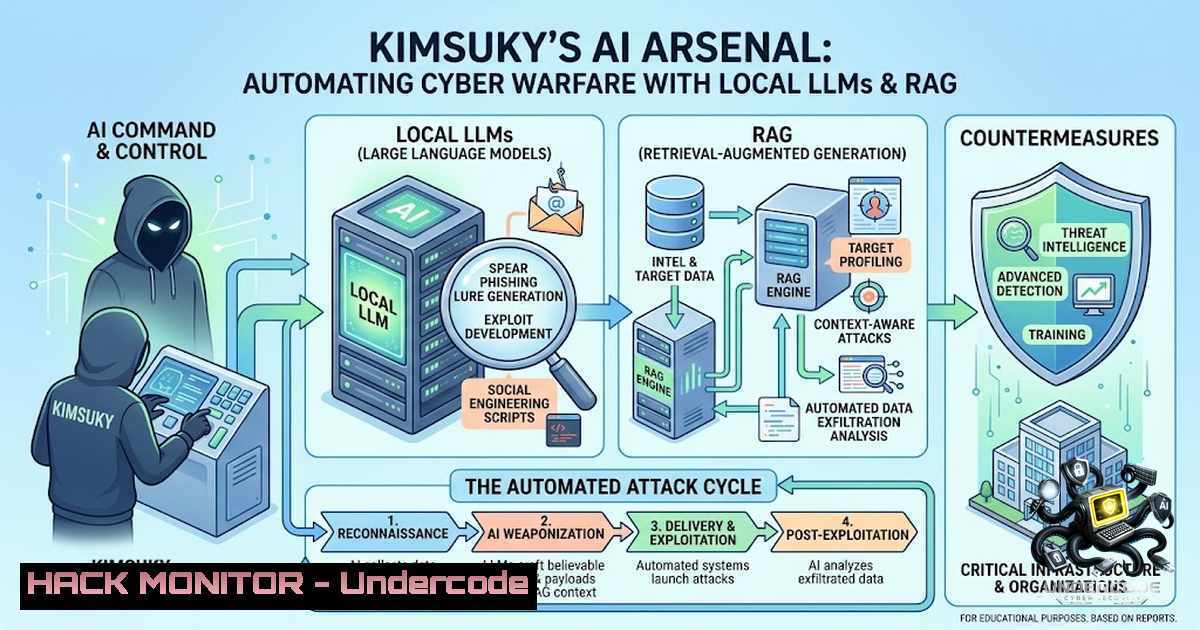
On August 10, 2026, South Korean cybersecurity firm Genians released a landmark report revealing that Kimsuky—a hacking group operating under North Korea’s Reconnaissance General Bureau—has moved beyond using generative AI for simple phishing lures. The group has now built and operated local large language model (LLM) environments using Ollama, GPT4All, and Msty, alongside retrieval-augmented generation (RAG) pipelines, AI agent development frameworks, and AI-assisted coding tools. This marks a paradigm shift: state-backed threat actors are no longer just consuming AI services—they are hosting, fine-tuning, and operationalizing AI internally to automate malware development, data analysis, and attack execution at scale.
Learning Objectives
- Understand how Kimsuky integrates local LLMs, RAG, and AI coding assistants into a complete attack automation pipeline
- Identify the technical indicators of compromise (IoCs) associated with Operation GitPower, including LNK-based phishing, PowerShell loaders, and GitHub C2 infrastructure
- Learn defensive strategies, including EDR-based threat hunting, email header analysis, and YARA rule development for AI-generated phishing detection
- Acquire practical Linux and Windows commands to detect, analyze, and mitigate AI-powered spear-phishing campaigns
- The AI Attack Pipeline: From Local LLMs to Autonomous Agents
Kimsuky’s evolution represents a three-stage maturation of AI weaponization. Stage one involved using generative AI to draft phishing emails and create decoy documents. Stage two—the current phase—involves building and operating local AI infrastructure to avoid sending stolen data to external cloud services. Stage three, which Genians warns is imminent, involves fully autonomous AI agents capable of executing entire attack chains with minimal human intervention.
Technical Deep-Dive: The Local LLM Stack
Genians identified the following tools on Kimsuky-controlled infrastructure:
| Tool | Purpose | Security Implication |
||||
| Ollama | Local LLM runtime | Enables offline model execution; no external API logs |
| GPT4All | Desktop LLM application | Runs on consumer hardware; difficult to detect |
| Msty | LLM management interface | Simplifies model switching and prompt engineering |
| Cursor | AI-assisted code editor | Accelerates malicious script development |
| RAG | Document retrieval + generation | Automates extraction of intelligence from stolen documents |
The group also deployed speech-to-text (STT) tools and AI agent development frameworks, suggesting they are automating the transcription of intercepted communications and building autonomous decision-making systems.
Why Local LLMs Matter for Threat Actors
Running models locally provides three critical advantages:
- Data exfiltration evasion: No API calls means no telemetry for security vendors to detect
- Air-gap operation: The infrastructure can function without internet connectivity after initial setup
- Custom model fine-tuning: The group can train models on stolen diplomatic, military, and financial documents to generate highly targeted lures
2. Operation GitPower: The Attack Chain Unpacked
Genians tracks this campaign as Operation GitPower, a continuation of the 2023 FlowerPower campaign that now incorporates Git-based command-and-control (C2) infrastructure. The attack chain follows a predictable but increasingly sophisticated pattern:
Step 1: AI-Generated Lure Documents
Kimsuky creates highly polished decoy documents using generative AI, themed around:
– Virtual asset investment reports
– Financial strategy documents
– Diplomatic correspondence and meeting materials
– Honorarium payment requests and research collaboration proposals
These documents use natural language, professional formatting, and authentic-looking design elements to bypass traditional content-filtering defenses.
Step 2: Malicious LNK Files in ZIP Archives
The lure documents are distributed via spear-phishing emails containing ZIP archives. Inside each archive is a Windows LNK shortcut file disguised with professional filenames such as “Investment_Strategy_2026.lnk” or “Embassy_Correspondence.lnk”.
Step 3: Obfuscated PowerShell Execution
When executed, the LNK file triggers obfuscated PowerShell commands that:
– Decode Base64-encoded payloads
– Split strings and use custom decoding routines
– Establish persistence via scheduled tasks
– Connect to GitHub repositories serving as C2 infrastructure
Step 4: GitHub as C2 and Payload Distribution
Kimsuky abuses GitHub and GitLab repositories to host encrypted AsyncRAT payloads and receive C2 instructions. This approach:
– Leverages legitimate, trusted domains (github.com)
– Evades traditional IP-based blocking
– Allows dynamic payload updates without redeploying infrastructure
Step 5: AsyncRAT Deployment
The final stage deploys AsyncRAT, an open-source remote access trojan, which:
– Establishes persistent remote control
– Exfiltrates credentials, documents, and cryptocurrency wallet information
– Supports plugin-based architecture for modular attacks
3. Defensive Countermeasures: Detection and Mitigation
Email-Level Defenses
AI-generated phishing emails often lack the grammatical errors of traditional phishing but exhibit other anomalies:
Linux/macOS (using `grep` and `awk`):
 Extract and analyze email headers for SPF/DKIM failures
cat suspicious.eml | grep -E "^(SPF|DKIM|DMARC):" | grep -E "FAIL|SOFTFAIL"

Check for unusual Reply-To addresses
grep -i "^Reply-To:" suspicious.eml

Extract sending IP and cross-reference with threat intelligence
grep -i "^Received:" suspicious.eml | head -1 | grep -oE '[0-9]+.[0-9]+.[0-9]+.[0-9]+'
Windows PowerShell:
 Parse .eml files and check authentication results
Get-Content .\suspicious.eml | Select-String -Pattern "Authentication-Results" -Context 2,5

Check for malicious attachments (LNK files in ZIP)
Get-ChildItem -Path .\ -Recurse -Include .zip | ForEach-Object {
Expand-Archive -Path $_.FullName -DestinationPath .\temp_extract -Force
Get-ChildItem -Path .\temp_extract -Recurse -Include .lnk
}
Endpoint Detection and Response (EDR) Hunting
Genians emphasizes that EDR-based threat hunting—focusing on execution behaviors rather than document content—is now critical. Key behavioral indicators to monitor:
Suspicious LNK file execution:
 Windows Event Log query for LNK file executions
Get-WinEvent -FilterHashtable @{LogName='Microsoft-Windows-Shell-Core/Operational'; ID=1000} |
Where-Object { $_.Message -match ".lnk" } |
Select-Object TimeCreated, Message
PowerShell obfuscation detection:
 Detect encoded commands and long argument strings
Get-WinEvent -FilterHashtable @{LogName='Windows PowerShell'; ID=4104} |
Where-Object { $_.Message -match "-e(ncoded)?\s+[A-Za-z0-9+/=]{50,}" } |
Select-Object TimeCreated, Message
GitHub C2 communication detection (Linux):
 Monitor outbound connections to GitHub API/raw content
sudo tcpdump -i any -1 "host raw.githubusercontent.com or host github.com" -c 100

Check for suspicious scheduled tasks
sudo cat /etc/crontab | grep -E "curl|wget|powershell"
YARA Rules for AI-Generated Phishing Detection
Create a YARA rule to detect Kimsuky-style AI-generated lure documents:
rule Kimsuky_AI_Generated_Lure_PDF {
meta:
description = "Detects AI-generated PDF lures used by Kimsuky"
author = "Security Team"
date = "2026-08-10"
strings:
$ai_pattern1 = /(cryptocurrency|blockchain|digital asset|investment strategy)/i
$ai_pattern2 = /(diplomatic|embassy|foreign ministry|security cooperation)/i
$ai_artifact = "%%" // Common AI watermark in some generated PDFs
$suspicious_metadata = "Creator: ChatGPT" nocase
condition:
uint16(0) == 0x2550 and // PDF magic bytes
($ai_pattern1 or $ai_pattern2) and
filesize < 500KB
}
4. RAG Security: The New Attack Surface
Kimsuky’s use of retrieval-augmented generation (RAG) represents a novel threat vector. By combining stolen documents with generative AI, the group can:
- Automatically extract intelligence from exfiltrated diplomatic cables and financial records
- Generate contextually perfect phishing lures that reference real internal communications
- Scale social engineering without human analysts reading every stolen document
Defending Against RAG-Enhanced Attacks
Organizations should implement data-centric security controls:
Linux: Monitor for unauthorized document access patterns
 Audit access to sensitive document repositories
sudo auditctl -w /sensitive_docs/ -p rwa -k document_access

Review audit logs for anomalous access
sudo ausearch -k document_access --start today | grep -v "user=authorized_user"
Windows: Enable advanced audit policies
 Enable object access auditing
auditpol /set /subcategory:"File System" /success:enable /failure:enable

Monitor for bulk file reads
Get-WinEvent -FilterHashtable @{LogName='Security'; ID=4663} |
Where-Object { $<em>.Message -match "ReadData" } |
Group-Object -Property UserId |
Where-Object { $</em>.Count -gt 50 }
5. Cloud and API Security Hardening
Given Kimsuky’s abuse of GitHub and cloud platforms for C2, organizations should implement:
GitHub Repository Monitoring
Linux: Monitor for unauthorized GitHub API access
 Check for unexpected GitHub-related outbound traffic
sudo netstat -tunap | grep -E "github|raw.githubusercontent"

Audit SSH keys and personal access tokens (if using GitHub Enterprise)
gh api /user/keys --jq '.[].title'
API Security Best Practices
1. Rotate API keys and tokens regularly
2. Implement IP allowlisting for cloud service access
3. Enable audit logging for all API calls
- Monitor for anomalous API usage patterns (e.g., bulk downloads, unusual user agents)
Windows: Detect unauthorized cloud sync tools
 Identify installed cloud storage applications
Get-WmiObject -Class Win32_Product | Where-Object {
$_.Name -match "Dropbox|Google Drive|OneDrive|GitHub Desktop"
}

Check for unexpected scheduled tasks invoking cloud tools
Get-ScheduledTask | Where-Object {
$_.Actions.Execute -match "dropbox|gdrive|onedrive|git"
}
What Undercode Say
- AI is the great equalizer—and the great threat multiplier. Kimsuky’s local LLM deployment demonstrates that sophisticated AI capabilities are no longer exclusive to wealthy nations or tech giants. Any state actor with basic infrastructure can now operationalize generative AI for offensive cyber operations.
-
Defense must shift from content to behavior. Traditional email filtering and signature-based detection are obsolete against AI-generated content that passes linguistic and stylistic scrutiny. EDR and behavior-based threat hunting are no longer optional—they are foundational.
-
The RAG threat is underestimated. By combining stolen data with retrieval-augmented generation, attackers can produce contextually perfect phishing that references real internal communications. This breaks the “too good to be true” heuristic that many users rely on.
-
Open-source tools are dual-use. Ollama, GPT4All, Msty, and Cursor are legitimate productivity tools. Their weaponization by Kimsuky highlights the urgent need for organizations to monitor and control AI tool usage within their environments.
-
The 2026 Kimsuky campaign is a wake-up call. This is not a future threat—it is happening now. Security teams must assume that attackers have access to the same AI capabilities as defenders, if not better ones, given their willingness to operate without ethical constraints.
Prediction
-
-1 AI-powered cyberattacks will become the default operational model for APT groups within 12–18 months. Kimsuky’s local LLM deployment is the first documented case, but Lazarus, APT37, and other state-backed groups are likely already building similar capabilities.
-
-1 The cost of entry for sophisticated phishing campaigns will drop to near zero. As AI tools become more accessible and easier to run locally, even non-state actors will be able to execute highly targeted, grammatically flawless spear-phishing at scale.
-
+1 Defensive AI will evolve in response, with EDR platforms incorporating LLM-based anomaly detection and behavioral analysis. The “AI vs. AI” arms race will accelerate, benefiting organizations that invest early in AI-1ative security tools.
-
-1 RAG-based attacks will expose a critical vulnerability: any organization whose sensitive documents are exfiltrated now faces the risk of those documents being used to generate perfect phishing lures against their own employees. Data breach consequences will escalate dramatically.
-
+1 Regulatory frameworks will catch up. Expect new compliance requirements around AI tool inventory, local LLM deployment monitoring, and mandatory reporting of AI-assisted cyberattacks within 2–3 years, similar to GDPR’s breach notification requirements.
This article is based on the Genians Security Center report released August 10, 2026, and subsequent analysis from Reuters, Al Jazeera, Chosun, and other cybersecurity sources.
▶️ Related Video (76% Match):
🎯Let’s Practice For Free:
🎓 Live Courses & Certifications:
Join Undercode Academy for Verified Certifications
🚀 Request a Custom Project:
Secure, high-velocity infrastructure and disruptive technological engineering. Contact our engineering team for high-tier development and proprietary systems:
[email protected]
💎 Smart Architecture | 🛡️ Secure by Design | ⭐ Trusted by Thousands
IT/Security Reporter URL:
Reported By: Gregorydevans North – Hackers Feeds
Extra Hub: Undercode MoN
Basic Verification: Pass ✅


