Listen to this Post
Introduction
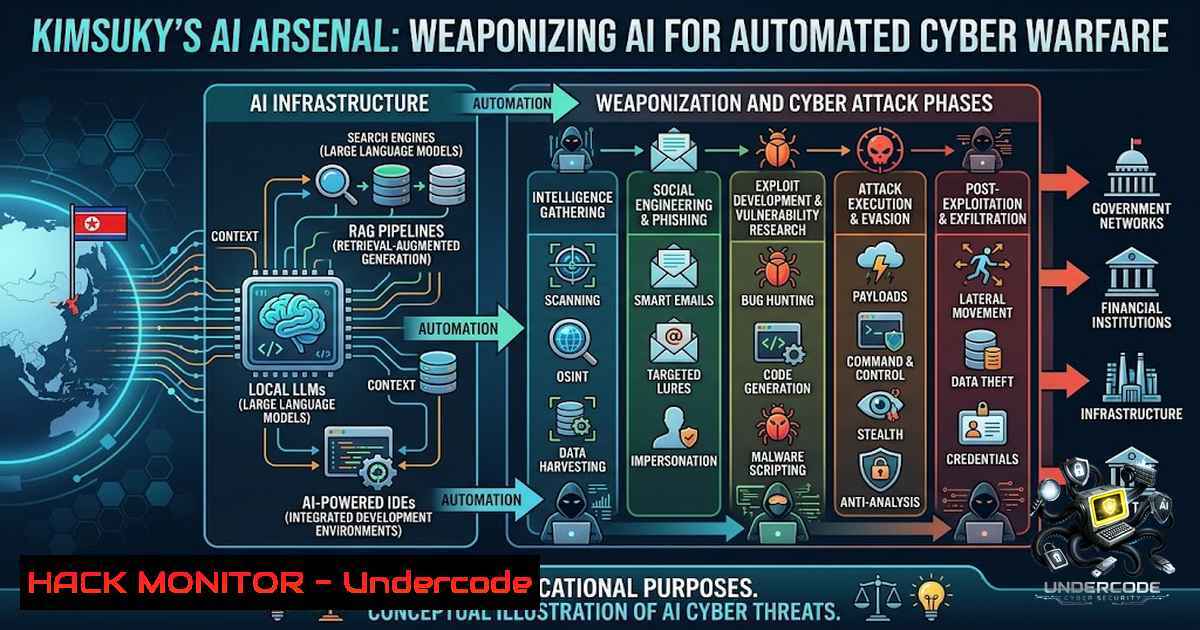
The convergence of generative artificial intelligence and advanced persistent threat (APT) operations has reached a critical inflection point. On August 10, 2026, South Korean cybersecurity firm Genians released evidence that the North Korean-linked hacking group Kimsuky has deployed local large language model (LLM) tools—including Ollama, GPT4All, and Msty—alongside retrieval-augmented generation (RAG) pipelines and AI-assisted coding platforms like Cursor to automate cyberattacks, analyze stolen intelligence, and generate hyper-realistic phishing campaigns. This marks a significant escalation from using generative AI for simple content creation to full-spectrum integration of AI models into malware development, data exfiltration, and attack automation—transforming Kimsuky into an AI-1ative cyber-espionage apparatus.
Learning Objectives
- Understand the technical architecture and security implications of locally deployed LLM tools (Ollama, GPT4All, Msty) and RAG pipelines in offensive cyber operations.
- Master the configuration, hardening, and vulnerability assessment of Ollama instances, including authentication bypasses, CVE mitigation, and reverse proxy deployment.
- Analyze the attack surface introduced by AI-assisted coding environments like Cursor, including sandbox escape vectors (CVE-2026-50548, CVE-2026-50549) and prompt injection-based RCE.
- Implement defensive strategies against AI-powered phishing, RAG poisoning, and automated malware generation using behavior-based detection and zero-trust architectures.
You Should Know
- Local LLM Infrastructure as an Attack Enabler: Ollama, GPT4All, and RAG Pipelines
Kimsuky’s deployment of Ollama, GPT4All, and Msty represents a strategic shift toward air-gapped AI processing. By running models locally, operators can process stolen documents—including financial reports, cryptocurrency-themed decoy materials, and government intelligence—without transmitting sensitive data to external cloud AI services, thereby evading detection and data-leak safeguards. The integration of retrieval-augmented generation (RAG) allows these models to query vectorized document databases, enabling rapid summarization, translation, and pattern extraction from exfiltrated material.
Offensive Use Cases:
- Automated Phishing Generation: LLMs craft spear-phishing emails with proper formatting, grammar, and contextual relevance, increasing success rates.
- Malware Code Assistance: Kaspersky identified Rust-based backdoors (HelloDoor) containing AI-generated code artifacts, indicating LLM involvement in malware development.
- Intelligence Triaging: RAG pipelines process large volumes of stolen documents, extracting actionable intelligence without human review.
Step‑by‑Step: Deploying and Securing an Ollama Instance
Installation (Linux/macOS):
 Install Ollama via official script
curl -fsSL https://ollama.com/install.sh | sh

Pull a model (e.g., Llama 3)
ollama pull llama3:8b

Run the model locally
ollama run llama3:8b
By default, Ollama binds to `127.0.0.1:11434` with no authentication. This is acceptable for local use but becomes a critical vulnerability when exposed to networks.
Hardening Ollama for Production (5-Step Process):
- Harden SSH Access: Disable root login and password authentication; enforce SSH key-based access.
sudo vim /etc/ssh/sshd_config
PermitRootLogin no
PasswordAuthentication no
sudo systemctl restart sshd
-
Configure UFW Firewall: Block external access to port 11434; allow only SSH and HTTPS.
sudo ufw default deny incoming
sudo ufw default allow outgoing
sudo ufw allow ssh
sudo ufw allow 443/tcp
sudo ufw deny 11434/tcp
sudo ufw enable
-
Restrict Ollama API Bindings to Localhost: Modify the systemd service to bind exclusively to
127.0.0.1.sudo systemctl edit ollama.service Add: Environment="OLLAMA_HOST=127.0.0.1:11434" sudo systemctl daemon-reload sudo systemctl restart ollama
-
Deploy an Nginx Reverse Proxy with mTLS or Basic Auth:
server { listen 443 ssl; server_name ai.yourdomain.com; ssl_certificate /etc/letsencrypt/live/ai.yourdomain.com/fullchain.pem; ssl_certificate_key /etc/letsencrypt/live/ai.yourdomain.com/privkey.pem; location / { proxy_pass http://127.0.0.1:11434; auth_basic "Restricted"; auth_basic_user_file /etc/nginx/.htpasswd; } } -
Audit with ServGuard: Scan for known CVEs and misconfigurations.
pip install servguard
servguard check --host 127.0.0.1 --port 11434 --format json
ServGuard checks for CVE-2026-22778 (vLLM RCE, CVSS 9.8), CVE-2026-7482 (“Bleeding Llama”), and CVE-2024-37032 (“Probllama”).
-
RAG Pipeline Vulnerabilities: Poisoning, Data Exfiltration, and Prompt Injection
Retrieval-augmented generation systems introduce a novel attack surface. Kimsuky’s use of RAG enables offline document processing, but defenders must recognize that RAG pipelines are vulnerable to:
- Knowledge Poisoning: Adversaries can inject malicious documents into vector databases, causing the LLM to retrieve and propagate false or harmful information.
- Prompt Injection: Malicious queries can override system instructions, exfiltrating sensitive context or triggering unauthorized actions.
- Reconstruction Attacks: Attackers can reverse-engineer retrieved documents from model outputs, exposing proprietary or classified information.
Defensive Measures for RAG Security:
- Input Sanitization: Filter and validate all documents before ingestion into vector databases.
- Access Controls: Implement role-based access to RAG knowledge bases; restrict query scopes.
- Audit Logging: Monitor all retrieval queries and model outputs for anomalous patterns.
- Encryption: Encrypt vector embeddings and document stores at rest and in transit.
- AI-Powered IDEs as Attack Vectors: Cursor’s Sandbox Escape Vulnerabilities (CVE-2026-50548, CVE-2026-50549)
Genians’ report specifically identifies Cursor, an AI-assisted coding IDE, as part of Kimsuky’s toolset. This is alarming given that Cursor versions prior to 3.0.0 contain critical sandbox escape vulnerabilities that enable remote code execution (RCE) through prompt injection.
DuneSlide Vulnerabilities (CVSS 9.8):
- CVE-2026-50548: An attacker can manipulate the `working_directory` parameter to escape the sandbox, overwrite the `cursorsandbox` executable, and execute arbitrary OS-level commands.
- CVE-2026-50549: A path canonicalization flaw allows symbolic links to bypass out-of-bounds write protections, enabling file system traversal and code execution.
Additional Cursor CVEs:
- CVE-2026-48124: Workspace-defined Claude hook commands execute without user approval, enabling persistent sandbox escape.
- CVE-2026-61613: Browser-enabled Cloud Agent sessions allow attacker-controlled web content to connect to unauthenticated local agent endpoints.
Step‑by‑Step: Securing AI-Assisted Development Environments
- Upgrade to Cursor 3.0.0 or Later: Patches for all above CVEs were released in version 3.0.0 (April 2, 2026).
- Disable Automatic Agent Command Execution: Require explicit user approval for all agent-initiated terminal commands.
- Restrict Workspace Permissions: Never open untrusted repositories in Cursor; treat AI-generated code as potentially malicious.
- Implement Endpoint Detection and Response (EDR): Monitor for unusual process executions originating from IDE processes.
- Network Segmentation: Run AI development tools in isolated environments or VMs with limited network access.
-
AI-Generated Phishing and Decoy Documents: Detection and Mitigation
Genians discovered finance and cryptocurrency-themed decoy documents generated by AI, designed to resemble legitimate investment reports. Kimsuky’s spear-phishing emails now feature proper formatting, grammar, and visual clues, making them nearly indistinguishable from legitimate correspondence.
Defensive Strategies:
- Non-Phishable Credentials: Move to FIDO2/WebAuthn hardware tokens; eliminate password-based authentication.
- AI-Augmented Detection: Deploy machine learning models that analyze email headers, linguistic patterns, and metadata for anomalies.
- Security Awareness Training: Educate employees on AI-generated phishing indicators (e.g., overly formal language, subtle contextual errors).
- Zero-Trust Architecture: Assume breach; verify every access request regardless of origin.
- Kimsuky’s Evolving TTPs: From Spear-Phishing to AI-1ative Espionage
First identified by Kaspersky in 2013, Kimsuky (also tracked as APT43, Ruby Sleet, Black Banshee) has evolved from a relatively low-skill spear-phishing group to an AI-1ative espionage apparatus. Recent campaigns demonstrate:
- Rust-Based Malware (HelloDoor): AI-generated backdoors with reduced detection signatures.
- VSCode Remote Tunneling: Abuse of legitimate Microsoft tunneling features to blend in with normal traffic.
- Government Certificate Targeting: AppleSeed malware collects GPKI digital certificates used by South Korean officials.
- ReconShark Component: Expanded reconnaissance capabilities, exfiltrating detection mechanisms and hardware information.
Command and Control (C2) Evasion:
Kimsuky now compromises legitimate South Korean websites to host C2 infrastructure and uses messenger platforms for initial contact.
- Defending at the Speed of AI: Layered Countermeasures
| Layer | Countermeasure | Implementation |
|-||-|
| Network | AI-augmented intrusion detection | Deploy behavioral analytics to detect automated attack patterns |
| Endpoint | EDR with ML-based threat hunting | Monitor for AI-generated code artifacts and unusual process chains |
| Identity | Non-phishable MFA | Enforce WebAuthn/FIDO2; eliminate SMS/OTP |
| Data | RAG pipeline security | Sanitize vector DB inputs; encrypt embeddings; audit queries |
| Response | Automated incident orchestration | Use AI-to-AI defense systems for real-time countermeasures |
What Undercode Say
- AI Democratizes Cyber Offense: Kimsuky’s adoption of locally deployed LLMs and RAG pipelines lowers the barrier to sophisticated attacks. Nation-state actors can now automate reconnaissance, malware development, and phishing at scale without relying on expensive human talent or cloud AI services that could expose their operations.
-
The Double-Edged Sword of Local AI: While local LLMs offer privacy benefits for legitimate use cases, they equally empower adversaries to process stolen data offline. Organizations must treat any locally deployed AI infrastructure as a high-value asset requiring the same rigorous security controls as databases or authentication systems.
-
AI-Assisted IDEs Are the New Supply Chain Risk: The discovery of critical RCE vulnerabilities in Cursor highlights a broader class of risks: AI-powered development tools that execute code automatically are prime targets for prompt injection and sandbox escape attacks. Security teams must expand their threat models to include AI agents as potential execution vectors.
-
Defense Must Match Offense: Adversaries are compressing the entire attack lifecycle—discovery, exploitation, and lateral movement—into automated sequences. Defenders must respond with AI-augmented detection, real-time behavioral analytics, and proactive red-teaming of their own AI systems. Passive defenses are no longer sufficient.
-
The Future Is AI vs. AI: As attacks become fully automated and instantaneous, human-in-the-loop security operations will be outpaced. Organizations must invest in autonomous multi-agent cyber defense systems that can detect, contain, and remediate AI-driven threats at machine speed.
Prediction
-
+1 Nation-state APT groups will increasingly adopt open-source local LLM frameworks (Ollama, GPT4All, LM Studio) as standard operational tools, leading to a new category of “AI-1ative” cyber-espionage that renders traditional signature-based detection obsolete by 2027.
-
-1 The proliferation of unauthenticated Ollama instances exposed to the internet—currently estimated at over 300,000 globally—will be exploited en masse by threat actors, resulting in large-scale data breaches and model poisoning incidents within the next 12-18 months.
-
+1 The cybersecurity industry will develop specialized “LLM Firewalls” and RAG security gateways that inspect prompts, sanitize retrieved documents, and enforce strict access controls, creating a new market segment projected to exceed $5 billion by 2028.
-
-1 AI-assisted coding environments like Cursor, Windsurf, and GitHub Copilot will become prime targets for supply chain attacks, with zero-click RCE vulnerabilities discovered regularly as attackers probe the intersection of LLM reasoning and sandboxed execution.
-
+1 Defenders who adopt AI-to-AI defense systems—autonomous agents that detect and respond to AI-generated threats in real-time—will gain a significant advantage, reducing mean time to detect (MTTD) from hours to seconds and enabling proactive threat hunting at machine scale.
▶️ Related Video (68% Match):
https://www.youtube.com/watch?v=0jKeGAhPreQ
🎯Let’s Practice For Free:
🎓 Live Courses & Certifications:
Join Undercode Academy for Verified Certifications
🚀 Request a Custom Project:
Secure, high-velocity infrastructure and disruptive technological engineering. Contact our engineering team for high-tier development and proprietary systems:
[email protected]
💎 Smart Architecture | 🛡️ Secure by Design | ⭐ Trusted by Thousands
IT/Security Reporter URL:
Reported By: Wadie Mikhail – Hackers Feeds
Extra Hub: Undercode MoN
Basic Verification: Pass ✅


