
Listen to this Post
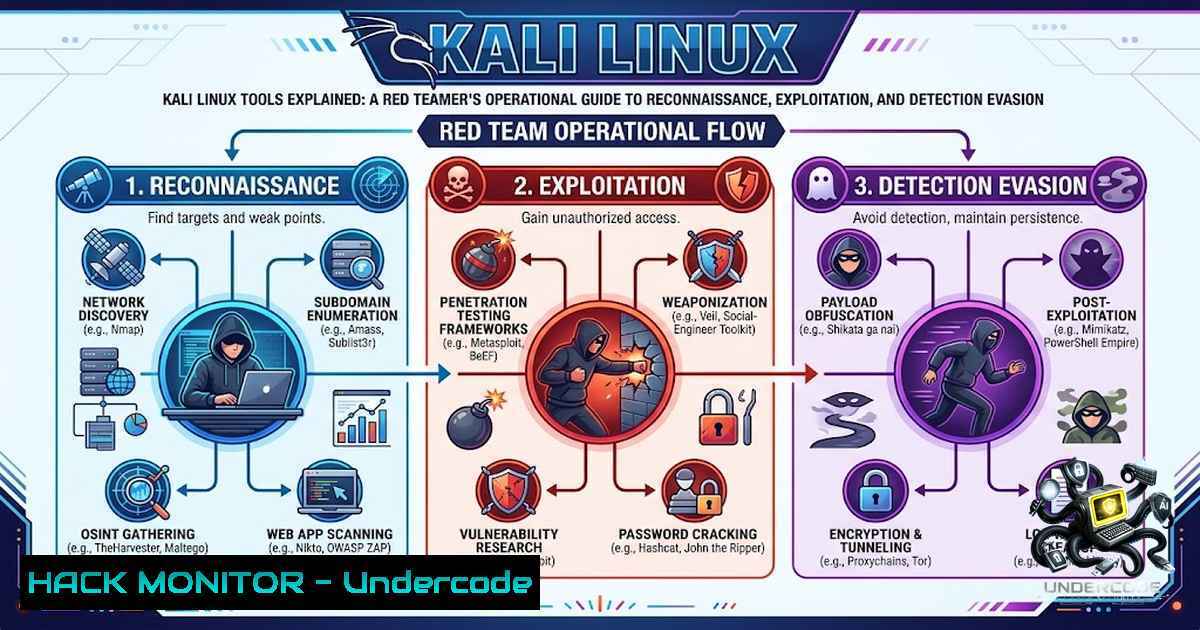
Introduction:
The cybersecurity industry is saturated with tool tutorials, yet the gap between knowing how to execute a command and understanding its strategic application remains vast. As Shoaib Ahmmed, an emerging Red Teamer, aptly observes, “Knowing how to run a tool doesn’t automatically make you a Red Teamer” — the true discipline lies in comprehending why, when, and how to deploy the right tool during an authorized security assessment. This article transforms the theoretical overview of Kali Linux tools into a practical, operational guide. We will dissect reconnaissance, network enumeration, web application testing, credential security, and detection awareness, providing verified commands and methodologies that reflect the mindset of an effective Red Teamer, not just a tool operator.
Learning Objectives & Secrets:
- Objective 1: Master Operational Reconnaissance – Learn to move beyond basic OSINT by chaining tools like theHarvester, Amass, and Recon-1g to build a comprehensive attack surface map, understanding the difference between passive and active data collection.
- Objective 2 (Secret Tip): Optimize Network Enumeration Workflows – Discover the power of combining RustScan’s speed with Nmap’s depth. The secret is not running a single scan but creating a pipeline that drastically reduces scan time while maximizing service and vulnerability discovery.
- Objective 3 (Secret Tip): Think Like an Attacker in Active Directory – Understand that tools like BloodHound are not just for visualization. The secret is learning to interpret BloodHound’s graph to identify “shortest paths to Domain Admin” and abusing misconfigurations like Kerberoasting, turning a low-privilege user into a domain compromise.
You Should Know:
1. Advanced Reconnaissance: Building the Attack Surface Map
Reconnaissance is the cornerstone of any red team engagement. It’s not about running a single tool but about orchestrating a pipeline that extracts maximum intelligence with minimum noise.
- Step 1: Passive Subdomain and Email Enumeration with theHarvester. This tool queries search engines and public sources to find email addresses and subdomains. Command:
theHarvester -d example.com -b google,linkedin,duckduckgo -l 1000 -f theharvester.json. This command targets `example.com` (-d), uses Google, LinkedIn, and DuckDuckGo as sources (-b), limits results to 1000 (-l), and saves output to a JSON file (-f). - Step 2: Deep Subdomain Discovery with Amass. Amass excels at passive and active subdomain enumeration through various techniques including DNS brute-forcing. Command:
amass enum -passive -d example.com -o subdomains.txt. For a more aggressive approach, add the `-brute` flag to force a wordlist-based subdomain bruteforce:amass enum -d example.com -brute. - Step 3: Modular Intelligence Gathering with Recon-1g. This framework provides a Metasploit-like interface for reconnaissance modules. Command: Launch the framework with
recon-1g, then use `marketplace install` to add functionality, and `workspace create ` to organize your findings. - Step 4: Data Aggregation and Processing. Use `jq` to parse the JSON output from theHarvester:
jq -r '.hosts[]?' theharvester.json | grep -E '^[^].\.example\.com' | cut -d ',' -f1 > unique_hosts.txt. This extracts and cleans host data, providing a refined list for further scanning.
2. Network Enumeration: The Speed and Depth Pipeline
A Red Teamer must balance speed with thoroughness. The modern approach uses RustScan for rapid port discovery and then pipes the results into Nmap for detailed service enumeration.
- Step 1: Rapid Port Discovery with RustScan. RustScan can scan all 65,535 ports in seconds. Command:
rustscan -a 10.129.136.187 -r 1-65535 --ulimit 5000. The `-a` specifies the target IP, `-r` defines the port range, and `–ulimit 5000` increases the file descriptor limit for faster scanning. - Step 2: Deep Service and Vulnerability Scanning with Nmap. Pipe the open ports from RustScan directly into Nmap for service version detection (-sV) and default script scanning (-sC). Command:
nmap -sC -sV -p 22,80,443,8080 <target_IP>. For comprehensive vulnerability discovery, use the Nmap scripting engine:nmap --script vuln <target_IP>. - Step 3: Manual Banner Grabbing with Netcat. For a quick, manual check of a service, use Netcat. Command:
nc -zv 192.168.1.100 80 443 8080. The `-z` flag is for zero-I/O mode (used for scanning), and `-v` enables verbose output.
3. Web Application Testing: Fuzzing and Vulnerability Scanning
Web applications are a primary attack vector. Combining fuzzing tools like ffuf with vulnerability scanners like Nikto and Nuclei provides a layered testing approach.
- Step 1: Directory and File Fuzzing with ffuf. Discover hidden directories and files. Command:
ffuf -u https://example.com/FUZZ -w /usr/share/wordlists/dirb/common.txt -mc 200. This command fuzzes the `FUZZ` keyword in the URL with a common wordlist and filters for HTTP status code 200 (success). - Step 2: Web Server Vulnerability Scanning with Nikto. A classic tool for finding web server misconfigurations and known vulnerabilities. Command: `nikto -h https://example.com`.
– Step 3: Template-Based Vulnerability Scanning with Nuclei. Nuclei uses a vast collection of templates to find vulnerabilities, making it more modern and effective than Nikto. Command: `nuclei -u https://example.com -severity critical,high -o nuclei_results.txt. To scan for specific CVEs, use-tags cve. For a large-scale scan, feed a list of targets:nuclei -l live_hosts.txt -t ~/nuclei-templates/ -o results.txt`.
- Credential & Identity Security: Cracking and Active Directory Attacks
This is where the Red Teamer moves from finding vulnerabilities to exploiting identity and access management weaknesses, particularly in Active Directory environments.
- Step 1: Password Cracking with Hashcat. Once hashes are obtained, crack them offline. Command: For a Kerberos TGS hash (often from a Kerberoast attack), use mode 13100:
hashcat -m 13100 -a 0 kerberos_hash.txt /usr/share/wordlists/rockyou.txt. NTLM hashes use mode 1000. - Step 2: Active Directory Mapping with BloodHound. This tool visualizes attack paths. Step 2a – Collect Data: On a Windows target, use
SharpHound.exe -c All. From a Linux machine, use the Python collector:bloodhound-python -u lowpriv -p 'Password123' -d corp.local -c All --zip. Step 2b – Analyze: Start the Neo4j database and BloodHound on Kali: `sudo neo4j console &` andbloodhound &. Import the collected `.zip` file and run built-in queries like “Shortest Paths to Domain Admins” to identify the most efficient attack route. - Step 3: AS-REP Roasting. Enumerate users without Kerberos pre-authentication and crack their hashes. Command:
GetNPUsers.py -dc-ip <DC_IP> corp.local/ -request. The resulting hash can be cracked with Hashcat mode 18200.
5. Detection Awareness: Understanding the Defender’s View
A skilled Red Teamer must operate with an awareness of the defensive controls in place. This isn’t just about using tools; it’s about understanding the telemetry they generate.
- Step 1: Simulate Defender Visibility. Understand that every scan, every connection, and every authentication attempt creates logs. Tools like Nmap’s default scripts and aggressive scans are easily detected by IDS/IPS and SIEMs.
- Step 2: Practice Evasion Techniques. To test detection capabilities, a Red Teamer may employ evasion tactics. This includes using Living Off the Land Binaries (LOLBins) for execution, in-memory payloads to avoid writing to disk, and obfuscation techniques to bypass AV/EDR. Tools like Chisel can be used to tunnel traffic and mask anomalous behaviors.
- Step 3: Correlate Actions with Logs. Before an engagement, understand what logs are generated by your actions. For example, a failed login attempt might generate a Windows Event ID 4625, while a successful one generates 4624. Knowing this helps a Red Teamer blend in and test the efficacy of the blue team’s monitoring.
What Undercode Say:
- Key Takeaway 1: The “Why” Matters More Than the “How”. Mastery of Kali Linux is not about memorizing command syntax; it is about developing a methodology. A Red Teamer’s value is in their ability to think critically about system architecture, identify potential weaknesses, and anticipate defensive responses, not just in their ability to run a tool.
- Key Takeaway 2: The Red Team Mindset is a Blend of Attacker and Defender. The most effective Red Teamers understand both sides of the coin. They know how to attack and, crucially, how defenders detect those attacks. This dual perspective allows them to simulate realistic threats and provide actionable intelligence to improve an organization’s security posture, making the assessment far more valuable than a simple vulnerability scan.
Prediction:
- +1 The integration of AI into offensive security tools will accelerate, leading to more autonomous reconnaissance and exploitation capabilities, as seen with tools like “Villager” that combine Kali tools with AI for automated attack chains. This will force both red and blue teams to evolve their methodologies significantly.
- +1 The demand for professionals who understand not just tool execution but also detection evasion and Active Directory attack paths (like Kerberoasting and BloodHound analysis) will surge, making skills in these areas highly sought after.
- -1 As offensive capabilities become more automated and accessible, the barrier to entry for malicious actors will lower, potentially leading to an increase in sophisticated, automated attacks that are harder for traditional defenses to detect.
- -1 The “tool-focused” training approach will continue to produce security professionals who are proficient in running commands but lack the critical thinking and methodology required for effective red teaming, creating a skills gap that organizations will struggle to fill.
- +1 The rise of cloud-1ative and containerized environments will drive the evolution of tools like Amass and Nuclei to incorporate cloud-specific reconnaissance and vulnerability scanning, expanding the Red Teamer’s toolkit beyond traditional on-premises infrastructure.
▶️ Related Video (78% Match):
🎯Let’s Practice For Free:
🎓 Live Courses & Certifications:
Join Undercode Academy for Verified Certifications
🚀 Request a Custom Project:
Secure, high-velocity infrastructure and disruptive technological engineering. Contact our engineering team for high-tier development and proprietary systems:
[email protected]
💎 Smart Architecture | 🛡️ Secure by Design | ⭐ Trusted by Thousands
IT/Security Reporter URL:
Reported By: https://lnkd.in/p/enG-vGk3 – Hackers Feeds
Extra Hub: Undercode MoN
Basic Verification: Pass ✅


