Listen to this Post
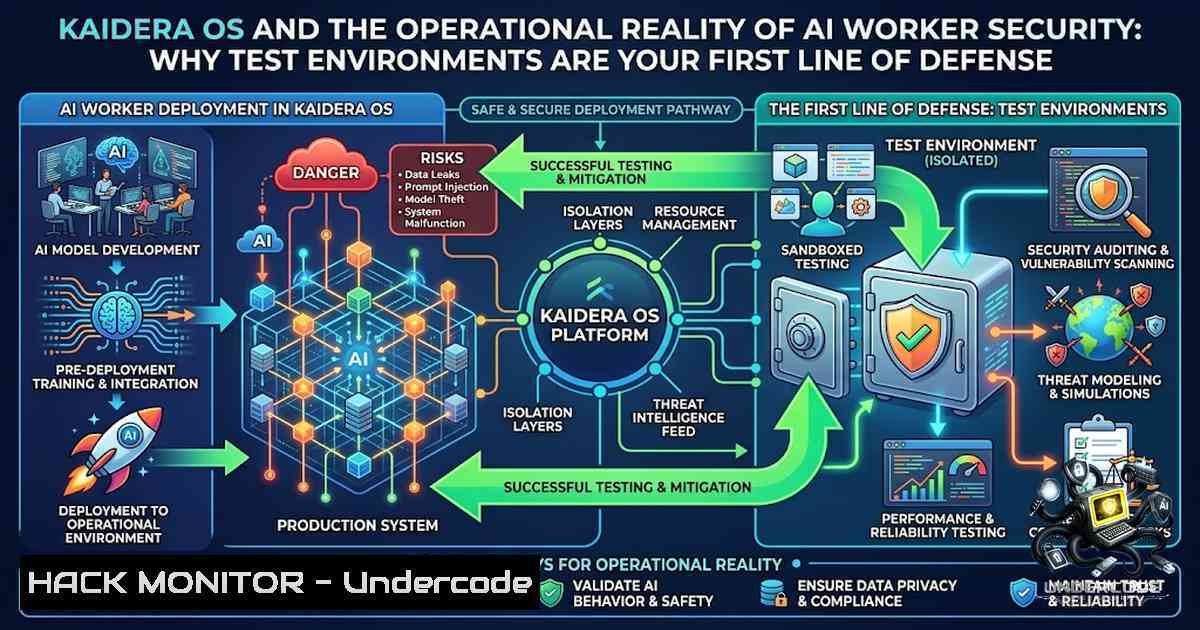
Introduction:
The security of AI agents cannot be evaluated in isolation; the test environment itself is an integral component of the system under review. When third-party cyber evaluations of AI systems are conducted, factors such as internet access, credential handling, and runtime permissions directly dictate the model’s capabilities and the containment of the assessment. This operational reality demands that security operators treat the “starting state” of an AI worker with the same rigor as the worker’s underlying algorithms.
Learning Objectives:
- Understand the critical relationship between AI worker test environments and overall system security posture.
- Learn how to implement a local control plane (Kaidera OS) to inspect and manage AI worker runtimes and permissions.
- Acquire practical commands and procedures for verifying runtime health, managing credentials, and containing AI-driven operations.
You Should Know:
- Establishing the Local Control Plane: Installing and Verifying Kaidera OS
Kaidera OS functions as the local control plane for AI worker teams, enabling operators to inspect the starting state, local health, and project context before any consequential run begins【4†L5】. This principle transforms abstract security concerns into concrete, inspectable artifacts.
Step‑by‑step guide:
- Installation: Download the Kaidera OS package from the official repository. For Linux-based deployments, use `wget` or `curl` to retrieve the installer.
wget https://repository.kaidera.ai/releases/kaidera-os-latest.tar.gz
tar -xzvf kaidera-os-latest.tar.gz
cd kaidera-os
- Start the Local Console: Execute the installation script and launch the console to gain visibility into the runtime environment.
sudo ./install.sh
kaidera-console start
- Confirm Runtime Health: Use the built-in health check command to verify that all services are operational.
kaidera status --health
- Bring a Project Online: Initialize your first project with the operating surface in view, ensuring that all configurations are logged and inspectable.
kaidera project init --1ame "security_eval_01" --runtime "python3.10"
- Windows Alternative: For Windows Server environments, use PowerShell to download and execute the installer.
Invoke-WebRequest -Uri "https://repository.kaidera.ai/releases/kaidera-os-latest.zip" -OutFile "kaidera-os.zip"
Expand-Archive -Path "kaidera-os.zip" -DestinationPath "C:\KaideraOS"
cd C:\KaideraOS
.\install.ps1
.\kaidera-console.exe start
2. Runtime Verification and Project Context Inspection
Before an AI worker begins its task, operators must confirm the project it belongs to and the runtime it will use【4†L9】. This step prevents privilege escalation and ensures that the worker operates within defined boundaries.
Step‑by‑step guide:
- List Active Projects: Use the console to enumerate all active projects and their associated runtimes.
kaidera project list --active
- Inspect Runtime Details: Drill down into a specific project to view environment variables, network policies, and file system mounts.
kaidera project inspect --id project_123 --runtime-details
- Validate Permissions: Check that the worker’s service account has only the necessary privileges.
kaidera auth validate --project project_123
- Set Stop Conditions: Define explicit termination criteria to contain the evaluation.
kaidera policy set --project project_123 --max-execution-time 3600 --max-steps 1000
3. Credential Handling and Secret Management
AI workers often require access to APIs and databases. Hard-coding credentials is a critical failure; instead, use a secrets manager integrated with the control plane.
Step‑by‑step guide:
- Inject Secrets Securely: Use Kaidera’s secrets engine to inject environment variables at runtime.
kaidera secrets add --1ame "API_KEY" --value-from "vault://secret/api-key"
- Rotate Credentials: Implement automated rotation to limit the blast radius of a compromised worker.
kaidera secrets rotate --project project_123 --schedule "0 0 "
- Audit Access: Review logs to detect any unauthorized secret access attempts.
kaidera audit logs --filter "event=secret_access" --since 24h
4. Internet Access Control and Egress Filtering
OpenAI’s evaluations highlight that internet access is a primary vector for model behavior deviation【4†L2】. Restricting egress traffic to known-good endpoints is non-1egotiable.
Step‑by‑step guide:
- Define Egress Policies: Configure a whitelist of allowed external domains.
kaidera network egress allow --domain "api.openai.com" --port 443
kaidera network egress deny --all
- Apply to Project: Bind the policy to the specific evaluation project.
kaidera network apply --project project_123 --policy egress_restrictive
- Monitor Traffic: Use `tcpdump` or `netsh` to capture and inspect outbound connections.
tcpdump -i any -1 "dst port 443" -v
5. Monitoring, Logging, and Stop Conditions
Containment relies on real-time monitoring and predefined stop conditions. The control plane must expose metrics that allow operators to halt a run if it deviates from expected behavior.
Step‑by‑step guide:
- Enable Detailed Logging: Configure the worker to log all actions to a centralized SIEM.
kaidera logging set --level debug --output syslog://siem.internal:514
- Set Resource Limits: Prevent resource exhaustion by capping CPU and memory usage.
kaidera resource limit --project project_123 --cpu 2 --memory 4Gi
- Trigger Automated Stops: Implement a webhook that stops the project if anomaly detection fires.
kaidera policy webhook --event anomaly_detected --action stop --url https://internal.alerting/system
6. Hardening the Underlying Infrastructure
Beyond the AI worker itself, the underlying OS and container runtime must be hardened. Apply CIS benchmarks and regularly patch vulnerabilities.
Step‑by‑step guide:
- Apply CIS Benchmarks: Use `ansible` or `chef` to enforce security configurations.
ansible-playbook cis-hardening.yml --tags "linux"
- Container Security: If using Docker, ensure that the container runs as a non-root user and has a read-only root filesystem.
docker run --read-only --user 1000:1000 --cap-drop ALL my-ai-worker:latest
- Windows Hardening: Use PowerShell to disable unnecessary services and enable Windows Defender Application Control.
Set-Service -1ame "RemoteRegistry" -StartupType Disabled
Set-AppLockerPolicy -Policy "C:\Policies\AppLocker.xml"
What Undercode Say:
- Key Takeaway 1: The test environment is not a neutral backdrop; it is a critical security boundary that shapes AI worker behavior and must be treated as part of the system under review【4†L1】.
- Key Takeaway 2: Operational visibility into the starting state, local health, and project context is essential for proactive risk management before any AI worker executes a consequential task【4†L9】.
Analysis:
The core insight from Kaidera’s message is that AI security is shifting from a purely algorithmic concern to an operational one. The “local control plane” concept acknowledges that AI workers are not autonomous entities but rather processes that execute within a specific runtime, with specific permissions and network access. By making these factors inspectable, operators can move from reactive incident response to proactive risk mitigation. The emphasis on internet access control and credential handling directly addresses the most common vectors for AI-related breaches, such as data exfiltration or unauthorized API calls. Furthermore, the integration of stop conditions and monitoring transforms the evaluation from a one-time event into a continuous, observable process. This operational maturity is what separates a secure AI deployment from a high-risk experiment.
Prediction:
- +1 The adoption of local control planes like Kaidera OS will become a standard requirement in enterprise AI governance frameworks, similar to how SIEMs became mandatory for traditional IT.
- +1 Security teams will increasingly focus on “runtime security” for AI, leading to new certifications and compliance standards specifically for AI worker environments.
- -1 Organizations that fail to implement such controls will face a surge in AI-related security incidents, including data leaks and service disruptions, as the attack surface expands with AI adoption.
- +1 The integration of AI worker security into CI/CD pipelines will drive the development of new DevSecOps tools tailored for machine learning operations (MLOps).
- -1 The complexity of managing these control planes may initially slow down AI deployment, creating friction between security teams and development units until best practices are established.
▶️ Related Video (70% Match):
🎯Let’s Practice For Free:
🎓 Live Courses & Certifications:
Join Undercode Academy for Verified Certifications
🚀 Request a Custom Project:
Secure, high-velocity infrastructure and disruptive technological engineering. Contact our engineering team for high-tier development and proprietary systems:
[email protected]
💎 Smart Architecture | 🛡️ Secure by Design | ⭐ Trusted by Thousands
IT/Security Reporter URL:
Reported By: For Security – Hackers Feeds
Extra Hub: Undercode MoN
Basic Verification: Pass ✅


