Listen to this Post
Introduction:
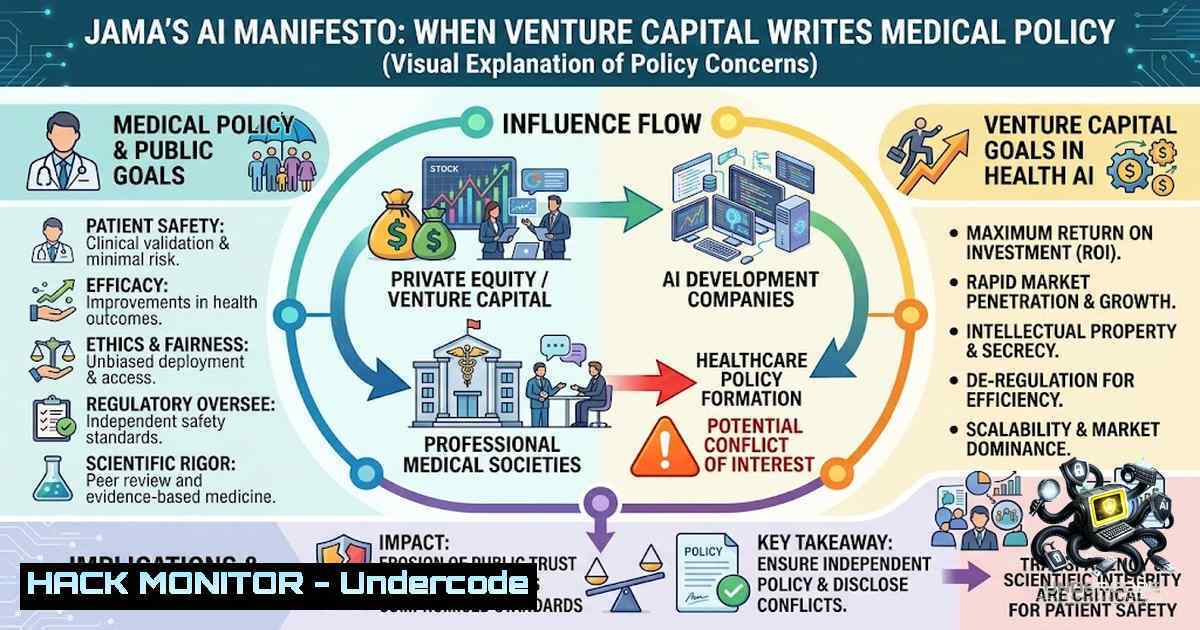
A Perspective published in the Journal of the American Medical Association (JAMA) on August 17, 2026, argues that autonomous AI systems will soon outperform both physicians and physician-AI teams across five fundamental cognitive medical tasks. The authors—oncologist-bioethicist Ezekiel Emanuel, Curai Health CEO Neal Khosla, Khosla Ventures founder Vinod Khosla, and researcher Abe Baker-Butler—contend that keeping humans “in the loop” may actually degrade superior AI performance. However, the father-son financial relationship between Vinod Khosla (investor) and Neal Khosla (CEO) creates an unprecedented conflict of interest: a venture-backed startup CEO co-authoring a policy piece that advocates regulatory pathways directly benefiting his own company, published under the authority of a top-tier medical journal.
Learning Objectives & Secrets:
- Objective 1: Understand the conflict-of-interest architecture in AI medical publishing—identify how venture capital, startup equity, and academic authority converge to shape regulatory policy.
- Objective 2 (Secret Tip): Scrutinize the underlying data—the article relies on synthetic benchmarks and simulated patient interactions (e.g., Google’s AMIE, ChatGPT o3 on 377 complex cases) rather than real-world clinical trials. Always question whether benchmarks translate to clinical reality.
- Objective 3 (Secret Tip): Recognize regulatory capture vectors—the article explicitly argues against mandated “human-in-the-loop” requirements, which would remove a key barrier to autonomous AI deployment and directly accelerate Curai Health’s go-to-market strategy.
You Should Know:
1. The Khosla-Curai Financial Ecosystem: Mapping the Conflict
The JAMA article’s author list reads like a cap table. Vinod Khosla, through Khosla Ventures, provided initial and subsequent funding for Curai Health, which has raised approximately $57 million from investors including Khosla Ventures, General Catalyst, and Morningside Ventures. Neal Khosla, his son, co-founded Curai Health in 2017 and serves as its CEO. Ezekiel Emanuel, a prominent bioethicist and former Obama health policy advisor, lends academic legitimacy. The article argues for regulatory pathways—specifically, opposing human-in-the-loop mandates—that would enable autonomous AI systems to operate without physician oversight. This is not abstract policy; it is the precise business model of Curai Health, an AI-powered virtual clinic that scales more profitably when physicians are removed from the loop.
Step‑by‑Step Guide: Auditing Author Conflicts of Interest
- Identify all authors and their affiliations. Use PubMed or the journal’s conflict-of-interest disclosure section.
- Trace funding sources back to their origin. Search Crunchbase, PitchBook, or SEC filings for investment relationships.
- Map the policy recommendation to the commercial interest. Ask: “If this policy passes, who profits directly?”
- Check for disclosure omissions. Did the authors fully disclose that the father funded the son’s company? If not, flag it.
- Cross-reference with journal policies. JAMA’s 2026 AI policy requires detailed disclosure of AI tool use but may not adequately address financial conflicts of this nature.
-
Synthetic Benchmarks vs. Clinical Reality: The Data Problem
The JAMA article’s central claim—that AI alone outperforms physicians—rests on studies using simulated environments. Google’s AMIE system performed well in simulated patient conversations. ChatGPT o3 named the correct diagnosis first in 60% of 377 complex cases, compared to 15.9% for 20 internists. A Microsoft diagnostic system reportedly achieved correct diagnoses roughly four times more often than physicians. However, these are synthetic benchmarks. Real clinical encounters involve physical exams, patient history nuances, emotional intelligence, and the art of medicine. The authors themselves acknowledge that “more assessments of AI in real-life clinical encounters are essential”—a concession buried beneath bold predictions.
Step‑by‑Step Guide: Evaluating AI Medical Benchmarks
- Identify the benchmark type. Is it simulated (e.g., AMIE), retrospective chart review, or prospective clinical trial?
- Check for real-world validation. Has the system been tested in actual clinical workflows with real patients?
- Examine the comparator. Were physicians given adequate time, access to patient history, and diagnostic tools?
- Look for publication bias. Positive results are more likely to be published; negative or null results often remain in file drawers.
- Assess generalizability. Does the benchmark reflect the diversity of real-world patient populations?
3. Regulatory Capture: The Policy Implications
The article’s policy recommendation—that regulators should not force a “human-in-the-loop” requirement—is the key commercial ask. If adopted, this would allow autonomous AI systems to operate without physician oversight, dramatically reducing labor costs for AI-powered virtual clinics like Curai Health. Current regulatory frameworks, including FDA clearance pathways for autonomous AI systems like IDx-DR (now LumineticsCore) for diabetic retinopathy screening, already exist but are limited to narrow indications. The JAMA article argues for expansion to broad cognitive medical tasks. Meanwhile, the AMA and American College of Physicians maintain that AI “should be limited to a supportive role” and “should not replace physician decision-making”. The AMA’s CEO, John Whyte, countered: “Do you really want to go to the ER and be treated by an LLM if you have chest pain? I don’t think so”.
Step‑by‑Step Guide: Analyzing Regulatory Capture Vectors
- Identify the policy ask. What specific regulatory change would benefit the commercial entity?
- Trace the author-investor relationship. Who stands to gain financially?
- Compare with established medical association positions. The AMA and ACP oppose full AI autonomy.
- Examine the timing. Is the policy push coinciding with a funding round, IPO, or product launch?
- Check for alternative viewpoints. Robert Wachter calls AI-only care medicine’s “economy class”.
4. AI-Induced Deskilling: The Unintended Consequence
The authors warn that physicians face “AI-induced deskilling”—a loss of clinical reasoning ability as they increasingly rely on AI tools. This is a legitimate concern, but it is also a self-serving argument: if physicians are deskilled, autonomous AI becomes the logical alternative. The irony is that the article itself may contribute to this deskilling by normalizing AI replacement narratives. Meanwhile, the AMA’s new framework insists that “physicians have to be in the loop” and that human connection, clinical judgment, and stewardship remain irreplaceable.
Step‑by‑Step Guide: Mitigating AI-Induced Deskilling
- Maintain deliberate practice. Physicians should continue solving cases independently before consulting AI.
- Use AI as a second opinion, not a first responder. Verify AI recommendations against clinical judgment.
- Participate in continuing medical education (CME) that emphasizes diagnostic reasoning, not just AI tool proficiency.
- Advocate for AI transparency. Require explainability and audit trails for AI recommendations.
- Document AI-assisted decisions to track performance and identify over-reliance patterns.
-
The JAMA Publishing Scandal: What This Means for Peer Review
The article’s publication raises profound questions about JAMA’s peer review and conflict-of-interest disclosure standards. The journal’s 2026 AI policy prohibits AI-generated clinical images and restricts AI use in peer review and opinion writing. Yet it apparently failed to adequately flag or reject a paper where the author list itself constitutes a financial ecosystem. The father-son dynamic—a venture investor and his CEO son co-authoring a policy piece—represents a failure of editorial gatekeeping. As Andy Barger noted, this is “ads masquerading as journals.” The broader implication is that top-tier medical journals are vulnerable to regulatory capture by well-funded commercial interests.
Step‑by‑Step Guide: Auditing Journal Integrity
- Read the conflict-of-interest disclosure section carefully. What is disclosed? What is omitted?
- Trace author relationships using public databases (SEC filings, venture capital announcements, company registries).
- Compare the policy recommendation to the commercial interests of the authors and their affiliates.
- Check for editorial comments. Did the journal include an editor’s note addressing the conflict?
- Report concerns to the journal’s ethics committee or to public watchdogs like Retraction Watch.
What Undercode Say:
- Key Takeaway 1: The JAMA article represents a watershed moment in the commercialization of medical publishing—a venture-backed startup CEO co-authoring a policy piece with his father, the investor, to shape regulations that directly benefit their company. This is not science; it is regulatory capture dressed in academic robes.
-
Key Takeaway 2: The reliance on synthetic benchmarks rather than real-world clinical data is a fundamental flaw. Simulated patient conversations and retrospective chart reviews do not equate to the complexity of actual clinical practice. Physicians, patients, and policymakers must demand prospective, real-world trials before accepting claims of AI superiority.
Analysis: The Khosla-Curai-JAMA controversy exposes a systemic vulnerability in medical publishing: the convergence of venture capital, startup equity, and academic authority. When a father funds his son’s company, and both co-author a policy piece in a top-tier journal advocating deregulation that benefits that company, the integrity of the scientific record is compromised. This is not an isolated incident; it is a pattern that will intensify as AI startups seek regulatory validation. The medical community must respond with stricter conflict-of-interest disclosure requirements, independent replication of AI benchmarks, and a commitment to keeping humans—not algorithms—at the center of clinical decision-making. The AMA’s framework, which insists that physicians remain in the loop, offers a counterweight, but it will face relentless pressure from well-capitalized AI ventures seeking to remove that loop entirely.
Prediction:
- +1 Increased scrutiny of conflict-of-interest disclosures in medical journals will lead to stricter editorial policies within 12–18 months, including mandatory disclosure of all venture capital relationships and family ties among authors.
-
-1 The JAMA article will accelerate regulatory lobbying by AI health startups, potentially leading to partial deregulation of autonomous AI in narrow clinical workflows (e.g., prescription renewals, chronic disease management) before adequate safety data is available.
-
-1 Physician trust in JAMA and other top-tier journals may erode as readers become aware of commercial capture, reducing the perceived authority of peer-reviewed medical literature.
-
+1 The controversy will spur the development of independent, publicly funded AI medical evaluation platforms that are free from venture capital influence, similar to the Cochrane Collaboration model.
-
-1 AI-induced deskilling may become a self-fulfilling prophecy: as physicians are pressured to rely on AI tools, their clinical reasoning skills may indeed atrophy, making autonomous AI appear more competent by comparison—a classic case of regulatory feedback loops benefiting incumbent commercial interests.
▶️ Related Video (90% Match):
https://www.youtube.com/watch?v=0cQ1vYzD3e0
🎯Let’s Practice For Free:
🎓 Live Courses & Certifications:
Join Undercode Academy for Verified Certifications
🚀 Request a Custom Project:
Secure, high-velocity infrastructure and disruptive technological engineering. Contact our engineering team for high-tier development and proprietary systems:
[email protected]
💎 Smart Architecture | 🛡️ Secure by Design | ⭐ Trusted by Thousands
IT/Security Reporter URL:
Reported By: https://lnkd.in/p/ei9pfmUe – Hackers Feeds
Extra Hub: Undercode MoN
Basic Verification: Pass ✅


