
Listen to this Post
Introduction:
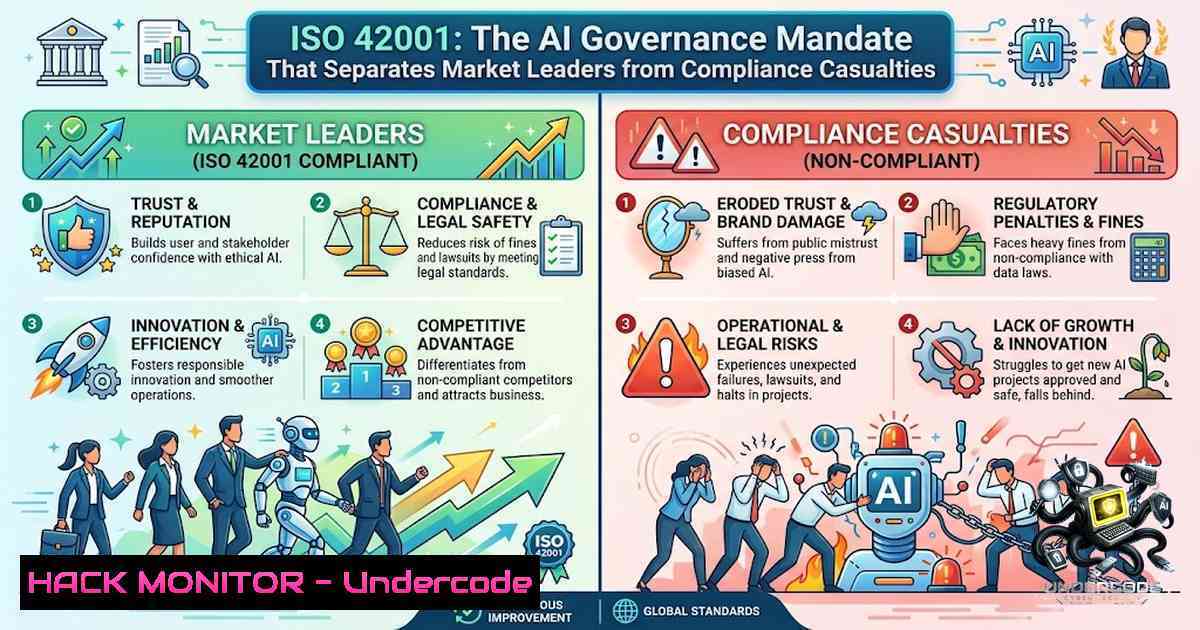
As organizations race to embed Generative AI and autonomous agents into their core business processes, a dangerous gap has emerged: AI capabilities are scaling exponentially, but governance frameworks remain stuck in the era of traditional IT security. ISO/IEC 42001:2023—the world’s first international standard for Artificial Intelligence Management Systems (AIMS)—shifts the conversation from “can we build it?” to “can we govern it responsibly?”. Unlike conventional security standards such as ISO 27001, which focus on information security broadly, ISO 42001 is purpose-built for the AI lifecycle, addressing everything from algorithmic bias and data provenance to human oversight and continuous performance monitoring. The standard doesn’t just protect models—it governs the entire ecosystem of AI development, deployment, and retirement.
Learning Objectives:
- Understand the structural requirements of ISO/IEC 42001:2023 and how they differ from traditional security frameworks
- Master the step-by-step process for establishing, implementing, and certifying an AI Management System (AIMS)
- Acquire practical command-line and configuration techniques for auditing AI systems, securing model endpoints, and enforcing governance controls across Linux and Windows environments
- Establishing the AI Governance Foundation: Scoping and Leadership Commitment
The journey to ISO 42001 compliance begins not with technology, but with organizational clarity. Clause 4 of the standard mandates that organizations define the scope of their AIMS by identifying internal and external factors that influence AI governance, including regulatory obligations, stakeholder expectations, and the specific AI systems in use. This scope definition is critical—it determines which business units, products, and AI applications fall under the management system and which remain out of scope.
Simultaneously, Clause 5 requires top-level leadership to establish an AI policy, assign accountability for AI-related decision-making, and integrate AI governance into the overall business strategy. Without executive sponsorship, AI risk management efforts become fragmented and easily deprioritized. Organizations must form cross-functional teams—comprising data scientists, compliance officers, legal counsel, and security engineers—to oversee AI initiatives.
Step‑by‑Step Guide to Scoping and Leadership Setup:
- Inventory All AI Systems: Conduct a comprehensive audit of every AI model, API, and autonomous agent in use. Document the purpose, data sources, and decision-making authority of each system.
-
Define AIMS Boundaries: Draft a formal scope statement that explicitly lists which AI systems, business functions, and geographic locations are included. Specify exclusions to avoid scope creep.
-
Secure Leadership Buy-In: Present a business case to executives, emphasizing that ISO 42001 certification builds customer trust, reduces regulatory risk, and creates competitive advantage. Obtain formal sign-off on the AI policy and governance structure.
-
Establish an AI Governance Committee: Appoint an AI Steering Group with representatives from engineering, legal, compliance, and business units. Define clear roles: AI Risk Owner, Data Protection Officer liaison, Model Validation Lead, and Audit Coordinator.
-
Document the Governance Framework: Create a living document that outlines escalation paths, decision rights, and communication protocols for AI-related incidents.
2. Conducting the Gap Assessment and Risk Baseline
With scope and leadership in place, the next phase is a systematic gap analysis. This involves comparing existing governance practices—including controls from ISO 27001, NIST AI RMF, and GDPR compliance measures—against the requirements of ISO 42001. Many organizations already have partial controls in place; the gap assessment identifies what is missing or deficient.
Clause 6 of the standard requires organizations to establish processes for identifying and addressing AI-specific risks such as security vulnerabilities, algorithmic bias, data poisoning, and model drift. A key requirement is 6.1.3, which mandates that organizations “determine all controls that are necessary to implement the AI risk treatment options chosen and compare the controls with those in Annex A to verify that no necessary controls have been omitted”.
Step‑by‑Step Guide to Gap Assessment and Risk Baseline:
- Map Existing Controls: Create a matrix mapping your current security and privacy controls (e.g., ISO 27001 Annex A, NIST SP 800-53) to ISO 42001 clauses 4–10 and Annex A controls.
-
Identify AI-Specific Risks: Conduct a risk assessment focused on AI-unique threats:
– Data Poisoning: Adversarial manipulation of training data
– Model Inversion: Extraction of training data through API queries
– Bias and Fairness: Disparate impact across demographic groups
– Model Drift: Performance degradation over time due to data distribution shifts
- Classify Gaps by Severity: Categorize each gap as Critical, High, Medium, or Low based on potential business impact and likelihood of exploitation.
-
Produce a Gap Analysis Report: Document findings with recommended remediation actions, estimated effort, and target completion dates.
-
Validate Against Annex A Controls: Cross-reference your risk treatment plan with the normative controls in Annex A to ensure no required controls are omitted.
Linux Command for AI System Inventory and Risk Scanning:
 Scan for exposed AI model endpoints and API services
nmap -sV -p 8000-9000 --open <target-ip-range> | grep -E "open|http"

Audit Python dependencies for known AI/ML vulnerabilities
pip-audit --requirement requirements.txt --format json > ai_dependency_audit.json

Check for exposed model files and training data in S3 buckets (AWS CLI)
aws s3 ls s3://<bucket-1ame> --recursive | grep -E ".(pkl|h5|pt|onnx|json)$"

Log all AI-related network connections for baseline
sudo tcpdump -i any -w ai_traffic_baseline.pcap -s 0 port 443 or port 8000 or port 5000
Windows PowerShell Command for AI Asset Discovery:
 Find all Python, R, and Julia scripts that import ML libraries
Get-ChildItem -Path C:\ -Recurse -Include .py,.r,.jl -ErrorAction SilentlyContinue |
Select-String -Pattern "import (tensorflow|torch|sklearn|keras|pandas|numpy)" |
Select-Object Filename, Line

Check for running AI model servers
Get-Process | Where-Object { $_.ProcessName -match "python|jupyter|tensorflow|torch" }

Audit Windows scheduled tasks for AI model retraining jobs
Get-ScheduledTask | Where-Object { $_.TaskName -match "train|model|ai|ml" }
- Designing and Implementing the AI Management System (AIMS)
Once gaps are identified, the organization must design an AIMS that addresses all applicable ISO 42001 requirements. This involves developing policies, defining roles and responsibilities, and mapping ISO 42001 requirements to internal controls and procedures. Clause 7 addresses the resources, training, and documentation necessary to maintain an effective AIMS, ensuring personnel have the necessary competencies in AI ethics and risk management.
Annex A of ISO 42001 provides a comprehensive list of controls covering policies, internal organization, resource documentation, AI system lifecycle management, data management, third-party relationships, and responsible AI use. These controls emphasize accountability, AI expertise, data integrity, fairness, maintainability, privacy, robustness, safety, security, transparency, and explainability.
Step‑by‑Step Guide to AIMS Design and Implementation:
1. Develop Core AI Policies: Draft policies covering:
- Acceptable use of AI systems
- Data governance and privacy
- Model development and validation standards
- Incident response and escalation
- Third-party AI service provider management
- Define Competency Frameworks: Establish required skills and training for each role involved in AI governance. Document training records and certification achievements.
-
Implement Technical Controls: Deploy security measures specific to AI systems:
– API rate limiting and authentication (OAuth2, API keys)
– Input validation and sanitization to prevent prompt injection
– Output filtering and content moderation
– Encryption for data at rest and in transit
– Model versioning and rollback capabilities
- Establish Monitoring and Logging: Configure comprehensive logging for all AI system interactions, including:
– Inference requests and responses
– Training data access and modifications
– Model updates and retraining events
– Anomaly detection alerts
- Create an AI Incident Response Plan: Develop playbooks for scenarios such as model compromise, data leakage, biased outputs, and regulatory inquiries.
Linux Command for Securing AI Model Endpoints (Nginx Reverse Proxy Configuration):
 /etc/nginx/sites-available/ai-gateway
server {
listen 443 ssl;
server_name ai-gateway.company.com;

Rate limiting to prevent API abuse
limit_req_zone $binary_remote_addr zone=ai_api:10m rate=10r/s;
limit_req zone=ai_api burst=20 nodelay;

Input validation - block malicious payloads
if ($request_body ~ "(<script|DROP TABLE|--|; SELECT)") {
return 403;
}

location /v1/models/ {
proxy_pass http://localhost:8000;
proxy_set_header Host $host;
proxy_set_header X-Real-IP $remote_addr;

Log all inference requests
access_log /var/log/nginx/ai_inference.log custom_json;
}
}
Windows Command for AI Model Registry Security (Azure ML CLI):
 List all registered models in Azure ML workspace
az ml model list --workspace-1ame <workspace> --resource-group <rg> --output table

Assign role-based access control to model registry
az role assignment create --assignee <user-or-spn> `
--role "Contributor" `
--scope /subscriptions/<sub>/resourceGroups/<rg>/providers/Microsoft.MachineLearningServices/workspaces/<ws>/models

Enable diagnostic logging for model registry
az monitor diagnostic-settings create `
--resource /subscriptions/<sub>/resourceGroups/<rg>/providers/Microsoft.MachineLearningServices/workspaces/<ws> `
--1ame "ai-audit-logs" `
--logs '[{"category": "AuditEvent","enabled": true}]' `
--workspace <log-analytics-workspace-id>
4. Operationalizing Continuous Monitoring and Performance Evaluation
Clause 8 of ISO 42001 covers the operational aspects of the AIMS, including performance evaluation, monitoring, and measurement. Organizations must establish metrics to track AI system performance, security posture, and compliance adherence. This includes regular internal audits, management reviews, and documentation of AI incidents and corrective actions.
Clause 9 addresses performance evaluation, requiring organizations to monitor whether AI systems are meeting their intended objectives and to identify areas for improvement. Clause 10 mandates continual improvement, ensuring that the AIMS evolves alongside the AI solutions it governs.
Step‑by‑Step Guide to Continuous Monitoring and Performance Evaluation:
- Define Key Performance Indicators (KPIs): Establish metrics for:
– Model accuracy, precision, recall, and F1-score
– Inference latency and throughput
– False positive/negative rates
– Data drift and concept drift detection
– Security incident frequency and resolution time
- Implement Automated Monitoring Dashboards: Deploy visualization tools (e.g., Grafana, Kibana, Power BI) to track KPIs in real-time and alert on anomalies.
-
Schedule Regular Audits: Conduct internal audits at defined intervals (e.g., quarterly) to verify compliance with ISO 42001 requirements. Document findings and corrective actions.
-
Perform Management Reviews: Hold periodic reviews with executive leadership to assess AIMS performance, review risk treatment plans, and approve resource allocation for improvements.
-
Establish a Continuous Improvement Loop: Implement a feedback mechanism where audit findings, incident reports, and performance data inform policy updates and control enhancements.
Linux Command for Model Performance Monitoring (Prometheus + Grafana):
 Expose model metrics via Prometheus client (Python example)
cat > model_metrics_exporter.py << 'EOF'
from prometheus_client import start_http_server, Counter, Histogram
import random
import time

Define metrics
INFERENCE_COUNT = Counter('ai_inference_total', 'Total inference requests')
INFERENCE_LATENCY = Histogram('ai_inference_latency_seconds', 'Inference latency')
ERROR_COUNT = Counter('ai_inference_errors_total', 'Total inference errors')

if <strong>name</strong> == '<strong>main</strong>':
start_http_server(8000)
while True:
INFERENCE_COUNT.inc()
with INFERENCE_LATENCY.time():
time.sleep(random.uniform(0.1, 0.5))
if random.random() < 0.05:
ERROR_COUNT.inc()
time.sleep(1)
EOF

Run the metrics exporter
python3 model_metrics_exporter.py &

Query Prometheus for model performance metrics
curl 'http://localhost:9090/api/v1/query?query=ai_inference_latency_seconds'
Windows PowerShell for AI Audit Log Collection:
 Collect Windows Event Logs related to AI system access
Get-WinEvent -LogName Security -MaxEvents 100 |
Where-Object { $_.Message -match "AI|model|inference|training" } |
Export-Csv -Path "C:\Logs\ai_security_audit.csv" -1oTypeInformation

Monitor file integrity for model artifacts
$watchFolder = "C:\Models"
$watcher = New-Object System.IO.FileSystemWatcher
$watcher.Path = $watchFolder
$watcher.Filter = ".pkl"
$watcher.EnableRaisingEvents = $true
$watcher.IncludeSubdirectories = $true

Register-ObjectEvent $watcher "Changed" -Action {
$path = $Event.SourceEventArgs.FullPath
$changeType = $Event.SourceEventArgs.ChangeType
$timestamp = Get-Date -Format "yyyy-MM-dd HH:mm:ss"
"$timestamp - $changeType - $path" | Out-File -Append "C:\Logs\model_integrity.log"
}
5. Third-Party Risk Management and Supply Chain Security
Many organizations rely on third-party AI models, APIs, and data providers. ISO 42001 explicitly addresses third-party and customer relationships, requiring organizations to ensure the reliability and compliance of external systems. This is particularly critical given the rise of supply chain attacks targeting AI models and the opaque nature of many commercial AI services.
Organizations must assess third-party AI providers for security posture, data handling practices, compliance certifications, and incident response capabilities. Contracts should include provisions for audits, data protection, and liability in the event of AI-related failures.
Step‑by‑Step Guide to Third-Party AI Risk Management:
- Create an Inventory of Third-Party AI Services: Document all external AI providers, including the purpose of each service, data shared, and contractual terms.
-
Conduct Third-Party Risk Assessments: Evaluate each provider against ISO 42001 requirements, including:
– Security certifications (e.g., ISO 27001, SOC 2)
– Data privacy compliance (GDPR, CCPA, HIPAA)
– Model transparency and explainability documentation
– Incident response and breach notification procedures
- Implement API Security Controls: For third-party AI APIs, enforce:
– Mutual TLS (mTLS) for authentication
– Short-lived access tokens
– Request/response logging for audit purposes
– Rate limiting and anomaly detection
- Establish Data Processing Agreements: Ensure contracts specify data ownership, usage limitations, retention policies, and deletion obligations.
-
Monitor Third-Party Performance: Regularly review provider SLAs, performance metrics, and security incident reports.
Linux Command for Third-Party API Security Scanning:
 Test for API key exposure in code repositories
grep -r "api_key|apikey|secret|token" --include=".py" --include=".js" --include=".env" .

Scan third-party Python packages for known vulnerabilities
safety check -r requirements.txt --json > third_party_vulns.json

Test API endpoints for common vulnerabilities (using OWASP ZAP)
zap-cli quick-scan --self-contained --start-options '-config api.disablekey=true' \
-t https://third-party-ai-api.com/v1/predict -o api_scan_report.xml

Monitor third-party API latency and availability
while true; do
curl -o /dev/null -s -w "%{http_code} %{time_total}\n" \
https://third-party-ai-api.com/health >> third_party_health.log
sleep 60
done
Windows PowerShell for Third-Party Vendor Compliance Verification:
 Check SSL/TLS configuration of third-party AI endpoints
Invoke-WebRequest -Uri "https://third-party-ai-api.com" -UseBasicParsing |
Select-Object -Property StatusCode, Headers

Verify certificate chain and expiration
$cert = (Invoke-WebRequest -Uri "https://third-party-ai-api.com" -UseBasicParsing).BaseResponse
$cert.ServicePoint.Certificate | Format-List Subject, Issuer, NotAfter, SerialNumber

Test for exposed sensitive data in third-party responses
$response = Invoke-RestMethod -Uri "https://third-party-ai-api.com/v1/predict" -Method Post -Body '{"input":"test"}'
if ($response -match "password|secret|token|key") {
Write-Warning "Sensitive data detected in API response"
}
6. Human Oversight and Explainability
One of the most critical differentiators of ISO 42001 is its emphasis on human oversight. The standard requires organizations to define when human input is required, particularly for high-risk decisions. This includes designing “human-in-the-loop” or “human-on-the-loop” systems where automated decisions are reviewed by qualified personnel.
Explainability is equally paramount. Organizations must document how AI systems make decisions, what data influences those decisions, and how outputs can be interpreted by non-technical stakeholders. This is essential not only for regulatory compliance but also for building trust with customers, partners, and regulators.
Step‑by‑Step Guide to Implementing Human Oversight and Explainability:
- Classify AI Systems by Risk Level: Categorize each AI system as High, Medium, or Low risk based on the potential impact of incorrect decisions. High-risk systems require mandatory human review.
-
Design Human Review Workflows: For high-risk decisions, implement a review process where:
– AI generates a recommendation with confidence scores
– A human reviewer evaluates the recommendation
– The reviewer can override, accept, or escalate the decision
– All review actions are logged for audit
3. Implement Explainability Tools: Deploy techniques such as:
- SHAP (SHapley Additive exPlanations) for feature importance
- LIME (Local Interpretable Model-agnostic Explanations) for local explanations
- Attention visualization for transformer models
- Counterfactual explanations for what-if scenarios
- Create Documentation for Non-Technical Audiences: Develop plain-language explanations of how each AI system works, what data it uses, and how decisions are made.
-
Establish an Appeals Process: Define a mechanism for stakeholders to challenge AI-generated decisions and request human re-evaluation.
Python Code for Model Explainability with SHAP:
import shap
import numpy as np
import pandas as pd
from sklearn.ensemble import RandomForestClassifier

Load pre-trained model and data
model = RandomForestClassifier()
X_train = pd.read_csv('training_data.csv')
X_test = pd.read_csv('test_data.csv')

Create SHAP explainer
explainer = shap.TreeExplainer(model)
shap_values = explainer.shap_values(X_test)

Generate summary plot for feature importance
shap.summary_plot(shap_values, X_test, plot_type="bar")

Generate force plot for individual prediction
shap.initjs()
shap.force_plot(explainer.expected_value[bash], shap_values[bash][0,:], X_test.iloc[0,:])

Save explanation as HTML for audit trail
shap.save_html('model_explanation.html',
shap.force_plot(explainer.expected_value[bash],
shap_values[bash][0,:],
X_test.iloc[0,:]))
Linux Command for Logging Human Review Actions:
 Configure auditd to log all human overrides of AI decisions
cat > /etc/audit/rules.d/ai_override.rules << 'EOF'
 Log file accesses to override logs
-w /var/log/ai/override.log -p wa -k ai_override
 Log execution of review dashboard
-w /usr/local/bin/review_dashboard -p x -k ai_review
 Monitor sudo usage for AI system commands
-w /usr/bin/sudo -p x -k ai_sudo
EOF

Reload audit rules
auditctl -R /etc/audit/rules.d/ai_override.rules

Query audit logs for human review events
ausearch -k ai_override --format text > human_review_audit.txt
7. Preparing for ISO 42001 Certification Audit
The final phase is the certification audit, conducted by an independent third-party conformity assessment body. The audit verifies that the organization’s AIMS meets the requirements of ISO/IEC 42001:2023. The certification process typically takes 6–12 months, depending on the maturity and complexity of the AI systems.
Auditors will evaluate documentation, interview personnel, observe processes, and test controls across all clauses (4–10) and Annex A controls. Organizations must demonstrate not only that policies exist but that they are effectively implemented, monitored, and continuously improved.
Step‑by‑Step Guide to Audit Preparation:
- Conduct Internal Mock Audits: Perform pre-assessment audits using internal or external resources to identify and remediate issues before the formal audit.
-
Compile Evidence Packages: For each clause and control, assemble documentation including:
– Policies and procedures
– Risk assessments and treatment plans
– Training records
– Incident logs and corrective actions
– Performance monitoring data
– Management review minutes
- Train Personnel for Interviews: Ensure all staff involved in AI governance understand their roles, the AIMS framework, and can articulate how they contribute to compliance.
-
Review and Update Documentation: Verify that all documents are current, version-controlled, and accessible to auditors.
-
Schedule the Formal Audit: Engage an accredited certification body and schedule the Stage 1 (documentation review) and Stage 2 (on-site verification) audits.
Linux Command for Audit Evidence Collection:
 Generate a comprehensive audit evidence report
echo "=== ISO 42001 Audit Evidence Collection ===" > audit_evidence.txt
echo "Date: $(date)" >> audit_evidence.txt
echo "" >> audit_evidence.txt

Collect policy documents
echo " AI Policies " >> audit_evidence.txt
find /docs/ai-policies -1ame ".pdf" -o -1ame ".docx" >> audit_evidence.txt

Collect risk assessment records
echo " Risk Assessments " >> audit_evidence.txt
find /docs/risk-assessments -1ame ".json" -o -1ame ".xlsx" >> audit_evidence.txt

Collect training records
echo " Training Records " >> audit_evidence.txt
find /hr/training -1ame ".csv" -o -1ame ".log" >> audit_evidence.txt

Collect incident logs
echo " Incident Logs " >> audit_evidence.txt
find /var/log/ai -1ame ".log" -mtime -90 >> audit_evidence.txt

Generate checksums for evidence integrity
sha256sum /docs/ai-policies/.pdf > audit_evidence_checksums.txt
Windows PowerShell for Audit Evidence Compilation:
 Create audit evidence folder structure
$evidenceRoot = "C:\AuditEvidence"
New-Item -ItemType Directory -Path $evidenceRoot -Force
@("Policies", "RiskAssessments", "Training", "Incidents", "Reviews") | ForEach-Object {
New-Item -ItemType Directory -Path "$evidenceRoot\$_" -Force
}

Copy policy documents
Copy-Item -Path "\fileserver\docs\AI\Policies\" -Destination "$evidenceRoot\Policies\" -Recurse

Export risk register to CSV
$riskRegister = Get-Content "\fileserver\docs\AI\risk_register.json" | ConvertFrom-Json
$riskRegister | Export-Csv -Path "$evidenceRoot\RiskAssessments\risk_register.csv" -1oTypeInformation

Export training completion records
Get-ADUser -Filter  -Properties ExtensionAttribute1 |
Where-Object { $_.ExtensionAttribute1 -match "AI" } |
Select-Object Name, ExtensionAttribute1, LastLogonDate |
Export-Csv -Path "$evidenceRoot\Training\ai_training_records.csv" -1oTypeInformation

Compress evidence for auditor delivery
Compress-Archive -Path "$evidenceRoot\" -DestinationPath "$env:USERPROFILE\Desktop\ISO42001_Audit_Evidence.zip"
What Undercode Say:
- Governance is the New Competitive Moat: Organizations that treat AI governance as a strategic imperative—not a compliance checkbox—will build lasting trust with customers, regulators, and partners. The smartest model is worthless if no one trusts its outputs.
-
ISO 42001 Provides a Structured, Repeatable Framework: Unlike ad hoc best practices, ISO 42001 transforms AI governance into a management system with defined processes, accountability, and continuous improvement. It bridges the gap between rapid AI innovation and responsible oversight.
-
Human Oversight is Non-1egotiable: The standard’s emphasis on human-in-the-loop design reflects a fundamental truth: AI systems are tools, not decision-makers. Organizations must maintain human accountability for high-risk AI decisions.
-
Integration with Existing Frameworks Reduces Friction: Organizations already certified under ISO 27001 or ISO 27701 will find significant overlap with ISO 42001, making integration more efficient. Mapping controls across frameworks reduces redundancy and audit fatigue.
-
Certification is a Journey, Not a Destination: The audit is a milestone, but the real value lies in the continuous improvement cycle—regularly reassessing risks, updating controls, and adapting to evolving AI capabilities and regulatory landscapes.
-
Third-Party Risk is Often the Weakest Link: Many organizations outsource AI capabilities without adequately vetting providers. ISO 42001’s third-party requirements force organizations to extend governance across the entire AI supply chain.
-
Explainability Builds Internal and External Trust: Documenting how AI systems make decisions is not just a regulatory requirement—it empowers internal teams to debug issues and gives customers confidence in automated outcomes.
-
Leadership Commitment Drives Success: Without executive sponsorship, AI governance efforts lack authority and resources. Clause 5’s leadership requirements ensure that AI accountability starts at the top.
-
The EU AI Act and ISO 42001 are Converging: As regulators worldwide introduce AI-specific legislation, ISO 42001 provides a ready-made framework for demonstrating compliance. Organizations that adopt the standard now will be ahead of the regulatory curve.
-
Technology Creates Capability; Governance Creates Confidence: This core insight from the original post captures the essence of ISO 42001. The standard doesn’t constrain innovation—it enables sustainable, trustworthy AI adoption at scale.
Prediction:
-
+1 ISO 42001 will become the de facto global benchmark for AI governance within 3–5 years, similar to how ISO 27001 became the gold standard for information security. Early adopters will gain a significant competitive advantage in regulated industries such as healthcare, finance, and government contracting.
-
+1 The standard will accelerate convergence between AI governance frameworks—including NIST AI RMF, EU AI Act, and national AI strategies—creating a harmonized global compliance landscape that reduces friction for multinational organizations.
-
-1 Organizations that delay ISO 42001 adoption face escalating regulatory risk, particularly as the EU AI Act and similar legislation impose mandatory requirements for high-risk AI systems. Non-compliance could result in fines, reputational damage, and loss of market access.
-
+1 The certification process will drive demand for new roles—AI Governance Officers, Model Risk Managers, and AIMS Auditors—creating a specialized job market and professional development pathways within the cybersecurity and compliance sectors.
-
-1 Small and medium-sized enterprises (SMEs) may struggle with the resource requirements of ISO 42001 certification, potentially widening the AI governance gap between large enterprises and smaller competitors. However, the standard is designed to be scalable and adaptable to organizations of all sizes.
-
+1 Integration of ISO 42001 with existing ISO standards (27001, 27701, 9001) will streamline multi-framework compliance, reducing audit costs and operational overhead for organizations already invested in ISO management systems.
-
-1 The rapid evolution of AI technology—particularly generative AI and autonomous agents—will outpace the standard’s current controls, requiring frequent updates and supplementary guidance (e.g., ISO/IEC 42003) to address emerging risks.
-
+1 Organizations that achieve ISO 42001 certification will see improved customer trust, stronger partner relationships, and enhanced resilience against AI-related incidents—transforming governance from a cost center into a value driver.
▶️ Related Video (82% Match):
https://www.youtube.com/watch?v=1dOCQ03lLLk
🎯Let’s Practice For Free:
🎓 Live Courses & Certifications:
Join Undercode Academy for Verified Certifications
🚀 Request a Custom Project:
Secure, high-velocity infrastructure and disruptive technological engineering. Contact our engineering team for high-tier development and proprietary systems:
[email protected]
💎 Smart Architecture | 🛡️ Secure by Design | ⭐ Trusted by Thousands
IT/Security Reporter URL:
Reported By: Yildizokan Ai – Hackers Feeds
Extra Hub: Undercode MoN
Basic Verification: Pass ✅


