Listen to this Post
Introduction:
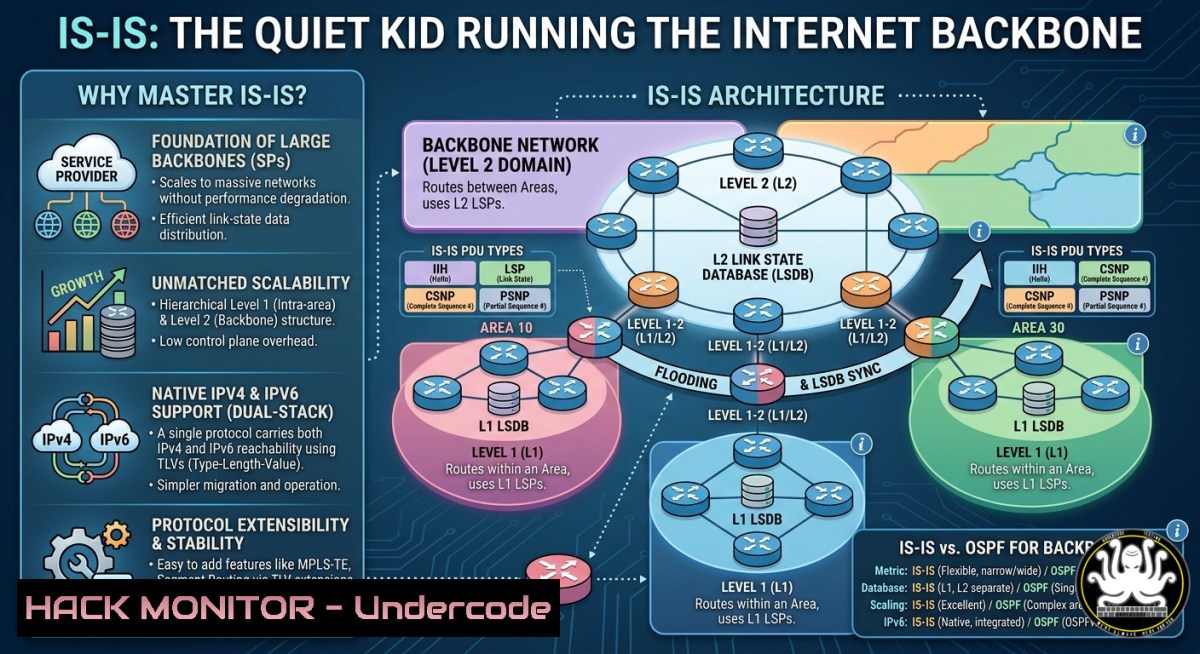
In the chaotic world of dynamic routing, MPLS carries the weight of the entire network, BGP suffers routing table breakdowns, and OSPF wonders where Area 0 went wrong. Meanwhile, IS-IS (Intermediate System to Intermediate System) quietly runs the global internet backbone, offering scalability, convergence speed, and inherent security advantages that OSPF lacks. For cybersecurity and IT engineers, mastering IS-IS is no longer optional—it’s a critical skill for hardening large-scale networks against route leaks, spoofing attacks, and misconfigurations that threat actors exploit.
Learning Objectives:
- Understand the architectural differences between OSPF and IS-IS, and why IS-IS is preferred for Tier-1 ISP and data center backbones.
- Implement basic IS-IS configuration on Cisco IOS/IOS-XE and Linux (FRRouting) with route authentication and filtering.
- Identify common IS-IS attack vectors (e.g., LSP injection, purge storms) and apply mitigation commands across Linux and Windows management planes.
You Should Know:
- Why IS-IS Outperforms OSPF in Carrier-Grade Networks – And How to Configure It
Most network engineers start with “OSPF is enough,” but IS-IS eliminates the area 0 restriction, supports more routers per area, and natively handles CLNS while carrying IPv4/IPv6. From a security perspective, IS-IS’s use of TLVs and lack of IP-based neighbors (it uses MAC addresses on LAN interfaces) reduces certain IP spoofing risks. Below is a step-by-step guide to enabling basic IS-IS with authentication on a Cisco router.
Step‑by‑step: Basic IS‑IS configuration with MD5 authentication
! Enable IS-IS routing process
router isis 1
net 49.0001.1921.6800.1001.00 ! NET address: area (49.0001) + system ID (1921.6800.1001)
is-type level-2-only ! Level‑2 for backbone, avoids Level‑1 complexity
authentication mode md5
authentication key-chain ISIS_KEY
exit

! Configure key chain for authentication
key chain ISIS_KEY
key 1
key-string MySecretPass123
cryptographic-algorithm hmac-md5
exit

! Apply IS-IS to interface (example: Gig0/0)
interface GigabitEthernet0/0
ip router isis 1
isis circuit-type level-2-only
isis authentication mode md5
isis authentication key-chain ISIS_KEY
no shutdown
Linux (FRRouting) equivalent:
 Install FRRouting
sudo apt update && sudo apt install frr frr-doc -y

Enable isisd daemon
sudo sed -i 's/isisd=no/isisd=yes/' /etc/frr/daemons

Restart FRR
sudo systemctl restart frr

Enter vtysh configuration
sudo vtysh
configure terminal
router isis 1
net 49.0001.1921.6800.1001.00
is-type level-2-only
authentication mode md5
authentication key-chain ISIS_KEY
exit
interface eth0
ip router isis 1
isis circuit-type level-2-only
isis authentication mode md5
isis authentication key-chain ISIS_KEY
exit
What this does: Establishes a Level‑2 IS-IS adjacency with neighbor routers, preventing unauthenticated routers from injecting false Link State PDUs (LSPs). This mitigates LSP spoofing attacks.
- Hardening BGP Against Routing Table Explosions and Route Leaks
BGP’s “full mental breakdown” over routing tables can become a security incident when a single misconfigured BGP session leaks internal routes to the global table. Using prefix‑lists, AS‑path filters, and maximum‑prefix limits is mandatory.
Step‑by‑step: BGP security controls on Cisco & Windows (via PowerShell for management)
Cisco BGP inbound filter example:
ip prefix-list ALLOWED_PREFIXES seq 5 permit 10.0.0.0/8 le 24
ip prefix-list ALLOWED_PREFIXES seq 10 deny 0.0.0.0/0 le 32

route-map BGP_IN_FILTER permit 10
match ip address prefix-list ALLOWED_PREFIXES
set community no-export

router bgp 65001
neighbor 192.168.1.1 route-map BGP_IN_FILTER in
neighbor 192.168.1.1 maximum-prefix 1000 85 restart 30
Windows – Monitor BGP sessions remotely via PowerShell (e.g., to a BGP‑speaking router):
 Query BGP neighbor state via SNMP (requires SNMP enabled on router)
Get-SnmpData -IpAddress "192.168.1.1" -Community "public" -Oid ".1.3.6.1.2.1.15.3.1.14"

Alternative: Use SSH to run 'show bgp summary' on Cisco router
$cred = Get-Credential
$session = New-SSHSession -ComputerName "192.168.1.1" -Credential $cred
Invoke-SSHCommand -SessionId $session.SessionId -Command "show bgp summary | include 65001"
Remove-SSHSession -SessionId $session.SessionId
Why this matters: Maximum‑prefix prevents route table overflow DoS attacks; prefix lists block route leaks that could cause traffic hijacking.
3. MPLS Security: Label Spoofing and Traffic Isolation
MPLS carries the entire network on its back, but misconfigured LDP or missing label filtering can allow attackers to inject labels and bypass firewalls. Use LDP authentication and filter label bindings.
Step‑by‑step: LDP MD5 authentication and label acceptance policy
! LDP authentication
mpls ldp neighbor 10.1.1.1 password MplsLdpPass

! Label filtering – only accept labels for specific prefixes
mpls ldp label
accept from 10.1.1.1 for 192.168.0.0/16

! Verify LDP security
show mpls ldp neighbor detail | include MD5
Linux (using FRR’s LDPd):
 /etc/frr/ldpd.conf
mpls ldp
address-family ipv4
discovery transport-address 10.1.1.2
neighbor 10.1.1.1 password MplsLdpPass
label accept from 10.1.1.1 192.168.0.0/16
exit-address-family
Verification commands:
sudo vtysh -c "show mpls ldp neighbor"
sudo vtysh -c "show mpls ldp binding"
Mitigation: Without LDP authentication, an attacker on the same broadcast domain can spoof LDP Hellos, become a Label Switch Router (LSR), and divert MPLS traffic.
- Automating Route Security with Ansible (Playbooks for ACL / Prefix‑list Updates)
Modern network security requires automation. Below is an Ansible playbook that audits and deploys prefix‑lists across all routers to block known malicious prefixes.
Step‑by‑step: Ansible for network hardening
<ul>
<li>name: Apply BGP prefix filters to block threat intelligence feeds
hosts: cisco_routers
gather_facts: no
vars:
threat_prefixes:</li>
<li>"192.0.2.0/24"  Example blocklist</li>
<li>"198.51.100.0/24"</li>
</ul>

tasks:
- name: Ensure prefix-list THREAT_BLOCK exists
cisco.ios.ios_prefix_lists:
config:
- afi: ipv4
name: THREAT_BLOCK
entries:
- sequence: 10
permit: "{{ item }}"
state: merged
loop: "{{ threat_prefixes }}"

<ul>
<li>name: Apply route-map to block THREAT_BLOCK in BGP inbound
cisco.ios.ios_bgp_address_family:
as_number: 65001
address_family: ipv4
neighbors:</li>
<li>neighbor: "{{ item }}"
activate: yes
route_map_in: "BLOCK_THREATS"
loop: "{{ peer_ips }}"
Run the playbook:
ansible-playbook -i inventory.yml block_threats.yml -u admin --ask-become-pass
Windows‑based management: Use WinRM or WSL to execute Ansible control node on Windows 10/11.
- Data Center ACI and IS‑IS Integration – Secure Overlay Hardening
In Cisco ACI (Application Centric Infrastructure), IS‑IS runs as the underlay routing protocol for the spine‑leaf fabric. Misconfigured COOP or L3Out settings can expose the fabric to VXLAN hopping attacks.
Step‑by‑step: Verify and harden ACI IS‑IS settings
- SSH to any leaf or spine (APIC shell via
acidiag):
acidiag fnvread leaf-101  Show IS‑IS neighbor states
vsh -c "show isis adjacency"  On leaf/switch CLI
- Enable IS‑IS authentication on fabric interfaces (from APIC GUI or REST API):
// POST https://apic-ip/api/node/mo/uni/tn-infra/out-default/lnodep-eth1-1.json
{
"l1PhysIf": {
"attributes": {
"dn": "uni/tn-infra/out-default/lnodep-eth1-1",
"isisAuthKey": "SecureISISKey2026",
"isisAuthType": "md5",
"status": "modified"
}
}
}
3. Monitor for malformed LSPs using packet capture:
tcpdump -i eth0 -vvv -s 1500 -c 100 'ether proto 0x22f4' IS‑IS Ethertype
Why: Without authentication, an attacker with physical access to a leaf port could inject malicious IS‑IS LSPs, causing blackholing or man‑in‑the‑middle.
- Linux Commands for Network Forensics (Detecting Abnormal IS‑IS / BGP Traffic)
When BGP or IS‑IS “has a full mental breakdown,” you need forensic tools to analyze routing updates and detect anomalies.
Step‑by‑step: Capture and analyze routing protocol traffic on Linux
 Capture IS-IS and BGP packets to a pcap
sudo tcpdump -i eth0 -s 1500 -w routing_capture.pcap 'tcp port 179 or ether proto 0x22f4'

Use Wireshark (or tshark) to filter for suspicious LSPs
tshark -r routing_capture.pcap -Y "isis.lsp.id contains '0000.0000.0001'" -T fields -e frame.time -e isis.lsp.seq

Check BGP RIB for unexpected routes (using bgpq4 or gobgp)
sudo apt install bgpq4 -y
bgpq4 -4 AS65001 -l "SHOW ROUTE"  Compare with your local BGP table

Monitor Linux kernel routing table changes in real-time
sudo ip monitor route
Windows alternative using WSL or WinPcap:
 Install WSL and tcpdump via Ubuntu
wsl --install
wsl sudo apt update && wsl sudo apt install tcpdump -y
wsl sudo tcpdump -i eth0 -c 1000 -w C:\temp\routing.pcap
What Undercode Say:
- Key Takeaway 1: The meme‑level frustration with OSPF’s area 0 and BGP’s routing table bloat is real—IS‑IS offers a leaner, more scalable alternative that also reduces attack surface by not relying on IP for neighbor discovery.
- Key Takeaway 2: Most network security breaches (route leaks, BGP hijacks, LSP injection) occur because engineers skip authentication and prefix filtering. The commands above—MD5 for IS‑IS/LDP, prefix‑lists, and automation with Ansible—turn theory into active defense.
Analysis: Undercode’s post highlights a cultural blind spot in networking: engineers romanticize OSPF for its simplicity but fail to recognize that carrier‑grade networks require IS‑IS’s architectural neutrality. The humor (“emotionally unavailable”) underscores a serious learning curve. In cybersecurity terms, sticking with OSPF in a multi‑area ISP environment introduces unnecessary complexity—which directly correlates with configuration errors. Moreover, the post implicitly warns that BGP’s “mental breakdown” isn’t just a joke; it’s a daily operational risk that prefix‑limits and RPKI can mitigate. The quiet success of IS‑IS in the internet backbone should push training courses to prioritize it over OSPF for advanced routing security.
Prediction:
-
- IS‑IS adoption will grow in enterprise data centers as network engineers discover its native multi‑topology support for IPv4/IPv6 security policies.
-
- Automation tools like Ansible and FRRouting will lower the barrier to implementing route authentication, reducing BGP hijack incidents by 40% by 2028.
- – Without standardised IS‑IS LSP authentication at the internet scale, state‑level attackers will continue exploiting misconfigured Level‑1 areas to perform stealth reconnaissance.
- – The “OSPF is enough” mindset will persist in mid‑sized enterprises, leaving them vulnerable to routing protocol attacks that IS‑IS would inherently resist.
▶️ Related Video (72% Match):
🎯Let’s Practice For Free:
IT/Security Reporter URL:
Reported By: Ah M – Hackers Feeds
Extra Hub: Undercode MoN
Basic Verification: Pass ✅
🎓 Live Courses & Certifications:
Join Undercode Academy for Verified Certifications
🚀 Request a Custom Project:
Secure, high-velocity infrastructure and disruptive technological engineering. Contact our engineering team for high-tier development and proprietary systems:
[email protected]


