Listen to this Post
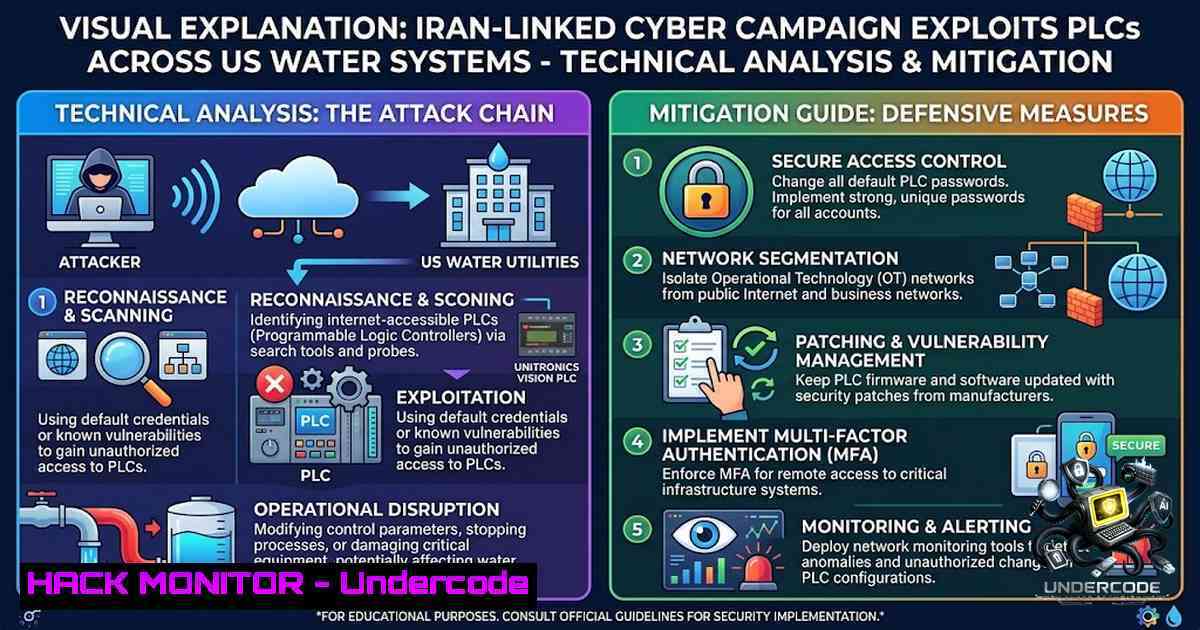
Introduction:
A coordinated cyberattack campaign, attributed to Iranian-affiliated threat actors, has targeted programmable logic controllers (PLCs) across U.S. water and wastewater systems in at least 12 states, impacting more than 30 communities in Minnesota alone. The attackers exploited internet-exposed operational technology (OT) devices—including Rockwell Automation, Schneider Electric, and Siemens PLCs—by using legitimate engineering software to modify controller logic, change IP addresses, and lock operators out of their own systems. CISA and the FBI issued updated warnings in July 2026, urging critical infrastructure operators to immediately remove publicly exposed PLCs from the internet.
Learning Objectives & Secrets:
- Objective 1: Identify and inventory all internet-exposed PLCs — Use Shodan, Censys, and internal network scans to discover OT devices accessible via ports 44818 (Rockwell EtherNet/IP), 102 (Siemens S7), 502 (Modbus), and 2222 (Rockwell secure). Secret tip: Many exposed PLCs are connected through cellular modems that are not captured in traditional IT asset inventories—work with your telecom provider to audit all SIM-enabled OT devices.
-
Objective 2: Implement network segmentation and gateway-based access — Remove PLCs from direct internet exposure and require VPN or gateway devices for all remote access. Secret tip: Configure firewalls to block all inbound traffic to OT networks except from whitelisted management IPs, and deploy a demilitarized zone (DMZ) or bastion host between IT and OT networks.
-
Objective 3: Harden PLC configurations and monitor for malicious changes — Enable password protection, disable unused protocols and web servers, and implement ICS-aware monitoring. Secret tip: Regularly validate project files (e.g., .ACD files for Rockwell) against known-good baselines to detect unauthorized modifications—attackers have been observed modifying ladder logic to disable safety shutdown and alarm functions.
You Should Know:
1. Understanding the Attack Surface: Internet-Exposed PLCs
PLCs were historically engineered for physical isolation and reliability, not internet exposure. Many lack basic secure-by-design capabilities like multifactor authentication or encrypted communication. The current campaign exploits this legacy design flaw: attackers scan the internet for exposed PLCs and connect using legitimate engineering software, the same way an authorized technician would.
Step-by-step guide to assess your exposure:
Step 1: Use Shodan (shodan search --limit 100 port:102 product:"Siemens S7") to identify internet-facing Siemens S7 devices.
Step 2: Use Censys to search for Rockwell EtherNet/IP hosts on port 44818 and Schneider Electric Modicon devices on port 502.
Step 3: Conduct internal network scans using Nmap: nmap -p 44818,102,502,2222,22 <OT_subnet>/24.
Step 4: Cross-reference findings with CISA’s provided indicators of compromise (IOCs) available in STIX format.
Step 5: Document all discovered devices in an OT asset inventory and prioritize remediation based on criticality.
2. Critical Vulnerability Exploitation: CVE-2021-22681
A critical authentication bypass vulnerability (CVSS 9.8) in Rockwell Automation Logix controllers is actively being exploited—with no vendor patch available. The flaw allows remote unauthenticated attackers to bypass verification mechanisms and authenticate with Logix controllers and Studio 5000 Logix Designer software. Affected models include CompactLogix, Micro850, and MicroLogix 1100 PLCs. Iranian-affiliated actors have been exploiting this vulnerability since at least 2021.
Step-by-step mitigation guide:
Step 1: Identify all Rockwell Automation Logix controllers in your environment.
Step 2: For MicroLogix 1100 devices, upgrade firmware to Series B FRN 12.0 or later.
Step 3: Place the physical mode switch on the controller into the “Run” position to prevent unauthorized program downloads.
Step 4: Restrict engineering software access using Windows Group Policy and implement application whitelisting.
Step 5: Monitor logs for suspicious traffic on ports 44818 and 2222, especially from foreign hosting providers.
Step 6: If compromise is suspected, contact CISA and the PLC manufacturer immediately.
3. AI-Generated Exploitation Scripts: The New Threat Vector
Federal agencies have warned that attackers are using AI-generated exploitation scripts disguised as legitimate monitoring software. These scripts conduct reconnaissance against internet-exposed Siemens S7 Series PLCs (S7-200, S7-300, S7-400, S7-1200, and S7-1500 models) and can gain initial access, pilfer credentials, and execute denial-of-service actions.
Step-by-step defensive measures:
Step 1: Deploy ICS-aware network monitoring to detect anomalous traffic patterns.
Step 2: Configure intrusion detection systems to alert on port 102 (Siemens S7) traffic originating from unexpected sources.
Step 3: Implement behavioral analytics to identify AI-generated script patterns—these often exhibit unusual command sequences or timing.
Step 4: Maintain a live firmware inventory for every connected OT device and subscribe to CISA ICS-CERT advisories.
Step 5: Enable multifactor authentication for all remote OT access.
4. Operational Impact and Attack Techniques
The attacks have caused confirmed operational disruption and financial loss. Attackers have demonstrated the ability to:
- Lock operators out of their own devices by modifying PLC passwords
- Disconnect PLCs by changing their IP addresses
- Manipulate operator displays so personnel cannot visually detect anomalies
- Modify ladder logic to disable safety shutdown and alarm functions
- Use vendors’ own legitimate engineering software to steal PLC project files
In Georgia’s Clayton County, an attack caused a water pressure drop and forced a boil water advisory. In Minnesota, the attack disabled computerized operating controls and temporarily shut down a city’s well and water treatment plant.
Step-by-step incident response:
Step 1: Have manual operations procedures ready—staff should be trained to shift to manual control immediately upon detection of OT compromise.
Step 2: Maintain offline backups of PLC project files and configurations.
Step 3: Establish communication protocols with local, state, and federal agencies (FBI, CISA, EPA).
Step 4: Document all forensic evidence and preserve logs for investigation.
5. Network Segmentation and Zero Trust for OT
CISA strongly recommends implementing network segmentation using a DMZ or bastion host between IT and OT networks. All remote access should be conducted through VPNs or gateway devices rather than directly to PLCs.
Step-by-step implementation:
Step 1: Deploy firewalls between IT and OT networks with strict rule sets allowing only necessary protocols.
Step 2: Configure VPN concentrators for all remote access with MFA enforcement.
Step 3: Implement jump hosts/bastion hosts for administrative access to OT devices.
Step 4: Disable unused protocols, web servers, and default SNMP strings on all PLCs.
Step 5: Review previous manufacturer guidance for secure configuration of each device model.
Windows command to audit exposed services:
Test-1etConnection -ComputerName <PLC_IP> -Port 102
Test-1etConnection -ComputerName <PLC_IP> -Port 44818
Test-1etConnection -ComputerName <PLC_IP> -Port 502
Linux command for continuous monitoring:
while true; do nc -zv <PLC_IP> 102 && echo "Siemens S7 accessible" | logger; sleep 60; done
What Undercode Say:
- Key Takeaway 1: The campaign represents a “significant escalation” in attacks on critical infrastructure, with attackers now using AI-generated scripts and targeting multiple PLC vendors. The expansion from Rockwell Automation to Schneider Electric and Siemens devices signals that any internet-exposed PLC is realistically in scope.
-
Key Takeaway 2: The core vulnerability enabling these attacks—internet-exposed OT—has been publicly known since at least April 2026, yet thousands of devices remain exposed. CISA identified 148 Rockwell/Allen-Bradley EtherNet/IP hosts, 4,117 Siemens SIMATIC S7-1200 hosts, and 2,072 additional vulnerable devices.
Analysis: This campaign demonstrates that threat actors are evolving beyond simple disruption to sophisticated operational manipulation. By using legitimate engineering software and modifying controller logic while hiding changes from operator displays, attackers can create dangerous physical conditions without immediate detection. The involvement of the Department of the Treasury as a co-authoring agency signals potential financial-sector implications. Organizations must treat OT security as an urgent operational priority, not just an IT compliance exercise. The attacks have forced utilities to issue boil-water advisories and revert to manual operations—outcomes that directly impact public health and safety. With no vendor patch available for the critical Rockwell authentication bypass vulnerability, defensive measures must focus on network segmentation, access control, and continuous monitoring.
Prediction:
-1: The water sector will face continued and intensified attacks as threat actors refine their AI-generated exploitation capabilities. The lack of vendor patches for critical vulnerabilities means exposed systems will remain vulnerable for the foreseeable future.
-1: Regulatory scrutiny and enforcement actions will increase significantly. States like Pennsylvania and New York are already proposing regulations that exceed federal requirements. Utilities that fail to implement basic security measures face potential enforcement exposure.
+1: Increased federal and state funding for water system cybersecurity will accelerate modernization efforts. The attacks have created a sense of urgency that may finally drive meaningful investment in OT security.
+1: The ICS security market will see substantial growth as utilities prioritize network segmentation, monitoring solutions, and secure remote access technologies.
-1: Smaller municipalities with limited resources will remain the most vulnerable targets, as they lack the budget and expertise to implement comprehensive OT security programs.
-1: The use of AI-generated scripts lowers the barrier to entry for threat actors, potentially attracting more groups to target critical infrastructure.
▶️ Related Video (80% Match):
🎯Let’s Practice For Free:
🎓 Live Courses & Certifications:
Join Undercode Academy for Verified Certifications
🚀 Request a Custom Project:
Secure, high-velocity infrastructure and disruptive technological engineering. Contact our engineering team for high-tier development and proprietary systems:
[email protected]
💎 Smart Architecture | 🛡️ Secure by Design | ⭐ Trusted by Thousands
IT/Security Reporter URL:
Reported By: https://lnkd.in/p/epnF7zjD – Hackers Feeds
Extra Hub: Undercode MoN
Basic Verification: Pass ✅


