Listen to this Post
Introduction:
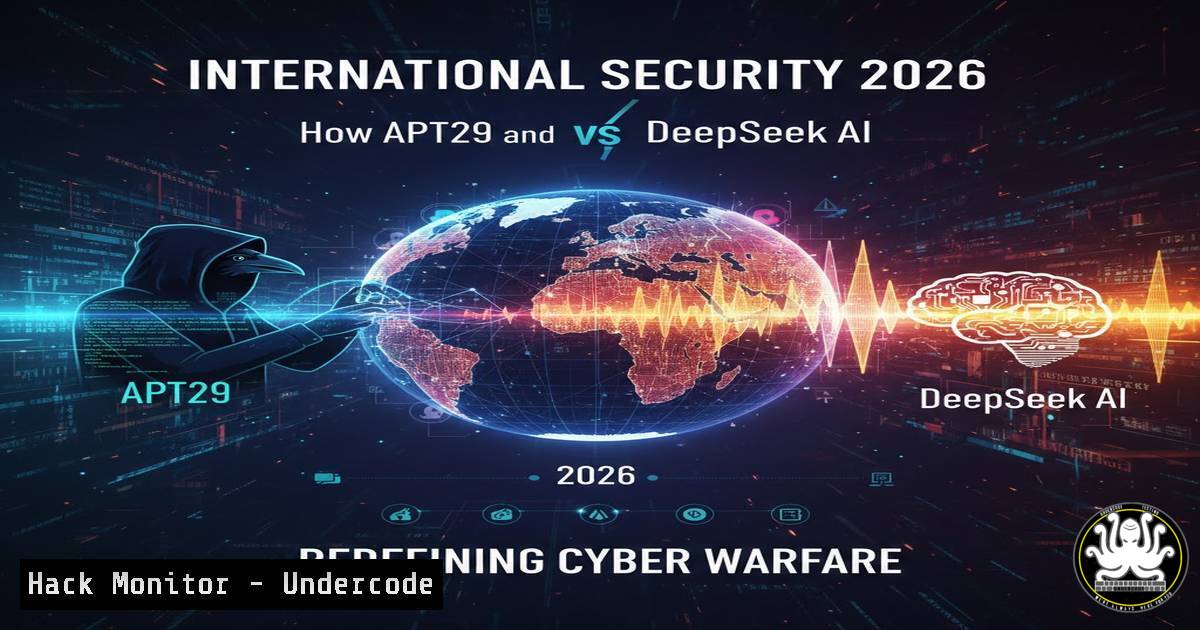
The Estonian Foreign Intelligence Service’s “International Security and Estonia 2026” report lays bare a grim reality: state‑backed information warfare is no longer ancillary to kinetic conflict—it is the primary battlefield. By detailing Russian GRU tactical evolution and the weaponization of DeepSeek AI for disinformation, the document provides a rare unclassified blueprint of how artificial intelligence and traditional cyber espionage now intersect. For defenders, this means updating threat models to account for AI‑generated deepfakes and GRU’s refined operational security tradecraft.
Learning Objectives:
- Analyze the latest GRU cyber tactics and operational security failures documented in Estonia 2026
- Identify how Chinese disinformation campaigns exploit open‑source AI platforms like DeepSeek
- Implement defensive measures against AI‑amplified phishing and deepfake social engineering
- Apply Linux and Windows forensics commands to detect GRU‑style persistence mechanisms
- Harden cloud workloads against AI‑driven reconnaissance and credential stuffing
You Should Know:
- GRU Cyber Tactics: From “Fancy Bear” to Operational Security Lapses
The 2026 report highlights a paradox: Russian military intelligence (GRU) units such as 26165 and 74455 have refined their tradecraft, yet continue to commit basic operational security errors. The Estonian service details how GRU operators increasingly use living‑off‑the‑land binaries (LOLBins) to evade endpoint detection. A favorite is PowerShell Empire stagers delivered via spear‑phishing.
Step‑by‑step guide to emulate (defensive training only) and detect GRU‑style LOLBin execution:
Linux detection – hunting for renamed system utilities:
 Find all binaries in /usr/bin that are not from official packages
sudo find /usr/bin -type f -exec sha256sum {} \; > /tmp/known_hashes.txt
 Compare against a trusted baseline; any mismatch may indicate a backdoored binary
diff /tmp/known_hashes.txt /var/log/package_hashes.db
 Monitor process ancestry to spot powershell launched from Office apps
sudo auditctl -w /usr/bin/pwsh -p x -k powershell_spawn
Windows detection – hunting for WMI and Scheduled Task persistence:
 List all scheduled tasks with XML output to spot obfuscated command lines
Get-ScheduledTask | Select-Object TaskName, State, Actions
 Check for WMI event subscriptions (GRU uses this for persistence)
Get-WmiObject -Namespace root\subscription -Class __EventFilter
Get-WmiObject -Namespace root\subscription -Class CommandLineEventConsumer
These commands help blue teams spot the exact persistence mechanisms GRU employed against Estonian ministries in late 2025.
2. Chinese Disinformation Distorted Through DeepSeek AI
The report’s annex on “DeepSeek‑amplified disinformation” reveals a concerning shift: Chinese state‑linked actors are no longer solely creating propaganda—they are poisoning open‑source AI models to generate content that mimics legitimate Western journalism. The Estonian service detected a coordinated campaign using DeepSeek‑R1 to produce hundreds of plausible but entirely fabricated news articles targeting Baltic energy infrastructure.
Technical analysis of the DeepSeek API abuse:
Attackers exploited the lack of rate‑limiting on early‑access endpoints to generate synthetic articles at scale. To defend against such AI‑generated disinformation, security teams must implement API security controls:
API gateway hardening against model abuse:
 Kong API Gateway rate-limiting policy example
plugins:
- name: rate-limiting
config:
minute: 10
policy: local
fault_tolerant: true
hide_client_headers: false
redis_host: redis.example.com
Additionally, defenders can fingerprint AI‑generated text using statistical perplexity scoring:
from transformers import pipeline
scorer = pipeline("text-classification", model="roberta-base-openai-detector")
text = "Suspected DeepSeek article content here..."
result = scorer(text)
print(f"Fake probability: {result[bash]['score']}")
- AI Risks: Model Inversion and Training Data Poisoning
Section 4.2 of the Estonia 2026 report warns that “adversaries are moving from exploiting AI outputs to corrupting the training pipeline itself.” This is no longer theoretical. The report cites a proof‑of‑concept where GRU actors inserted a backdoor into a popular code‑generation model, causing it to suggest vulnerable code when specific non‑obvious prompts were used (e.g., “serialize user input in PHP”).
Mitigation requires secure MLOps practices. For organizations fine‑tuning models like DeepSeek or LLaMA:
CI/CD pipeline security for model weights:
 Scan model artifacts for embedded malware or backdoors
pip install model-security-scanner
model-security-scan --input ./models/deepseek-r1.gguf --output report.json
 Sign model weights with Sigstore
cosign sign-blob deepseek-r1.gguf --bundle model.sig
Adversarial robustness testing:
from art.estimators.text_generation import HuggingFaceGPT2
from art.attacks.evidence import TextEvasion

classifier = HuggingFaceGPT2(model=loaded_model)
attack = TextEvasion(classifier, epsilon=0.1)
adversarial_texts = attack.generate(x_test)
- Russian Information Operations: The GRU’s “Secondary Effect” Doctrine
The Estonian intelligence assessment details how Russian IO now deliberately leaks true but damaging internal documents—a tactic dubbed “secondary effect.” The goal is not to deceive, but to erode trust in institutions by selectively exposing embarrassing internal communications. From a technical standpoint, this shifts the defender’s burden: it is no longer enough to prevent exfiltration; you must also assume exfiltration will occur and prepare for public release.
Linux incident response for staged data leaks:
 Detect large outbound SCP/SFTP transfers (GRU preferred method)
sudo ausearch -k scp_transfer -ts today | grep "size="
 Identify tarballs created in user home directories
find /home -name ".tar" -o -name ".tar.gz" -mtime -1
Windows – hunting for GRU’s favourite exfil tool (7-Zip renamed):
Get-Process | Where-Object {$<em>.ProcessName -like "7z" -or $</em>.ProcessName -like "zip"}
 Check alternate data streams for hidden archives
Get-ChildItem -Recurse | ForEach-Object { Get-Item $_.FullName -Stream  }
5. Cloud Hardening Against GRU Credential Stuffing
The report confirms that GRU’s 85th Main Special Service Center continues to credential‑stuff exposed cloud management endpoints. In 2025, they successfully accessed an unsecured Azure DevOps instance belonging to a NATO partner. To counter this, organizations must enforce FIDO2/phishing‑resistant MFA and implement just‑in‑time (JIT) privileged access.
Azure JIT policy via CLI:
az vm jit-policy create \
--resource-group MyResourceGroup \
--location eastus \
--name MyJITPolicy \
--vm MyVM \
--max-access-rights 3 \
--max-duration 3h
AWS IAM condition key to enforce MFA:
{
"Condition": {
"BoolIfExists": {
"aws:MultiFactorAuthPresent": "true"
}
}
}
What Undercode Say:
Key Takeaway 1: Estonia 2026 confirms that the lines between cyber espionage, information warfare, and AI manipulation have fully dissolved. Defenders must now treat AI models as an attack surface equal to endpoints or networks.
Key Takeaway 2: The GRU remains a high‑volume, high‑tempo threat, but their repeated operational security failures provide a rich source of detection analytics. Adversary emulation should focus on their specific LOLBin choices and persistence via Windows Management Instrumentation.
Analysis: The Estonian report is a watershed—it is arguably the first national intelligence assessment to explicitly name specific AI platforms (DeepSeek) as direct threat vectors. It also signals that small states, often overlooked in commercial threat intelligence, possess the most granular visibility into Russian tradecraft. For practitioners, the message is clear: treat every AI chatbot endpoint as a potential propaganda botnet node, and assume your cloud credentials are already in GRU’s password spray lists. The defensive playbook must now integrate prompt injection testing alongside traditional vulnerability scanning.
Prediction:
By 2027, we will see the first attribution of a major ransomware incident to a state‑backed group using a generative AI to write custom encryption malware on the fly. The Estonian report hints at this by detailing GRU experiments with AI‑assisted code obfuscation. Once adversarial LLMs can autonomously generate novel, polymorphic ransomware, current endpoint detection will become statistically obsolete. Expect a new arms race: defenders deploying AI against AI, with the Baltic states again serving as the testbed.
▶️ Related Video (84% Match):
🎯Let’s Practice For Free:
IT/Security Reporter URL:
Reported By: Mthomasson International – Hackers Feeds
Extra Hub: Undercode MoN
Basic Verification: Pass ✅


