
Listen to this Post
Introduction:
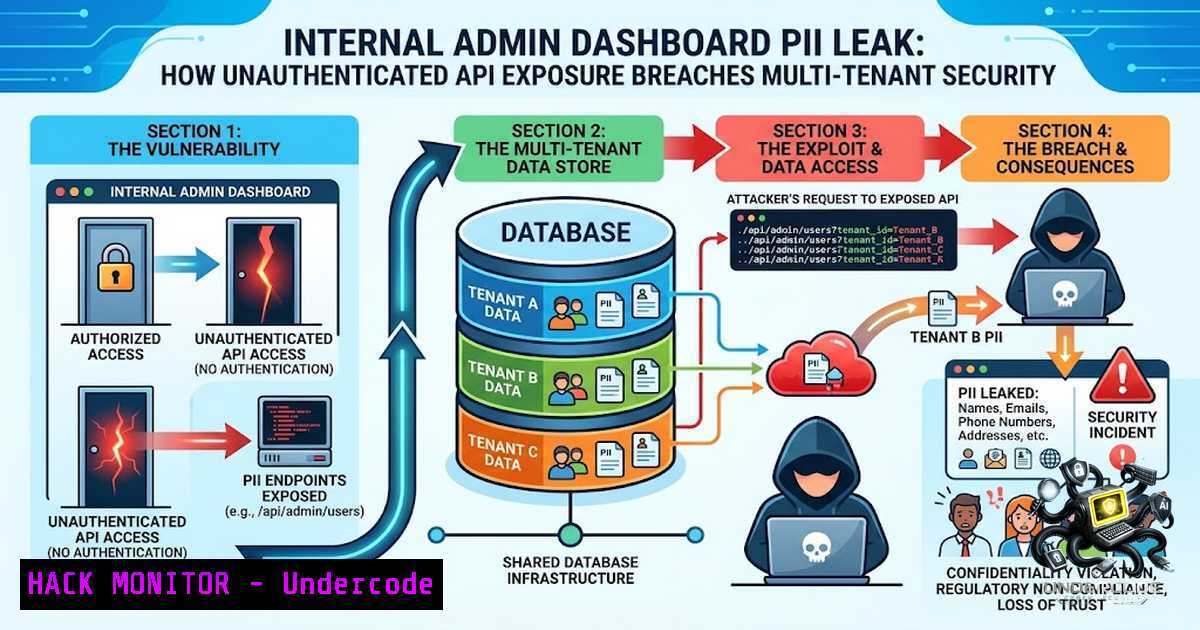
A critical security oversight—an internal admin dashboard accessible without authentication—recently exposed sensitive production data and active authentication tokens across multiple organizations. This incident underscores a fundamental flaw in modern API-driven architectures: the assumption that restricting UI access alone is sufficient. When background API endpoints lack proper authorization controls, they become silent conduits for data exfiltration and privilege escalation. The vulnerability chain—from JavaScript reconnaissance to credential exposure—represents a multi-tenant security failure that could enable complete account takeover.
Learning Objectives & Secrets:
- Objective 1: Master JavaScript Reconnaissance for Hidden Endpoints – Learn to extract API routes, parameters, and authentication flows from publicly accessible JavaScript files using tools like LinkFinder, GoLinkFinderEVO, and Anastasis. Secret tip: Chain passive sources (Wayback Machine, CommonCrawl, URLScan) to aggregate JavaScript files from historical snapshots—endpoints removed from production may still be accessible.
-
Objective 2: Exploit Authentication Bypass Through Endpoint Mapping – Discover how comparing authenticated vs. unauthenticated API responses reveals access control failures. Secret tip: Test endpoints using 54 HTTP verbs, 1,137 headers, and 22+ path normalization tricks—many APIs enforce authorization only for GET requests while overlooking OPTIONS, TRACE, or PATCH methods.
-
Objective 3: Identify and Chain API Vulnerabilities for Maximum Impact – Go beyond the first endpoint. Map related API functionality, review JavaScript for hidden routes, and examine raw API responses—not just what the UI displays. Secret tip: API responses often contain fields the frontend never renders, including internal user IDs, permission flags, and authentication tokens that can be chained for privilege escalation.
You Should Know:
1. JavaScript Reconnaissance: Extracting Hidden API Endpoints
Modern web applications bundle extensive JavaScript that contains hardcoded API endpoints, internal route references, and third-party domain calls. During authorized testing, the researcher discovered references to an internal endpoint and a third-party domain within publicly accessible JavaScript—the first step toward identifying the unauthenticated dashboard.
Step‑by‑step guide:
 Install LinkFinder for JavaScript endpoint extraction
git clone https://github.com/GerbenJavado/LinkFinder.git
cd LinkFinder
pip install -r requirements.txt

Extract endpoints from a single JavaScript file
python linkfinder.py -i https://target.com/static/app.js -o cli

Crawl all JavaScript files from a domain
python linkfinder.py -i https://target.com -d -o cli

Use GoLinkFinderEVO for faster, batteries-included recon
 Download from: https://pkg.go.dev/GoLinkfinderEVO
golinkfinder -u https://target.com -d -o output.txt

Aggregate JavaScript from passive sources using Anastasis
 https://github.com/0xazanul/Anastasis
anastasis -d target.com -o endpoints.txt
For Firefox users, the JS Recon & Secret Scanner extension automatically discovers API endpoints, detects possible API keys and tokens, and identifies exposed sourcemap files.
2. Authentication Bypass Testing with Burp Suite
Once endpoints are discovered, the next step is testing whether they enforce authentication. The endpoint in question responded without requiring authentication—a critical misconfiguration.
Step‑by‑step guide using Burp Suite:
- Intercept the request – Configure Burp Suite as a proxy and capture the API request to the discovered endpoint.
-
Remove or modify authorization headers – Delete the `Authorization: Bearer
` header or replace it with an invalid token. If the API still returns data, authentication is broken. -
Test with Auth-Bypass-Scanner – Right-click the request in Burp and select “Send to Auth-bypass-scanner.” This automated tool tests 54 HTTP verbs, 1,137 headers, and 22+ path normalization tricks against access-controlled endpoints.
-
Compare authenticated vs. unauthenticated responses – Send the same request twice: once with a valid session cookie/token and once without. Use Burp’s Compare function (right-click → Compare) to identify what data is exposed without authentication.
-
Check for alternative auth flows – Skip the locked-down login form and hunt for password reset, OTP verification, or OAuth callback endpoints that may have weaker validation.
3. Detecting IDOR and Broken Object-Level Authorization
The exposed API response contained live production information associated with multiple organizations—a classic Insecure Direct Object Reference (IDOR) vulnerability. Unlike simple IDOR, this incident demonstrates how trusting client-side requests without server-side ownership validation leads to cross-tenant data exposure.
Step‑by‑step guide:
 Using curl to test IDOR on an API endpoint
 Replace USER_ID with sequential values to enumerate other users' data
curl -X GET "https://api.target.com/v1/users/1001/profile" \
-H "Authorization: Bearer VALID_TOKEN"

Test for mass assignment vulnerabilities
 Inject unexpected parameters in POST/PUT requests
curl -X PUT "https://api.target.com/v1/users/1001/profile" \
-H "Authorization: Bearer VALID_TOKEN" \
-H "Content-Type: application/json" \
-d '{"username":"attacker","role":"admin","is_admin":true}'
Mitigation: Enforce object-level authorization checks on every request that returns or modifies a specific resource. Replace sequential integer IDs with random UUIDv4 or signed tokens. Never trust client-side JSON payloads to determine resource ownership—always extract the authenticated user’s identity from the server-side session or token.
4. JWT and OAuth Token Exploitation
The exposed API response contained sensitive authentication material associated with organization administrators. JWT and OAuth tokens, when exposed, grant attackers authenticated access to the victim’s account and resources.
Step‑by‑step guide for JWT testing:
 Install JWT tool for testing
git clone https://github.com/ticarpi/jwt_tool
cd jwt_tool
python3 jwt_tool.py <JWT_TOKEN>

Test for alg=none attack
python3 jwt_tool.py <JWT_TOKEN> -X a

Test for weak secret brute-force
python3 jwt_tool.py <JWT_TOKEN> -C -d /usr/share/wordlists/rockyou.txt

Test for algorithm confusion (RS256 to HS256)
python3 jwt_tool.py <JWT_TOKEN> -X k -pk public_key.pem

Full scan with all known attacks
python3 jwt_tool.py <JWT_TOKEN> -M pb
Common JWT misconfigurations to test:
– `alg=none` – Accepting tokens with no signature
– Weak secret keys – Brute-forceable HMAC secrets
– Missing expiration validation – Tokens that never expire (exp claim ignored)
– Algorithm confusion – RS256 public key used as HMAC secret
– Role forgery – Modifying the `role` or `scope` claim
– OAuth `redirect_uri` manipulation – Stealing tokens via open redirects
5. GraphQL API Security Testing
Many modern APIs use GraphQL, which exposes the entire schema through introspection queries by default. Attackers can discover all queries, mutations, and data relationships without documentation.
Step‑by‑step GraphQL testing:
 Standard introspection query to dump the entire schema
query {
__schema {
types {
name
kind
description
fields {
name
type {
name
kind
}
}
}
}
}
 Automated GraphQL security testing
 https://github.com/NullAILab/graphql-security-tester
python graphql_tester.py -u https://api.target.com/graphql

Test for introspection enabled
curl -X POST https://api.target.com/graphql \
-H "Content-Type: application/json" \
-d '{"query":"{__schema{types{name}}}"}'
Mitigation: Disable introspection in production (introspection=False). Implement query depth and complexity limits to prevent DoS attacks. Restrict persisted queries and validate all input.
6. Cloud API Security and IAM Hardening
The multi-tenant nature of the exposure suggests a cloud-1ative architecture where IAM misconfigurations allowed cross-tenant access. OWASP’s 2025 Top 10 ranks Security Misconfiguration at 2, up from 5 in 2021.
Cloud IAM hardening checklist:
- Apply least privilege as a default – Set permissions, run tests, verify behavior, then tighten
- Audit and restrict API endpoint exposure – Ensure internal admin dashboards are not internet-facing
- Rotate service credentials regularly – Long-lived keys are a top risk
- Implement resource-based policies – Use WAF, input validation, and SCPs
- Enable comprehensive API logging – Insufficient logging hinders detection and response
- Avoid hardcoded secrets – Never embed API keys, database credentials, or tokens in source code
7. Professional Bug Bounty Reporting and CVSS Scoring
When vulnerabilities are discovered during authorized testing, professional reporting is essential. The NDCEH certification includes training on CVSS scoring and professional report writing.
CVSS 3.1 scoring for this vulnerability:
- Attack Vector (AV): Network – Exploitable remotely
- Attack Complexity (AC): Low – No special conditions required
- Privileges Required (PR): None – Unauthenticated access
- User Interaction (UI): None – No user action needed
- Scope (S): Changed – Affects multiple tenants
- Confidentiality Impact (C): High – PII and tokens exposed
- Integrity Impact (I): High – Token theft enables account takeover
- Availability Impact (A): None
Base Score: 9.1 (Critical)
What Undercode Say:
- Key Takeaway 1: Never trust the UI to enforce security. The most critical vulnerabilities often live in background API endpoints that the frontend never displays. Always audit the API layer independently of the user interface.
-
Key Takeaway 2: One vulnerability is rarely the full story. After finding the first endpoint, dig deeper—map related functionality, review JavaScript for hidden routes, and compare authenticated vs. unauthenticated behavior. The most serious vulnerabilities are often discovered through persistence and thorough reconnaissance.
Analysis: The incident demonstrates a systemic failure in multi-tenant API security. The exposure of administrative authentication tokens across multiple organizations represents a critical security boundary violation. This pattern—unauthenticated admin dashboards combined with overly permissive API endpoints—is increasingly common as organizations rush to adopt microservices without implementing proper authorization at every layer. The OWASP Top 10 2025 highlights that Broken Access Control remains the 1 application security risk, with 100% of tested applications exhibiting some form of access control failure. Organizations must adopt a zero-trust approach: authenticate every request, authorize every action, and never assume that network location or UI restrictions provide adequate protection.
Prediction:
- +1 Increased Demand for API-First Security Training – Incidents like this will drive organizations to prioritize API security training, creating growth opportunities for certification programs like NDCEH that emphasize practical, hands-on API testing.
-
+1 Shift Toward Automated API Discovery Tools – The sophistication of JavaScript reconnaissance will accelerate adoption of automated tools that continuously discover and inventory API endpoints, reducing the window for unauthenticated exposure.
-
-1 Rise in Multi-Tenant Data Breaches – As more organizations adopt multi-tenant architectures without proper isolation, similar exposures will become more frequent. The 65% of organizations lacking adaptive MFA and widespread IAM misconfigurations create a perfect storm for data breaches.
-
+1 Stronger Regulatory Scrutiny on API Security – Regulators will increasingly mandate API security testing and certification, similar to PCI DSS for payment data. Organizations failing to secure APIs will face significant fines and reputational damage.
-
-1 Token Theft Will Become Primary Attack Vector – With exposed tokens enabling direct account takeover, attackers will shift focus from phishing to API token harvesting. The OWASP Non-Human Identities Top 10 2025 identifies key泄露 as a top risk, and this trend will accelerate.
-
+1 Evolution of Bug Bounty Programs – Bug bounty platforms will expand scope to include deeper API testing, JavaScript recon, and cloud IAM reviews, creating more opportunities for ethical hackers.
▶️ Related Video (84% Match):
https://www.youtube.com/watch?v=betJusIMNiA
🎯Let’s Practice For Free:
🎓 Live Courses & Certifications:
Join Undercode Academy for Verified Certifications
🚀 Request a Custom Project:
Secure, high-velocity infrastructure and disruptive technological engineering. Contact our engineering team for high-tier development and proprietary systems:
[email protected]
💎 Smart Architecture | 🛡️ Secure by Design | ⭐ Trusted by Thousands
IT/Security Reporter URL:
Reported By: https://lnkd.in/p/etetxcXW – Hackers Feeds
Extra Hub: Undercode MoN
Basic Verification: Pass ✅


