Listen to this Post
Introduction
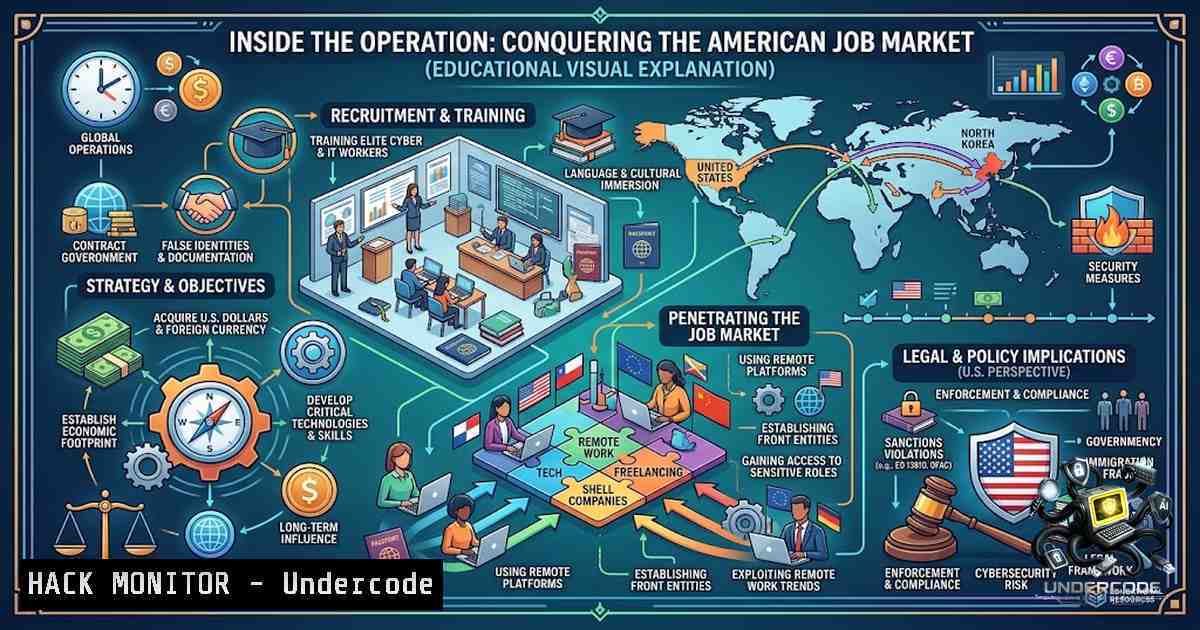
North Korea has quietly built one of the most pervasive workforce infiltration operations ever uncovered—a scheme in which thousands of operatives use stolen identities, AI-generated personas, and American accomplices to land remote jobs at U.S. companies, funneling an estimated $800 million annually back to the Pyongyang regime. Unlike traditional cyberattacks that exploit technical vulnerabilities, this operation exploits the trust inherent in remote hiring processes: operatives walk through the front door as legitimate employees, complete with company-issued laptops, payroll deposits, and internal system access. The Wall Street Journal’s year-long investigation, which tracked a single North Korean cell code-1amed “Eagle Vision,” revealed that the group applied to over 1,000 U.S. and U.K. companies in just three months and secured job offers from at least nine of them.
Learning Objectives
- Understand the technical architecture of North Korea’s IT worker infiltration scheme, including identity theft, AI-powered deception, and laptop farms
- Identify red flags in remote hiring processes and implement defensive countermeasures across HR, cybersecurity, and compliance functions
- Master practical command-line and security tool configurations to detect and block North Korean IT worker activity in enterprise environments
You Should Know
1. The Technical Architecture of the Infiltration Pipeline
The North Korean IT worker scheme operates as a sophisticated assembly line. At its core, operatives create polished digital personas using stolen or fabricated identities—Social Security numbers, driver’s licenses, passports, and complete digital histories of real Americans. These identities are either stolen through data breaches or purchased from willing participants. According to Mandiant threat intelligence, one American facilitator alone impacted more than 300 U.S. companies, generating at least $6.8 million in revenue for overseas operatives between October 2020 and October 2023.
Once hired, the company ships a laptop to a U.S.-based facilitator—often an unwitting or complicit American. The facilitator maintains the physical device in what investigators call a “laptop farm,” while North Korean operatives connect remotely via VPN. The FBI has seized laptop farms containing up to 100 devices, and officials estimate that thousands of Americans must be involved for the system to function at scale. Facilitators open bank accounts, cash checks, and sometimes even attend company meetings in person while North Koreans do the actual work remotely.
The financial pipeline is equally sophisticated: salaries are routed through intermediaries, cryptocurrency transactions, and shell companies before reaching Pyongyang. The U.S. Treasury has confirmed that in some cases, up to 90% of an operative’s salary—which can reach $300,000 annually—flows directly to the North Korean regime.
Technical Indicators to Monitor:
Organizations should audit network traffic for the following patterns:
- VPN concentrator logs: Look for connections originating from IP ranges associated with China, Russia, and Laos, where an estimated 1,000 to 1,500 North Korean IT workers are based. Use the following Linux command to analyze auth logs for unusual VPN access patterns:
sudo grep "VPN" /var/log/auth.log | awk '{print $1, $2, $3, $9}' | sort | uniq -c | sort -1r
- Endpoint telemetry: Monitor for remote desktop tools (Google Remote Desktop, AnyDesk, TeamViewer) configured via PowerShell. On Windows, audit scheduled tasks and PowerShell logs:
Get-WinEvent -LogName "Microsoft-Windows-PowerShell/Operational" | Where-Object { $_.Message -match "RemoteDesktop|AnyDesk|TeamViewer" }
- Browser-based OTP generators: Lazarus Group operatives have been observed using browser-based one-time password generators to bypass two-factor authentication. Monitor for unusual browser extensions or automated form-filling activity.
- AI-Powered Deception: Deepfakes, Real-Time Face Swapping, and Voice Cloning
Generative AI has collapsed the cost of fabrication. A convincing resume, professional headshot, and polished cover letter now take minutes to produce. But the scheme goes far beyond static documents. North Korean operatives use AI throughout the entire hiring lifecycle—from crafting application materials to real-time interview deception.
During interviews, operatives have been caught on camera frantically querying ChatGPT for software engineering answers seconds before responding to technical questions. As recruiters became more adept at detecting impostors, the operatives escalated to real-time deepfake tools that alter facial images during video calls. CrowdStrike’s 2025 Threat Hunting Report documented that the DPRK-1exus group FAMOUS CHOLLIMA—which accounted for 47% of all state-sponsored cyber intrusions against U.S. tech companies between April 2025 and May 2026—uses AI-generated deepfake images to spoof real faces during online interviews.
Voice-cloning software masks accents, and operatives maintain multiple “foreign” profiles simultaneously, applying for multiple jobs under each stolen identity. The CrowdStrike report noted a 220% year-over-year increase in infiltrations, with FAMOUS CHOLLIMA breaching over 320 companies in a single 12-month period.
Countermeasures and Detection Commands:
To detect AI-generated application materials and deepfake attempts:
- Metadata analysis: Examine PDF and DOCX files for signs of AI generation. Use `exiftool` on Linux to extract metadata:
exiftool -Author -Creator -Producer -CreateDate candidate_resume.pdf
Look for inconsistencies—AI-generated documents often lack proper metadata or show creation timestamps that don’t align with the claimed history.
- Video interview monitoring: Implement liveness detection. On Linux, use OpenCV-based tools to analyze video streams for deepfake artifacts:
 Install OpenCV and deepfake detection dependencies
pip install opencv-python deepface

Run basic frame analysis
python -c "import cv2; cap = cv2.VideoCapture('interview_recording.mp4'); print(f'Total frames: {int(cap.get(cv2.CAP_PROP_FRAME_COUNT))}')"
- Network-based detection: Monitor for unusual outbound connections during video calls. On Windows, use `netstat` to identify active connections:
netstat -ano | findstr ESTABLISHED
Cross-reference suspicious IPs with threat intelligence feeds.
3. Laptop Farms and Insider Threat Vectors
The laptop farm is the operational linchpin of the entire scheme. Company-issued devices remain physically in the U.S., while North Korean operatives connect remotely, creating a technical and legal gray area that complicates detection and prosecution. The FBI has indicted 39 individuals—including both North Korean operatives and American facilitators—for their roles in sustaining this ecosystem.
The insider threat implications are severe. Once employed, operatives gain access to:
- Internal dashboards and privileged accounts
- Source code repositories and intellectual property
- Customer databases and sensitive business data
- Financial systems and payment processing infrastructure
Lazarus Group operatives have been observed requesting full access to victims’ laptops, including sensitive personal information such as SSN, ID, LinkedIn credentials, and Gmail credentials. Instead of deploying traditional malware, they use a lean toolkit focused on identity takeover: browser-based OTP generators to bypass 2FA, Google Remote Desktop configured via PowerShell for persistent access, and VPN connections routed through Astrill VPN. This approach—using legitimate tools for malicious purposes—makes detection exceptionally challenging for traditional security software.
Detection and Mitigation Commands:
- Monitor for unauthorized remote access tools on Windows using PowerShell to audit installed software:
Get-WmiObject -Class Win32_Product | Where-Object { $_.Name -match "AnyDesk|TeamViewer|RemoteDesktop|Chrome Remote Desktop" }
- Audit VPN usage patterns on Linux gateways:
sudo grep "VPN" /var/log/syslog | grep -E "([0-9]{1,3}.){3}[0-9]{1,3}" | awk '{print $NF}' | sort | uniq -c | sort -1r
- Implement least-privilege access: Use `auditd` on Linux to monitor privileged command execution:
sudo auditctl -w /etc/sudoers -p wa -k sudoers_changes
sudo auditctl -w /bin/su -p x -k su_execution
sudo ausearch -k sudoers_changes
4. Identity Verification and Background Check Hardening
Traditional background checks are insufficient against North Korean IT workers. The operatives use stolen Social Security numbers and personal information that pass basic verification. The victim—a real American whose identity was stolen—often discovers the fraud only when they cannot open a bank account, obtain credit, or rent housing.
Technical Hardening Steps:
- Implement multi-factor identity verification: Require live, on-camera interviews with government-issued ID verification. On Linux, use `ffmpeg` to capture and verify video metadata:
ffmpeg -i interview_video.mp4 -f null - 2>&1 | grep -E "Duration|Video|Audio"
- Independently verify prior employment: Contact previous employers directly using publicly listed phone numbers rather than candidate-provided contacts.
-
Use E-Verify and third-party screening with robust identity verification procedures.
-
Scan for synthetic identities: Use OSINT tools to cross-reference candidate information. On Linux, install and use `theHarvester` for email and domain reconnaissance:
theHarvester -d candidate_provided_domain.com -l 50 -b google,bing,linkedin
5. Continuous Monitoring and Zero-Trust Architecture
Pre-employment screening alone is insufficient. Organizations must implement continuous authentication and least-privilege access controls. The zero-trust model is particularly relevant here: never trust, always verify.
Implementation Commands:
- Linux – Monitor for unusual user behavior using `auditd` and
fail2ban:
 Install and configure auditd
sudo apt-get install auditd audispd-plugins
sudo auditctl -e 1

Monitor failed login attempts
sudo ausearch -m USER_LOGIN -sv no
- Windows – Enable advanced audit policies:
auditpol /set /subcategory:"Logon" /success:enable /failure:enable
auditpol /set /subcategory:"Special Logon" /success:enable /failure:enable
Get-EventLog -LogName Security -InstanceId 4625 | Select-Object TimeGenerated, Message
- Restrict access from high-risk jurisdictions: Configure firewall rules to block connections from known DPRK-associated IP ranges. On Linux with
iptables:
 Block specific country IP ranges (example using ipset)
sudo ipset create blocklist hash:net
sudo ipset add blocklist 175.45.176.0/22  Example DPRK IP range
sudo iptables -I INPUT -m set --match-set blocklist src -j DROP
- Implement endpoint detection and response (EDR) tools to continuously monitor suspicious activity. On Windows, use `Sysmon` for detailed process logging:
Sysmon64.exe -accepteula -i
6. Cryptocurrency and Payment Screening
North Korean operatives frequently request cryptocurrency payments or route salaries through third-party accounts. The scheme has been linked to approximately $2 billion in cryptocurrency theft in 2025 alone.
Screening Commands:
- Monitor blockchain transactions for suspicious patterns using Python:
 Basic blockchain analysis script
import requests
response = requests.get('https://api.blockchair.com/bitcoin/transactions')
 Analyze for unusual transaction patterns
- Screen vendors, contractors, and workers against applicable sanctions lists. Use `curl` to query OFAC SDN lists:
curl -s https://sanctionslistservice.ofac.treas.gov/api/v1/SdnList | jq '.'
- Avoid cryptocurrency payments where possible, and do not pay ransoms or extortion demands.
What Undercode Say
- The front door is the new attack vector – North Korean operatives have realized that getting hired is more effective, less detectable, and more lucrative than traditional hacking. Organizations must treat hiring as a security function, not just an HR function.
-
AI is a double-edged sword – While generative AI enables attackers to scale deception, it also provides defenders with new tools for detection. Metadata analysis, behavioral biometrics, and deepfake detection are becoming essential components of the security stack. The CrowdStrike report’s finding that FAMOUS CHOLLIMA accounted for 47% of state-sponsored tech intrusions underscores the scale of this threat.
-
The laptop farm is the weak link – Physical devices in the U.S. create a legal and technical vulnerability that law enforcement can exploit. The FBI’s indictment of 39 individuals demonstrates that disruption is possible, but it requires cross-functional coordination between HR, IT security, legal, and law enforcement.
-
Zero trust is not optional – Continuous authentication, least-privilege access, and behavioral monitoring are no longer best practices—they are necessities. The Lazarus Group’s use of legitimate tools (Google Remote Desktop, browser-based OTP generators) instead of malware makes traditional signature-based detection obsolete.
-
The human cost is real – Beyond national security, this scheme destroys the lives of American identity theft victims who cannot open bank accounts, obtain credit, or rent housing. Organizations have a moral and legal obligation to verify identities thoroughly.
Prediction
-1 The North Korean IT worker scheme will continue to scale as generative AI tools become more sophisticated and accessible. Gartner predicts that by 2028, the problem will worsen significantly as AI-generated applications become indistinguishable from legitimate ones.
-1 The infiltration of U.S. federal government agencies—as recently confirmed by the FBI—represents a catastrophic escalation. If operatives have accessed classified systems, the intelligence compromise could take years to fully assess and remediate.
-1 The cryptocurrency dimension adds another layer of complexity. With North Korea-linked actors stealing approximately $2 billion in crypto in 2025 alone, the regime is building a financial war chest that directly funds weapons of mass destruction programs.
+1 However, increased awareness and coordinated action—including the FBI’s aggressive prosecution of facilitators, multi-1ational joint alerts, and congressional hearings with tech platforms—are beginning to disrupt the ecosystem.
+1 The development of AI-powered detection tools specifically designed to identify synthetic identities and deepfake interviews offers a promising countermeasure. Organizations that invest in these technologies early will gain a significant defensive advantage.
▶️ Related Video (88% Match):
🎯Let’s Practice For Free:
🎓 Live Courses & Certifications:
Join Undercode Academy for Verified Certifications
🚀 Request a Custom Project:
Secure, high-velocity infrastructure and disruptive technological engineering. Contact our engineering team for high-tier development and proprietary systems:
[email protected]
💎 Smart Architecture | 🛡️ Secure by Design | ⭐ Trusted by Thousands
IT/Security Reporter URL:
Reported By: https://lnkd.in/p/eBbd5RTK – Hackers Feeds
Extra Hub: Undercode MoN
Basic Verification: Pass ✅


