Listen to this Post
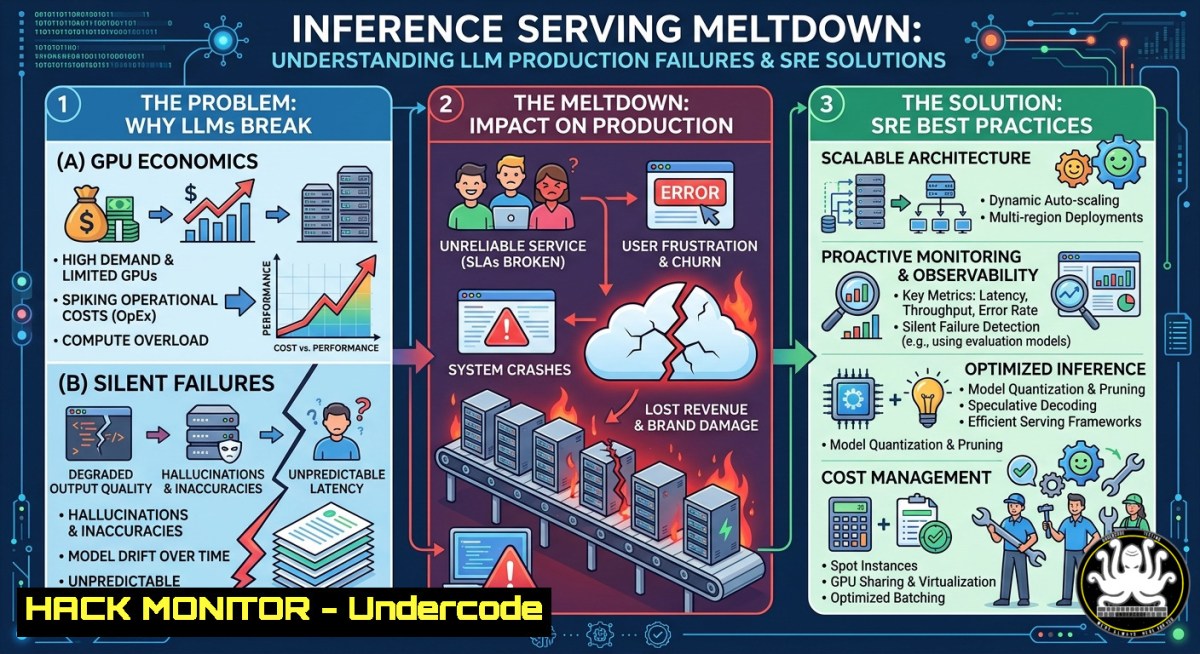
Introduction:
Inference serving has evolved from a research afterthought into the single most expensive and failure-prone component of production AI systems. As Abi Aryan highlighted in her LLMday keynote announcement, GPU economics, latency tails, and silent failure modes are now first-order reliability problems—not edge cases—demanding rigorous Site Reliability Engineering (SRE) principles tailored for LLM and agentic workloads.
Learning Objectives:
- Diagnose and mitigate silent inference failures (model drift, hardware degradation, memory leaks) using observability stacks and chaos engineering.
- Optimize GPU economics through autoscaling strategies, request batching, and token-aware load balancing.
- Implement reliability patterns (retries with jitter, circuit breakers, graceful degradation) for inference serving on Kubernetes or serverless platforms.
You Should Know:
- GPU Economics 101: Measuring and Reducing Cost per Million Tokens
Inference costs explode when GPUs idle due to variable request rates or inefficient batching. The key metric is cost per million tokens—calculated as (GPU hourly cost × utilization factor) / tokens generated. To monitor real-time utilization, use these commands:
Linux (NVIDIA GPUs):
 Watch GPU utilization, memory, and temperature every second
watch -n 1 nvidia-smi --query-gpu=utilization.gpu,memory.used,temperature.gpu --format=csv

For detailed metrics with timestamps
nvidia-smi --query-gpu=timestamp,utilization.gpu,memory.total,memory.used --format=csv -l 5
Windows (PowerShell with NVIDIA tools):
 If nvidia-smi is in PATH
while ($true) { nvidia-smi --query-gpu=utilization.gpu,memory.used --format=csv; Start-Sleep -Seconds 2 }
Step‑by‑step guide:
- Run the above command while sending production traffic to your inference endpoint.
2. Record utilization patterns—dips below 40% indicate over-provisioning.
- Implement dynamic batching: in vLLM or TGI, set `–max-num-batched-tokens` to aggregate requests.
- Add an autoscaler (KEDA or Prometheus + HPA) that scales replicas based on GPU utilization or queue length.
- Validate cost reduction by comparing cost per million tokens before/after.
2. Taming Latency Tails: From P95 to P999
Inference serving suffers from long-tail latencies caused by preemption, memory fragmentation, or slow prompts. SREs must shift from average latency to tail-at-scale metrics.
Linux (using `h2load` for HTTP/2 inference endpoints):
 Simulate 100 concurrent users, 1000 total requests, measure percentiles
h2load -c 100 -n 1000 -m 10 --h2 https://your-inference-endpoint/v1/completions -d '{"prompt":"Hello","max_tokens":50}'
Mitigation with NVIDIA Triton’s dynamic batching:
 Triton model configuration snippet (config.pbtxt)
dynamic_batching {
preferred_batch_size: [1, 2, 4, 8]
max_queue_delay_microseconds: 1000
preserve_ordering: false
}
Step‑by‑step guide:
- Enable percentile logging in your inference server (e.g., vLLM
--log-stats). - Inject synthetic traffic with `h2load` or `wrk` to establish baseline P95/P99.
- Apply dynamic batching with small max queue delay (1ms) to coalesce requests.
- Add a request prioritization layer (e.g., using Envoy’s weighted round robin for short prompts).
5. Re-test and lower tail latency by 30–50%.
- Silent Failure Modes: Detecting Model Drift and Hardware Degradation
Silent failures—degraded accuracy, nondeterministic outputs, or GPU ECC errors—don’t crash the service but destroy trust. Monitor with:
Linux (check GPU memory errors):
 Persistent ECC errors indicate impending hardware failure
nvidia-smi -q -d ECC | grep -E "ECC.Errors|Aggregate"

Log model output distributions (use Python)
python -c "import numpy as np; print(np.std([infer(p)['logprobs'] for p in test_prompts]))"
Step‑by‑step guide:
- Implement canary deployment: route 5% traffic to each model version.
- Compute semantic similarity (e.g., BERTScore) between current and baseline outputs per prompt type.
- Set alert on drift > 0.1 (scaled metric).
- For GPU health, schedule weekly `nvidia-smi -r` (GPU reset) and parse ECC logs.
5. Automate rollback when drift exceeds threshold.
- API Security for Inference Endpoints: Preventing Prompt Injection and Rate Abuse
Inference APIs are prime targets for prompt injection (jailbreak attempts) and DDoS via long context windows. Harden with:
Linux (rate limiting using nginx + Lua):
limit_req_zone $binary_remote_addr zone=inference:10m rate=10r/m;
server {
location /v1/completions {
limit_req zone=inference burst=5 nodelay;
 Token budget check (custom Lua)
access_by_lua_block {
local max_tokens = 4096
local req_tokens = ngx.var.request_body and require("json").decode(ngx.var.request_body)["max_tokens"]
if req_tokens and req_tokens > max_tokens then
ngx.exit(429)
end
}
proxy_pass http://inference-service;
}
}
Windows (PowerShell with Azure API Management or custom middleware):
 Monitor token consumption per key
$rateLimit = @{}
$rateLimit["user123"] = @{Count=0; ResetTime=(Get-Date).AddMinutes(1)}
 Then enforce in pipeline
Step‑by‑step guide:
- Deploy a WAF or API gateway in front of your inference service.
- Set rate limits per API key or IP (e.g., 100 requests/minute).
- Validate max token size per request—reject payloads exceeding 8k tokens.
- Use a content filter (e.g., Llama Guard) to scan prompts for injection patterns.
- Log all rejected requests to SIEM for threat hunting.
-
Cloud Hardening for GPU Instances: Secure Multi‑Tenancy and VPC Isolation
GPU instances in public cloud (AWS P5, Azure NCasv4) require stringent isolation to prevent cross‑tenant attacks via PCIe or memory side‑channels.
Step‑by‑step guide (AWS example):
- Launch GPU instances in a private subnet with no direct internet access.
- Use AWS Nitro Enclaves to isolate inference workloads from host.
- Enforce IAM roles with least privilege—deny `ec2:TerminateInstances` except for CI/CD roles.
- Apply security group rules: allow only your API gateway’s CIDR on port 443.
- Enable VPC Flow Logs and monitor for unusual traffic patterns (e.g., outbound data exfiltration on port 22).
Linux (verify no exposed management ports):
ss -tuln | grep -E ':(22|8000|5000|9090)' Should show only essential ports
- Observability Stack for Inference Systems: OpenTelemetry + Prometheus + Grafana
Reliable inference requires tracing each request’s journey: prompt → tokenization → GPU kernel → sampling → response.
Step‑by‑step guide:
- Instrument your serving layer with OpenTelemetry (e.g., Python
opentelemetry-instrumentation-fastapi). - Export traces to Jaeger and metrics to Prometheus.
- Define SLOs: 99.9% of requests with P99 latency < 200ms, error rate < 0.1%.
- Create Grafana dashboards showing GPU utilization, request queue depth, token throughput, and error budget burn rate.
- Set up alerting: if error budget depletes > 10% in 1 hour, page on-call SRE.
Example PromQL query for GPU memory leak detection:
rate(nvidia_gpu_memory_used_bytes[bash]) > 1e7 increase >10MB/s
- Vulnerability Mitigation: Protecting Against Model Weights Theft and Adversarial Inputs
Attackers may extract model architecture or weights via side‑channel timing or by crafting adversarial inputs that trigger unique error messages.
Mitigations:
- Add randomized noise to output logprobs (prevents black‑box extraction).
- Return generic error messages (“Unable to process request”) instead of stack traces.
- Implement request signing (HMAC) between client and server to prevent replay attacks.
Linux (generate HMAC signature with OpenSSL):
 Server side verification
echo -n "$request_body" | openssl dgst -sha256 -hmac "$shared_secret" -hex
Step‑by‑step guide:
- Strip debug headers from inference responses (remove `X-Request-ID` if it reveals internal paths).
- Rate‑limit token‑generation endpoints to 10 requests/second per user.
- Deploy a poisoning detection model that flags inputs with abnormal embedding distance.
- Use confidential computing (AMD SEV-SNP or Intel TDX) for GPU instances if available.
What Undercode Say:
- Key Takeaway 1: Inference serving is no longer a model optimization problem—it is an SRE problem. GPU economics, tail latency, and silent failures require the same rigor as financial transaction systems.
- Key Takeaway 2: Community‑driven events like LLMday+SREday are bridging the gap between AI research and production engineering. Abi Aryan’s course (GPU Engineering for AI Systems, Packt 2026) provides the necessary training for inference engineers to adopt reliability thinking.
Analysis: The industry is waking up to the fact that LLM inference at scale breaks traditional monitoring and scaling assumptions. Silent failures—like gradual model drift or ECC errors—cannot be caught by simple health checks; they require statistical output validation and hardware‑level telemetry. Moreover, GPU economics force organizations to move from static provisioning to dynamic, token‑aware autoscaling. The convergence of SRE principles with LLMOps will define production AI in 2026. Abi’s keynote addresses exactly this shift, offering practitioners a roadmap from brittle research demos to resilient, cost‑optimized inference systems.
Prediction:
By late 2026, inference‑specific SRE certifications will emerge as a standard requirement for AI platform teams. We will see widespread adoption of “inference chaos engineering” toolkits that inject GPU throttling, memory fragmentation, and prompt‑injection failures into production canaries. The most successful organizations will treat inference reliability as a competitive moat, publishing SLOs as product features. Open source projects like vLLM and Triton will integrate native tail‑latency optimization and drift detection, while cloud providers will offer inference SLAs with monetary credits for silent failure violations. The camera‑shy engineer turned keynote speaker is a sign that reliability is finally getting the spotlight it deserves.
▶️ Related Video (70% Match):
🎯Let’s Practice For Free:
IT/Security Reporter URL:
Reported By: Goabiaryan Ill – Hackers Feeds
Extra Hub: Undercode MoN
Basic Verification: Pass ✅


