Listen to this Post
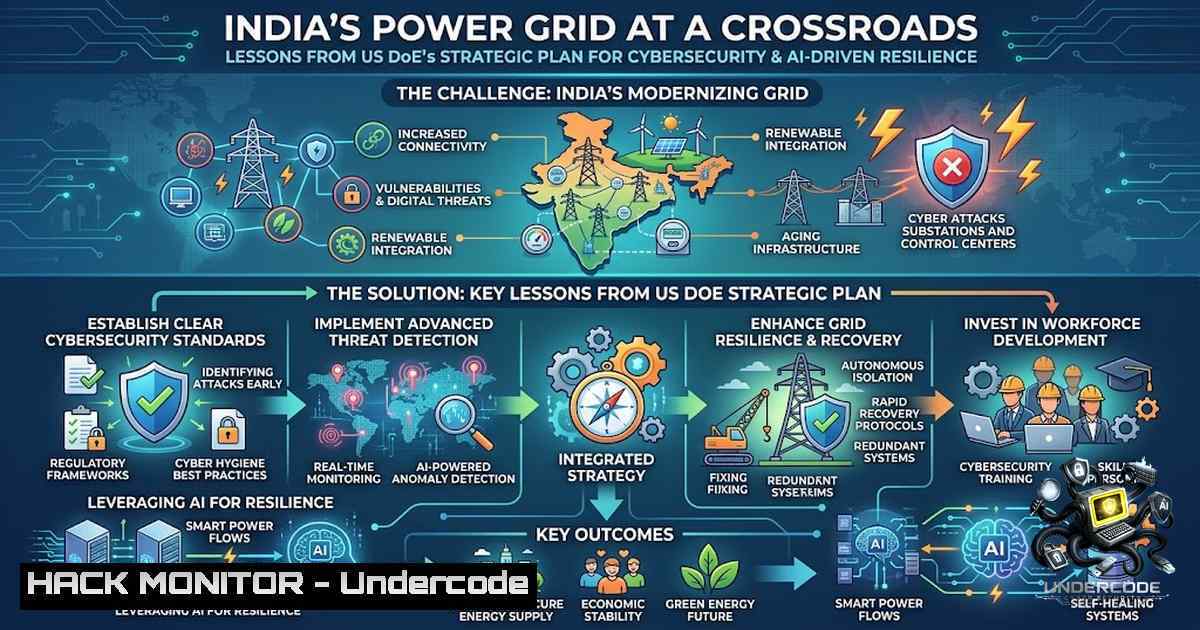
Introduction:
India’s power sector is undergoing a monumental transformation, driven by surging electricity demand and an ambitious renewable energy push. However, this progress is shadowed by escalating cyber and physical security risks, transmission bottlenecks, and supply chain vulnerabilities. The U.S. Department of Energy’s Office of Electricity (OE) Strategic Plan 2026 provides a critical blueprint, emphasizing that grid modernization is not just about adding capacity but about building an intelligent, resilient, and secure system from the ground up.
Learning Objectives:
- Understand the imperative of integrating resource adequacy with transmission planning to prevent congestion and stranded assets.
- Learn how to implement grid-enhancing technologies (GETs) and AI-driven analytics for real-time network optimization.
- Recognize the importance of establishing measurable resilience indicators and developing domestic supply chains for critical grid equipment.
You Should Know:
- The Convergence of Resource Adequacy and Transmission Planning
The OE plan highlights a fundamental flaw in many expansion strategies: building generation without synchronizing it with transmission infrastructure. For India, this means that new solar and wind farms risk being underutilized due to grid congestion. To address this, utilities must adopt integrated planning models that forecast generation, transmission, and storage together.
Step-by-step guide for integrated planning:
- Data Aggregation: Use tools like `Python` with `Pandas` to combine historical load data, weather patterns, and generation schedules.
- Load Flow Analysis: Employ `PyPSA` or `PowerWorld` simulators to model how new generation impacts existing transmission lines.
- Scenario Testing: Run simulations for peak demand and contingency events to identify bottlenecks before they occur.
- Command (Linux): `sudo apt-get install python3-pandas python3-1umpy` – Install necessary data analysis libraries.
- Command (Windows – PowerShell): `Install-Module -1ame PowerGridSim` – For simulation modules.
2. Technology-Enabled Grid Optimization: Moving Beyond Mere Expansion
Before laying down expensive new infrastructure, India can leverage advanced sensors and AI to maximize existing capacity. Dynamic Line Rating (DLR) and Automated Controls are central to the OE strategy, allowing grids to handle more power based on real-time weather conditions.
Step-by-step guide for implementing DLR:
- Sensor Deployment: Install weather sensors (temperature, wind speed, solar radiation) on key transmission lines.
- Data Acquisition: Configure `Modbus` protocol to pull data from sensors to a central SCADA system.
- Algorithm Integration: Use a `Machine Learning` model (e.g.,
RandomForest) to predict line capacity based on environmental data. - Configuration (Linux): `crontab -e` – Schedule a cron job to run the prediction model every 5 minutes.
- Configuration (Windows): Use `Task Scheduler` to execute a `.ps1` script that updates relay settings based on model output.
3. Establishing Measurable Resilience Indicators
Resilience is often a vague concept until it is quantified. The OE plan pushes for specific metrics to hold utilities accountable against extreme weather and cyber threats. India can adopt metrics like “SAIDI” (System Average Interruption Duration Index) and “Cyber Mean Time to Restore” (CMTTR).
Step-by-step guide to calculating and using SAIDI:
- Log Collection: Extract outage logs from IEDs (Intelligent Electronic Devices) via `Syslog` or `SNMP` traps.
- Parsing: Use `awk` and `grep` in Linux to parse log files:
grep "OUTAGE" /var/log/electrical.log | awk '{print $5}'. - Formula Application: Sum the total outage duration for customers and divide by the total number of customers served.
- Mitigation: Link investment decisions (e.g., hardening substations) to utilities that fail to meet SAIDI thresholds.
4. Developing a Secure Domestic Supply Chain
Over-reliance on foreign manufacturers for transformers and breakers is a strategic vulnerability. The OE plan calls for domestic production to ensure supply chain resilience and reduce exposure to geopolitical tampering.
Step-by-step guide for supply chain validation:
- Vendor Verification: Use `OpenSCAP` to scan firmware and hardware specifications for backdoors or vulnerabilities.
- SBOM Generation: Generate a Software Bill of Materials (SBOM) for every critical device.
- Command (Linux): `syft packages /path/to/device/firmware -o spdx-json` – Generate SBOM in JSON format.
- Compliance Check: Cross-reference SBOM with NIST’s National Vulnerability Database (NVD) using a `curl` script.
- Command (Windows): `Invoke-WebRequest -Uri “https://nvd.nist.gov/…/cve-1.1.json” -OutFile “vuln.json”`
- API Security and Cloud Hardening for Grid Management
As grids become more digital, the attack surface expands via APIs and cloud infrastructure. Protecting these interfaces is crucial for maintaining operational integrity.
Step-by-step guide for hardening grid APIs:
- Authentication: Enforce OAuth 2.0 with `client_credentials` flow for machine-to-machine communication.
- Rate Limiting: Configure `NGINX` to limit requests to prevent DDoS attacks.
- Configuration (Linux – NGINX):
limit_req_zone $binary_remote_addr zone=mylimit:10m rate=5r/s; location /api/ { limit_req zone=mylimit burst=10; proxy_pass http://grid_backend; } - Encryption: Ensure TLS 1.3 is enforced. Command:
openssl ciphers -v 'TLSv1.3'.
6. AI-Driven Vulnerability Exploitation and Mitigation
While AI optimizes the grid, it also introduces risks if manipulated. Adversarial attacks on load forecasting models can cause cascading failures.
Step-by-step guide for AI model protection:
- Data Integrity: Implement checksums (
SHA-256) on training datasets to prevent data poisoning. - Adversarial Retraining: Inject noise into training data to make models robust against gradient-based attacks.
- Command: `python3 -c “import hashlib; print(hashlib.sha256(open(‘train_data.csv’,’rb’).read()).hexdigest())”` to verify integrity.
- Mitigation: If a model shows anomaly, revert to a “safe state” prediction using deterministic mathematical models (e.g., Newton-Raphson load flow) rather than AI.
What Undercode Say:
- Key Takeaway 1: The future of India’s grid hinges on data-driven planning. The OE plan proves that “Stabilize, Optimize and Grow” is not just a slogan but a methodology requiring precise data pipelines and integrated forecasting.
- Key Takeaway 2: Cybersecurity must be embedded into grid hardware from the supply chain level. Treating digital security as an afterthought will lead to catastrophic failures given the interconnectedness of modern SCADA and IoT devices.
Analysis: The shift from a “megawatts-added” mindset to an “intelligent-system” approach is a monumental leap. It requires training a workforce capable of handling both power electronics and `Python` scripts. For India, this is a unique opportunity to leapfrog older, less secure infrastructure. The adoption of SBOMs and AI-driven dynamic line rating can reduce operational costs while increasing resilience. However, the greatest challenge lies in standardization; without a unified data format, these tools will fail. The OE plan provides a mature framework, but India must contextualize it, focusing heavily on disaster recovery for cyclone-prone coastal regions, which are different from the US’s hurricane scenarios.
Prediction:
- -1: Without immediate investment in cybersecurity training and a unified national grid data standard, a major state-level blackout due to a ransomware attack is likely within 2–3 years as digitization outpaces security protocols.
- +1: Aggressive adoption of AI for predictive maintenance, as outlined in the OE plan, could reduce transmission losses by up to 15% by 2028, saving billions of rupees in operational costs.
- +1: The push for domestic manufacturing of high-voltage equipment will not only secure supply chains but also position India as a significant exporter of grid technology to Southeast Asia, mirroring the US’s strategic goals.
▶️ Related Video (72% Match):
🎯Let’s Practice For Free:
🎓 Live Courses & Certifications:
Join Undercode Academy for Verified Certifications
🚀 Request a Custom Project:
Secure, high-velocity infrastructure and disruptive technological engineering. Contact our engineering team for high-tier development and proprietary systems:
[email protected]
💎 Smart Architecture | 🛡️ Secure by Design | ⭐ Trusted by Thousands
IT/Security Reporter URL:
Reported By: Amitava Nag – Hackers Feeds
Extra Hub: Undercode MoN
Basic Verification: Pass ✅


