Listen to this Post
Introduction:
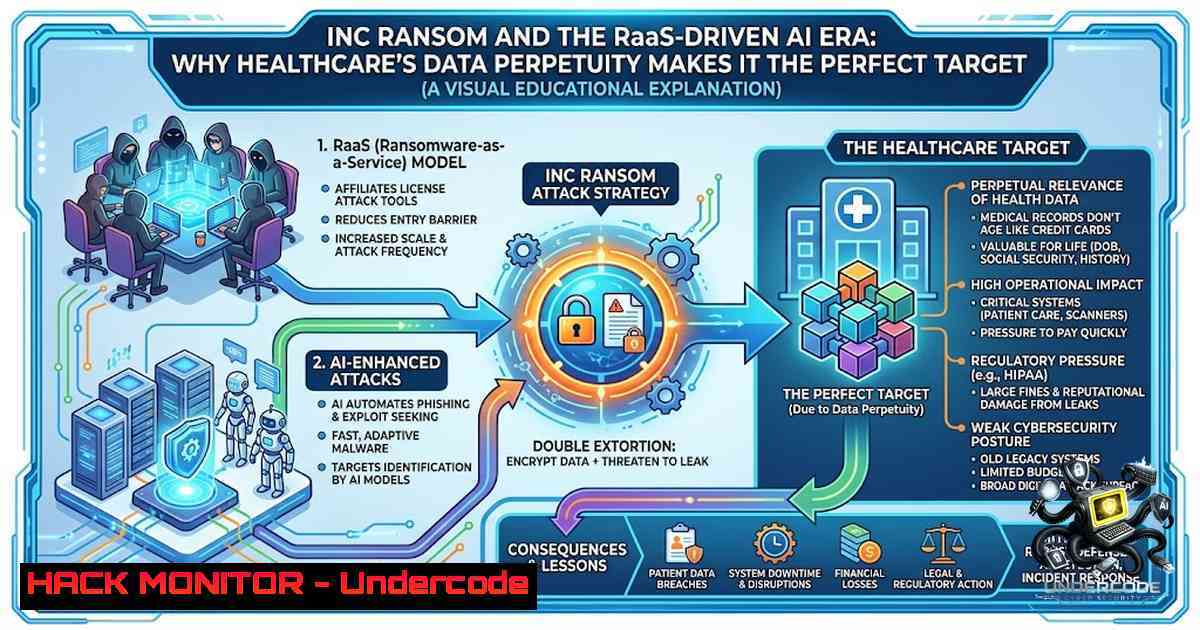
The ransomware landscape has undergone a fundamental transformation. What was once the domain of skilled hackers is now a commoditized service industry, complete with affiliate programs, revenue-sharing models, and AI-powered automation. The recent INC Ransom attack on Australian GP network Partnered Health—which saw 3.2 terabytes of patient data exfiltrated across 2.2 million files spanning 27 years of medical records—exemplifies this new reality. With healthcare data that never expires and RaaS platforms lowering the barrier to entry to “can I access this marketplace,” defenders must confront a threat landscape where the tools that empower security teams equally empower criminals.
Learning Objectives:
- Understand the Ransomware-as-a-Service (RaaS) affiliate model and how it enables low-skill attackers to execute sophisticated breaches
- Identify the specific TTPs (Tactics, Techniques, and Procedures) used by INC Ransom affiliates, including living-off-the-land tools and AI-assisted phishing
- Implement network segmentation, credential hardening, and incident response protocols tailored for healthcare environments
- Detect and block data exfiltration attempts using legitimate administrative tools abused by ransomware operators
- Build a legal and technical response plan that addresses both breach containment and regulatory obligations
You Should Know:
- The RaaS Economy: How Ransomware Became a Franchise Business
INC Ransom operates as a criminal franchise model where core developers build and maintain the ransomware platform, then lease it to “affiliates” who carry out the actual attacks in exchange for a cut of the ransom. Think of it as a dark-web franchise: the brand, tools, and infrastructure belong to INC; the break-ins happen through hired hands. Since emerging in mid-2023, INC Ransom has claimed over 885 victims, with the ACSC responding to 11 INC-related incidents in Australia between July 2024 and December 2025, predominantly affecting healthcare and professional services.
The affiliate model creates a supply chain that mirrors legitimate software-as-a-service businesses. Affiliates can purchase initial access from Initial Access Brokers (IABs) for as little as $500 to $3,000, then deploy INC’s Rust-based encryptors—protected with VMProtect 3.X on Windows and targeting VMware environments on Linux through commands like vim-cmd. The core operators handle victim communication and ransom demands, splitting proceeds with affiliates.
Technical Deep Dive: Detecting RaaS Affiliate Activity
To identify RaaS affiliate reconnaissance, monitor for these common commands executed in succession:
 Domain Admin Enumeration (T1069.002)
net group "domain admins" /domain

Domain Controller Discovery (T1016)
nltest /dclist:

Active Directory Enumeration via AdFind (T1087.002)
adfind.exe -b dc=exampleDomain,dc=net -f "objectcategory=computer"

Network Scanning (T1049)
netscan.exe /hide /auto:"C:\scans\report.xml" /range:192.168.1.0/24
These commands, documented in INC Ransom attack simulations, are used to map the victim’s domain structure and identify high-privileged accounts before lateral movement. Security teams should implement logging for these specific command-line patterns and alert on their execution, especially from non-administrative workstations.
- The Attack Chain: From Phished Password to Published Data
INC Ransom affiliates typically gain initial access through three primary vectors: spear-phishing, exploitation of unpatched internet-facing devices, or purchasing valid credentials from initial access brokers. Documented entry points include CVE-2023-3519 (Citrix NetScaler remote code execution), CVE-2023-48788 (Fortinet EMS SQL injection), and CVE-2024-57727 (SimpleHelp RMM path traversal).
Once inside, affiliates escalate privileges by creating administrator-level accounts and moving laterally within victim networks. They abuse legitimate administrative tools including AnyDesk and NETSCAN for discovery and lateral movement. Before encryption, data is staged and compressed using 7-Zip and WinRAR, then exfiltrated using rclone, MEGASync, or cloud storage services.
Detection and Response Commands
Monitor for unauthorized use of these exfiltration tools:
 Linux - Detect rclone processes and configurations
ps aux | grep rclone
find / -1ame ".conf" | grep -i rclone 2>/dev/null

Linux - Check for large archive creation in unusual locations
find / -1ame ".7z" -size +100M -mtime -1 2>/dev/null

Windows - Detect 7-Zip compression activity
Get-WinEvent -FilterHashtable @{LogName='Security'; ID=4688} |
Where-Object {$<em>.Message -match "7z.exe" -or $</em>.Message -match "WinRAR.exe"} |
Select-Object TimeCreated, Message

Windows - Detect rclone execution
Get-WinEvent -FilterHashtable @{LogName='Security'; ID=4688} |
Where-Object {$_.Message -match "rclone.exe"} |
Select-Object TimeCreated, Message
The presence of rclone on a corporate network almost always signifies malicious activity. Organizations should implement application whitelisting to block unauthorized execution of these tools.
- AI-Powered Attacks: The Force Multiplier Tipping the Scales
Generative AI is rapidly accelerating ransomware operations by reducing friction and increasing scale. Threat groups commonly use AI to draft phishing and extortion messages, debug scripts, translate content, and streamline repetitive tasks. Security researchers have uncovered how criminal groups use generative AI tools to enhance operations, with automation tools deployed to assist with coding, producing phishing templates, and creating operational tooling.
The healthcare sector has become a proving ground for AI-enabled cyberattacks, with attackers leveraging generative AI to craft highly convincing phishing emails that mimic clinical communications with near-perfect medical jargon and personalized context. According to Acronis threat data, 80% of RaaS operators have integrated AI and automation capabilities into their attack chains. AI-powered malware email attacks rose by 131% in 2025, and 61% of CISOs believe AI has directly increased ransomware risk.
AI Defense Strategy
To counter AI-generated phishing, implement:
- Phishing-resistant MFA (FIDO2/WebAuthn) rather than SMS or TOTP
- AI-powered email filtering that analyzes linguistic patterns and sender behavior
- Regular phishing simulation exercises that include AI-generated templates
- User training on verifying requests through out-of-band channels
- Network Segmentation: The Difference Between a Department Incident and an Enterprise Takeover
Segmentation can be the difference between an incident that affects one department and one that takes down the entire enterprise. For healthcare organizations, this means:
– Isolating clinical systems from administrative networks
– Segmenting patient record databases from general-purpose file servers
– Implementing microsegmentation to restrict lateral movement
– Maintaining out-of-band communication plans for incident response
Implementation Commands
 Windows - View current firewall rules and identify overly permissive policies
New-1etFirewallRule -DisplayName "Block SMB from non-clinical subnets" `
-Direction Inbound -Protocol TCP -LocalPort 445 `
-RemoteAddress "192.168.0.0/16" -Action Block

Windows - Enable Windows Defender Firewall logging for suspicious outbound traffic
Set-1etFirewallProfile -Profile Domain,Public,Private -LogFileName "C:\Windows\System32\LogFiles\Firewall\pfirewall.log" -LogMaxSize 4096 -LogAllowed True -LogBlocked True

Linux - Implement iptables restrictions for clinical data servers
iptables -A INPUT -s 192.168.0.0/16 -p tcp --dport 3306 -j DROP  Block MySQL from non-clinical subnets
iptables -A OUTPUT -d 0.0.0.0/0 -p tcp --dport 443 -m owner --uid-owner mysql -j REJECT  Prevent database exfiltration
5. The 3-2-1 Backup Strategy and Immutable Recovery
Organizations should adopt the 3-2-1 backup strategy and ensure that backups include immutable or offline copies to support recovery. For healthcare, this is particularly critical given the permanent nature of medical data.
Backup Verification Commands
 Linux - Verify backup integrity using SHA checksums
sha256sum -c backup_manifest.sha256

Linux - Test restore to isolated environment
tar -xzf /mnt/backup/clinical_data.tar.gz -C /restore_test/

Windows - Use VSSAdmin to verify shadow copy integrity
vssadmin list shadows
vssadmin list shadowstorage

Windows - Test backup restoration to isolated VLAN
 (Requires network segmentation and isolated restore environment)
- Legal and Incident Response: The Injunction Doesn’t Undo the Breach
Partnered Health obtained an injunction preventing access to the leaked data, but as the analysis correctly notes, “The court order protects the data’s confidentiality going forward. It does nothing about the breach that already happened.” Organizations that recover quickly are the ones that have invested in realistic, tested incident response plans before an attack occurs—not just having a written plan on a shelf, but conducting regular tabletop exercises that involve clinical leadership, IT, legal, communications, and executive management.
Incident Response Checklist for Healthcare
- Declare the incident immediately—empower frontline staff to escalate early
- Isolate affected systems physically to halt lateral movement
- Engage the ACSC via 1300 CYBER1 (1300 292 371)
4. Preserve forensic evidence before any remediation
- Notify the Office of the Australian Information Commissioner
6. Activate out-of-band communication channels
7. Verify backup integrity before restoration begins
What Undercode Say:
- RaaS Democratizes Cybercrime: The barrier to attacking healthcare has dropped from “am I a skilled attacker” to “can I access this marketplace.” With initial access available for as little as $500 and RaaS platforms handling the technical heavy lifting, the threat surface has expanded exponentially.
-
Healthcare Data Is Perpetual Liability: Unlike financial data that can be replaced, medical histories are permanent. This makes healthcare a persistent target—the data doesn’t expire, and the extortion leverage compounds over time as patients remain vulnerable to identity theft and medical fraud for decades.
Analysis:
The INC Ransom attack on Partnered Health is not an isolated incident but rather a harbinger of the new normal. The convergence of RaaS business models, AI-powered automation, and the healthcare sector’s inherent vulnerabilities creates a perfect storm. Organizations can no longer rely on perimeter defenses or assume that attackers lack sophistication. The tools that make two-person security teams more effective are making two-person criminal affiliates equally dangerous. The ACSC’s observation that INC affiliates target healthcare using compromised accounts, with privilege escalation and lateral movement occurring rapidly after initial access, underscores the need for zero-trust architectures and continuous verification. The advice remains unchanged but more urgent: segment clinical systems, assume the entry point will be mundane (a phished password or unpatched box), and build legal and incident response plans before they’re needed. An injunction stops people from looking at the data; it doesn’t stop it from having been taken.
Prediction:
- -1 RaaS-AI Integration Will Accelerate: As generative AI tools become more accessible and RaaS platforms integrate them natively, we will see fully autonomous ransomware pipelines that allow individual operators to attack multiple targets simultaneously at a scale exceeding anything seen in the ransomware ecosystem to date. The barrier to entry will drop further, and attack velocity will outpace most response teams’ ability to react.
-
-1 Healthcare Will Remain the Primary Target: With breach costs averaging $5.3 million per incident—25% above the next closest industry—and the permanent nature of medical data, healthcare will continue to be the most attractive sector for ransomware operators. The operational pressure to restore systems quickly will drive more ransom payments, reinforcing the cycle.
-
+1 Regulatory Pressure Will Force Change: The Partnered Health breach, following similar incidents targeting NHS Scotland and Tonga’s Ministry of Health, will accelerate regulatory action. We can expect stricter mandatory breach notification timelines, higher penalties for inadequate security, and potential legislation requiring healthcare organizations to maintain immutable backups and implement specific security controls like the ACSC’s Essential Eight.
-
+1 AI Defense Will Mature: Just as attackers use AI to automate attacks, defenders will deploy AI-powered threat detection, automated incident response, and predictive analytics to identify compromises before data exfiltration occurs. The arms race will intensify, but organizations that invest early in AI defense capabilities will have a significant advantage.
-
-1 The Injunction Fallacy Will Persist: Many organizations will continue to view legal remedies (injunctions, cease-and-desist orders) as sufficient response to data breaches, failing to address the fundamental security gaps that allowed the breach to occur. This reactive approach will leave them vulnerable to repeat attacks, as the Partnered Health case demonstrates—the data was already stolen before the court order was obtained.
▶️ Related Video (76% Match):
https://www.youtube.com/watch?v=3isz4nP_28M
🎯Let’s Practice For Free:
🎓 Live Courses & Certifications:
Join Undercode Academy for Verified Certifications
🚀 Request a Custom Project:
Secure, high-velocity infrastructure and disruptive technological engineering. Contact our engineering team for high-tier development and proprietary systems:
[email protected]
💎 Smart Architecture | 🛡️ Secure by Design | ⭐ Trusted by Thousands
IT/Security Reporter URL:
Reported By: Eugene Nolan – Hackers Feeds
Extra Hub: Undercode MoN
Basic Verification: Pass ✅


