Listen to this Post
Introduction:
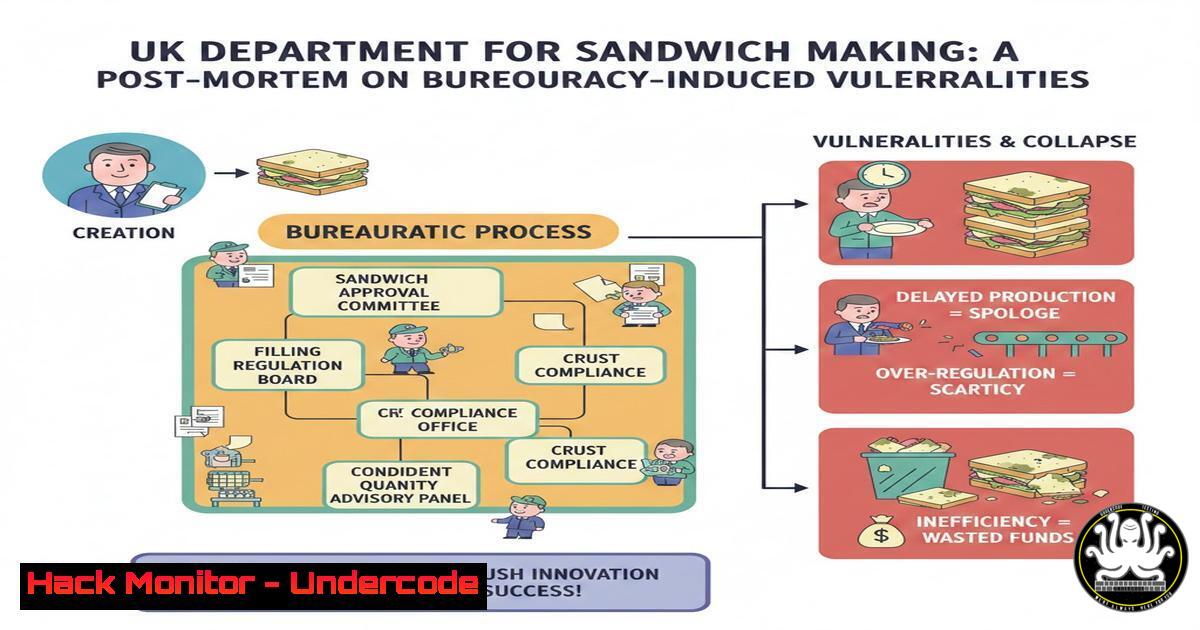
The recent viral LinkedIn meme hypothesizing a UK government “Department for Sandwich Making” serves as a perfect analogy for over-engineered, bureaucratic processes that plague IT departments and DevSecOps pipelines worldwide. Just as a simple sandwich becomes an “impossible environment” (as noted by commenter Alex Jovanovic) through excessive red tape, a simple software deployment can collapse under the weight of non-compliance checks, redundant security layers, and misconfigured cloud assets. This article deconstructs the “Sandwich Department” failure mode, extracting technical lessons on how to avoid supply chain bottlenecks, cloud misconfigurations, and API sprawl.
Learning Objectives:
- Analyze how bureaucratic processes (bloat) introduce systemic vulnerabilities in CI/CD pipelines.
- Identify specific Linux and Windows commands to audit “over-permissioned” systems and services.
- Implement lean security controls (the “minimum viable bread”) to prevent runtime failures.
You Should Know:
1. The “Quango” Cloud: Auditing Over-Provisioned IAM Roles
The meme references a “think tank” taking two years to state the obvious—a direct parallel to cloud environments where over-privileged IAM roles sit unused, creating massive attack surfaces. In the rush to comply with vague governance, administrators often grant “AdministratorAccess” just to “make the sandwich” (get the app running).
To audit this in AWS, you would use the CLI to identify unused roles:
aws iam list-roles --query 'Roles[?Arn!=<code>None</code>]' --output text | while read line; do
ROLE_NAME=$(echo $line | awk '{print $6}')
LAST_USED=$(aws iam get-role --role-name $ROLE_NAME --query 'Role.RoleLastUsed.LastUsedDate' --output text)
if [[ "$LAST_USED" == "None" ]]; then
echo "Role $ROLE_NAME has never been used. Possible bloat."
fi
done
In Windows Server, you can audit local groups for users who shouldn’t be in the “Administrators” group:
Get-LocalGroupMember -Group "Administrators" | Where-Object { $_.PrincipalSource -ne "Local" }
This identifies domain users who have been granted local admin rights unnecessarily—the digital equivalent of letting the policy team slice the bread.
2. Supply Chain Integrity: The “Lab-Grown Ham” Problem
Commenter Mike Searle suggested the sandwich would feature “lab-grown rubbish,” a nod to the rise of AI-generated code and third-party libraries. Attackers are increasingly injecting malicious code into popular open-source packages (dependency confusion). If your “sandwich” (application) relies on a package that has been poisoned, the entire system fails.
To verify the integrity of your dependencies in a Linux (Debian/Ubuntu) environment, you must check package signatures:
 Verify a specific .deb package signature
dpkg-sig --verify package.deb

Check for known vulnerabilities in installed packages
apt list --upgradable 2>/dev/null | grep -i security
For Node.js applications (a common pipeline component), audit the supply chain:
npm audit --json | jq '.["vulnerabilities"] | to_entries[] | {package: .key, severity: .value.severity}'
If you find a vulnerability marked “high” or “critical,” you must immediately patch or replace the ingredient.
3. Hardening the “Impossible Environment”
Alex Jovanovic’s comment about “impossible environments” resonates deeply with security engineers. These environments are often created by misconfigured Docker containers or virtual machines running with unnecessary privileges.
To harden a Linux host against escape attacks (container breakout), you must modify sysctl parameters:
 Prevent IP spoofing and mitigate certain DoS attacks
sudo sysctl -w net.ipv4.conf.all.rp_filter=1
sudo sysctl -w net.ipv4.tcp_syncookies=1
sudo sysctl -w kernel.kptr_restrict=2
On the Windows side, hardening against lateral movement involves restricting Kerberos ticket delegation. Use `klist` to view current tickets, and modify GPOs to enforce “Protected Users” group membership.
 List Kerberos tickets for current user
klist tickets

Check if the Protected Users group is populated
Get-ADGroupMember -Identity "Protected Users"
An empty Protected Users group is like a sandwich with no filling—security theater.
4. API Gateway: Preventing the “Quango” Sprawl
The meme suggests a quango (quasi-autonomous NGO) would be created to manage the sandwich. In IT, this is equivalent to spinning up dozens of microservices and API gateways without a clear strategy. This leads to Shadow APIs and unauthenticated endpoints.
To discover exposed APIs on a network, Nmap can be used with specific scripts:
 Discover HTTP methods and potential API endpoints
nmap -p 8080 --script http-methods,http-open-proxy <target>

Use ffuf to fuzz for hidden API directories
ffuf -u https://target.com/FUZZ -w /usr/share/wordlists/api_discovery.txt -mc 200,403
For cloud-native environments (AWS API Gateway), you must check for logging:
 Check if execution logging is enabled for a REST API
aws apigateway get-stages --rest-api-id <api-id> --query 'item[?stageName==<code>prod</code>].accessLogSettings'
If logging is off, you have no visibility into who is eating your sandwich.
5. Vulnerability Exploitation: The “Missing Butter” Attack
Dwight Diotte’s comment, “No butter!?”, highlights a missing essential component. In cybersecurity, missing a single control (like patching) can lead to full system compromise. A real-world example is the PrintNightmare vulnerability (CVE-2021-34527).
To exploit this on a vulnerable Windows system (for educational purposes in a lab), an attacker might use:
 Check if the Print Spooler is running (vulnerable if enabled)
Get-Service -Name Spooler

If running and unpatched, an attacker could add a new admin user remotely
 (POC: This requires additional tooling like Impacket)
The mitigation is immediate:
 Disable the Print Spooler service if not needed
Stop-Service -Name Spooler -Force
Set-Service -Name Spooler -StartupType Disabled
Just as a dry sandwich is inedible, an unpatched service is a liability.
- Linux Kernel Hardening: The “Bread Type Diversity” Check
Paul Howlett’s sarcastic query about bread diversity mirrors the security debate over kernel module loading. Allowing any user to load kernel modules is like allowing any citizen to redesign the bakery.
To lock this down in Linux, restrict module loading:
 Disable loading of new modules entirely (for production servers)
echo "kernel.modules_disabled = 1" >> /etc/sysctl.d/99-disable-modules.conf
sysctl -p /etc/sysctl.d/99-disable-modules.conf

Or, only allow signed modules
echo "module.sig_enforce=1" >> /etc/default/grub
update-grub
Verify loaded modules to spot malicious rootkits:
lsmod | grep -i hide
A hidden module is often a sign of kernel-level malware.
7. Windows Registry: Auditing the “After Tax” Leftovers
Mick Webb’s “After Tax” comment illustrates the concept of residual data—what’s left after the main event. Attackers hunt for leftovers in the Windows Registry (like saved passwords or autologon credentials).
To audit for these leftovers:
 Check for AutoAdminLogon (stored plaintext passwords)
Get-ItemProperty -Path "HKLM:\SOFTWARE\Microsoft\Windows NT\CurrentVersion\Winlogon" -Name AutoAdminLogon

Search for passwords in registry keys (slow, but effective)
Get-ChildItem -Path HKLM:\ -Recurse | Where-Object { $_.Name -match "password" }
If AutoAdminLogon is set to “1,” the system is essentially leaving the keys to the bakery in the lock.
What Undercode Say:
- Key Takeaway 1: Bureaucratic complexity in IT (IAM sprawl, unused microservices) is not just a cost issue—it is a direct security vulnerability. Every “quango” in your cloud architecture is a potential entry point for an attacker.
- Key Takeaway 2: The human tendency to over-engineer solutions (“diversification of bread”) must be countered with ruthless automation and auditing. If a control cannot be validated by a script within seconds, it is likely misconfigured.
The LinkedIn meme, while humorous, perfectly encapsulates the current state of over-regulated IT environments. The path to resilience is not more committees, but leaner configurations, continuous auditing of IAM roles, and a relentless focus on patching the “missing butter” vulnerabilities before they are exploited.
Prediction:
As AI-generated code becomes prevalent, we will see a rise in “lab-grown” supply chain attacks. The future of cybersecurity will pivot from protecting the code we write to verifying the provenance of every digital ingredient, with blockchain-based Software Bills of Materials (SBOMs) becoming mandatory, much like food ingredient labels. The “Department for Sandwich Making” will be replaced by automated, zero-trust CI/CD pipelines that reject any untrusted component before it reaches production.
▶️ Related Video (80% Match):
🎯Let’s Practice For Free:
IT/Security Reporter URL:
Reported By: Ianwest1 If – Hackers Feeds
Extra Hub: Undercode MoN
Basic Verification: Pass ✅


