Listen to this Post
Introduction:
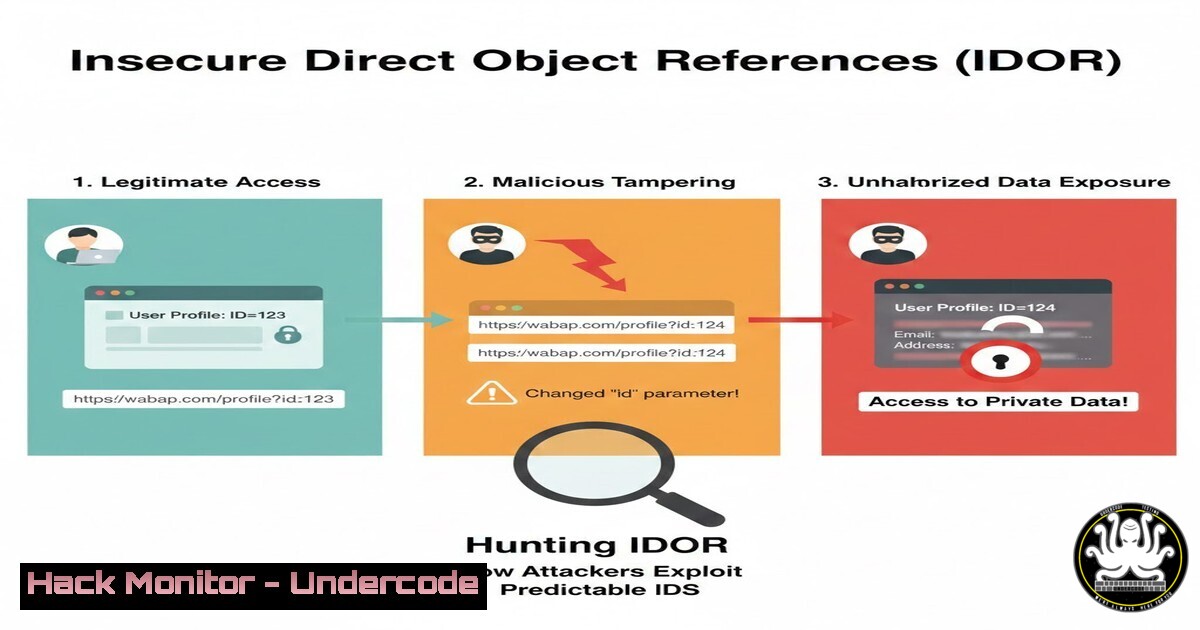
In the complex ecosystem of web application security, some of the most damaging vulnerabilities are often the simplest to exploit. Based on recent industry discussions regarding web application vulnerabilities and fundamental security concepts, this article dives deep into one of the most prevalent and dangerous flaws: Insecure Direct Object References (IDOR). This vulnerability occurs when an application exposes a reference to an internal object, such as a file, database record, or user account, without proper authorization checks, allowing attackers to manipulate these references to access unauthorized data.
Learning Objectives:
- Understand the core mechanics of IDOR vulnerabilities and how they differ from broken access controls.
- Learn to identify and manually exploit IDORs using browser developer tools and parameter manipulation.
- Implement robust mitigation strategies, including reference maps and strict access control checks, in various development environments.
You Should Know:
- Anatomy of an IDOR: Parameter Tampering in the Wild
IDOR vulnerabilities typically manifest when an application uses user-supplied input to access objects directly. Consider a standard REST API endpoint:https://example.com/api/v1/users/12345`. The application retrieves user data based on the ID `12345` from the URL. If the server verifies that the user is authenticated but fails to verify that the authenticated user is authorized to access the resource for user12345`, an IDOR exists.
Step‑by‑step guide to identifying a basic IDOR:
- Log in to the application with a standard user account (User A).
- Navigate to a feature that displays your private data (e.g., profile, invoice, support ticket).
- Intercept the request using a proxy tool like Burp Suite, or simply open your browser’s Developer Tools (F12), go to the Network tab, and find the request.
- Examine the URL or POST body for identifiers. Look for parameters like
?id=,?file=,?user_id=,invoice=,?ticket_number=. - Modify the value of the parameter to a different, but predictable, value (e.g., change `id=12345` to
id=12346). - Forward the request and observe the response. If you can view User B’s private data, you have successfully identified an IDOR.
2. Automated Discovery with Command-Line Tools
While manual testing is crucial, automating the discovery of predictable patterns can save time. Tools like `curl` and `ffuf` (Ffuf) are invaluable for fuzzing parameters.
Linux Command Example (Fuzzing with ffuf):
Assuming you have identified a user ID parameter (user_id) that might be vulnerable, you can use a list of potential IDs (e.g., a sequence from 1000-2000) to test for accessible data.
 Install ffuf if not already present (sudo apt install ffuf - Debian/Ubuntu)
 Create a simple list of IDs using seq
seq 1000 2000 > ids.txt

Fuzz the user_id parameter and filter out responses with a specific size (e.g., the "not found" page size)
ffuf -u https://example.com/api/profile?user_id=FUZZ -w ids.txt -fs 1024
Explanation: This command replaces the `FUZZ` keyword in the URL with each ID from ids.txt. The `-fs 1024` flag filters out responses that are 1024 bytes in size (assuming that’s the size of the “access denied” or “not found” page), leaving only potential hits where data was returned.
Windows Command Example (using cURL in PowerShell):
You can create a simple loop in PowerShell to test a range of IDs.
 PowerShell loop to test a range of IDs
for ($i=1000; $i -le 2000; $i++) {
$url = "https://example.com/api/profile?user_id=$i"
$response = Invoke-RestMethod -Uri $url -Headers @{Authorization = "Bearer YOUR_TOKEN_HERE"} -ErrorAction SilentlyContinue
if ($response -ne $null) {
Write-Output "Potential Hit: $url"
 Optionally print the response content
 $response | ConvertTo-Json
}
}
3. Exploiting IDOR in API Endpoints and GraphQL
Modern applications rely heavily on APIs, where IDORs are rampant. In RESTful APIs, the vulnerability often lies in HTTP methods. For instance, a user might be able to `GET` their own invoice, but can they `PUT` or `DELETE` someone else’s?
A more complex vector is in GraphQL, where a single query can request nested resources. An attacker might modify an argument within a query to fetch data from an unrelated object.
Example GraphQL Exploit:
A legitimate query might look like this:
query {
user(id: "12345") {
name
email
posts {
title
}
}
}
An attacker modifies it to:
query {
user(id: "12346") {
name
email
privateNotes {  Attempt to access a field not intended for the current user
content
}
}
}
4. Advanced Exploitation: Horizontal vs. Vertical Privilege Escalation
IDORs can be used for both horizontal and vertical privilege escalation.
– Horizontal: Accessing data of a user with the same privilege level (e.g., User A accessing User B’s email).
– Vertical: Accessing data or functionality of a user with higher privileges (e.g., a standard user modifying a parameter to access an admin panel: `https://example.com/admin/deleteUser?user_id=123`).
Windows Command Example (Testing for Vertical Escalation):
REM Attempting to access an admin function as a standard user
curl -X POST https://example.com/admin/deleteUser ^
-H "Cookie: session=YOUR_STANDARD_USER_SESSION" ^
-d "user_id=12345"
If the server processes this request without checking if the session belongs to an admin, it is vulnerable.
5. Mitigation: Implementing Indirect Reference Maps
The primary fix for IDOR is to avoid exposing direct object references. Instead, use indirect reference maps. When a user requests a resource, the application generates a temporary, random, per-user mapping.
Python (Flask) Code Example (Conceptual):
import uuid
from flask import session

On login, generate a map for the user's accessible resources
user_resources = {
'real_id_123': 'note_1',
'real_id_456': 'note_2'
}
 Store this mapping in the user's session
session['resource_map'] = {v: k for k, v in user_resources.items()}

When serving a request for /note/note_1
def get_note(indirect_id):
real_id = session['resource_map'].get(indirect_id)
if real_id:
 Fetch the note using real_id
return fetch_from_db(real_id)
else:
return "Access Denied", 403
6. Mitigation: Enforcing Robust Access Control Checks
Even with indirect references, you must verify authorization on the server side for every request. Never rely on the client to enforce security.
Linux Command (Checking Logs for IDOR Attempts):
 Grep web server access logs for attempts to traverse IDs
sudo grep -E "GET /api/user/[0-9]{5}" /var/log/nginx/access.log | awk '{print $1, $7}' | sort | uniq -c | sort -nr
This command helps identify if a single IP ($1) is requesting a wide range of user IDs ($7), which could indicate an automated IDOR scanning attempt.
What Undercode Say:
- The Human Element: IDORs are fundamentally a logic flaw, not a cryptographic one. They highlight a failure in the development process to map user actions to authorization checks, emphasizing that security must be integrated into the design phase, not just the testing phase.
- Beyond the URL: While often found in URLs, IDORs can lurk in JSON bodies, HTTP headers, and even cookies. Modern applications using microservices are particularly susceptible, as a service might trust an internal `user_id` header passed from another service without re-validating it.
- Defense in Depth: Relying solely on obfuscation (like hashed IDs) is not a fix. A hashed ID like `https://example.com/user/MTIzNDU=` (Base64 of “12345”) is trivially decoded. True security requires combining unpredictable identifiers with rigorous, server-side authorization checks.
Prediction:
As application architectures shift towards serverless functions and microservices, the attack surface for IDORs will expand. The complexity of managing authorization across distributed systems, where a user context may be lost or improperly propagated, will become a primary battleground. We will likely see a rise in “IDOR chains,” where one minor IDOR in a helper service leads to a critical breach in a core system, forcing the industry to adopt more robust, standardized authorization frameworks like Open Policy Agent (OPA) to maintain a consistent security posture across the entire application fabric.
▶️ Related Video (78% Match):
🎯Let’s Practice For Free:
IT/Security Reporter URL:
Reported By: Https: – Hackers Feeds
Extra Hub: Undercode MoN
Basic Verification: Pass ✅


