
Listen to this Post
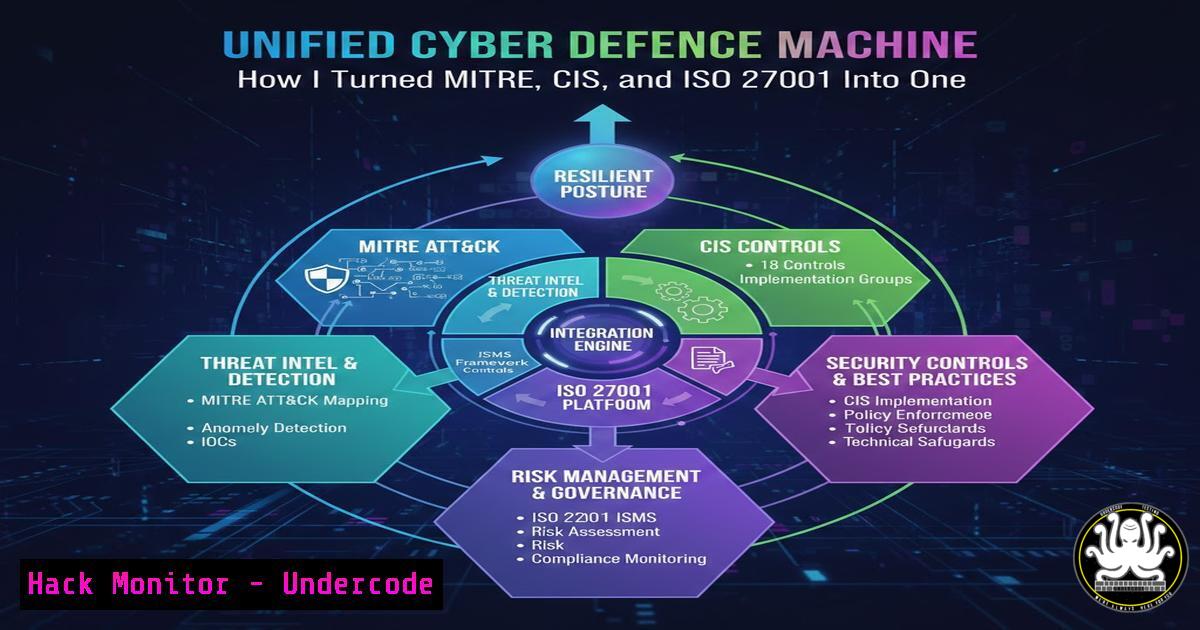
Introduction:
In the chaotic landscape of enterprise cybersecurity, compliance teams often treat every framework as a siloed checklist, drowning in paperwork while real threats exploit the gaps. The smarter approach is not to adopt more standards, but to integrate them into a single, operational loop. By merging the “what” of attacker behavior (MITRE ATT&CK) with the “how” of technical hardening (CIS Controls) and the “why” of risk management (ISO 27001), organizations can build a measurable defence system that reduces administrative sprawl and actually stops attacks.
Learning Objectives:
- Understand how to map the MITRE ATT&CK framework to specific CIS Controls for actionable threat mitigation.
- Learn to translate CIS Benchmarks into verifiable ISO 27002 control statements for audit readiness.
- Develop a unified operational loop that integrates threat intelligence, technical implementation, and risk governance.
You Should Know:
- Deconstructing the Trinity: The WHAT, HOW, and WHY
The post outlines a critical distinction often missed in GRC (Governance, Risk, and Compliance). You cannot defend against what you do not understand, and you cannot govern what you cannot measure.
– The WHAT (MITRE ATT&CK): This is your threat model. It provides a living library of adversary tactics (like Persistence or Lateral Movement) and techniques (like T1078 – Valid Accounts). It answers the question: “What are we defending against?”
– The HOW (CIS Controls & Benchmarks): This is your technical configuration standard. The Center for Internet Security (CIS) provides prioritized safeguards and configuration benchmarks for specific systems (e.g., CIS Benchmark for Windows Server 2022). It answers: “How do we configure our machines to stop these attacks?”
– The WHY (ISO 27001:2022): This is your management system. Annex A of ISO 27001 provides a list of controls (A.5 to A.8), but ISO 27002 offers the detailed implementation guidance. This framework ensures that your technical controls are risk-based, have assigned owners, and are subject to continual improvement and audit.
- Building the Bridge: Mapping CIS Controls to ISO 27002
To operationalize this, you must create a living document that links the practical hardening of CIS to the formal language of ISO. For example, an auditor asks for evidence of “Access Control,” but your engineers need a command to implement it.
Step‑by‑step guide to mapping and implementing a control:
Let’s take ISO 27001:2022 Annex A Control 8.8 (Management of Technical Vulnerabilities) .
1. Identify the ISO Objective: Ensure vulnerabilities are identified and remediated.
2. Map to CIS Control: Look at CIS Control 7 (Continuous Vulnerability Management) .
3. Map to CIS Benchmark (Technical Hardening): Open the CIS Benchmark for your specific OS (e.g., Ubuntu Linux 22.04 LTS). Locate a recommendation related to patching or vulnerability scanning.
Linux Hardening Command (Based on CIS Benchmark):
To automate patch management (covering ISO 8.8 and CIS Control 7), you would configure automatic updates. On an Ubuntu system, you would edit the unattended-upgrades configuration:
 Edit the configuration file
sudo nano /etc/apt/apt.conf.d/50unattended-upgrades

Uncomment and ensure the following lines are present to apply security updates automatically
Unattended-Upgrade::Allowed-Origins {
"${distro_id}:${distro_codename}";
"${distro_id}:${distro_codename}-security";
// "${distro_id}:${distro_codename}-updates";
};

Enable automatic updates in the main apt configuration
sudo nano /etc/apt/apt.conf.d/20auto-upgrades

Set the following values
APT::Periodic::Update-Package-Lists "1";
APT::Periodic::Download-Upgradeable-Packages "1";
APT::Periodic::AutocleanInterval "7";
APT::Periodic::Unattended-Upgrade "1";
What this does: This ensures your system automatically downloads and installs security patches, providing technical evidence for ISO Control 8.8 and satisfying the intent of CIS Control 7 without manual intervention.
- Operationalizing the Loop: From Threat Intel to Block Rule
The power of this model is the feedback loop. When a new attack technique appears in MITRE, you can trace it down to a specific firewall or endpoint rule.
Scenario: MITRE highlights T1566.001 (Phishing: Spearphishing Attachment) .
1. MITRE (WHAT): Attackers are sending malicious attachments.
- CIS (HOW): Look at CIS Control 9 (Email and Web Browser Protections) . Specifically, CIS recommends blocking dangerous file types at the email gateway.
- ISO (WHY): This maps to ISO 27002 Control 8.7 (Protection against malware) and 5.14 (Information transfer) .
Windows / Exchange Online (PowerShell) Implementation:
To block specific malicious attachment types at the gateway level (simulating a Defender for Office 365 policy), you would use PowerShell to connect to Exchange Online and create a malware filter rule.
 Connect to Exchange Online
Connect-ExchangeOnline

Create a new malware filter policy to block specific file types (CIS Control 9)
New-MalwareFilterPolicy -Name "BlockExecutablesPolicy" -Enable $true -FileTypes "exe","scr","vbs","js","jar"

Apply the policy to all domains (scope)
New-MalwareFilterRule -Name "BlockExecutablesRule" -MalwareFilterPolicy "BlockExecutablesPolicy" -RecipientDomainIs "" -State Enabled

Verify the configuration
Get-MalwareFilterPolicy | Format-List Name,FileTypes,State
What this does: This PowerShell script directly translates the CIS recommendation into a technical control, providing the “HOW” that fulfills the ISO requirement for malware protection and directly mitigates the MITRE technique.
4. Creating the Risk Register (ISO: The WHY)
Once the technical control is in place, you need to document the “WHY” for the auditors and the risk manager.
– Asset: Email Gateway / User Mailboxes.
– Threat (MITRE): T1566.001 – Spearphishing Attachment.
– Vulnerability: User may open malicious attachments.
– Control (CIS/Technical): PowerShell script blocking executables via email.
– Residual Risk: Low (scripts blocked, but links may still be clicked).
– Owner: Security Operations Manager.
5. Testing the Control (Verification)
You must ensure the control works. This moves you from “paper security” to “practical defence.”
Linux Verification Command:
Simulate an attempt to download a malicious file type from a command line to test egress filtering (another CIS Control):
 Attempt to download a test executable file (use a known safe test file like eicar)
wget https://secure.eicar.org/eicar.com.exe

If your network perimeter (CIS Control 12: Network Infrastructure Management) is configured correctly, this should be blocked.
 Expected output: "ERROR: The certificate of 'secure.eicar.org' is not trusted." or a connection timeout if the domain/IP is blocked.
6. Reporting and Metrics (Continual Improvement)
ISO 27001 demands continual improvement. Use the MITRE layer as a heatmap.
1. List the top 10 MITRE techniques relevant to your industry.
2. Map them to your implemented CIS Controls.
3. Create a “Coverage Score.” For example:
- T1566.001: Covered by email filter (Score: 100%).
- T1078 (Valid Accounts): Covered by MFA (Score: 100%).
- T1550.001 (Use Alternate Authentication Material: Application Access Token): Currently reviewing OAuth apps (Score: 50%).
What Undercode Say:
- Stop Treating Frameworks as Religion: The key takeaway is that MITRE, CIS, and ISO are not competing religions. They are layers of the same cake. Viewing them as a single ecosystem rather than individual checklists is the only way to align technical teams (who love MITRE) with audit teams (who love ISO).
- Context is King: The magic is not in the framework itself, but in the mapping. The hard work is creating the translation layer between the technical jargon of a Linux patch command (CIS) and the governance language of an ISO “Statement of Applicability.” Organizations that do this mapping once have a strategic advantage.
The convergence of threat intelligence (MITRE) with technical hardening (CIS) and governance (ISO) creates a defence that is both lean and auditable. It transforms security from a bureaucratic burden into an engineering discipline. The ultimate goal is to ensure that when a new vulnerability drops, you can instantly answer: “Does this affect our environment, which control covers it, and is it configured correctly?”
Prediction:
We will see the rise of “Compliance as Code” tools that automate this entire loop. Within the next three years, expect platforms that ingest MITRE updates, automatically adjust cloud infrastructure configurations (CIS hardening) via Infrastructure as Code (IaC), and generate real-time ISO 27001 audit evidence, rendering manual spreadsheets and static annual audits obsolete.
▶️ Related Video (80% Match):
🎯Let’s Practice For Free:
IT/Security Reporter URL:
Reported By: Cyberkarl Cybersecurity – Hackers Feeds
Extra Hub: Undercode MoN
Basic Verification: Pass ✅


