Listen to this Post
Introduction:
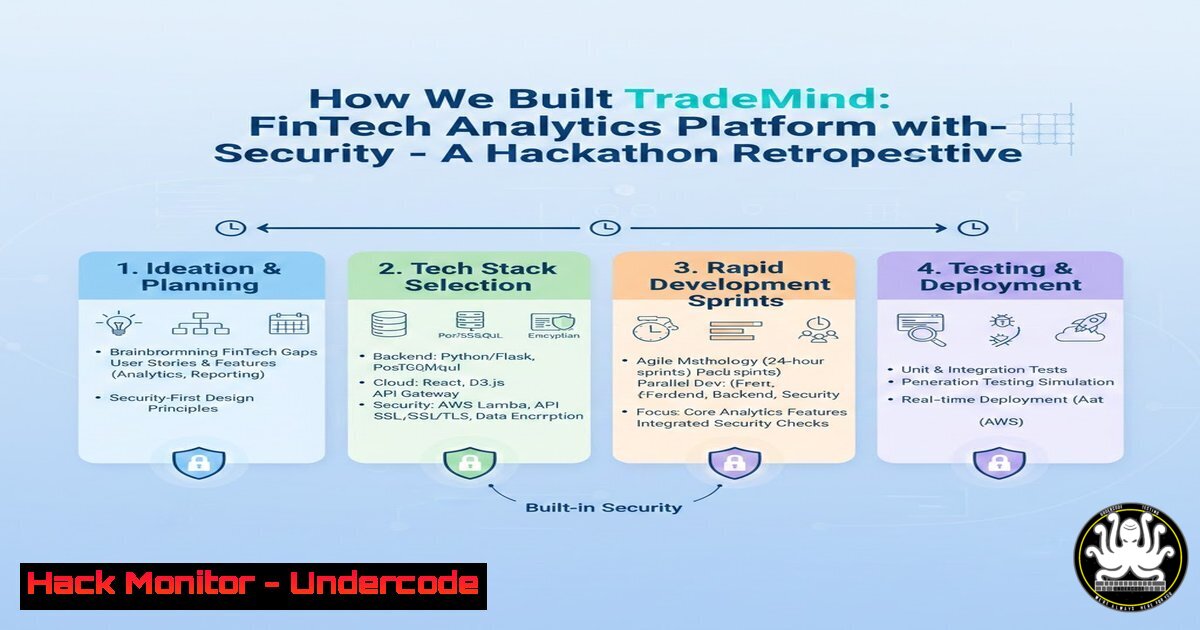
In the fast-paced world of hackathons, building a production‑ready solution often overshadows security considerations. TradeMind, a data analytics platform developed at CodeForge, processes sensitive options market data using Python, FastAPI, and PostgreSQL. While the core functionality delivers market insights through anomaly detection and interactive dashboards, the underlying infrastructure must be hardened against cyber threats. This article dissects TradeMind’s architecture from a security perspective, providing a step‑by‑step guide to building and securing a similar FinTech analytics pipeline.
Learning Objectives:
- Understand the end‑to‑end architecture of a data analytics platform for financial markets.
- Learn to implement security controls at every layer: development environment, database, API, and deployment.
- Explore how machine learning can be leveraged for both market anomaly detection and cybersecurity threat identification.
You Should Know:
1. Hardening the Development Environment
A secure pipeline begins with a locked‑down development environment. For TradeMind, we used Python’s virtual environments to isolate dependencies and prevent version conflicts that could introduce vulnerabilities.
Step‑by‑step guide:
 Create and activate a virtual environment
python -m venv trademind-env
source trademind-env/bin/activate  Linux/macOS
trademind-env\Scripts\activate  Windows

Install required packages
pip install pandas numpy psycopg2-binary fastapi uvicorn streamlit scikit-learn

Scan dependencies for known vulnerabilities
pip install safety
safety check
Additionally, we containerized the application using Docker to ensure consistency across environments. The Dockerfile includes a non‑root user and minimal base image to reduce attack surface:
FROM python:3.9-slim
RUN useradd -m trademind
USER trademind
WORKDIR /app
COPY requirements.txt .
RUN pip install --user -r requirements.txt
COPY . .
CMD ["uvicorn", "main:app", "--host", "0.0.0.0", "--port", "8000"]
2. Securing the Data Pipeline (Pandas & NumPy)
TradeMind ingests raw options data using Pandas and NumPy. Beyond data cleaning, we implemented strict input validation to thwart CSV injection and denial‑of‑service attacks.
Code snippet:
import pandas as pd
import numpy as np

def load_and_validate_data(file_path):
 Only allow expected columns and data types
expected_dtypes = {
'symbol': str,
'strike': float,
'volume': int,
'open_interest': int
}
df = pd.read_csv(file_path)
 Validate columns
if not set(expected_dtypes.keys()).issubset(df.columns):
raise ValueError("Missing required columns")
 Sanitize string fields to prevent injection
df['symbol'] = df['symbol'].apply(lambda x: x.strip().upper())
return df
3. Hardening PostgreSQL for Financial Data
The PostgreSQL database stores sensitive processed data. We enforced encryption in transit, strong authentication, and least‑privilege access.
Commands (Linux):
 Generate SSL certificate for PostgreSQL
openssl req -new -text -nodes -subj "/CN=postgres" -out server.req
openssl rsa -in privkey.pem -out server.key
openssl req -x509 -in server.req -text -key server.key -out server.crt
chmod 600 server.key
sudo mv server.key server.crt /var/lib/postgresql/12/main/

Edit postgresql.conf to enable SSL
ssl = on
ssl_cert_file = 'server.crt'
ssl_key_file = 'server.key'

Restrict connections in pg_hba.conf
hostssl trademind trademind_user 192.168.1.0/24 md5
Always use environment variables for credentials, never hardcode them:
import os
from sqlalchemy import create_engine
engine = create_engine(os.getenv('DATABASE_URL'))
4. Securing the FastAPI Backend
TradeMind’s FastAPI backend exposes endpoints for analysis. We added JWT authentication, rate limiting, and input validation using Pydantic.
Implementation:
from fastapi import FastAPI, Depends, HTTPException
from fastapi.security import HTTPBearer, HTTPAuthorizationCredentials
from slowapi import Limiter, _rate_limit_exceeded_handler
from slowapi.util import get_remote_address
import jwt

app = FastAPI()
limiter = Limiter(key_func=get_remote_address)
app.state.limiter = limiter
app.add_exception_handler(429, _rate_limit_exceeded_handler)

security = HTTPBearer()
SECRET_KEY = os.getenv('JWT_SECRET')

def verify_jwt(credentials: HTTPAuthorizationCredentials = Depends(security)):
try:
payload = jwt.decode(credentials.credentials, SECRET_KEY, algorithms=['HS256'])
return payload
except jwt.PyJWTError:
raise HTTPException(status_code=403, detail="Invalid token")

@app.get("/api/analysis")
@limiter.limit("5/minute")
async def get_analysis(user=Depends(verify_jwt)):
 Return market insights
return {"message": "Sensitive data"}
5. Deploying the Streamlit Dashboard with HTTPS
The interactive dashboard visualizes insights but must be served securely. We placed Streamlit behind an Nginx reverse proxy with Let’s Encrypt SSL.
Commands (Linux):
 Install and configure Nginx
sudo apt install nginx certbot python3-certbot-nginx

Obtain SSL certificate
sudo certbot --nginx -d dashboard.trademind.com

Nginx configuration snippet
server {
listen 443 ssl;
server_name dashboard.trademind.com;
ssl_certificate /etc/letsencrypt/live/dashboard.trademind.com/fullchain.pem;
ssl_certificate_key /etc/letsencrypt/live/dashboard.trademind.com/privkey.pem;

location / {
proxy_pass http://127.0.0.1:8501;
proxy_set_header Host $host;
proxy_set_header X-Real-IP $remote_addr;
}
}
Additionally, we added basic authentication to the dashboard using Streamlit’s secrets management:
 .streamlit/secrets.toml
[bash]
password = "hashed_password_here"
6. Machine Learning for Dual‑Purpose Anomaly Detection
TradeMind uses Isolation Forest to detect unusual trading patterns. The same model can flag potential cybersecurity incidents by monitoring API access patterns or data exfiltration attempts.
Training snippet:
from sklearn.ensemble import IsolationForest
import joblib

Features: volume, open_interest, put_call_ratio, etc.
X = np.array([[...], ...])
model = IsolationForest(contamination=0.05, random_state=42)
model.fit(X)

Save model for later use
joblib.dump(model, 'anomaly_detector.pkl')

In production, use it to score new data
def detect_anomalies(new_data):
preds = model.predict(new_data)
return preds == -1  -1 indicates anomaly
7. Post‑Deployment Security Testing
After deployment, we performed security scans to identify misconfigurations.
Commands:
 Nikto web server scanner
nikto -h https://dashboard.trademind.com

OWASP ZAP baseline scan
zap-cli quick-scan --self-contained --start-options '-config api.disablekey=true' https://api.trademind.com

Nmap port scan to check open ports
nmap -sV -p- api.trademind.com
We also integrated static analysis tools like Bandit into the CI/CD pipeline:
pip install bandit
bandit -r /path/to/trademind/
What Undercode Say:
- Key Takeaway 1: Security must be embedded from day one—even in a hackathon project. TradeMind’s success lies not only in its analytics but in its resilience against common web and database attacks.
- Key Takeaway 2: Machine learning models can serve a dual purpose: detecting market anomalies and spotting suspicious user behavior that may indicate a breach. This convergence is critical in modern FinTech.
Analysis: As financial platforms increasingly rely on real‑time data and ML, the attack surface expands. TradeMind’s approach—securing the development environment, database, API, and deployment—demonstrates that robust security can be achieved without sacrificing agility. The use of open‑source tools like FastAPI, PostgreSQL, and Streamlit, when properly hardened, offers a solid foundation. However, continuous monitoring and regular security updates remain essential. The integration of anomaly detection for both market and security events is a forward‑thinking strategy that aligns with the industry’s shift toward AI‑driven defense. In the future, such platforms will likely incorporate automated threat intelligence and real‑time response mechanisms, making them not just data analytics tools but active guardians of financial integrity.
Prediction:
Within the next three years, FinTech analytics platforms will routinely embed AI‑based security modules that detect and respond to both market manipulation and cyber intrusions. TradeMind’s architecture foreshadows this evolution, where data pipelines become self‑defending, leveraging the same machine learning that powers market insights to block malicious activities in real time.
▶️ Related Video (78% Match):
🎯Let’s Practice For Free:
IT/Security Reporter URL:
Reported By: Meetidoshi2007 Hackathon – Hackers Feeds
Extra Hub: Undercode MoN
Basic Verification: Pass ✅


