Listen to this Post
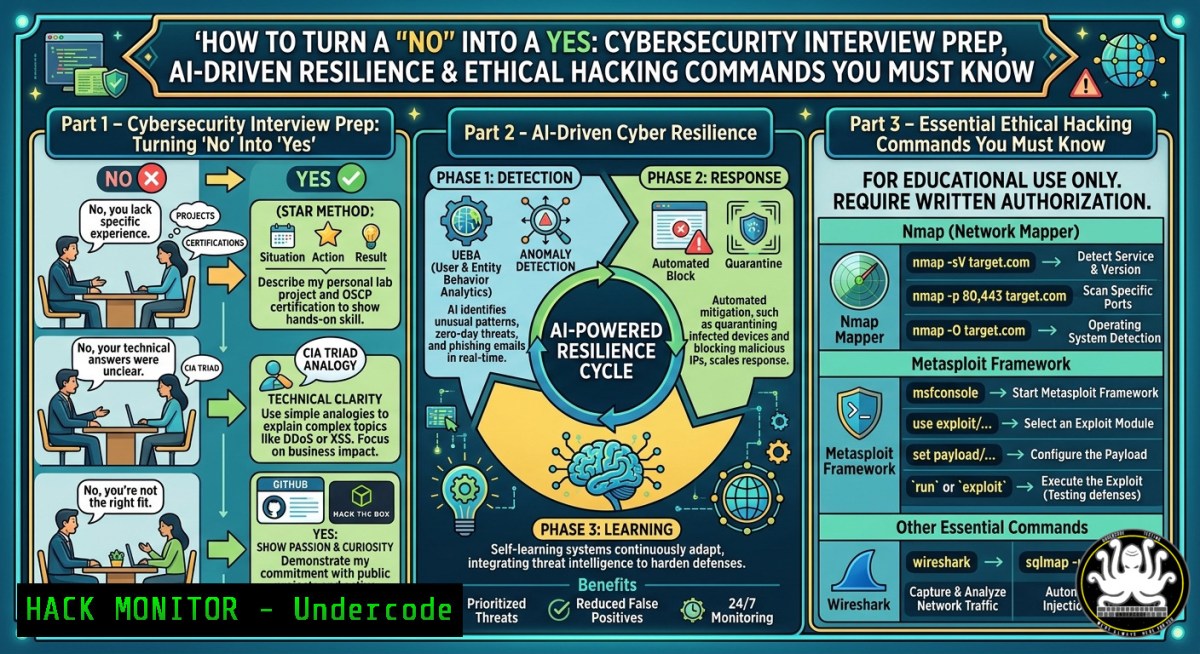
Introduction:
Rejection in high‑stakes tech interviews often feels like a verdict on your entire skill set—especially in fields like cybersecurity, AI, and IT where imposter syndrome runs deep. But every closed door can be reverse‑engineered into a learning path: analyzing your technical gaps, hardening your cloud security knowledge, and simulating real attack scenarios. This article transforms the pain of a “no” into a structured upskilling roadmap, complete with verified Linux/Windows commands, AI‑powered training strategies, and configuration guides to ensure your next interview is met with confidence.
Learning Objectives:
- Identify the top five technical vulnerabilities that frequently derail cybersecurity and AI engineer interviews.
- Apply Linux and Windows command‑line techniques to harden systems and simulate penetration testing environments.
- Build a personal AI‑assisted interview simulation lab using open‑source tools and cloud hardening checklists.
You Should Know:
- Reverse‑Engineering Your Rejection: Technical Gap Analysis with Linux & Windows
Start by treating your interview failure as a forensic exercise. List every question you stumbled on—was it OWASP Top Ten, SIEM configuration, or identity management? Then replicate those scenarios locally.
Linux Commands for Self‑Assessment:
- Use `history | grep -i “fail\|error”` to review past system logs where you struggled.
- Run `sudo journalctl -p err -b` to see error patterns that mimic real‑world misconfigurations.
- For network analysis: `ss -tulwn` (list listening ports) and `nmap -sV localhost` to inventory services you should know how to secure.
Windows PowerShell Equivalents:
– `Get-EventLog -LogName System -EntryType Error | Select-Object -First 20`
– `netstat -an | findstr “LISTENING”`
– `Get-NetTCPConnection | Where-Object {$_.State -eq “Listen”}`
Step‑by‑Step Guide:
1. Create a “gap log” file: `touch interview_gaps.txt`
- For each missed question, write a one‑line command that would have solved it (e.g., `grep “Failed password” /var/log/auth.log` for brute‑force detection).
- Automate a daily quiz: `crontab -e` → `0 9 /usr/bin/python3 /home/user/security_flashcards.py`
- Building an AI‑Powered Mock Interview Lab Using Open‑Source LLMs
Instead of relying on human mock panels, deploy a local AI model to grill you on API security, cloud hardening, and vulnerability exploitation. This mirrors real interview pressure and costs nothing.
Tools & Commands:
- Install Ollama (Linux/macOS/WSL): `curl -fsSL https://ollama.com/install.sh | sh`
– Pull a cybersecurity‑fine‑tuned model: `ollama pull falcon2:11b` or `ollama pull llama3.1:8b`
– Run an interactive interview session:
`ollama run llama3.1:8b –system “You are a senior cloud security architect. Ask me five tough questions about IAM misconfigurations and S3 bucket policies. Score each answer.”`
Windows (WSL2) Setup:
wsl --install -d Ubuntu
wsl -d Ubuntu bash -c "curl -fsSL https://ollama.com/install.sh | sh"
Step‑by‑Step Guide:
1. Create a prompt file `interview_prompt.txt` containing:
“Act as a hiring manager for a DevSecOps role. Ask about: CVE‑2021‑44228 (Log4Shell), Kubernetes secrets management, and OAuth 2.0 vulnerabilities.”
2. Run: `ollama run llama3.1 < interview_prompt.txt > mock_results.log`
3. Use `grep -i “weak\|incorrect” mock_results.log` to identify weak areas.
- Hardening Cloud Infrastructure – The Technical “Root Cause” of Most Rejections
Many candidates fail because they cannot demonstrate live cloud hardening. Set up a cheap AWS/Azure sandbox and apply CIS benchmarks.
Linux CLI Tools for Cloud Hardening (using AWS CLI):
– Install AWS CLI: `sudo apt install awscli` (Debian) or `winget install Amazon.AWSCLI` (Windows)
– List all S3 buckets and check public access:
`aws s3api get-bucket-acl –bucket YOUR_BUCKET_NAME`
`aws s3api get-public-access-block –bucket YOUR_BUCKET_NAME`
- Enforce bucket encryption:
`aws s3api put-bucket-encryption –bucket YOUR_BUCKET_NAME –server-side-encryption-configuration ‘{“Rules”:[{“ApplyServerSideEncryptionByDefault”:{“SSEAlgorithm”:”AES256″}}]}’`
Windows Command for Azure:
az storage account list --query "[?allowBlobPublicAccess == true]"
az storage container set-permission --name private-container --public-access off
Step‑by‑Step Hardening Checklist:
- Run `prowler` (open‑source security tool): `docker run –rm -it toniblyx/prowler aws` – this generates a report of misconfigurations.
- Fix each failing control by following the remediation commands printed.
- Re‑run the report and save the diff: `diff old_report.json new_report.json > hardening_progress.log`
- Vulnerability Exploitation & Mitigation – The Technical Deep Dive Interviewers Love
You must show you can both attack and defend. Set up a local Metasploit environment and walk through a real CVE.
Linux (Kali or Parrot OS) Commands:
- Start Metasploit: `msfconsole`
– Search for a known Apache vulnerability: `search apache mod_proxy`
– Use a module (e.g., CVE‑2021‑40438):
`use exploit/linux/http/apache_mod_proxy_cve_2021_40438`
`set RHOSTS 127.0.0.1`
`set TARGETURI /`
`check` (non‑destructive test)
- Mitigation patch command: `sudo apt update && sudo apt upgrade apache2`
Windows Defender & Firewall Hardening:
Set-MpPreference -DisableRealtimeMonitoring $false
Add-MpPreference -AttackSurfaceReductionRules_Ids 75668C1F-73B5-4DD0-BF47-9C9D4E4B7C6E -AttackSurfaceReductionRules_Actions Enabled
New-NetFirewallRule -DisplayName "Block Apache Exploit" -Direction Inbound -Protocol TCP -LocalPort 80,443 -Action Block
Step‑by‑Step Guide:
- Run a vulnerable Docker container (for lab only):
`docker run –rm -p 8080:80 vulnerables/web-dav`
- Attempt exploitation with `nmap –script http-webdav-scan -p 8080 localhost`
3. Apply mitigation (disable WebDAV) and re‑scan to confirm closure. -
AI Ethics & Secure Model Deployment – Handling “No” as a Feature Flag
Since the original post was from AIwithETHICS, interviewers will probe your knowledge of adversarial ML, model poisoning, and secure LLM deployment.
Command Line Model Hardening (using Hugging Face + Transformers):
pip install transformers torch adversarial-robustness-toolbox
python -c "
from transformers import pipeline
from art.estimators.classification import HuggingFaceClassifier
 Load a sentiment model and test against adversarial example
classifier = pipeline('sentiment-analysis')
print(classifier('This product is awful'))  baseline
"
Linux Security for AI Pipelines:
- Restrict model file permissions: `chmod 640 ./my_model.bin`
– Use `auditd` to track model access: `auditctl -w /models -p rwa -k ai_model_integrity`
Step‑by‑Step Guide to Explain in an Interview:
- Describe a scenario where a “no” (rejecting a model version) is a security win – e.g., failing a red‑team test on prompt injection.
- Implement input validation with `string = sanitize(user_input)` using
re.sub(r'[^\w\s]', '', input). - Show how you would log and alert:
logger.warning(f'Rejected prompt from {ip} containing malicious pattern'). -
Automating Your Interview Readiness with CI/CD for Skills
Treat your learning pipeline like a DevSecOps workflow. Use GitHub Actions to test your command knowledge daily.
Example `.github/workflows/security_quiz.yml`:
name: Daily Security Drill
on: [bash]
jobs:
quiz:
runs-on: ubuntu-latest
steps:
- run: |
echo "Question: How to find SUID binaries?" > result.txt
find / -perm -4000 2>/dev/null | head -5 >> result.txt
echo "Question: List all iptables rules" >> result.txt
sudo iptables -L -n >> result.txt
- name: Archive results
uses: actions/upload-artifact@v4
with:
name: quiz_output
path: result.txt
Step‑by‑Step:
- Fork a public repo and add the above YAML.
- Commit and watch the Actions tab – each run simulates an interview drill.
- Review logs for correctness; treat failures as “kind rejections” that improve your pipeline.
What Undercode Say:
- Rejection is raw data, not a verdict. Every “no” reveals a technical or behavioral gap you can patch with the same rigor as a CVE.
- The most valuable skill in cybersecurity isn’t knowing all the answers—it’s building feedback loops that transform failure into hardened configurations and automated retries.
Prediction:
- More companies will adopt AI‑driven interview simulators that adapt to your weak spots, reducing human bias and making rejection purely performance‑based.
- Open‑source hardening tools (Prowler, Lynis, OpenSCAP) will become mandatory pre‑interview certification steps for cloud roles.
- The line between “career rejection” and “security misconfiguration” will blur as professionals treat both with the same root‑cause analysis playbook.
▶️ Related Video (68% Match):
🎯Let’s Practice For Free:
IT/Security Reporter URL:
Reported By: I Spent – Hackers Feeds
Extra Hub: Undercode MoN
Basic Verification: Pass ✅
🎓 Live Courses & Certifications:
Join Undercode Academy for Verified Certifications
🚀 Request a Custom Project:
Secure, high-velocity infrastructure and disruptive technological engineering. Contact our engineering team for high-tier development and proprietary systems:
[email protected]


