Listen to this Post
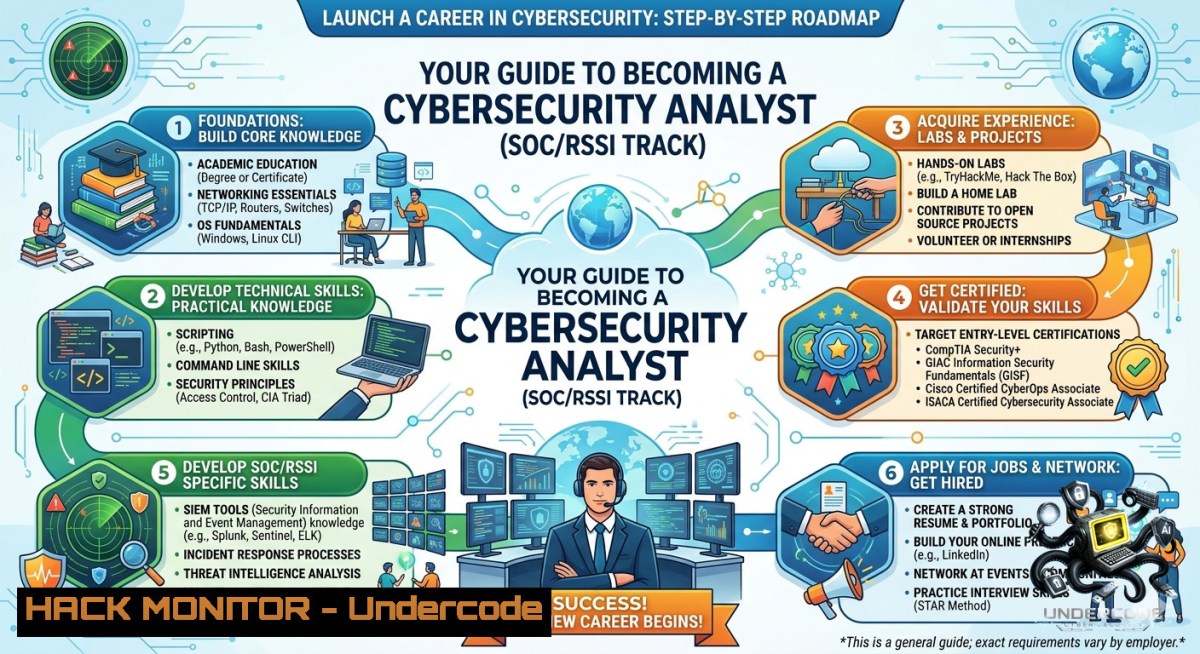
Introduction:
The digital battlefield is expanding—and so is the demand for skilled defenders. As payment processors and financial institutions increasingly face stringent regulations like DORA, PCI DSS, and ISO 27001, the need for entry-level security analysts has skyrocketed. For those looking to break into the field, apprenticeships (alternance) at major players like BPCE Payment Services offer a direct pipeline into hands-on roles such as Security Analyst (SOC Tier 1) or Assistant RSSI (CISO Assistant), where you will tackle risk assessments, incident response, and compliance audits.
Learning Objectives:
– Perform initial security incident triage using forensic commands on both Windows and Linux endpoints.
– Implement core security hardening measures for cloud infrastructure using automated tools and Terraform.
– Navigate key compliance frameworks (PCI DSS, DORA, ISO 27001) applicable to payment service providers.
You Should Know:
1. Extended Post Content: The Blueprint for Security Apprenticeships
The original post highlights an apprenticeship at BPCE Payment Services, a major payment actor in France, for the role of Assistant RSSI (CISO Assistant). This role is not just administrative; it sits at the intersection of risk, compliance, incident handling, and audit. In the current financial landscape, compliance is mandatory and severe, with fines for GDPR violations reaching up to €20 million or 4% of revenue, and PCI DSS Level 1 requiring annual on-site audits by a Qualified Security Assessor (QSA).
For a student stepping into this alternance, the technical reality involves three critical areas: Payment Security Risk Management (navigating the Banque de France oversight and the Labaronne Law), Cloud Hardening (securing cloud-1ative applications), and Incident Response. Additionally, the role includes participating in vulnerability assessments and contributing to the Information Security Management System (ISMS) under ISO 27001 guidance.
Step‑by‑step guide for onboarding as a Security Analyst (Assistant RSSI):
1. Understand the Regulatory Map: Get familiar with DORA (effective Jan 17, 2025) and PCI DSS v4.0.1. A payment processor must implement a risk management framework for retail payment activities as mandated by regulatory oversight.
2. Learn the Tools: BPCE invests heavily in modernizing its technological platforms. Focus on learning SIEM tools (Splunk/Elastic), EDR (CrowdStrike/SentinelOne), and cloud platforms (GCP/AWS) as they are the frontline of detection.
3. Master the Logs: Security analysis relies on logs. Start analyzing Windows Event IDs (4624/4625 for logins) and Linux Syslog.
2. Your Complete Triage & Incident Response Commands (Windows/Linux)
When an alert fires—be it ransomware or unauthorized lateral movement—speed is critical, but haste destroys evidence. Based on NIST SP 800-61 and standard IR procedures, here is the validated step-by-step guide for initial triage.
Step‑by‑step guide (Isolation & Collection):
1. Isolate: Immediately cut network access to prevent propagation.
– Windows: `netsh interface set interface “Ethernet” disable`
– Linux: `ifconfig eth0 down` or drop specific traffic.
– ⚠️ Critical rule: Never run `rm -rf` on a live system during investigation; always use `mv` to move suspicious samples to a secure quarantine folder (`mkdir $HOME/sample && mv suspicious_file $HOME/sample/`).
2. Check Live Processes (Windows): Identify resource-heavy or suspicious processes.
 Get CPU heavy processes
Get-Process | Sort-Object CPU -Descending | Select-Object -First 20
tasklist /v
 Check established network connections
netstat -ano | findstr ESTABLISHED
 Check recent PowerShell history for malicious execution
Get-Content (Get-PSReadLineOption).HistorySavePath
 Query Autoruns for persistence
reg query HKLM\Software\Microsoft\Windows\CurrentVersion\Run
3. Check Live Processes (Linux): Look for hidden or high-CPU processes.
 Display CPU usage and processes
top -bn1 | head -30
ps auxf
 Check network connections and listening ports
ss -tulnp
netstat -tulnp
 Check for cron jobs (persistence)
for user in $(cut -f1 -d: /etc/passwd); do crontab -l -u $user 2>/dev/null; done
 Check recently modified files (past 24 hours)
find / -mtime -1 -type f 2>/dev/null | head -50
4. Capture Evidence: Do not rely on live system commands alone if you suspect kernel-level compromise. Use static binaries from a trusted USB drive. Collect volatile data (RAM) using tools like `AVML` before powering off the machine.
3. Cloud Security Hardening & IaC Security
Securing cloud infrastructure is no longer optional; it is a core requirement for roles involving assistant security responsibilities. The NIST API security guidelines emphasize that protection must begin in design (Shift-Left security). Furthermore, OWASP Top 10 for APIs highlights Broken Object Level Authorization (BOLA) as the top risk for APIs.
Step‑by‑step guide (Cloud & API Hardening):
1. Implement Terraform for Compliance: Use Infrastructure as Code (IaC) to enforce CIS benchmarks.
 From the automated security hardening GitHub repo for AWS/GCP/Azure
cd terraform
terraform init
terraform plan
terraform apply
2. GCP Hardening Agent: For brownfield environments (messy, existing infrastructure), use the GCP Hardening Toolkit.
– Audit: `./export_org_state.sh` (dumps Cloud Asset Inventory)
– Remediate: The Hardening Agent generates safe Terraform blueprints to fix organizational policy violations without breaking production.
gemini extensions install https://github.com/GoogleCloudPlatform/gcp-hardening-toolkit
3. API Security (OWASP Top 10): Ensure every API call includes proper authentication (OAuth 2.0/MFA). Implement Web Application Firewalls (WAF) to block malicious payloads and mitigate DoS attacks.
4. Compliance & Risk Assessment (ISO 27001 & PCI DSS)
As an Assistant RSSI, you will support the implementation of the Information Security Management System (ISMS). The ISO 27001:2022 standard requires a structured approach.
Step‑by‑step guide (ISMS Implementation):
1. Scope Definition: Identify the boundaries of your ISMS. Which servers process cardholder data?
2. Risk Assessment: Perform a risk analysis for each payment method. Identify threats, vulnerabilities, and likelihood.
3. Statement of Applicability (SoA): Select which controls from Annex A apply. For payment processors, this must include PCI DSS controls.
Relevant Compliance Commands/Checks:
– PCI DSS 12.10: Ensure an incident response plan is documented, tested, and includes specific procedures for handling payment card data breaches.
– GDPR Checks: Verify data encryption at rest and in transit. Ensure data retention policies are enforced (e.g., log retention for minimum 90 days).
5. Leveraging AI and Automation for Security
Modern SOCs rely on automation. Understanding how to use AI for threat intelligence is now a distinguishing skill.
Step‑by‑step guide (Implementing AI Security Checks):
1. Automated Log Analysis: Use AI-driven tools (like Gemini in GCP or CloudGuard) to analyze vast amounts of logs for zero-day anomalies.
2. Threat Hunting: Use platforms like Stellar Cyber or Splunk to run behavioral analytics. Look for “living off the land” binaries (LOLBins) using AI pattern matching.
What Undercode Say:
– Key Takeaway 1: Breaking into cybersecurity requires more than theory. Practical skills in Windows/Linux forensic commands, cloud hardening (IaC), and a solid grasp of regulatory compliance (PCI DSS/ISO 27001) are the true gateways to roles like Assistant RSSI at major financial institutions.
– Key Takeaway 2: The defense of payment systems is a multi-layered discipline. From isolating a compromised host using `netsh` commands to deploying automated compliance guardrails in GCP, a security analyst must be equally comfortable with the command line and policy documents.
Analysis:
The post highlights a growing trend in the industry: major financial groups like BPCE are investing heavily in junior talent through alternance programs. This is not just a job; it is a strategic pipeline to fill the skills gap in specialized areas like Application Security (secure development) and Payment Compliance. With the enforcement of DORA in the EU and the evolution of PCI DSS, the demand for security professionals who can translate technical threats into business risk (and vice versa) will continue to outpace supply. The “Assistant RSSI” role is no longer just a helpdesk function—it is the operational core of the security department.
Prediction:
– -1 Regulatory Complexity will increase entry barriers: By 2026, as the Labaronne Law and stricter PSP frameworks take full effect, the learning curve for entry-level analysts will steepen. Those without specific training in DORA or PCI DSS will struggle to find roles.
– +1 Automation will replace Tier 1 SOC grunt work: AI-driven triage will handle basic alert fatigue, forcing entry-level analysts to upskill into Threat Hunting and SOAR playbook development to remain relevant.
– +1 Cloud-1ative security apprenticeships will dominate: As Groupe BPCE pursues its common technological platform vision, demand for security professionals skilled in Terraform, GCP Hardening, and API security will skyrocket, offering high salaries for junior roles with cloud expertise.
– -1 Increase in payment fraud attacks: With 79% of organizations reporting payment fraud attempts in 2025, the pressure on SOC teams will be immense, leading to higher burnout rates if not managed by automation.
– +1 Free SOC training will democratize access: The availability of Google’s 8 free SOC courses and platforms like Stellar Cyber Academy means that driven students from non-traditional backgrounds can close the skills gap effectively, increasing diversity in the field.
▶️ Related Video (74% Match):
🎯Let’s Practice For Free:
🎓 Live Courses & Certifications:
[Join Undercode Academy for Verified Certifications](https://undercode.co.uk/certifications/)
🚀 Request a Custom Project:
Secure, high-velocity infrastructure and disruptive technological engineering. Contact our engineering team for high-tier development and proprietary systems:
[[email protected]](mailto:[email protected])
💎 Smart Architecture | 🛡️ Secure by Design | ⭐ Trusted by Thousands
IT/Security Reporter URL:
Reported By: [Serge Misik](https://www.linkedin.com/posts/serge-misik-71992a10_cybersaezcuritaez-alternance-share-7467671063955570688-DzUs/) – Hackers Feeds
Extra Hub: Undercode MoN
Basic Verification: Pass ✅
🔐JOIN OUR CYBER WORLD [ CVE News • HackMonitor • UndercodeNews ]
[💬 Whatsapp](https://undercode.help/whatsapp) | [💬 Telegram](https://t.me/UndercodeCommunity)
📢 Follow UndercodeTesting & Stay Tuned:
[𝕏 formerly Twitter 🐦](https://x.com/undercodeupdate) | [@ Threads](https://www.threads.net/@undercodetesting) | [🔗 Linkedin](https://www.linkedin.com/company/undercodetesting/) | [🦋BlueSky](https://bsky.app/profile/undercode.bsky.social)


