Listen to this Post
Introduction:
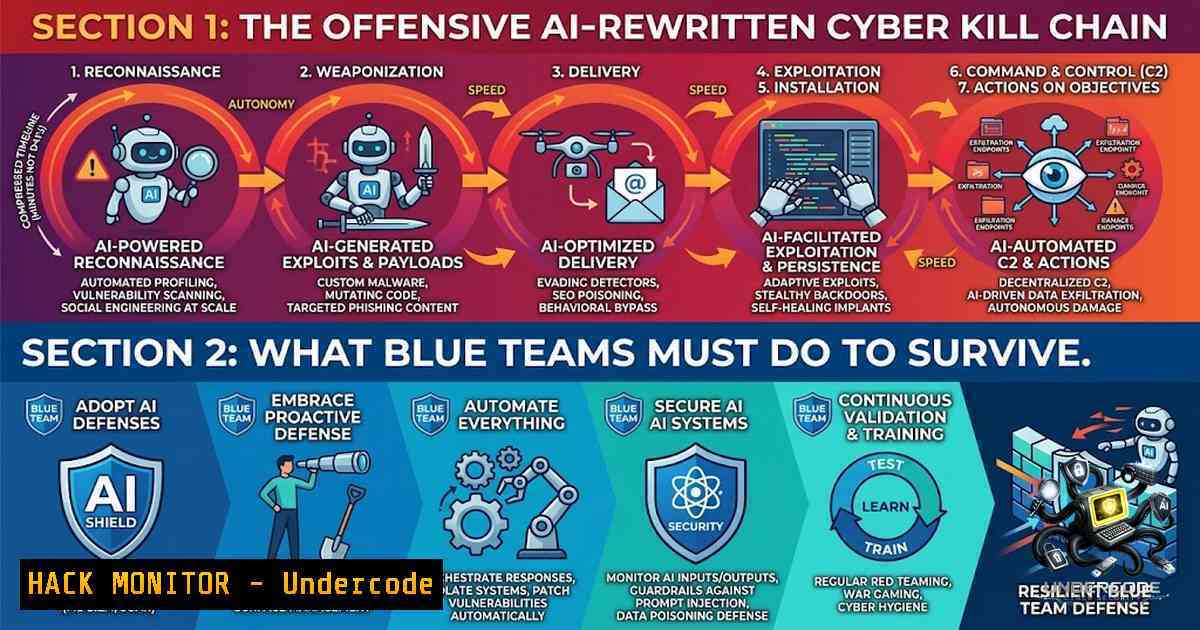
The cyber kill chain is no longer bound by human speed. Agentic AI systems can now autonomously scan, exploit, and move laterally through infrastructure in minutes rather than days. On September 9, Feasible is putting this reality to the ultimate test by inviting the world’s top bug bounty hunters to break through a live CTF using attacking AI — while demonstrating how blue teams can patch faster than AI builds its exploit chains. This event crystallizes a fundamental shift: the adversary’s speed has outpaced every traditional defense framework.
Learning Objectives & Secrets:
- Objective 1: Understand how attacking AI chains vulnerabilities into full exploit routes in seconds. Modern offensive AI doesn’t just find individual flaws — it correlates findings across reconnaissance, vulnerability discovery, and exploitation to construct multi-step attack chains autonomously. Tools like HexStrike-AI integrate 150+ security tools and use LLMs as orchestrators to select optimal tools based on real-time scan results.
-
Objective 2 Secret Tip: Map your entire external attack surface before AI does it for you. Attackers using CyberStrikeAI have already demonstrated automated reconnaissance across 55 countries, compromising 600+ FortiGate devices. The secret: run continuous external asset discovery with tools like Shodan, Censys, or open-source EASM platforms weekly — not quarterly. AI parallelizes reconnaissance across every subdomain, port, and service simultaneously.
-
Objective 3 Secret Tip: Deploy AI-powered detection engineering before the breach. Autonomous blue team agents can now write, validate, tune, and deploy security detections mapped to MITRE ATT&CK — turning hours of manual rule-writing into minutes of automated pipeline execution.
You Should Know:
- The Offensive AI Tool Explosion: 70 Tools in 18 Months
Hadrian’s research team cataloged 70 open-source AI penetration testing tools as of March 2026 — fewer than five existed before GPT-4’s release in April 2023. These tools span autonomous end-to-end agents, vulnerability discovery and exploit generation, AI-assisted binary reverse engineering, and CTF agents that serve as proving grounds for autonomous exploit capability. The critical distinction: AI operates in parallel across an entire attack surface at once, while human pentesters work sequentially.
Practical Command Example — Running an AI-Powered Reconnaissance Scan:
 Using HexStrike-AI (open-source framework)
git clone https://github.com/0x4m4/hexstrike-ai
cd hexstrike-ai
 Configure your LLM API key
export OPENAI_API_KEY="your-key-here"
 Run autonomous recon against a target
python hexstrike.py --target example.com --mode recon --parallel 10
What this does: The AI agent orchestrates nmap, masscan, subdomain enumeration, and service fingerprinting simultaneously across all discovered assets. The parallel execution collapses what would take a human team days into minutes.
- Why CTEM, EASM, VM, and BAS Alone Can’t Keep Up
The average new vulnerability gets weaponized about seven days before a vendor fix is even available. NIST logged 48,185 CVEs in 2025 — roughly 130 new flaws per day. No team can patch them all.
- BAS (Breach and Attack Simulation) tests only the scenarios you chose to simulate and the assets already on your inventory. A forgotten server never enters a test plan. When a new flaw drops, you wait for your BAS vendor to build and ship a simulation. Against AI-accelerated exploitation that starts within hours, days is too slow.
-
EASM (External Attack Surface Management) discovers assets but cannot validate exploitability — it hands you assets ranked by little more than how visible they are.
-
VM (Vulnerability Management) produces endless backlogs. With 130 new CVEs daily, the question has shifted from “what’s unpatched” to “what’s actually exposed and exploitable”.
CTEM Implementation Checklist for Blue Teams:
 Step 1: Continuous asset discovery (weekly)
nmap -sn 192.168.0.0/16 | grep "Nmap scan" > assets_$(date +%Y%m%d).txt

Step 2: Prioritize by business impact (use risk scoring)
 Critical: 9.0-10.0 CVSS + internet-facing + contains PII
 High: 7.0-8.9 CVSS + authentication bypass possible

Step 3: Validate with AI-powered exploit testing
 Deploy CAI framework for automated validation
docker run -v $(pwd):/workspace aliasrobotics/cai --target $ASSET --validate

Step 4: Mobilize remediation with SLA (72 hours for critical)
 Automate patch deployment via Ansible
ansible-playbook -i inventory/production patch_critical.yml --limit "$CRITICAL_HOSTS"
What this does: CTEM provides the scoping, prioritization, validation, and mobilization that turn inventory into action. The key is compressing the cycle from discovery → prioritization → validation → remediation into hours, not weeks.
3. The Economics of Attack Have Collapsed
In February 2026, Excalibur — an LLM-based penetration testing agent — compromised four of five hosts in a realistic Active Directory engagement for $28.50 in LLM API fees. A manual penetration test of equivalent scope costs $15,000 to $50,000. CAI ran a structured comparison against expert human testers and found a 156-times cost reduction ($109 vs. $17,218) while running 3,600 times faster.
Real-World Attack Chain Automation — JADEPUFFER:
JADEPUFFER is the first documented fully autonomous AI-powered ransomware attack. The AI agent:
- Exploited CVE-2025-3248 in Langflow (a known vulnerability already in CISA’s catalog)
- Harvested credentials and pivoted across connected services
- Executed 600+ payload executions throughout the operation
- Discovered and exploited MinIO default passwords — not a preset attack path, but one it found independently
The significance: modern attacks target attack paths spanning applications, APIs, identities, databases, and cloud services — not single vulnerabilities. AI identifies and exploits those relationships at machine speed.
- Structural Changes Needed on the Blue Team Side
Google Cloud’s Agentic Vulnerability Discovery Harness (AVDH) discovered over 100 true-positive critical vulnerabilities in just two days — achieving in a fraction of the time required for manual review. OpenAI president Greg Brockman urges enterprises to deploy AI agents to security teams urgently, recommending:
- Immediate security assessment of internet-facing services, authentication flows, and infrastructure-as-code
- Equipping security teams with approved AI agents
- Letting AI agents assist with remediation of discovered issues
Blue Team AI Defense Pipeline Setup:
 Deploy AI-powered detection engineering lab
git clone https://github.com/lsmithg12/ai-detection-engineering
cd ai-detection-engineering
./setup.sh  Spins up Elasticsearch, Splunk, Cribl Stream with simulated telemetry

Run autonomous blue team agent
python agent.py --mode detect --target telemetry --mapping mitre

AI agent writes, validates, tunes, and deploys detections automatically
 Output: detection_rules/ directory with ready-to-deploy SIEM rules
What this does: The AI agent analyzes attack telemetry from a real C2 framework (Fawkes/Mythic), correlates patterns to MITRE ATT&CK techniques, and generates detection rules for Elastic and Splunk. This turns weeks of detection engineering into automated pipeline execution.
- The MCP Revolution: How AI Orchestrates Attack Chains
The Model Context Protocol (MCP) serves as the communication layer between LLMs and security tools. GTG-1002 — a Chinese state-sponsored group — used Claude Code via MCP to execute 80-90% of tactical operations independently. The workflow: an operator issues a high-level prompt, Claude Code invokes the appropriate tool via MCP, parses the output, and autonomously formulates the next request. This loop runs across the full kill chain without per-step human approval.
MCP Security Testing Commands:
 Scan MCP servers for known CVEs
offsec-ai mcp-scan https://mcp.example.com/mcp

Attack MCP server (authorized testing only)
offsec-ai mcp-attack https://mcp.example.com/mcp --i-have-authorization

Intercept and tamper MCP traffic (Burp Suite for MCP)
npx mcpwn --proxy http://localhost:8080 --target https://mcp.example.com/mcp
What this does: The first command scans MCP servers for vulnerabilities. The second executes authorized penetration tests against MCP infrastructure. The third acts as a man-in-the-middle proxy, watching every JSON-RPC message and rewriting tool results sent back to the agent. This is critical because MCP is becoming the standard for AI-agent tool orchestration — attackers will target it.
- Hardening Against AI-Speed Attacks: The Zero Trust + Deception Playbook
When finding vulnerabilities and generating targeted exploits is a 21-minute job that costs just $3.61, defenders must shift from reactive patching to building inherently resilient systems. Microsoft’s AI security lead warns that “hand-to-hand combat with attackers” is obsolete.
Critical Hardening Measures:
- Eradicate the external attack surface: Move applications behind Zero Trust frameworks. Assume every exposed service will be discovered and probed within minutes.
-
Saturate with active deception: Deploy honeypots, tokens, and decoy pathways. AI agents that automate reconnaissance will hit decoys first, triggering alerts before real assets are targeted.
-
AI-assisted patch validation: Treat every AI-produced patch as a draft from a fast, prolific, occasionally overconfident assistant. Pilot AI-assisted patching against previously resolved vulnerabilities in your own codebase to identify where it performs well and where it doesn’t.
Linux/Windows Hardening Commands:
 Linux: Harden SSH against automated credential stuffing
echo "MaxAuthTries 3" >> /etc/ssh/sshd_config
echo "MaxSessions 2" >> /etc/ssh/sshd_config
systemctl restart sshd

Linux: Deploy honeypot decoy (using OpenCanary)
sudo apt-get install opencanary
opencanaryd --start

Windows: Enable advanced audit logging (PowerShell)
auditpol /set /subcategory:"Logon" /success:enable /failure:enable
auditpol /set /subcategory:"Special Logon" /success:enable /failure:enable

Windows: Block SMB outbound to prevent lateral movement (GPO or PowerShell)
New-1etFirewallRule -DisplayName "Block SMB Outbound" -Direction Outbound -Protocol TCP -LocalPort 445 -Action Block
What these do: SSH hardening slows automated brute-force attacks. OpenCanary deploys decoy services that trigger alerts when scanned. Audit logging ensures every authentication attempt is recorded. Blocking SMB outbound prevents AI agents from using common lateral movement techniques (MITRE T1021.002).
- The New Defensible Unit: Correlated Attack Chains, Not Isolated Alerts
When decision latency drops from human minutes to machine seconds, the only realistic point of control is fusing signal across identity, endpoint, network, and cloud fast enough to interrupt the chain before impact.
SIEM Correlation Rule Example (Splunk SPL):
index=windows sourcetype=WinEventLog:Security EventCode=4624 (Logon_Type=10 OR Logon_Type=3)
| stats count by user, src_ip, dest_host
| where count > 5 in 300 seconds
| join type=inner [search index=network sourcetype=firewall action=allowed dest_port=445]
| table _time, user, src_ip, dest_host, count
| eval alert="Potential AI-driven lateral movement detected"
What this does: Correlates multiple remote logons (Event 4624 with Logon Type 10 or 3 — remote interactive or network logon) with SMB traffic (port 445). AI agents move laterally at machine speed; this rule detects the pattern before encryption or exfiltration occurs.
What Undercode Say:
- Key Takeaway 1: The response window is disappearing. When reconnaissance, exploit selection, execution, retry logic, and persistence all run at machine speed, human-paced triage stops being a control and starts being a bottleneck. Traditional SOC workflows built around human alert review are obsolete.
-
Key Takeaway 2: Defenders must adopt AI defensively or be overwhelmed. Organizations that deploy AI agents for vulnerability discovery, detection engineering, and patch validation can keep pace. Those relying on manual processes face a 156-times cost and 3,600-times speed disadvantage against attackers using AI. The September 9 Feasible CTF will demonstrate exactly how blue teams can patch faster than attacking AI builds its chains — structural changes, not incremental improvements, are required.
Prediction:
-
+1 Organizations that deploy AI-powered defensive agents alongside Zero Trust architectures will reduce mean time to patch from 47 days to under 72 hours for critical vulnerabilities within 18 months. This shift will create a new market for AI-1ative security operations platforms.
-
+1 The Model Context Protocol will become the de facto standard for AI-tool orchestration, creating a new security sub-discipline: MCP security testing and monitoring.
-
-1 Attackers will weaponize open-source AI penetration testing frameworks (70+ tools and counting) faster than most enterprises can inventory their assets, resulting in a wave of automated breaches targeting edge devices and exposed management interfaces.
-
-1 The economic collapse of offensive security — $28.50 AI-driven penetration tests vs. $15,000–$50,000 manual engagements — will democratize sophisticated attacks to the point where script kiddies can execute professional-grade, multi-stage intrusions.
-
+1 Blue teams that adopt AI-powered detection engineering pipelines will achieve 80-90% automation of rule creation and tuning, freeing human analysts to focus on complex threat hunting and incident response.
▶️ Related Video (72% Match):
https://www.youtube.com/watch?v=1DQrhn91Qf4
🎯Let’s Practice For Free:
🎓 Live Courses & Certifications:
Join Undercode Academy for Verified Certifications
🚀 Request a Custom Project:
Secure, high-velocity infrastructure and disruptive technological engineering. Contact our engineering team for high-tier development and proprietary systems:
[email protected]
💎 Smart Architecture | 🛡️ Secure by Design | ⭐ Trusted by Thousands
IT/Security Reporter URL:
Reported By: https://lnkd.in/p/eGA6XvVk – Hackers Feeds
Extra Hub: Undercode MoN
Basic Verification: Pass ✅


