Listen to this Post
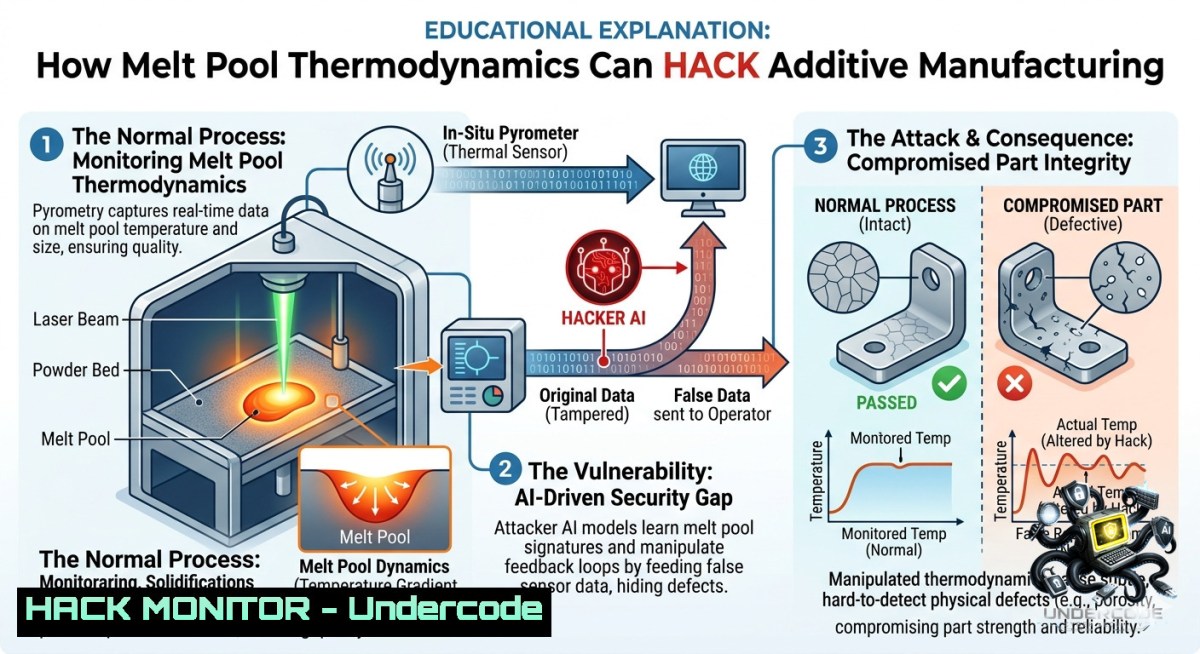
Introduction:
Laser Powder Bed Fusion (LPBF) processes like IN718 superalloy printing rely on precise thermal control—but unsecured in-situ monitoring data streams and thermal models are vulnerable to tampering and adversarial AI attacks. This article extracts technical insights from a recent materials science study (integrating two-wavelength pyrometry, COMSOL thermal modeling, and SEM/EBSD validation) and reinterprets them as cybersecurity and AI risks for Industry 4.0, including command-line forensics, API hardening, and defensive training.
Learning Objectives:
- Understand how melt pool temperature data can be poisoned to alter microstructural predictions in AI models.
- Implement Linux/Windows commands to monitor and secure real-time sensor streams (pyrometry, thermal cameras) in LPBF machines.
- Apply cloud hardening and API security to protect finite-element modeling (FEM) pipelines from injection attacks.
You Should Know:
1. Sensor Data Poisoning: Exploiting Two-Wavelength Pyrometry Streams
The study uses high-speed two-wavelength pyrometry to measure melt pool surface temperatures. In a cyber-physical attack, adversaries could intercept or modify these temperature values (e.g., via man-in-the-middle on the sensor network) to force incorrect solidification predictions—leading to weak microstructures or catastrophic part failure.
Step‑by‑step guide to simulate and defend against pyrometry data injection:
- Capture live sensor data (example using `socat` on Linux to proxy a pyrometer’s TCP stream):
sudo socat -v TCP-LISTEN:5020,fork TCP:192.168.1.100:5020
- Detect anomalies with `tcpdump` and checksum validation:
sudo tcpdump -i eth0 -A -s 0 'tcp port 5020' | grep -E "TEMP|PDAS"
- On Windows (PowerShell), monitor serial-based pyrometers:
Get-WinEvent -LogName "Microsoft-Windows-Serial/Operational" | Where-Object {$_.Message -match "buffer overflow"} - Mitigation: Implement TLS 1.3 for sensor data and use hash-based message authentication codes (HMAC) on each temperature packet.
2. COMSOL Finite-Element Model (FEM) Command Injection
COMSOL models (as used in the paper) are often scripted via Java or MATLAB. Attackers can inject malicious commands into `.mph` or `.java` model files. The following demonstrates a safe, educational verification:
Step‑by‑step guide to audit COMSOL model integrity:
- Linux: Recursively grep for suspicious `system()` calls in COMSOL Java exports:
grep -rnw 'COMSOL_project/' -e 'Runtime.getRuntime().exec' --include='.java'
- Windows: Use `findstr` in COMSOL model directories:
findstr /s /i "eval|execute" .mph
- Hardening: Run COMSOL in a Docker container with read-only bind mounts:
docker run --rm -v /path/to/model:/model:ro comsol/comsol:6.0 comsol batch -inputfile /model/safe.mph
- Training course: “Secure Simulation Workflows for Additive Manufacturing” (ISC² CPE credits).
3. API Security for Machine Learning Microstructure Predictions
The paper mentions “data-driven microstructure models.” APIs that serve these predictions (e.g., a REST endpoint that takes thermal gradients and outputs PDAS) are attack surfaces. Use OWASP API Top 10 mitigations.
Step‑by‑step to secure a hypothetical ML inference API (Python + FastAPI):
- Install defenses:
pip install fastapi slowapi tenacity
- Add rate limiting and input validation:
from slowapi import Limiter, _rate_limit_exceeded_handler
limiter = Limiter(key_func=lambda: request.client.host)
app.add_exception_handler(RateLimitExceeded, _rate_limit_exceeded_handler)</li>
</ul>

@app.post("/predict_pdas")
@limiter.limit("5/minute")
async def predict(data: ThermalInput):
if data.temp_gradient > 1e6:  reject unrealistic values
raise HTTPException(status_code=422)
– Test for injection: Use `curl` to attempt SQLi/NoSQLi:
curl -X POST -H "Content-Type: application/json" -d '{"temp_gradient":"1e6 $ne 0"}' http://localhost:8000/predict_pdas4. Cloud Hardening for SEM/EBSD Image Repositories
Post-mortem SEM/EBSD data (often stored in AWS S3 or Azure Blob) is critical for validating thermal models. Misconfigured buckets can leak proprietary microstructural images.
Step‑by‑step to audit and harden cloud storage:
- AWS CLI – List public buckets:
aws s3api get-bucket-acl --bucket microstructure-lab --query 'Grants[?Grantee.URI==`http://acs.amazonaws.com/groups/global/AllUsers`]'
- Azure PowerShell – Enforce private endpoint:
$storage = Get-AzStorageAccount -ResourceGroupName "AM_Lab" -1ame "in718data"
Add-AzStorageAccountNetworkRule -ResourceGroupName "AM_Lab" -1ame "in718data" -VirtualNetworkResourceId "/subscriptions/.../vnet"
- Monitor for anomalous downloads with AWS CloudTrail:
aws cloudtrail lookup-events --lookup-attributes AttributeKey=EventName,AttributeValue=GetObject --start-time "2026-05-01T00:00:00Z"
- Vulnerability Exploitation via Thermal Model Parameters (Mitigation Focus)
Adversaries can exploit the finite-element thermal model by adjusting boundary conditions (e.g., laser power, scan speed) via unauthenticated APIs. This mimics a “model inversion attack” where outputs (PDAS) reveal sensitive process parameters.
Step‑by‑step to detect parameter tampering:
- Linux `auditd` rule to monitor changes to COMSOL input files:
auditctl -w /opt/comsol/models/ -p wa -k thermal_model_integrity
- Windows SACL (System Access Control List) on `.mph` files:
icacls "C:\COMSOL\Models.mph" /setintegritylevel H
- Remediation: Digitally sign input parameter files using GPG:
gpg --detach-sign --armor input_parameters.json
What Undercode Say:
- Even rigorous materials science studies implicitly rely on insecure sensor networks and unauthenticated simulation APIs—attack vectors ignored by most AM researchers.
- Bridging metallurgy and cybersecurity requires new training courses, e.g., “AI Poisoning in Digital Twins” and “Secure OT for LPBF.”
Expected Output:
- Integrate pyrometry authentication (HMAC-SHA256) into industrial edge gateways.
- Enforce zero-trust for COMSOL model repositories (e.g., OPA policies on Git commits).
Prediction:
- +1 By 2028, major AM machine vendors will adopt hardware security modules (HSMs) for in-situ sensor data signing.
- +1 AI-driven microstructure prediction will include adversarial training against temperature spoofing.
- -1 Without mandatory security standards, LPBF supply chains will see first reported cyber-physical attack by 2027, causing $50M+ in defective aerospace parts.
▶️ Related Video (78% Match):
🎯Let’s Practice For Free:
🎓 Live Courses & Certifications:
Join Undercode Academy for Verified Certifications
🚀 Request a Custom Project:
Secure, high-velocity infrastructure and disruptive technological engineering. Contact our engineering team for high-tier development and proprietary systems:
[email protected]
💎 Smart Architecture | 🛡️ Secure by Design | ⭐ Trusted by ThousandsIT/Security Reporter URL:
Reported By: Yuzhe Liu – Hackers Feeds
Extra Hub: Undercode MoN
Basic Verification: Pass ✅🔐JOIN OUR CYBER WORLD [ CVE News • HackMonitor • UndercodeNews ]
📢 Follow UndercodeTesting & Stay Tuned:
- AWS CLI – List public buckets:


