Listen to this Post
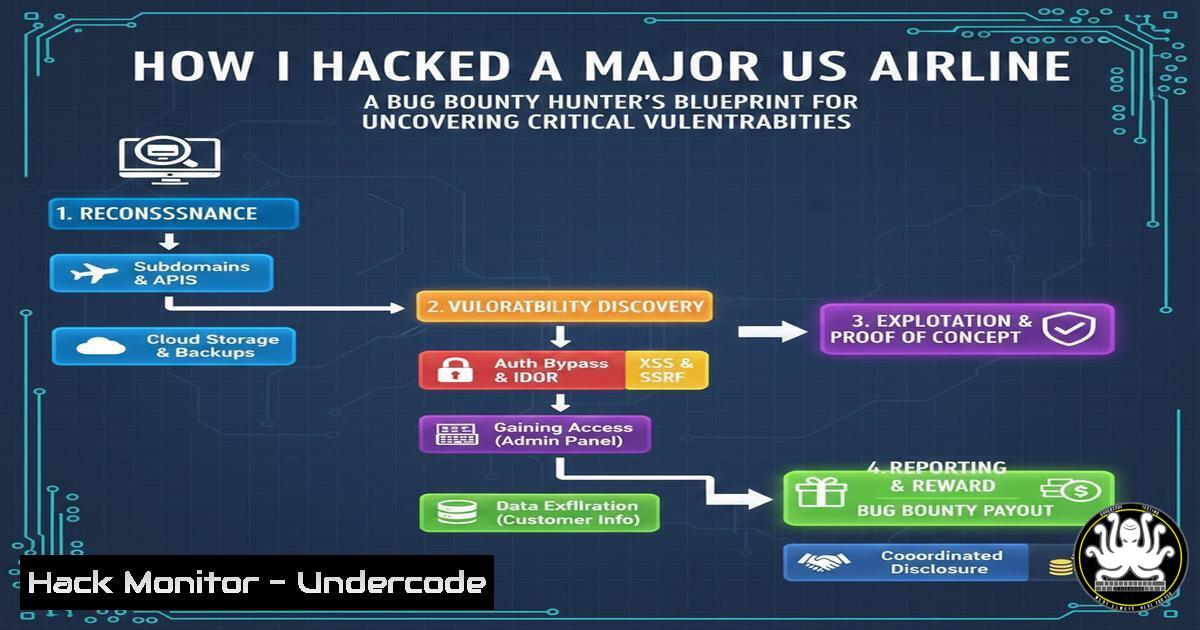
Introduction:
In the high-stakes world of aviation cybersecurity, a single vulnerability can compromise millions of passenger records and critical flight operations. This article deconstructs the methodology behind a successful bug bounty discovery against a U.S. airline, translating a researcher’s achievement into a actionable technical guide. We’ll move beyond the congratulatory post to explore the concrete steps, tools, and techniques that define professional security research in critical infrastructure.
Learning Objectives:
- Understand the structured methodology for targeting and assessing large-scale web applications in the aviation sector.
- Learn practical command-line and tool-driven techniques for reconnaissance, vulnerability identification, and proof-of-concept development.
- Develop a mindset for ethical disclosure and navigating bug bounty programs for complex, high-value targets.
You Should Know:
- The Reconnaissance Phase: Mapping the Digital Attack Surface
The first step in any professional engagement is passive and active reconnaissance. For an airline, the attack surface is vast: customer portals, booking APIs, crew management systems, and partner portals.
Step‑by‑step guide explaining what this does and how to use it.
Subdomain Enumeration: Use tools to discover all associated subdomains, which often host development, staging, or forgotten services.Using subfinder and amass for passive enumeration subfinder -d example-airline.com -silent | tee subdomains.txt amass enum -passive -d example-airline.com -o amass_passive.txt Using a powerful wordlist with gobuster for brute-forcing gobuster dns -d example-airline.com -w /usr/share/seclists/Discovery/DNS/subdomains-top1million-5000.txt -o gobuster.out -t 50
Technology Stack Fingerprinting: Identify the web server, programming frameworks, and third-party components.
Using WhatWeb for fingerprinting
whatweb https://booking.example-airline.com -v
Using Wappalyzer via browser extension for quick analysis
Endpoint Discovery: Hunt for hidden directories, API endpoints, and configuration files.
Using ffuf for directory fuzzing
ffuf -w /usr/share/seclists/Discovery/Web-Content/raft-large-words.txt -u https://example-airline.com/FUZZ -fc 403,404 -c
-
API Endpoint Testing: The Goldmine of Modern Applications
Airlines rely heavily on REST and GraphQL APIs for mobile apps and dynamic websites. These are prime targets for broken object-level authorization (BOLA), excessive data exposure, and injection flaws.
Step‑by‑step guide explaining what this does and how to use it.
Intercepting API Traffic: Use a proxy to capture all requests from the official mobile app or website.
Configure Burp Suite or OWASP ZAP as your system/device proxy.
Install the proxy’s CA certificate on your device to intercept HTTPS traffic.
Browse the application comprehensively to populate your proxy history with API calls.
Analyzing Requests: Look for endpoints that handle sensitive objects:/api/booking/{id},/api/user/profile,/api/admin/crew.
Testing for IDOR/BOLA: Change the ID parameter in the request to another user’s resource identifier.Original Request: GET /api/v1/bookings/12345 HTTP/1.1 Cookie: session=your_valid_session Modified Test: GET /api/v1/bookings/12346 HTTP/1.1 Cookie: session=your_valid_session
If the modified request returns booking 12346’s details, you have a critical IDOR vulnerability.
3. Authentication & Session Management Flaws
Logical flaws in login, password reset, and multi-factor authentication (MFA) mechanisms are common high-severity finds.
Step‑by‑step guide explaining what this does and how to use it.
Testing for Account Enumeration: Determine if the application reveals whether a username/email is valid via subtle differences in HTTP responses.
 Scripting a test with curl
for user in $(cat user_list.txt); do
response=$(curl -s -d "email=$user&password=wrong" -w "%{http_code},%{size_download}" https://example-airline.com/login -o /dev/null)
echo "$user - $response"
done
Look for variations in status codes, response times, or body content that signal a valid account.
JWT Token Analysis: If the app uses JSON Web Tokens, check for weak signing (e.g., “none” algorithm), lack of expiration, or tampering.
Use the `jwt_tool` to audit tokens: `python3 jwt_tool.py
4. Privilege Escalation via Parameter Tampering
Many applications control user privilege via hidden HTML form fields, cookies, or API parameters.
Step‑by‑step guide explaining what this does and how to use it.
Intercept a POST request from a low-privileged user profile update.
Look for parameters like `”role”:”user”`, `”admin”:false`, `”privilege_level”:1`.
Tamper and Replay the request with modified values: "role":"super_admin", "admin":true, "privilege_level":999.
Observe the Response: Did the change succeed? Does subsequent navigation show admin panels? This is a direct application logic flaw.
5. Automated Scanning & Manual Validation
While automated scanners generate noise, they can provide excellent starting points for a skilled researcher to deep-dive.
Step‑by‑step guide explaining what this does and how to use it.
Run a Targeted Scan: Use Nuclei with a specific template set to avoid overwhelming the target.
nuclei -u https://example-airline.com -t /nuclei-templates/exposures/ -severity medium,high,critical -silent
Manual SQL Injection Testing: Even with WAFs, subtle injection points persist, especially in search filters or report generators.
In Burp Suite, use the Repeater tool to test a parameter: `flight=1′ AND ‘1’=’1` vs. flight=1' AND '1'='2.
Use SQLmap cautiously, with proper flags to avoid damage:
sqlmap -u "https://example-airline.com/search?flight=" --batch --level=2 --risk=1 --flush-session
6. Documenting the Finding for Maximum Impact
A well-documented report is what turns a bug into a bounty. It must be clear, reproducible, and demonstrate impact.
Step‑by‑step guide explaining what this does and how to use it.
Clear and concise (e.g., “Broken Object Level Authorization on `/api/booking/{id}` leading to PII exposure”).
Proof of Concept (PoC): Provide a step-by-step walkthrough. Include:
Request/Response Pairs: Raw HTTP traffic from your proxy.
Screenshots/Video: Annotated screenshots or a short screen recording.
Impact Analysis: Explain what an attacker could do: access other passengers’ PII, modify bookings, view payment details.
Remediation Advice: Suggest a fix (e.g., implement proper authorization checks using the session context, not user-supplied IDs).
What Undercode Say:
- Methodology is King: The public post celebrates the result, but the real value is in the repeatable, structured process that led to the discovery. Success in bug bounties is 90% systematic process and 10% inspiration.
- Ethics & Professionalism Define the Researcher: The researcher’s extensive certification path (eJPT, eCPPT, CPTS) underscores a commitment to foundational knowledge. This, combined with responsible disclosure, builds the trust that allows bug bounty programs to thrive, especially in sensitive sectors like aviation. The true “hack” is maintaining integrity while thinking like an adversary.
Prediction:
The convergence of IT and Operational Technology (OT) in the aviation industry will escalate the impact of web and API vulnerabilities. Future bug bounty discoveries in this sector will increasingly bridge the gap between compromised passenger data and potential interference with ground operations or in-flight entertainment systems. Researchers will need deeper knowledge of aviation-specific protocols (like ACARS), while airlines will be forced to adopt more rigorous, continuous penetration testing frameworks beyond basic compliance scans. The role of the ethical hacker as a critical line of defense for national infrastructure will become formally recognized and integrated.
▶️ Related Video (76% Match):
🎯Let’s Practice For Free:
IT/Security Reporter URL:
Reported By: Abdulhadi Arif – Hackers Feeds
Extra Hub: Undercode MoN
Basic Verification: Pass ✅


