Listen to this Post
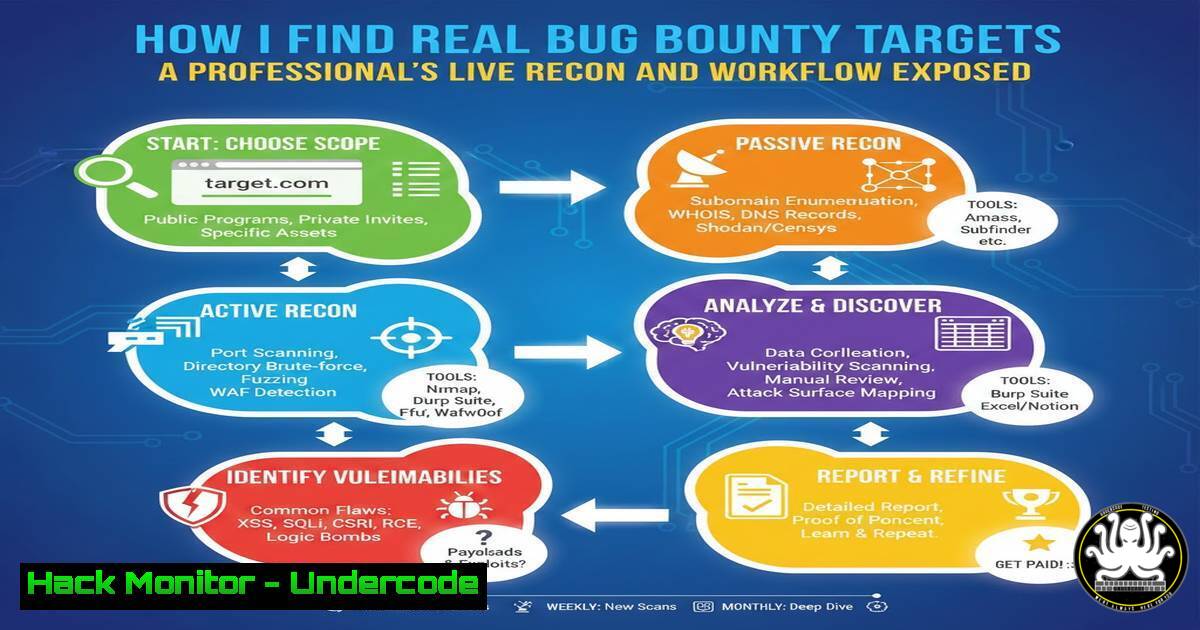
Introduction:
Bug bounty hunting has evolved from a hobbyist pursuit into a professional discipline requiring systematic reconnaissance and a defined workflow. The core of a successful bug bounty program lies in the ability to efficiently identify and prioritize real, in-scope targets from the vast attack surface of an organization. This article deconstructs a professional’s live reconnaissance methodology, transforming a chaotic process into a structured and repeatable pipeline for uncovering critical vulnerabilities.
Learning Objectives:
- Master the methodology for comprehensive subdomain enumeration to map an organization’s digital footprint.
- Develop the skills to differentiate between live, in-scope assets and irrelevant or out-of-scope infrastructure.
- Learn to automate the initial phases of reconnaissance to efficiently discover low-hanging vulnerabilities and potential attack vectors.
You Should Know:
1. Subdomain Enumeration: Casting the Widest Net
The first and most critical step in reconnaissance is subdomain enumeration. A primary domain (e.g., example.com) is often just the tip of the iceberg. The real value for a bug bounty hunter lies in the forgotten, deprecated, or poorly configured subdomains (e.g., dev.example.com, staging.example.com, api-old.example.com). These assets are frequently less secured and can provide an initial entry point.
Step-by-step guide explaining what this does and how to use it.
Step 1: Passive Enumeration. Use tools that gather data from public sources without directly interacting with the target’s servers.
Command (Linux): `subfinder -d example.com -silent | tee subfinder.txt`
Explanation: `subfinder` queries multiple public databases and search engines to find subdomains associated with example.com. The `-silent` flag suppresses unnecessary output, and `tee` saves the results to a file while also displaying them.
Step 2: Brute-Forcing and Permutations. Actively discover subdomains by testing a massive wordlist of common prefixes.
Command (Linux): `gotator -sub subfinder.txt -perm permutations.txt -depth 1 -numbers 10 -mindup -adv -md | sort -u | tee gotator.txt`
Explanation: `gotator` takes the list from `subfinder` and generates permutations (e.g., api-dev, dev-api). The `-numbers` flag adds numerical suffixes. The output is sorted and duplicates are removed.
Step 3: Resolving to IP Addresses. Determine which of the discovered subdomains are actually active and resolve to a live server.
Command (Linux): `cat gotator.txt | dnsx -silent -a -resp | tee resolved_domains.txt`
Explanation: `dnsx` takes the massive list of potential subdomains and performs a DNS `A` record lookup. Only those that successfully resolve to an IP address are kept, filtering out the noise.
2. Probing for Live Hosts and Web Services
Not every subdomain that resolves to an IP is a web server. The next step is to probe these resolved IPs to identify which ones are running HTTP/HTTPS services. This separates web applications (your primary target) from mail servers, name servers, or other non-web infrastructure.
Step-by-step guide explaining what this does and how to use it.
Step 1: HTTP/HTTPS Probing. Use a tool designed to quickly and accurately check for web services.
Command (Linux): `cat resolved_domains.txt | httpx -silent -title -status-code -tech-detect | tee live_targets.txt`
Explanation: `httpx` attempts to connect to each target on ports 80 and 443 (and others if specified). It returns valuable information like the HTTP status code (e.g., 200, 403, 500), the page title, and the technologies in use (e.g., PHP, Nginx, React). This data is crucial for prioritization.
3. Endpoint Discovery and Fuzzing
Once you have a list of live web targets, the next phase is to discover hidden endpoints, directories, and files. These could be administrative panels, API endpoints, backup files, or configuration files that are not linked from the main application.
Step-by-step guide explaining what this does and how to use it.
Step 1: Directory Bruteforcing. Use a curated wordlist to request thousands of common paths.
Command (Linux): `ffuf -u “https://target.example.com/FUZZ” -w /usr/share/wordlists/dirb/common.txt -mc 200,403,302 -recursion -o fuzz_results.json`
Explanation: `ffuf` is a fast web fuzzer. It replaces `FUZZ` with each word in the wordlist. The `-mc` flag tells it to display responses with specific status codes (200 OK, 403 Forbidden, 302 Redirect are all interesting). `-recursion` will automatically fuzz any discovered directories.
4. Automating the Reconnaissance Pipeline
A professional hunter does not run these commands manually. The true power lies in chaining them together into a single, automated script that takes a root domain and outputs a curated list of interesting endpoints and their technologies.
Step-by-step guide explaining what this does and how to use it.
Step 1: Create a Bash Script. Combine the previous steps into a script.
Code (recon.sh):
!/bin/bash
domain=$1
echo "[+] Starting reconnaissance for: $domain"

echo "[+] Enumerating subdomains..."
subfinder -d $domain -silent > subdomains.txt
gotator -sub subdomains.txt -perm permutations.txt -depth 1 -numbers 10 -mindup -adv -md | sort -u > permutations.txt

echo "[+] Resolving live hosts..."
cat permutations.txt | dnsx -silent -a -resp > resolved.txt

echo "[+] Probing for HTTP/HTTPS services..."
cat resolved.txt | httpx -silent -title -status-code -tech-detect -o live_targets.txt

echo "[!] Recon complete. Live targets saved to: live_targets.txt"
Explanation: This script automates the entire process. You would run it with ./recon.sh example.com. It sequentially performs subdomain discovery, resolution, and live service probing, saving the final output for analysis.
5. Analyzing Results and Prioritizing Targets
Automation provides data, but a hunter provides analysis. The final, manual step is to review the `live_targets.txt` file and prioritize targets based on several key factors.
Step-by-step guide explaining what this does and how to use it.
Step 1: Review Technologies. Look for specific technologies known to have vulnerabilities (e.g., outdated WordPress versions, specific API frameworks).
Step 2: Identify Interesting Status Codes. Pay close attention to `403 Forbidden` (might be bypassable), `302 Redirect` (could lead to interesting flows), and `500 Internal Server Error` (potential for information disclosure).
Step 3: Scope Validation. Double-check that all identified targets are within the scope of the bug bounty program. Attacking out-of-scope assets can lead to disqualification or legal issues.
What Undercode Say:
- Automation is Force Multiplication: The difference between an amateur and a professional is the scale and efficiency of their workflow. A structured, automated recon pipeline allows a single hunter to assess the attack surface of multiple large organizations simultaneously.
- Persistence Over Genius: Consistent, daily execution of a proven methodology will yield more results than sporadic bursts of “brilliant” hacking. The workflow is a system, and success comes from diligently following it.
The outlined workflow demystifies the initial phase of bug bounty hunting. It replaces randomness with a rigorous, engineering-based approach. By mastering subdomain enumeration, live host discovery, and endpoint fuzzing, and then automating these processes, a hunter can consistently surface vulnerable targets that are invisible to less systematic approaches. This methodology does not guarantee a critical bug, but it systematically tilts the odds in the hunter’s favor by ensuring they are looking in the right places.
Prediction:
The future of bug bounty reconnaissance will be dominated by AI-assisted tooling. We will see a shift from static wordlists for fuzzing to dynamic, context-aware list generation powered by machine learning models trained on millions of existing endpoints. Furthermore, continuous reconnaissance platforms that monitor for subtle changes in an organization’s attack surface (new subdomains, code commits, technology shifts) in real-time will become the standard, allowing hunters to be the first to discover and test new assets the moment they go live, dramatically shrinking the window of exposure for companies.
🎯Let’s Practice For Free:
IT/Security Reporter URL:
Reported By: Abhirup Konwar – Hackers Feeds
Extra Hub: Undercode MoN
Basic Verification: Pass ✅


