Listen to this Post
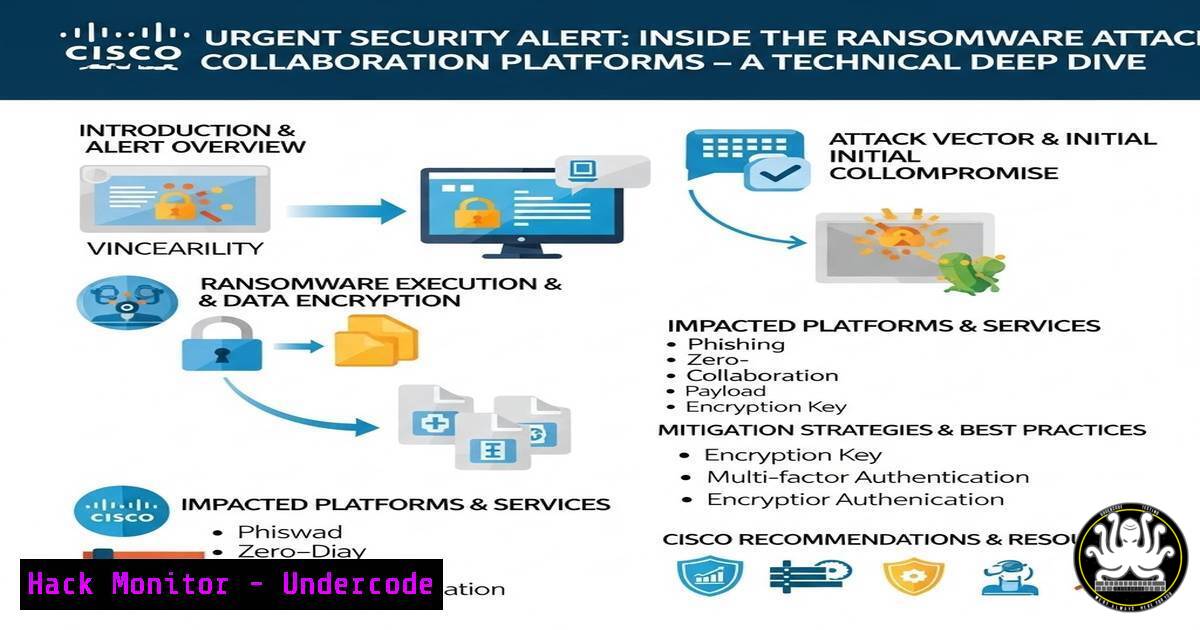
Introduction:
On March 24, 2025, Cisco Talos confirmed a sophisticated cyberattack targeting Cisco’s internal infrastructure, specifically focusing on collaboration platforms. While the company asserts that operational networks and core products remain unaffected, the breach exposed sensitive employee data to a ransomware operator. This incident highlights the evolving attack surface of hybrid work environments, where API misconfigurations and identity vulnerabilities serve as primary ingress points for threat actors. Understanding the technical mechanics behind this breach is critical for organizations relying on unified communications and identity management.
Learning Objectives:
- Understand the attack vectors targeting collaboration and identity management platforms.
- Learn how to enumerate and secure exposed APIs and endpoints using open-source tools.
- Analyze the lateral movement techniques used by ransomware gangs within hybrid cloud environments.
1. Reconnaissance: Enumerating Exposed Collaboration Endpoints
The initial phase of the attack likely involved scanning for exposed collaboration portals, developer APIs, and authentication endpoints.
Step‑by‑step guide:
To identify potential entry points in your own environment, security teams can use tools like `Nmap` and `ffuf` to discover hidden or misconfigured endpoints.
Linux Command: Nmap Scan for Web Services
nmap -p 443,8443,9443 --script http-title,http-enum -iL targets.txt -oN collaboration_scan.txt
Explanation: This scans common collaboration ports and attempts to enumerate web directories. Look for paths like /api, /v1, /auth, or `/webex` which might indicate exposed Cisco collaboration services.
Windows Command: Using curl to test for insecure API exposure
curl -k -X GET https://[target-ip]/api/v1/users -H "Content-Type: application/json"
Explanation: If the API endpoint lacks proper authentication, this command might return a list of user objects, indicating a critical misconfiguration similar to what attackers exploited.
2. Exploiting Identity Management (IAM) Flaws
Ransomware actors often compromise identity providers. In this case, attackers likely targeted the Single Sign-On (SSO) or OAuth implementations tied to Cisco’s collaboration suite.
Step‑by‑step guide: Simulating an OAuth Misconfiguration Check
Security professionals can use `oauth2c` or manual inspection to verify if redirect URIs are properly validated, preventing authorization code interception.
Linux Command: Testing for open redirect in OAuth flow
curl -I "https://[target-sso]/oauth/authorize?response_type=code&client_id=[bash]&redirect_uri=https://evil.com/callback&state=test"
Explanation: If the server responds with a `302 Found` redirecting to evil.com, the application is vulnerable to authorization code interception, a technique used to steal tokens and gain persistent access.
3. Lateral Movement: Exploiting Webex and Collaboration APIs
Once inside, attackers pivot to internal APIs. The goal is to enumerate users, read messages, and exfiltrate sensitive data.
Step‑by‑step guide: Enumerating users via a compromised API token
Assuming an attacker obtained a valid JWT or OAuth token, they could query the user directory.
Linux Command: Using curl with a stolen token
curl -X GET "https://api.ciscospark.com/v1/people" -H "Authorization: Bearer <STOLEN_TOKEN>" | jq '.items[] | {displayName, emails}'
Explanation: This command queries the Webex Teams API to list all people in the organization, extracting their names and emails. This data is then used for phishing or extortion.
4. Data Exfiltration and Ransomware Deployment
After reconnaissance, attackers deploy ransomware. In cloud environments, they might encrypt data stored in SharePoint, OneDrive, or S3 buckets connected to the collaboration platform.
Step‑by‑step guide: Identifying and securing cloud storage mounts
System administrators should audit mounted drives and cloud sync folders to prevent mass encryption.
Windows Command: Checking for mapped drives and cloud sync paths
net use
wmic logicaldisk get caption,description,providername
dir C:\Users\%USERNAME%\Cisco\Webex\ /s /b
Explanation: The first command lists network shares. The second identifies cloud storage providers. The third searches for locally cached Webex data which could be targeted by file-encrypting malware.
5. Mitigation: Hardening Windows and Linux Collaboration Hosts
To prevent such attacks, implement strict host-based firewalls and application whitelisting.
Step‑by‑step guide: Blocking unauthorized API calls via host firewall
Linux Command (iptables): Block outbound connections to known malicious C2 servers or unauthorized API endpoints.
sudo iptables -A OUTPUT -d [malicious-ip] -j DROP
sudo iptables -A OUTPUT -p tcp --dport 443 -m string --string "api.evil.com" --algo bm -j REJECT
Explanation: This drops traffic to a specific IP and rejects packets containing a specific domain string in the payload, preventing data exfiltration to command-and-control servers.
Windows Command (PowerShell): Block an IP via Windows Firewall
New-NetFirewallRule -DisplayName "Block Malicious C2" -Direction Outbound -LocalPort Any -Protocol Any -RemoteAddress [malicious-ip] -Action Block
Explanation: This creates a rule to block all outbound traffic to the attacker’s IP address.
- Incident Response: Analyzing Logs for Indicators of Compromise
Post-breach analysis involves correlating logs from identity providers, collaboration platforms, and firewalls.
Step‑by‑step guide: Searching Windows Event Logs for suspicious logins
Get-WinEvent -LogName Security | Where-Object { $<em>.Id -eq 4624 -and $</em>.Message -match "Webex" -and $_.Message -match "Anomaly" }
Explanation: This filters successful logon events (4624) related to Webex applications that were flagged as anomalous, helping identify compromised accounts.
What Undercode Say:
- Key Takeaway 1: Collaboration tools are high-value targets. The attack on Cisco underscores that APIs, not just endpoints, are the new perimeter. Organizations must implement rigorous API security testing and monitoring.
- Key Takeaway 2: Identity is the new battleground. The breach likely pivoted on compromised OAuth tokens or misconfigured SSO. Deploying Conditional Access policies and rigorous token validation is non-negotiable.
Analysis: The Cisco incident serves as a stark reminder that internal infrastructure is often less fortified than customer-facing products. The use of ransomware here indicates a shift from pure data theft to disruption, aiming to cripple internal operations. Security teams must treat collaboration data with the same sensitivity as core business databases. The blending of API security with endpoint detection is now mandatory, as attackers chain these weaknesses to move laterally and exfiltrate data silently.
Prediction:
We will see a surge in targeted ransomware attacks against collaboration and identity platforms in 2025. Attackers will move beyond phishing to exploiting API rate limiting and OAuth implementation flaws. The market for “Identity Detection and Response” (IDR) tools will explode as organizations scramble to monitor authentication flows and API behavior in real time, moving away from reliance on perimeter-based defenses.
▶️ Related Video (76% Match):
🎯Let’s Practice For Free:
IT/Security Reporter URL:
Reported By: Etnikhalili Client – Hackers Feeds
Extra Hub: Undercode MoN
Basic Verification: Pass ✅


