Listen to this Post
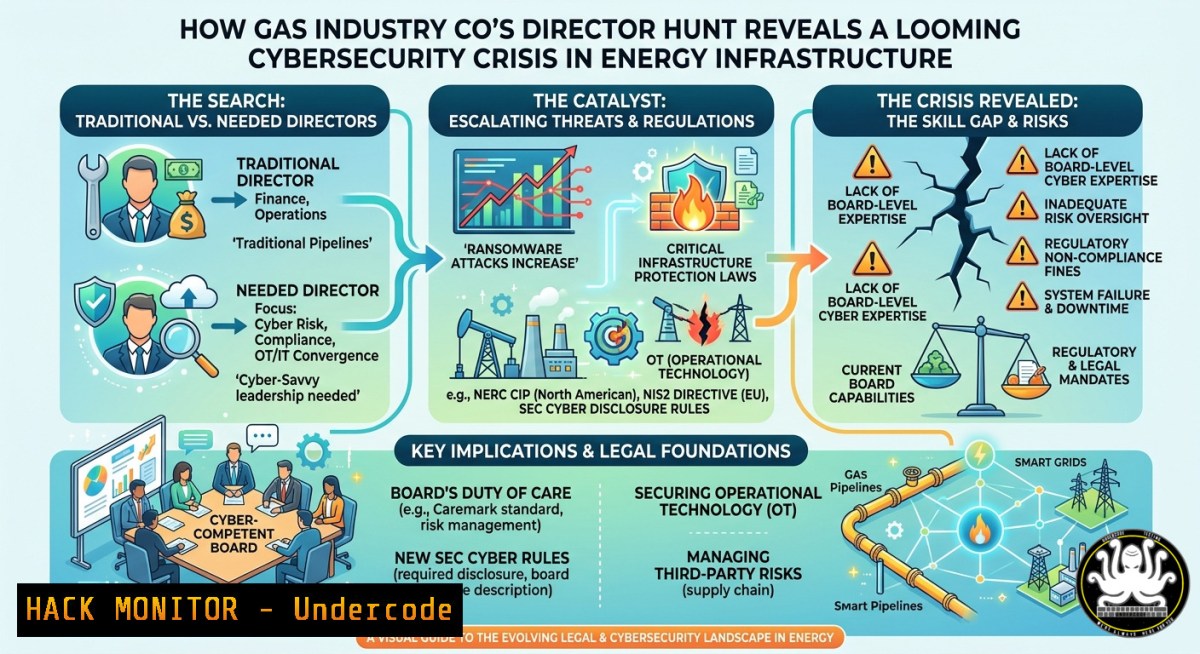
The global energy sector is racing through its most profound transformation in a century, propelled by digitalization, decarbonization mandates, and the relentless integration of AI-driven automation. But as operational technology (OT) systems and supervisory control and data acquisition (SCADA) networks merge with enterprise IT infrastructures, the attack surface of critical gas and energy assets has exploded, creating unprecedented risk vectors for co-regulatory bodies like New Zealand’s Gas Industry Company Limited (Gas Industry Co).
Learning Objectives:
- Understand how digital transformation in gas governance (gas registry management, D+1 models, reconciliation processes) expands cyber vulnerabilities.
- Identify key industrial control system (ICS) and OT threats facing energy co-regulators, including APTs targeting remote terminal units (RTUs) and human-machine interfaces (HMIs).
- Master hands-on Linux and Windows commands for auditing network perimeters, securing remote access, and hardening critical infrastructure endpoints.
You Should Know:
- Harden Remote Access Gateways Against APTs Targeting OT Networks
Gas Industry Co facilitates critical downstream systems including the gas registry and reconciliation rules processing. Recent threat intelligence reveals groups like VOLTZITE and AZURITE compromising OT environments by exploiting unmonitored cellular gateways and engineering workstations. Below is a step-by-step guide to securing remote access pathways on both Linux and Windows, adapted from CISA and Dragos 2026 recommendations.
- Step‑by‑step guide explaining what this does and how to use it.
Step 1: Audit All Internet-Facing Edge Devices
On Linux (e.g., an Ubuntu management server), use `nmap` to scan for unexpected open ports on OT gateways:
sudo nmap -sS -p- -T4 192.168.1.0/24
On Windows (PowerShell as Admin), discover devices via ARP table and then test connectivity:
arp -a | findstr "dynamic"
Test-NetConnection -ComputerName 192.168.1.100 -Port 22
This identifies unauthenticated or poorly configured devices. Immediately block any unauthorized SSH or RDP paths.
Step 2: Enforce Multi-Factor Authentication (MFA) and Disable Default Credentials
CISA’s analysis of the Poland 2025 energy sector incident showed attackers used default credentials to pivot onto HMIs and RTUs. On Linux, harden /etc/ssh/sshd_config:
 Force public-key authentication only
PubkeyAuthentication yes
PasswordAuthentication no
ChallengeResponseAuthentication no
On Windows, enforce MFA for all remote access via Group Policy (gpedit.msc). Navigate to Computer Configuration > Administrative Templates > Windows Components > Remote Desktop Services > Require user authentication for remote connections by using Network Level Authentication.
- Deploy ICS-Aware Network Monitoring to Detect Silent Malware
The Dragos 2026 OT/ICS Year in Review found that malware operated silently without triggering alerts in 13% of incident response cases, and oil/gas sectors had malware detection gaps in 37% of findings. Gas Industry Co’s oversight of downstream reconciliation processes requires monitoring of ICS-specific protocols.
- Step‑by‑step guide explaining what this does and how to use it.
Step 1: Install and Configure Zeek (formerly Bro) for Modbus/TCP Analysis (Linux)
On an Ubuntu 22.04 system dedicated to network monitoring, install Zeek and enable Modbus analyzer:
sudo apt update && sudo apt install zeek
export PATH=$PATH:/opt/zeek/bin
zeekctl deploy
Edit `/opt/zeek/share/zeek/site/local.zeek` to load Modbus:
@load protocols/modbus
Step 2: Set Up Windows-Based OT Asset Inventory with PowerShell
To map unauthorized device changes (critical for gas registry integrity), run this Windows PowerShell script daily:
Get-NetNeighbor | Export-Csv -Path "C:\OT_Inventory\arp_$(Get-Date -Format 'yyyyMMdd').csv"
Get-SmbConnection | Format-Table -AutoSize
This baseline helps detect suspicious connections that could indicate lateral movement from an OT workstation to a SCADA controller.
- Implement Critical Patch Management Without Downtime in Gas Facilities
Patching constraints due to operational continuity requirements are a primary vulnerability in the gas industry. Adopt a risk-based virtual patching approach using Microsoft Defender for IoT or open-source Snort for Windows and Linux.
- Step‑by‑step guide explaining what this does and how to use it.
Step 1: Deploy Snort for Virtual Patching on Windows
Download Snort from Snort.org. Install WinPcap. Run Snort in inline mode to block known exploits targeting RTUs:
snort -i eth0 -c C:\snort\etc\snort.conf -Q --daq afpacket
Step 2: Use Linux eBPF for Kernel-Level Monitoring Without Rebooting
For gas control servers that cannot be taken offline, use eBPF tools (bpftrace) to monitor for suspicious syscalls:
sudo apt install bpftrace
sudo bpftrace -e 'tracepoint:syscalls:sys_enter_execve { printf("%s executed %s\n", comm, str(args->filename)); }'
- Secure API and Cloud Interfaces for Gas Market Data
Gas Industry Co facilitates market administration and data disclosures through API endpoints. Attackers increasingly target APIs to exfiltrate pricing or consumer data. Implement API security scanning on Linux CI/CD pipelines.
- Step‑by‑step guide explaining what this does and how to use it.
Step 1: Run OWASP ZAP API Scan (Linux)
wget https://github.com/zaproxy/zaproxy/releases/latest/download/ZAP_2_14_0_Linux.tar.gz
tar -xvf ZAP_2_14_0_Linux.tar.gz
cd ZAP_2_14_0
./zap.sh -cmd -quickurl https://api.gasindustry.co.nz/v1/marketdata -quickprogress
Step 2: Set Up API Rate Limiting on NGINX (Reverse Proxy)
To prevent credential stuffing attacks on gas participant portals, add this to /etc/nginx/nginx.conf:
limit_req_zone $binary_remote_addr zone=login:10m rate=5r/m;
server {
location /api/login {
limit_req zone=login;
proxy_pass http://backend_api;
}
}
- Build a Board-Level Cyber Risk Dashboard Using Open Source Tools
With 51% of boards now demanding foundational security metrics and business resiliency indicators, co-regulatory bodies need to translate OT cyber risk into enterprise language. Use Elastic Stack (ELK) on Ubuntu to aggregate logs and visualize metrics for the board.
- Step‑by‑step guide explaining what this does and how to use it.
Step 1: Install Elastic Stack on Linux
wget -qO - https://artifacts.elastic.co/GPG-KEY-elasticsearch | sudo apt-key add -
sudo apt-get update && sudo apt-get install elasticsearch kibana logstash
sudo systemctl start elasticsearch kibana
Step 2: Create a “Gas Industry Cyber Resilience” Dashboard
In Kibana, import a pre-built dashboard for OT data: visualize number of failed login attempts on gas registries, latency in backup reconciliation processes, and counts of blocked malware events from Snort. This aligns cybersecurity metrics with the organization’s statutory objective to “ensure gas is delivered in a safe, efficient, and reliable manner”.
What Undercode Say:
- Co-regulatory gas bodies face a unique governance paradox: they oversee digital systems (gas registries, reconciliation rules, D+1 models) that are rapidly digitizing, yet many board members lack the operational technology (OT) risk literacy to challenge management on SCADA vulnerabilities. Without mandatory cyber-risk training for directors—such as the NACD Cyber-Risk Oversight Program or CISA’s CCE certification—organizations will continue to treat cybersecurity as a technical “cost center” rather than a strategic resilience pillar.
- The March 2026 consultation on New Zealand’s new Critical Infrastructure Cyber Security Regime will bring mandatory standards to approximately 200 entities, including energy sector participants that Gas Industry Co co-regulates. Directors who join the board now must be prepared to navigate this evolving compliance landscape, where failure to implement ICS-specific controls (e.g., NIST SP 800-82, ISO/IEC 27019) could lead to regulatory penalties—and potentially personal liability if a breach causes cascading outages.
Prediction:
-
- New Zealand’s upcoming critical infrastructure cyber law will drive a surge in demand for board members with verifiable OT security credentials, accelerating the professionalization of gas governance.
-
- The integration of AI-driven threat detection into gas SCADA systems will reduce mean-time-to-detection (MTTD) from days to minutes by 2028, but it will also require gas co-regulators to invest heavily in retraining IT staff on AI model governance.
-
- If the proposed NZ cyber regime does not explicitly mandate regular third-party penetration testing of gas registry and reconciliation APIs, threat groups like VOLTZITE could pivot from targeting U.S. pipelines to exploiting vulnerable co-regulatory data platforms, causing “loss of view and control” similar to the Poland 2025 energy sector incident.
▶️ Related Video (80% Match):
🎯Let’s Practice For Free:
IT/Security Reporter URL:
Reported By: Gas Industry – Hackers Feeds
Extra Hub: Undercode MoN
Basic Verification: Pass ✅
🎓 Live Courses & Certifications:
Join Undercode Academy for Verified Certifications
🚀 Request a Custom Project:
Secure, high-velocity infrastructure and disruptive technological engineering. Contact our engineering team for high-tier development and proprietary systems:
[email protected]


