Listen to this Post
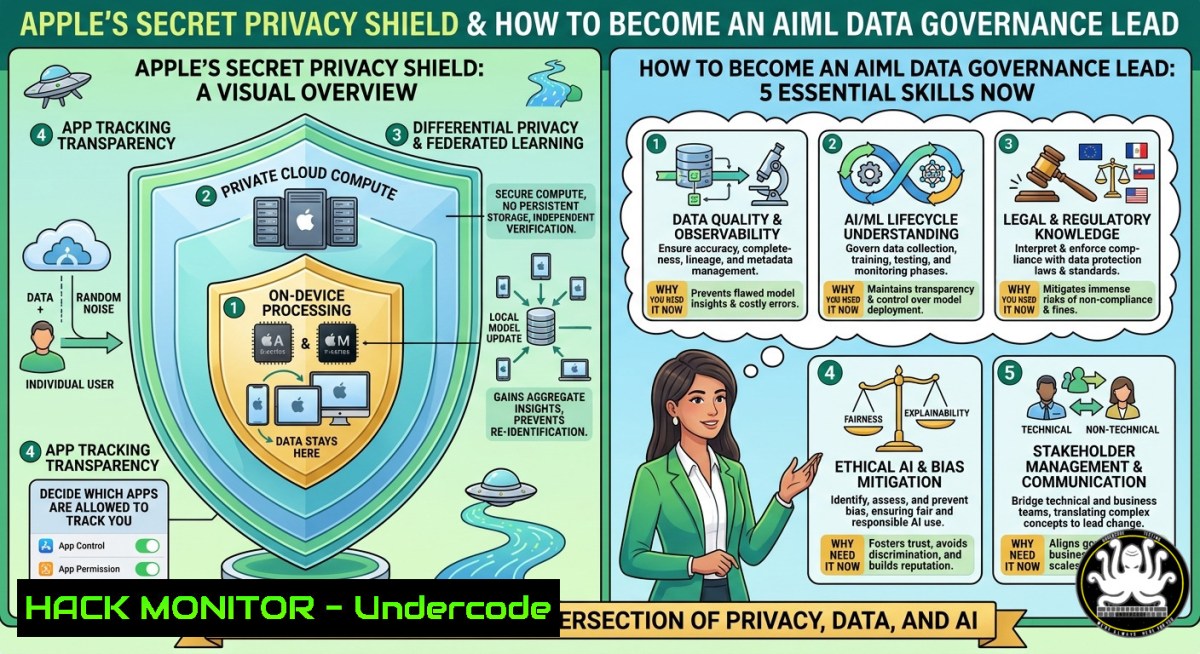
Introduction:
As Apple’s AIML Privacy & Regulatory Compliance Team actively recruits a Privacy & Data Governance Engineering Lead, the intersection of artificial intelligence, privacy-preserving machine learning, and regulatory compliance becomes a battlefield for enterprise security. Core concepts include differential privacy (adding statistical noise to prevent individual data identification), federated learning (training models without centralizing raw data), and immutable audit logging—all critical to meeting GDPR, CCPA, and emerging AI regulations. This article transforms that job description into a hands-on technical playbook, equipping you with commands, configurations, and exploitation/mitigation strategies used by Apple’s internal teams.
Learning Objectives:
- Implement differential privacy and federated learning pipelines using open-source libraries and verify privacy budget leakage.
- Deploy end-to-end data governance with lineage tracking, automated tagging, and role-based access control (RBAC) on Linux/Windows.
- Build tamper-proof audit trails for ML inference requests and remediate common API security flaws in AI endpoints.
You Should Know:
- Privacy‑Preserving ML: Differential Privacy & Federated Learning in Practice
Apple’s teams rely on differential privacy (DP) to extract insights without exposing individuals. Below is a step‑by‑step guide to injecting DP into a PyTorch training loop using Opacus (Facebook’s library), plus Linux commands to verify epsilon (privacy budget) consumption.
Step‑by‑step:
1. Install Opacus and dependencies (Linux/macOS/WSL):
python3 -m venv dp_env
source dp_env/bin/activate
pip install opacus torch torchvision
2. Train a model with DP – Code snippet:
from opacus import PrivacyEngine
model = torch.nn.Linear(784, 10)
optimizer = torch.optim.SGD(model.parameters(), lr=0.05)
privacy_engine = PrivacyEngine()
model, optimizer, data_loader = privacy_engine.make_private(
module=model,
optimizer=optimizer,
data_loader=train_loader,
noise_multiplier=1.0,
max_grad_norm=1.0,
)
 Training loop; after each epoch, check epsilon
epsilon = privacy_engine.get_epsilon(delta=1e-5)
print(f"Privacy budget spent: {epsilon:.2f}")
3. Monitor budget leakage – Use `audit` module to detect if gradients leak:
 Linux: watch for unauthorized memory reads
sudo strace -p $(pgrep python) -e read,write -o dp_audit.log
4. Federated Learning simulation with Flower framework:
pip install flwr
 Start server and clients; enable secure aggregation via TLS
flower-server --ssl_cert=cert.pem --ssl_key=key.pem
Windows alternative: Use WSL2 with Ubuntu 22.04 for the same commands, or run Opacus natively via Anaconda PowerShell.
- Data Governance & Lineage Tracking for AI Pipelines
Data governance requires cataloging every dataset, transformation, and model input. Apache Atlas (Linux) and Azure Purview (Windows/cloud) are enterprise standards. This section implements column‑level lineage and RBAC.
Step‑by‑step (Linux + Docker):
1. Deploy Apache Atlas:
docker run -d --name atlas -p 21000:21000 apache/atlas:latest
2. Register a dataset via REST API (replace `<>` with your values):
curl -u admin:admin -X POST -H "Content-Type: application/json" \
-d '{"entity":{"typeName":"hive_table","attributes":{"name":"user_behavior","qualifiedName":"hdfs://cluster/data/user_behavior"}}}' \
http://localhost:21000/api/atlas/v2/entity
3. Tag with PII classification:
curl -u admin:admin -X POST -H "Content-Type: application/json" \
-d '{"typeName":"PII_SENSITIVE"}' \
http://localhost:21000/api/atlas/v2/entity/guid/{entity_guid}/classification
4. Windows – Azure Purview CLI:
az login
az purview account create --name "MyPurview" --resource-group "RG" --location "eastus"
az purview scan start --scan-id "scan1" --data-source "myadls"
Tutorial: Lineage helps answer “which models used this compromised dataset?” – essential for breach response.
- Tamper‑Proof Logging & Audit Trails for Regulatory Compliance
Apple’s lead must design logs that resist deletion or modification. Use Linux `auditd` and Windows Advanced Audit Policy, then forward to a WORM (Write Once Read Many) store like AWS S3 Object Lock.
Step‑by‑step (Linux):
1. Configure auditd to monitor ML model files:
sudo auditctl -w /opt/models/ -p wa -k model_integrity
2. Send logs to remote syslog with hashing (append SHA256 to each line):
logger "$(echo 'Inference request: user123' | sha256sum) - $(date)"
3. Simulate tampering attempt and detect:
sudo ausearch -k model_integrity | grep 'write'
Windows PowerShell (Event Log + Forwarding):
 Enable object access auditing on the model folder
auditpol /set /subcategory:"File System" /success:enable
$path = "C:\Models.pkl"
$acl = Get-Acl $path
$rule = New-Object System.Security.AccessControl.FileSystemAuditRule("Everyone","Write","Success")
$acl.AddAuditRule($rule)
Set-Acl $path $acl
 Forward to central collector
wevtutil epl "Security" "\collector\logs\model_audit.evtx"
4. API Security Hardening for AI Endpoints
ML inference APIs are prime attack vectors (model theft, prompt injection). Hardening includes OAuth2, rate limiting, and input validation. Below configures Kong API Gateway (Linux) and tests with curl.
Step‑by‑step:
1. Run Kong with Postgres:
docker run -d --name kong -e "KONG_DATABASE=postgres" -e "KONG_PG_HOST=host.docker.internal" -p 8000:8000 kong:latest
2. Enable rate limiting (10 req/min per API key):
curl -i -X POST http://localhost:8001/services/inference/plugins \
--data "name=rate-limiting" --data "config.minute=10" --data "config.policy=redis"
3. Require JWT token validation:
curl -X POST http://localhost:8001/consumers/myapp/jwt -H "Content-Type: application/x-www-form-urlencoded"
 Test with a forged token – should be rejected
curl -H "Authorization: Bearer fake.jwt.token" http://localhost:8000/predict
4. Input sanitization – Python example running inside the ML container:
import bleach
user_prompt = bleach.clean(request.json['prompt'], tags=[], strip=True)
Windows alternative: Use Azure API Management with similar policies via PowerShell.
- Cloud Hardening for AI Workloads (AWS + GCP Example)
AI pipelines run in the cloud; misconfigured IAM or storage leads to data leaks. Hardening steps assume Terraform and AWS CLI.
Step‑by‑step (Linux/macOS):
1. Enforce S3 object lock for training data:
aws s3api put-object-lock-configuration --bucket my-ml-data \
--object-lock-configuration '{"ObjectLockEnabled":"Enabled","Rule":{"DefaultRetention":{"Mode":"GOVERNANCE","Days":365}}}'
2. Block public access and restrict VPC endpoints:
aws s3api put-public-access-block --bucket my-ml-data --public-access-block-configuration BlockPublicAcls=true,IgnorePublicAcls=true
3. GCP – enforce VPC Service Controls to prevent data exfiltration:
gcloud access-context-manager perimeters create ai_perimeter --resources=projects/123 --restricted-services=aiplatform.googleapis.com
4. Vulnerability exploitation demonstration – attempt to assume an over‑privileged role:
aws sts assume-role --role-arn arn:aws:iam::123:role/TooPermissiveRole --role-session-name test
Mitigation: Enforce `Condition` keys like `aws:SourceVpc` in IAM policies.
6. Exploiting & Mitigating Model Poisoning Attacks
Attackers can inject backdoors into training data. Apple’s lead must both understand the attack and implement robust aggregation.
Step‑by‑step (Linux + Python):
- Simulate a poisoning attack – add mislabeled samples to CIFAR‑10:
Poison 5% of labels: set 'cat' to 'dog'
poisoned_labels = [9 if label == 3 else label for label in original_labels]  3=cat,9=dog
- Train a victim model – observe accuracy drop on clean cats.
- Mitigation using trimmed mean aggregation (federated learning context):
import numpy as np
def trimmed_mean(gradients, trim_ratio=0.3):
sorted_g = np.sort(gradients, axis=0)
trim = int(trim_ratio  len(gradients))
return np.mean(sorted_g[trim:-trim], axis=0)
- Linux monitoring – detect anomalous gradient magnitudes with
prometheus:Export gradients as metrics echo "gradient_norm $(python -c 'import torch; print(torch.randn(100).norm().item())')" | curl --data-binary @- http://localhost:9091/metrics/job/ml_monitoring
7. GDPR/CCPA Compliance Automation for AI Systems
Automate data subject access requests (DSAR) and deletion. Use `gcloud` and AWS resourcegroupstaggingapi.
Step‑by‑step:
- Tag all ML assets with `purpose=training` and
retention=2y:aws resourcegroupstaggingapi tag-resources --resource-arn-list arn:aws:s3:::my-data --tags '{"purpose":"training","retention":"2y"}' - Respond to DSAR – script to locate all PII for a given user:
Find user email in S3, DynamoDB, RDS
aws s3 ls s3://my-data/ --recursive | grep "[email protected]"
- Automated deletion after retention using AWS Lambda + S3 lifecycle policy:
{ "Rules": [{ "Id": "ExpireOldData", "Status": "Enabled", "Expiration": { "Days": 730 } }] } - Windows/AD integration – use `Get-ADUser` to map user IDs to ML datasets.
What Undercode Say:
- Key Takeaway 1: Apple’s job description implicitly demands proficiency in differential privacy libraries (Opacus, TensorFlow Privacy) and federated learning frameworks (Flower, FATE) – not just theory but quantifiable privacy budget management.
- Key Takeaway 2: Data governance leads must move beyond metadata catalogs; they need to implement automated tagging, WORM logging, and real‑time audit stream analysis to satisfy regulators like the California Privacy Protection Agency.
Analysis: The role combines legal/regulatory knowledge with low‑level engineering – you’re expected to write audit daemons, harden cloud IAM, and advise on differential privacy epsilon values. Most candidates overlook the “logging considerations” line; that’s where auditd, syslog‑ng, and blockchain‑based notarization become differentiators. Additionally, Apple’s focus on “evaluation” suggests you’ll build test harnesses that simulate privacy attacks (membership inference, model inversion) to validate mitigations. The practical commands above (e.g., `strace` on DP trainers, Kong rate limits) mirror internal Apple workflows shared in WWDC privacy sessions.
Prediction:
-
- Apple’s investment will force competitors (Google, Meta, Microsoft) to publicly disclose privacy budgets for their AI models, leading to industry‑wide transparency standards within 18 months.
-
- The adoption of tamper‑proof logging and WORM storage for inference requests will become a default requirement in all EU AI Act high‑risk systems, creating a $2B compliance tech market.
-
- Small AI startups lacking resources to implement differential privacy and hardened API gateways will be acquired or abandon the US/EU markets, consolidating AI privacy to Big Tech and specialized vendors.
▶️ Related Video (68% Match):
🎯Let’s Practice For Free:
IT/Security Reporter URL:
Reported By: Vinay Goel – Hackers Feeds
Extra Hub: Undercode MoN
Basic Verification: Pass ✅
🎓 Live Courses & Certifications:
Join Undercode Academy for Verified Certifications
🚀 Request a Custom Project:
Secure, high-velocity infrastructure and disruptive technological engineering. Contact our engineering team for high-tier development and proprietary systems:
[email protected]


