Listen to this Post
Introduction:
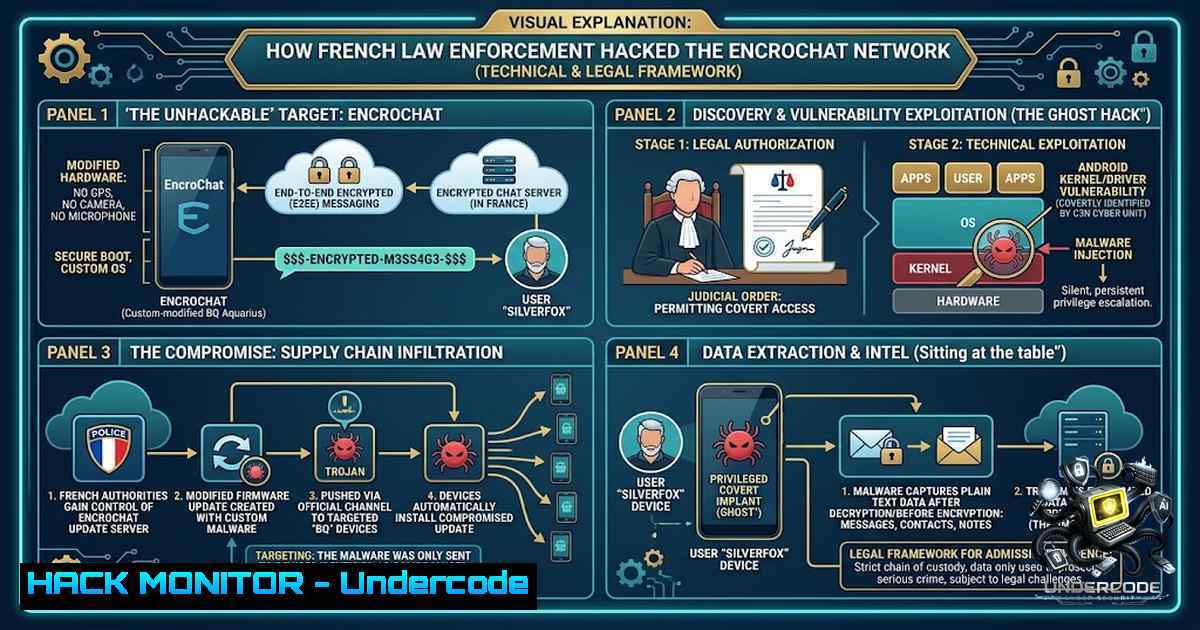
The 2020 infiltration of EncroChat, a communication platform widely used by organized crime, represents a landmark case study in law enforcement hacking, digital forensics, and the legal admissibility of technical evidence. French cyber spies leveraged CVE-2019-2215, a critical Android kernel use-after-free vulnerability known as “Bad Binder,” to deploy malware that intercepted messages directly from device memory. A recent forensic report by Czech firm Invasys, which reverse-engineered the French operation, revealed that the implant was poorly written, frequently failed, and relied on exploit code copied from GitHub, raising significant questions about the reliability and legality of the evidence used in hundreds of criminal trials across Europe.
Learning Objectives:
- Understand the technical architecture of the EncroChat network and the Android Bad Binder vulnerability (CVE-2019-2215) that enabled its compromise.
- Analyze the operational methodology of the French state hacking group, including the use of a fake update server and Frida-based instrumentation.
- Evaluate the forensic and legal implications of the Invasys report, including the distinction between equipment interference and interception.
- Identify practical security measures and commands to detect, mitigate, and analyze similar Android kernel exploits.
You Should Know:
1. The Bad Binder Vulnerability (CVE-2019-2215)
The cornerstone of the French operation was the exploitation of CVE-2019-2215, a use-after-free (UAF) vulnerability in Android’s Binder inter-process communication (IPC) subsystem. First discovered in 2017 by a Google researcher investigating NSO Group’s Pegasus spyware, the bug remained unpatched in over 2.5 billion devices for two years. The vulnerability allows a local attacker to escalate privileges to root by corrupting kernel memory.
Step‑by‑step guide explaining what this does and how to use it:
The exploit works by manipulating the `binder_thread` structure and the epoll wait queue. The following is a simplified breakdown of the exploitation flow, based on public Proof-of-Concept (PoC) code:
- Leak
task_struct: The exploit triggers the UAF to leak the kernel address of the `task_struct` for the current process. - Overwrite
addr_limit: It then overwrites the `addr_limit` field in the `task_struct` to0xfffffffffffffffe, enabling arbitrary kernel memory read and write. - Escalate Privileges: Finally, it locates and overwrites the `cred` structure (which stores user privileges) to set the effective user ID (EUID) to 0 (root).
Example from a public PoC (wired0ut/CVE-2019-2215):
~ $ whoami
whoami: unknown uid 1000
~ $ ./poc
[!] Starting first phase of exploit; task_struct leak...
[] Leaked task_struct @ 0xffffffc0fb3f0d80
[] addr_limit overwritten, leaking cred ptr @ 0xffffffc0fb3f1440
[] Overwriting entire id block in cred...
[] You should now be r00t...
[] getuid(): 0
/ whoami
whoami: unknown uid 0
- The French Operation: Implant Deployment and Message Interception
The French police cyber crime team (C3N) and the state hacking group (STNCJ) executed a sophisticated man-in-the-middle attack. After obtaining legal authorization, they duplicated EncroChat’s virtual servers hosted at OVH in France. They then built a replica update server and used a network load balancer to secretly route EncroChat customer phones to their imposter server.
Step‑by‑step guide explaining what this does and how to use it:
On April 1, 2020, the hacking team pushed a malware implant via the fake update server, ultimately infecting 32,014 devices. The implant’s core functions were:
- Exploitation: Leverage the Bad Binder exploit to disable SELinux and gain root control.
- Instrumentation: Use Frida, an open-source dynamic instrumentation toolkit, to “hook” into the EncroChat messaging app.
- Data Exfiltration: Intercept and copy messages directly from the device’s memory before encryption, then exfiltrate them to a French police control server.
The following conceptual commands illustrate how Frida can be used to intercept Android application data (for authorized security testing only):
 Install Frida on a testing machine
pip install frida-tools

List running processes on a connected Android device
frida-ps -U

Inject a script to intercept specific function calls (conceptual example)
frida -U -f com.encrochat.app -l hook_script.js --1o-pause
3. The Invasys Forensic Analysis and Reverse Engineering
In 2024, a UK judge ordered an infected EncroChat device to be handed over to Invasys for independent forensic analysis. The Czech company successfully reverse-engineered the hack by recreating the fake update server and tricking the device into accepting the malware.
Step‑by‑step guide explaining what this does and how to use it:
The forensic analysis concluded that the French malware was poorly written and prone to repeated failure. The reverse engineering process typically involves:
- Static Analysis: Decompiling the malware binary to understand its functionality. Tools like `jadx` for Android DEX files or `Ghidra` for native libraries.
- Dynamic Analysis: Running the malware in a controlled environment (e.g., an Android emulator) to observe its behavior.
- Network Analysis: Monitoring the malware’s network communications to identify command-and-control (C2) servers.
Example commands for Android forensic analysis:
 Extract APK from a device
adb shell pm path com.encrochat.app
adb pull /data/app/com.encrochat.app/base.apk

Decompile the APK using jadx
jadx-gui base.apk

Monitor network traffic (requires root)
adb shell tcpdump -i any -w /sdcard/capture.pcap
adb pull /sdcard/capture.pcap
4. Legal Implications: Equipment Interference vs. Interception
The Invasys report proved that the messages were copied directly from the endpoint device (equipment interference) rather than intercepted during transmission. This distinction is critical in legal proceedings, as different legal frameworks and warrants apply.
Step‑by‑step guide explaining what this does and how to use it:
Understanding this distinction is vital for legal professionals and forensic experts:
- Interception: Typically refers to capturing data during transmission (e.g., wiretapping). Often requires a warrant under specific communications laws.
- Equipment Interference: Involves accessing data stored on a device. May require a different type of legal authorization, such as a search warrant.
- Forensic Verification: The integrity of evidence obtained via equipment interference must be rigorously verified, as the method is more susceptible to manipulation.
5. Mitigation and Hardening Against Android Kernel Exploits
The EncroChat case underscores the importance of timely patching and robust endpoint security.
Step‑by‑step guide explaining what this does and how to use it:
To protect against similar attacks:
- Patch Management: Regularly apply security updates. CVE-2019-2215 was patched in the Android Security Bulletin of October 2019.
- SELinux Enforcement: Ensure SELinux is in enforcing mode. The French implant disabled it to gain root access.
- Application Sandboxing: Restrict application permissions. EncroChat phones lacked standard features but still ran a modified Android OS.
- Endpoint Detection and Response (EDR): Deploy EDR solutions on mobile devices to detect suspicious instrumentation (e.g., Frida hooks).
Commands to check SELinux status and kernel version on Android:
 Check SELinux status
adb shell getenforce

Check kernel version
adb shell uname -a

Check for specific patch levels
adb shell getprop ro.build.version.security_patch
What Undercode Say:
- Key Takeaway 1: The EncroChat hack demonstrates that even “secure” communication platforms are vulnerable to sophisticated, state-level adversaries who can exploit unpatched software vulnerabilities and deploy custom malware. The use of a public vulnerability (CVE-2019-2215) and open-source tools (Frida) highlights the dual-use nature of cybersecurity research.
-
Key Takeaway 2: The legal and forensic fallout from the EncroChat operation is as significant as the technical breach itself. The revelation that the French implant was poorly written and unreliable challenges the admissibility of evidence in ongoing trials. The case underscores the critical need for transparency and independent verification in law enforcement hacking operations.
Analysis:
The EncroChat case is a watershed moment for both cybersecurity and criminal justice. Technically, it illustrates the devastating potential of a single kernel vulnerability when combined with a man-in-the-middle attack on a software update mechanism. Operationally, the French team’s reliance on publicly available exploit code and a testing toolkit like Frida suggests a rapid, perhaps rushed, development cycle, leading to the “student project” quality criticized by experts. Legally, the case is a battleground over the rules of evidence in the digital age. The Invasys report provides defense lawyers with the technical ammunition to challenge the prosecution’s narrative, potentially leading to overturned convictions and a re-evaluation of police surveillance powers. The distinction between equipment interference and interception is not just a legal nicety; it is a fundamental question about the nature of the intrusion and the rights of the accused.
Prediction:
- +1 The legal challenges stemming from the EncroChat case will likely lead to more stringent judicial oversight and transparency requirements for law enforcement hacking operations across Europe, establishing clearer precedents for digital evidence admissibility.
- +1 The case will accelerate the development and adoption of more robust, verifiable mobile device forensics tools and methodologies, as both law enforcement and the defense seek to validate the integrity of extracted data.
- -1 The exposure of the French hacking methodology will prompt criminal networks to adopt even more secure communication platforms, potentially leveraging post-quantum cryptography or decentralized architectures that are harder to compromise.
- -1 The precedent of state actors using and reusing public exploit code from platforms like GitHub may lead to increased scrutiny and potential restrictions on the public sharing of security research, hindering the broader cybersecurity community.
▶️ Related Video (78% Match):
🎯Let’s Practice For Free:
🎓 Live Courses & Certifications:
Join Undercode Academy for Verified Certifications
🚀 Request a Custom Project:
Secure, high-velocity infrastructure and disruptive technological engineering. Contact our engineering team for high-tier development and proprietary systems:
[email protected]
💎 Smart Architecture | 🛡️ Secure by Design | ⭐ Trusted by Thousands
IT/Security Reporter URL:
Reported By: https://lnkd.in/p/e6biqsK5 – Hackers Feeds
Extra Hub: Undercode MoN
Basic Verification: Pass ✅


