Listen to this Post
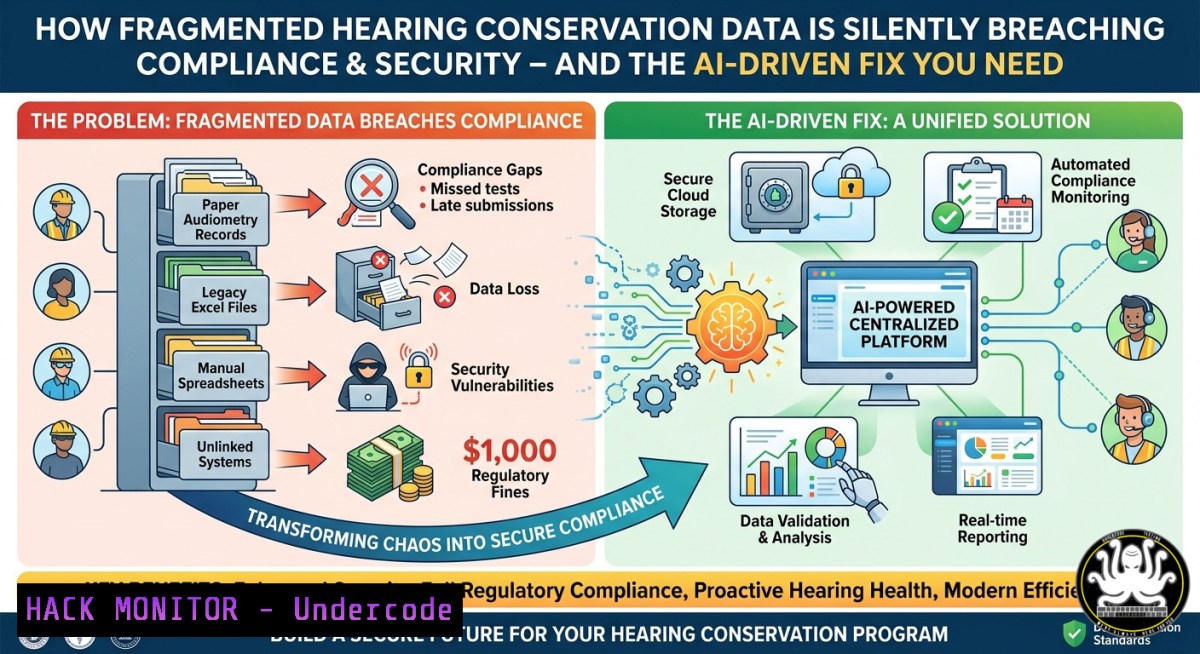
Introduction:
Fragmented workflows in Hearing Conservation Programs (HCP) – where audiometry data, exposure records, spreadsheets, and paper documents live in disconnected silos – create not only operational inefficiencies but also significant cybersecurity and compliance risks. Unintegrated systems increase attack surfaces, hinder audit trails, and violate data protection mandates like HIPAA or OSHA recordkeeping rules, turning a clinical data problem into a security liability.
Learning Objectives:
- Identify security gaps introduced by fragmented occupational health data workflows.
- Implement unified data pipelines with encryption and access controls for hearing conservation records.
- Apply Linux/Windows commands and API security practices to automate and protect longitudinal health data.
You Should Know:
- The Hidden Security Cost of Disconnected Systems – And How to Map Your Attack Surface
The post highlights delayed follow-ups, compliance risks, and limited insights. From a cybersecurity perspective, every separate data silo (audiometry DB, exposure logs, spreadsheets, paper scans) is an independent asset with its own authentication, logging, and vulnerability profile. Attackers often exploit forgotten spreadsheets or unpatched legacy audiometry devices to pivot into corporate networks.
Step‑by‑step guide to audit your current fragmentation risk:
- Inventory all data stores: Use Nmap or `netstat` on Windows to discover active services holding health data.
– Linux: `sudo nmap -sV -p- 192.168.1.0/24 | grep -E “mysql|postgres|smb|http”`
– Windows (PowerShell): `Get-NetTCPConnection | Where-Object {$_.LocalPort -in (1433,3306,5432,445,8080)} | Format-Table`
2. Check for unencrypted spreadsheets: Search for `.xls` or `.csv` files with patient identifiers.
– Linux: `find /shared_drive -type f \( -name “.xls” -o -name “.csv” \) -exec grep -l “SSN\|DOB” {} \;`
– Windows (cmd): `findstr /s /i /m “SSN.DOB” .xlsx .csv`
3. Verify paper documentation handling: Ensure scanned documents are not stored in world-readable network shares. Use `icacls` on Windows to review permissions.
– `icacls “\\fileserver\HCP_Scans” /t` → look for `(BUILTIN\Users:F)` which allows write access to all.
- Remediate: Consolidate into a single database with row‑level security, enforce TLS 1.3 for any data transmission, and implement automated logging via Sysmon (Windows) or auditd (Linux).
Tutorial – Encrypting a legacy audiometry export:
If you must keep a CSV, encrypt it using GPG (Linux) or 7-Zip AES-256 (Windows).
– Linux: `gpg –symmetric –cipher-algo AES256 audiometry_export.csv`
– Windows (PowerShell): `7z a -pYourStrongPass -mhe=on audiometry_export.7z .csv`
2. Building a Connected, Intelligent Pipeline for Hearing Conservation Data (With API Security Hardening)
The post advocates for a connected, intelligent, proactive infrastructure. The technical solution is an API‑first data hub that ingests audiometry (from ISO‑standard devices), exposure data (from industrial hygiene sensors), and HR records. But without proper API security, you expose sensitive health data to injection attacks and broken authentication.
Step‑by‑step guide to deploy a secure ingestion API (using Python + FastAPI with OAuth2):
- Set up a Linux VM (Ubuntu 22.04) as your API gateway.
sudo apt update && sudo apt install python3-pip nginx certbot
pip3 install fastapi uvicorn python-multipart psycopg2-binary pyjwt
-
Create a minimal API endpoint that accepts audiometry JSON, validates JWT, and logs to PostgreSQL.
main.py
from fastapi import FastAPI, Depends, HTTPException, Security
from fastapi.security import HTTPBearer, HTTPAuthorizationCredentials
import jwt, json, psycopg2
app = FastAPI()
security = HTTPBearer()</p></li>
</ol>

<p>def verify_jwt(creds: HTTPAuthorizationCredentials = Security(security)):
try:
payload = jwt.decode(creds.credentials, "YOUR_SECRET_KEY", algorithms=["HS256"])
return payload
except jwt.InvalidTokenError:
raise HTTPException(status_code=403, detail="Invalid token")

@app.post("/api/v1/audiometry")
async def ingest_audiometry(data: dict, user = Depends(verify_jwt)):
 Insert into DB
conn = psycopg2.connect("dbname=hcp user=admin password=secure host=localhost")
cur = conn.cursor()
cur.execute("INSERT INTO audiometry (patient_id, left_ear, right_ear, timestamp) VALUES (%s, %s, %s, NOW())",
(data['patient_id'], data['left_db'], data['right_db']))
conn.commit()
return {"status": "ingested", "patient": data['patient_id']}
3. Run with Uvicorn behind Nginx (HTTPS only).
- Generate self‑signed cert for testing: `openssl req -x509 -newkey rsa:4096 -keyout key.pem -out cert.pem -days 365 -nodes`
– Run: `uvicorn main:app –host 0.0.0.0 –port 8000 –ssl-keyfile=key.pem –ssl-certfile=cert.pem`
4. Hardening commands (Linux):
- Rate limiting: `sudo iptables -A INPUT -p tcp –dport 8000 -m limit –limit 10/minute -j ACCEPT`
– Block SQLi patterns using ModSecurity (install viaapt install libapache2-mod-security2).
- Automating Longitudinal Tracking & Compliance Reporting With PowerShell/Bash
One major pain point is “difficult longitudinal tracking.” Automate the generation of OSHA 300 logs and individual hearing threshold shift reports using command‑line scripts that pull from your unified database.
Linux Bash script to detect standard threshold shifts (STS):
!/bin/bash
 Compare baseline (first test) with most recent test per patient
psql -d hcp -t -c "SELECT patient_id, baseline_left, baseline_right FROM audiometry_baseline" | while read id left_base right_base; do
latest_left=$(psql -d hcp -t -c "SELECT left_ear FROM audiometry WHERE patient_id='$id' ORDER BY timestamp DESC LIMIT 1")
if (( $(echo "$latest_left - $left_base > 10" | bc -l) )); then
echo "STS detected for patient $id" >> /var/log/sts_alerts.log
fi
done
Windows PowerShell script to check for missing follow‑up appointments (compliance risk):
$threshold = (Get-Date).AddDays(-30) Import-Csv "C:\HCP\scheduled_tests.csv" | Where-Object {$<em>.test_date -lt $threshold -and $</em>.completed -eq $false} | Export-Csv -Path "C:\HCP\compliance_breaches.csv" -NoTypeInformation Write-Host "Compliance report generated. $(Get-Content C:\HCP\compliance_breaches.csv | Measure-Object -Line).Lines of risk"- Cloud Hardening for HealthTech Data Lakes (AWS S3 + IAM Example)
Moving to a connected, intelligent system often means cloud storage. Misconfigured S3 buckets are a top cause of health data breaches. Apply these hardening steps.
Step‑by‑step AWS CLI commands for secure hearing conservation storage:
Create bucket with blocking public access aws s3api create-bucket --bucket hcp-expert-data --region us-east-1 --object-ownership BucketOwnerEnforced aws s3api put-public-access-block --bucket hcp-expert-data --public-access-block-configuration BlockPublicAcls=true,IgnorePublicAcls=true,BlockPublicPolicy=true,RestrictPublicBuckets=true Enable default encryption (AES-256) aws s3api put-bucket-encryption --bucket hcp-expert-data --server-side-encryption-configuration '{"Rules":[{"ApplyServerSideEncryptionByDefault":{"SSEAlgorithm":"AES256"}}]}' Create IAM policy for least privilege (read/write only specific prefix) cat > hcp_policy.json << EOF { "Version": "2012-10-17", "Statement": [ {"Effect": "Allow", "Action": ["s3:GetObject","s3:PutObject"], "Resource": "arn:aws:s3:::hcp-expert-data/audiometry/"}, {"Effect": "Deny", "Action": "s3:", "NotResource": "arn:aws:s3:::hcp-expert-data/audiometry/"} ] } EOF aws iam create-policy --policy-name HCPAudiometryOnly --policy-document file://hcp_policy.json- Exploiting the “Incentive Problem” – Simulating an Insider Threat
Toby J Daniel’s comment notes that clinics get paid for tests, not prevention, so connecting systems would hurt revenue. This creates a perverse incentive where staff might deliberately leave data fragmented or block integrations. From a red‑team view, an insider could hide fraudulent test records in an unmonitored spreadsheet.
Demonstration – How an attacker (or malicious insider) could inject false audiometry data into a disconnected CSV:
 malicious_edit.py
import csv, random
with open('legacy_audiometry.csv', 'a', newline='') as f:
writer = csv.writer(f)
 Add 10 fake patients with normal hearing (to avoid suspicion)
for i in range(10):
writer.writerow([f"FAKE_{i}", random.randint(0,10), random.randint(0,10), "2025-01-01"])
Mitigation: Implement file integrity monitoring (FIM) using `auditd` on Linux or Windows SACL.
– Linux: `auditctl -w /shared/legacy_audiometry.csv -p wa -k hcp_integrity`
– Check alerts: `ausearch -k hcp_integrity`6. AI-Driven Predictive Analytics for Proactive Hearing Conservation
The post desires “intelligent and proactive” infrastructure. Use a simple machine learning model (e.g., logistic regression) on your unified data to predict which workers will exceed noise exposure limits next quarter.
Tutorial – Train a risk model with Python (scikit-learn) on exposure + audiometry:
import pandas as pd
from sklearn.ensemble import RandomForestClassifier
 Assume unified table with columns: avg_exposure_dB, baseline_threshold, years_on_job, exceeded_limit (1/0)
df = pd.read_sql("SELECT avg_exposure, baseline_left, tenure, exceeded FROM unified_hcp", con)
X = df[['avg_exposure', 'baseline_left', 'tenure']]
y = df['exceeded']
model = RandomForestClassifier().fit(X, y)
 Save model and create API endpoint that returns risk score for new employee
import joblib; joblib.dump(model, 'hcp_risk_model.pkl')
Deploy as a cron job (Linux) to email weekly risk list:
0 9 1 /usr/bin/python3 /opt/hcp/predict_risk.py | mail -s "HCP Risk Report" [email protected]
What Undercode Say:
- Key Takeaway 1: Fragmented health data isn’t just an operational headache – it creates tangible security vulnerabilities (unencrypted spreadsheets, missing audit trails, legacy device exploits) that compliance auditors and attackers will leverage.
- Key Takeaway 2: The economic incentive problem (pay per test, not prevention) can only be solved by regulatory pressure and automated reporting that makes fragmentation more expensive than integration.
Prediction:
Within 18–24 months, OSHA and HIPAA will mandate real-time API-based reporting for hearing conservation data, similar to recent updates for electronic health records. This will force clinics to abandon fragmented workflows, triggering a wave of M&A in occupational health IT. Simultaneously, AI-driven anomaly detection (like the random forest model above) will become a standard feature to identify clinics that deliberately withhold data. Organizations that ignore integration now will face both security breaches and regulatory fines.
▶️ Related Video (72% Match):
🎯Let’s Practice For Free:
IT/Security Reporter URL:
Reported By: Hearingconservation Occupationalhealth – Hackers Feeds
Extra Hub: Undercode MoN
Basic Verification: Pass ✅🔐JOIN OUR CYBER WORLD [ CVE News • HackMonitor • UndercodeNews ]
📢 Follow UndercodeTesting & Stay Tuned:
- Generate self‑signed cert for testing: `openssl req -x509 -newkey rsa:4096 -keyout key.pem -out cert.pem -days 365 -nodes`


