Listen to this Post
Introduction:
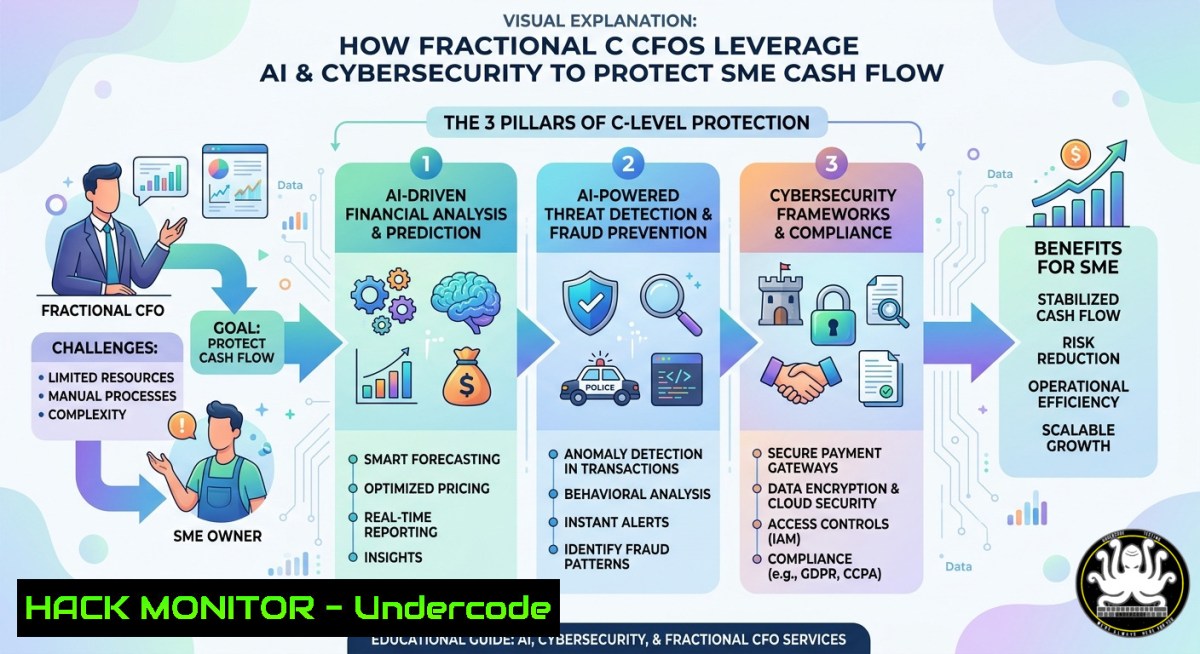
Financial leadership is no longer just about spreadsheets and tax returns. As SMEs adopt cloud accounting, API-driven banking, and AI forecasting tools, the attack surface for financial data expands dramatically. This article transforms the launch of PartnerWise Advisory Limited into a technical deep dive: securing financial workflows, automating compliance with Linux/Windows commands, and upskilling with training courses at the intersection of IT, AI, and cybersecurity.
Learning Objectives:
- Implement Linux and Windows commands to audit financial system logs and detect anomalies in cash flow data.
- Configure API security for banking and accounting integrations (e.g., OAuth2, rate limiting, mTLS).
- Apply cloud hardening techniques for financial data stored in AWS, Azure, or Google Cloud.
- Enroll in free/paid training courses to master AI-driven fraud detection and incident response for finance teams.
You Should Know:
- Auditing Financial Data Access on Linux & Windows (Step‑by‑Step)
Most founders ignore who accessed their financial reports or accounting VMs. Start with command‑line forensics.
Linux – Check authentication logs for unauthorized access to financial servers:
 View recent failed SSH attempts (indicators of brute force)
sudo grep "Failed password" /var/log/auth.log | tail -20

Track all sudo commands related to accounting software (e.g., QuickBooks runs)
sudo ausearch -m USER_CMD -ts recent | grep -i "quickbooks|xero|invoice"
Windows – PowerShell for audit policies on financial file shares:
 Enable object access auditing on a folder containing financial statements
$path = "D:\Finance\CashFlow_Reports"
$acl = Get-Acl $path
$auditRule = New-Object System.Security.AccessControl.FileSystemAuditRule("Everyone", "Write,Delete", "Success,Failure")
$acl.SetAuditRule($auditRule)
Set-Acl $path $acl

Query security event log for file access (Event ID 4663)
Get-WinEvent -FilterHashtable @{LogName='Security'; ID=4663} | Where-Object {$_.Message -like "D:\Finance"} | Select-Object TimeCreated, Message
What this does: These commands help you verify who touched critical financial data. Use them weekly to detect insider threats or compromised credentials before a wire transfer is altered.
- Hardening API Security for Banking & Accounting Integrations
Modern fractional CFOs rely on APIs to pull real-time cash flow from banks (Plaid, Yodlee) or ERPs (SAP, Oracle NetSuite). Weak API security is a top vector for financial data leaks.
Step‑by‑step to secure an API endpoint (using OAuth2 and mTLS):
- Enforce OAuth2 with short-lived tokens (never use API keys directly in client code).
- Implement rate limiting to prevent scraping of transaction history.
– Example with Nginx (Linux):
limit_req_zone $binary_remote_addr zone=finance_api:10m rate=5r/m;
location /api/v1/transactions {
limit_req zone=finance_api burst=2 nodelay;
proxy_pass http://finance-backend;
}
3. Validate webhook signatures to avoid forged bank notifications.
– Python snippet for verifying a typical HMAC-SHA256 signature:
import hmac, hashlib
def verify_webhook(payload, signature, secret):
expected = hmac.new(secret.encode(), payload, hashlib.sha256).hexdigest()
return hmac.compare_digest(signature, expected)
4. Use mTLS for server-to-server financial APIs – generate client certificates and enforce on the firewall.
Why this matters for PartnerWise clients: A misconfigured accounting API could leak payroll, supplier payments, or investor details. Audit every integration your fractional CFO touches.
3. Cloud Hardening for Financial Forecasting Workloads
Fractional CFOs increasingly run cash flow models on cloud VMs or serverless functions. Misconfigured cloud storage is a common source of breaches.
AWS example – secure S3 bucket for financial reports:
 Block public access at bucket level
aws s3api put-public-access-block --bucket partnerwise-financials --public-access-block-configuration BlockPublicAcls=true,IgnorePublicAcls=true,BlockPublicPolicy=true,RestrictPublicBuckets=true

Enforce bucket encryption (AES-256)
aws s3api put-bucket-encryption --bucket partnerwise-financials --server-side-encryption-configuration '{"Rules":[{"ApplyServerSideEncryptionByDefault":{"SSEAlgorithm":"AES256"}}]}'
Azure – restrict network access to storage accounts containing profit margin analysis:
 Add a service endpoint and deny all public networks
$storage = Get-AzStorageAccount -ResourceGroupName "FinanceRG" -Name "cfomodels"
$rules = @()
$rules += (Add-AzStorageAccountNetworkRule -ResourceGroupName "FinanceRG" -Name $storage.StorageAccountName -VirtualNetworkResourceId "/subscriptions/.../subnets/FinanceSubnet")
Set-AzStorageAccount -ResourceGroupName "FinanceRG" -Name $storage.StorageAccountName -DefaultAction Deny -NetworkRuleSet $rules
Step‑by‑step to harden a Linux VM running forecasting scripts:
1. Disable password authentication for SSH: `sudo sed -i ‘s/PasswordAuthentication yes/PasswordAuthentication no/’ /etc/ssh/sshd_config`
2. Install Fail2ban to block brute force on financial dashboards:
sudo apt install fail2ban -y
sudo systemctl enable fail2ban
3. Use `auditd` to monitor changes to financial model scripts:
sudo auditctl -w /opt/finance_models/ -p wa -k model_integrity
- AI for Fraud Detection in Cash Flow – Commands & Tutorials
AI can flag anomalous transactions that a fractional CFO might miss. Use open‑source tools (TensorFlow, scikit‑learn) to build a simple anomaly detector for SME expenses.
Python environment setup on Linux/Windows:
 Create virtual environment
python3 -m venv fin_ai
source fin_ai/bin/activate  Linux/macOS
fin_ai\Scripts\activate  Windows

Install required libraries
pip install pandas scikit-learn matplotlib
Minimal code to detect outliers in daily cash outflows:
import pandas as pd
from sklearn.ensemble import IsolationForest

Load transaction data (amounts in USD)
df = pd.read_csv("cash_outflows.csv")
model = IsolationForest(contamination=0.05, random_state=42)
df['anomaly'] = model.fit_predict(df[['amount']])
anomalies = df[df['anomaly'] == -1]
print("Suspicious transactions:\n", anomalies)
Training course recommendation:
- AI for Finance Specialization (Coursera / DeepLearning.AI) – covers time‑series anomaly detection.
- SEC488: Cloud Security and DevOps Automation (SANS) – includes securing AI pipelines for financial data.
5. Windows Security Policies for Accounting Workstations
Many SME finance teams still run QuickBooks or Xero on Windows endpoints. Enforce security baselines to prevent ransomware from encrypting your ledgers.
Step‑by‑step using Local Group Policy:
1. Disable PowerShell script execution for non‑admins:
`Set-ExecutionPolicy -ExecutionPolicy Restricted -Scope LocalMachine`
- Enable Windows Defender Controlled Folder Access to protect
C:\FinanceData:Add-MpPreference -ControlledFolderAccessAllowedApplications "C:\Program Files\QuickBooks\QBW32.exe" Set-MpPreference -EnableControlledFolderAccess Enabled
- Block legacy authentication (SMBv1) to prevent lateral movement:
Disable-WindowsOptionalFeature -Online -FeatureName SMB1Protocol
What Undercode Say:
- Key Takeaway 1: Fractional CFO services like PartnerWise must embed cybersecurity into their cash flow dashboards – commands like `auditd` and S3 policies become part of financial due diligence.
- Key Takeaway 2: AI-driven anomaly detection is not optional for SMEs; training courses on Isolation Forest and webhook validation pay for themselves after one prevented BEC attack.
Analysis (approx. 10 lines): The post by PartnerWise correctly identifies that scaling requires more than basic accounting. However, it overlooks the technical reality: cash flow data is a prime ransomware target. Attackers know SMEs use cloud ERPs and APIs. By integrating the Linux/Windows audits, API hardening, and AI models described above, a fractional CFO becomes a de facto security officer. Most founders ignore burn rate conversations – but they also ignore who has access to their AWS S3 bucket. The commands and policies shown close that gap. Training finance teams on OAuth2 and mTLS is as critical as forecasting. Without this layer, even the best strategic financial advice can be rendered worthless by a single compromised API key. PartnerWise and similar firms should offer a “technical readiness assessment” alongside their fractional CFO services.
Expected Output:
Prediction:
Within 18 months, fractional CFO offerings will bundle mandatory cybersecurity tooling (e.g., automated log analysis, API gateway configuration, and AI fraud models) as a core deliverable. Firms that fail to provide these will lose SME clients to competitors who publish public hardening guides. Expect the rise of “vCISO + vCFO” hybrid roles, with training courses on SANS SEC505 (Securing Windows and Linux for Finance) becoming prerequisites for any finance director serving tech‑enabled businesses.
▶️ Related Video (72% Match):
🎯Let’s Practice For Free:
IT/Security Reporter URL:
Reported By: Fractionalcfo Businessgrowth – Hackers Feeds
Extra Hub: Undercode MoN
Basic Verification: Pass ✅
🎓 Live Courses & Certifications:
Join Undercode Academy for Verified Certifications
🚀 Request a Custom Project:
Secure, high-velocity infrastructure and disruptive technological engineering. Contact our engineering team for high-tier development and proprietary systems:
[email protected]


