
Listen to this Post
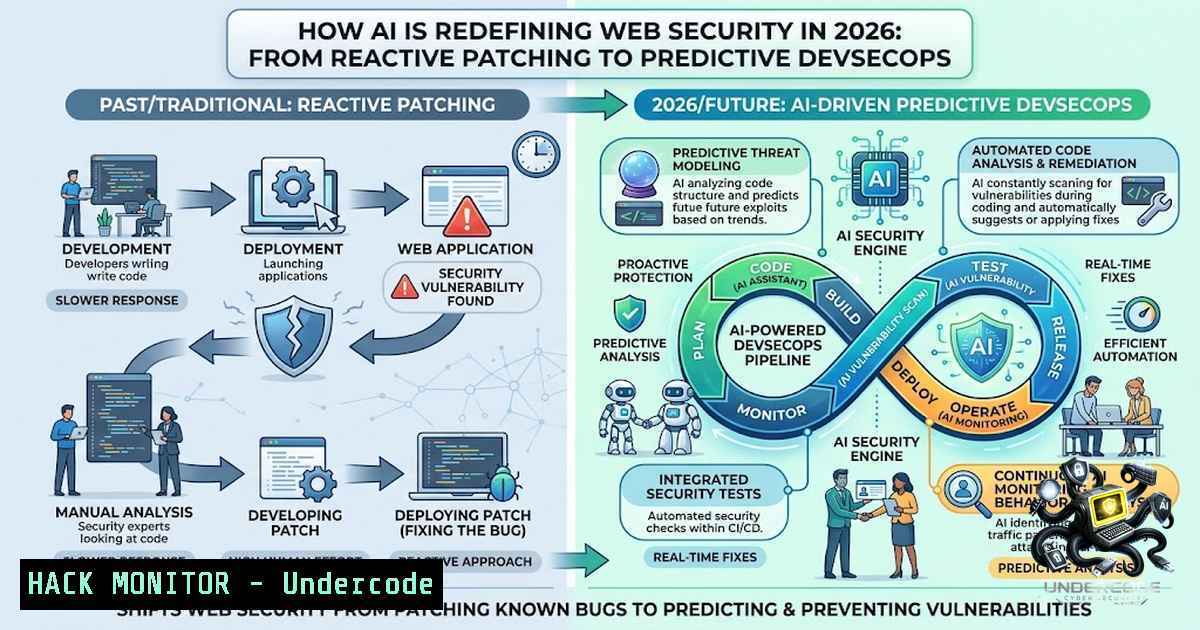
Introduction:
Traditional security models operate on a reactive paradigm—waiting for a breach to occur before patching vulnerabilities. However, with the exponential growth of code deployment and the sophistication of modern cyberattacks, fixed-rule detection systems are proving insufficient. The integration of Artificial Intelligence into DevSecOps is shifting the security left, enabling predictive analysis, real-time code auditing, and automated remediation. This article explores how AI is transforming web application security, offering a technical deep dive into practical implementations, command-line tools, and configuration strategies to future-proof your development pipeline.
Learning Objectives & Secrets:
- Objective 1: Master Predictive Code Analysis – Learn to implement Machine Learning models that analyze code structure during development to predict and mitigate vulnerabilities before deployment, moving beyond signature-based detection.
- Objective 2 Secret Tip: Continuous Audit Automation – Discover how to leverage AI-driven tools to scan millions of lines of code in minutes, cross-referencing global vulnerability databases (CVE) to isolate complex flaws like SQL injections and XSS with high precision.
- Objective 3 Secret Tip: Contextual False Positive Reduction – Understand how Natural Language Processing (NLP) applied to code understands application context, drastically reducing false alerts and saving developer hours wasted on irrelevant warnings.
You Should Know:
- Setting Up a Predictive AI Pipeline for Code Security
The core of AI-driven security lies in integrating predictive models directly into your CI/CD pipeline. This allows you to analyze code commits in real-time and flag potential vulnerabilities before they hit production.
Step‑by‑Step Guide:
- Step 1: Choose an AI/ML framework compatible with your stack (e.g., TensorFlow, PyTorch) or a specialized security API.
- Step 2: Train your model using historical code datasets and known CVE patterns. This requires parsing code into Abstract Syntax Trees (AST) to identify structural anomalies.
- Step 3: Integrate the model into your CI/CD tool (e.g., Jenkins, GitLab CI). Use a webhook to trigger analysis on every pull request.
- Command (Linux/Windows): For a lightweight setup, use `semgrep` with AI-enhanced rules.
Linux/macOS
semgrep --config auto --ai <your-repo-path>
Windows (PowerShell)
semgrep --config auto --ai <your-repo-path>
- Pro Tip: Combine this with `bandit` (Python) or `ESLint` (JavaScript) plugins that support machine learning extensions to catch logic flaws rather than just syntax errors.
2. Conducting Ultra‑Targeted Continuous Audits
Manual code audits are time-consuming and error-prone. AI can automate this process, cross-referencing against the latest Common Vulnerabilities and Exposures (CVE) database and OWASP Top 10.
Step‑by‑Step Guide:
- Step 1: Deploy a tool like `Dependency-Check` or `Snyk` that uses AI to prioritize vulnerabilities.
- Step 2: Schedule daily or per-commit scans. Use `cron` (Linux) or Task Scheduler (Windows) for automation.
- Step 3: Configure the tool to output results in a machine-readable format (JSON/XML) for further analysis by AI models.
- Command (Linux/macOS): Monitor your application for known vulnerabilities.
Check for Python dependencies
safety check -r requirements.txt --full-report
Check for JavaScript/Node.js
npm audit --audit-level=high
- Command (Windows): Use PowerShell to parse JSON output and integrate with SIEM.
$audit = npm audit --json | ConvertFrom-Json $audit.advisories | Where-Object { $_.severity -eq "critical" } - Configuration Tip: Enhance your audit with AI by using `GitHub Advanced Security` or
GitLab Ultimate, which use ML to identify complex injection flaws that static analyzers miss.
- Reducing False Positives with NLP and Contextual Analysis
The primary complaint against traditional SAST tools is the deluge of false positives. AI, utilizing NLP, can understand the developer’s intent and the application’s logic to filter out irrelevant alerts.
Step‑by‑Step Guide:
- Step 1: Select a tool that incorporates NLP, such as `CodeQL` or `DeepCode` (now part of Snyk).
- Step 2: Configure the tool’s context file to define your application’s architecture (e.g., MVC pattern, specific frameworks like React/Symfony).
- Step 3: Run a baseline scan to allow the AI to learn what constitutes a “normal” pattern in your codebase. This creates a custom baseline for anomaly detection.
- Command (Linux/Windows): Use `CodeQL` to perform deep semantic analysis.
codeql database create ./db --language=javascript
codeql database analyze ./db --format=csv --output=results.csv
- Critical Insight: Tuning the model’s sensitivity is key. Use a feedback loop where developers mark false positives—this data is fed back to retrain the model, improving accuracy over time.
4. Implementing Auto‑Remediation (Patch Suggestions)
AI is moving beyond detection to suggest specific code patches, dramatically reducing Mean Time To Resolve (MTTR). This is particularly effective for common frameworks and libraries.
Step‑by‑Step Guide:
- Step 1: Integrate an AI engine that supports auto-remediation, such as `Dependabot` (for dependency updates) or
GitLab's Auto DevSecOps. - Step 2: Configure the engine to create merge requests automatically with suggested fixes.
- Step 3: Establish a review process where a human security expert validates the patch before merging.
- Command (Linux/Windows): For Python
requirements.txt, use `pip-audit` to fix known issues:pip-audit --fix
- Advanced Configuration: For custom code, use AI-driven IDEs like `GitHub Copilot` or `Tabnine` which can generate secure code snippets based on the context of the vulnerability. Ensure you have a policy to review these suggestions, as AI-generated code can have its own security blind spots.
5. API Security and Cloud Hardening with AI
APIs and cloud configurations are prime attack vectors. AI can analyze API traffic patterns and cloud infrastructure-as-code (IaC) to detect misconfigurations and anomalous behavior.
Step‑by‑Step Guide:
- Step 1: Deploy an AI-based API gateway (e.g.,
Cloudflare AI Gateway,AWS WAF with ML) that learns your API’s normal traffic patterns. - Step 2: Use tools like `Checkov` or `Terraform Sentinel` with AI plugins to scan IaC templates (e.g., CloudFormation, Terraform) for misconfigurations.
- Step 3: Set up anomaly detection alerts for API requests that deviate from learned baselines.
- Command (Linux/Windows): Scan your Terraform files for misconfigurations using
checkov:checkov -d ./terraform/
- Hardening Tip: For Kubernetes, use `kubescape` with AI-enhanced scanning to identify deviations from NSA/CISA security standards.
kubescape scan framework nsa --verbose
6. Vulnerability Exploitation and Mitigation Testing
To truly secure an application, you must test it like an attacker. AI can assist in automating penetration testing, generating exploit payloads, and validating patches.
Step‑by‑Step Guide:
- Step 1: Use an AI-augmented pen-testing tool like `Burp Suite Pro` with its ML-driven scanner or open-source tools like `OWASP ZAP` with AI add-ons.
- Step 2: Configure the tool to fuzz endpoints and intelligently craft payloads based on the application’s response.
- Step 3: After an AI-generated patch is applied, run a regression test to ensure the vulnerability is mitigated without breaking functionality.
- Command (Linux/macOS): Use `sqlmap` for automated SQL injection detection (now with AI-enhanced tamper scripts).
sqlmap -u "http://example.com/page?id=1" --batch --random-agent
- Mitigation Strategy: Validate patches against the OWASP Application Security Verification Standard (ASVS) to ensure comprehensive coverage.
What Undercode Say:
- Key Takeaway 1: AI in DevSecOps is not a silver bullet but a force multiplier—automating the mundane tasks of scanning and pattern recognition frees up experts to focus on complex architectural decisions.
- Key Takeaway 2: The human element remains paramount. While AI suggests fixes, a security expert must validate them to avoid introducing logic errors or business logic flaws that an AI may misinterpret.
Analysis: The integration of AI into cybersecurity is a paradigm shift from detection to prediction. However, the current landscape shows that while AI excels at identifying known patterns and anomalies, it struggles with zero-day exploits and complex business logic attacks. The most effective strategy is a hybrid approach: AI handles the heavy lifting of continuous scanning and contextual alerting, while human experts provide oversight, strategic direction, and final validation. This collaboration not only accelerates the development cycle but also builds a more resilient security posture.
Prediction:
- +1: AI-driven DevSecOps will significantly reduce the exploitation window by automating 80% of patching processes for known vulnerabilities, leading to a measurable decrease in successful attacks on web applications by 2027.
- +1: The evolution of AI in code auditing will foster a new generation of “Self-Healing” applications that can autonomously mitigate threats in real-time, enhancing uptime and user trust.
- -1: The reliance on AI for security introduces a new attack vector—Adversarial AI. Malicious actors will attempt to poison training data or craft payloads designed to evade AI detection, shifting the arms race from code to data integrity.
- -1: Over-automation without expert oversight will lead to critical misconfigurations and false complacency, potentially leaving complex vulnerabilities unaddressed because they were incorrectly categorized as safe by AI models.
▶️ Related Video (80% Match):
🎯Let’s Practice For Free:
🎓 Live Courses & Certifications:
Join Undercode Academy for Verified Certifications
🚀 Request a Custom Project:
Secure, high-velocity infrastructure and disruptive technological engineering. Contact our engineering team for high-tier development and proprietary systems:
[email protected]
💎 Smart Architecture | 🛡️ Secure by Design | ⭐ Trusted by Thousands
IT/Security Reporter URL:
Reported By: https://lnkd.in/p/eewg_RVd – Hackers Feeds
Extra Hub: Undercode MoN
Basic Verification: Pass ✅


