Listen to this Post
Introduction:
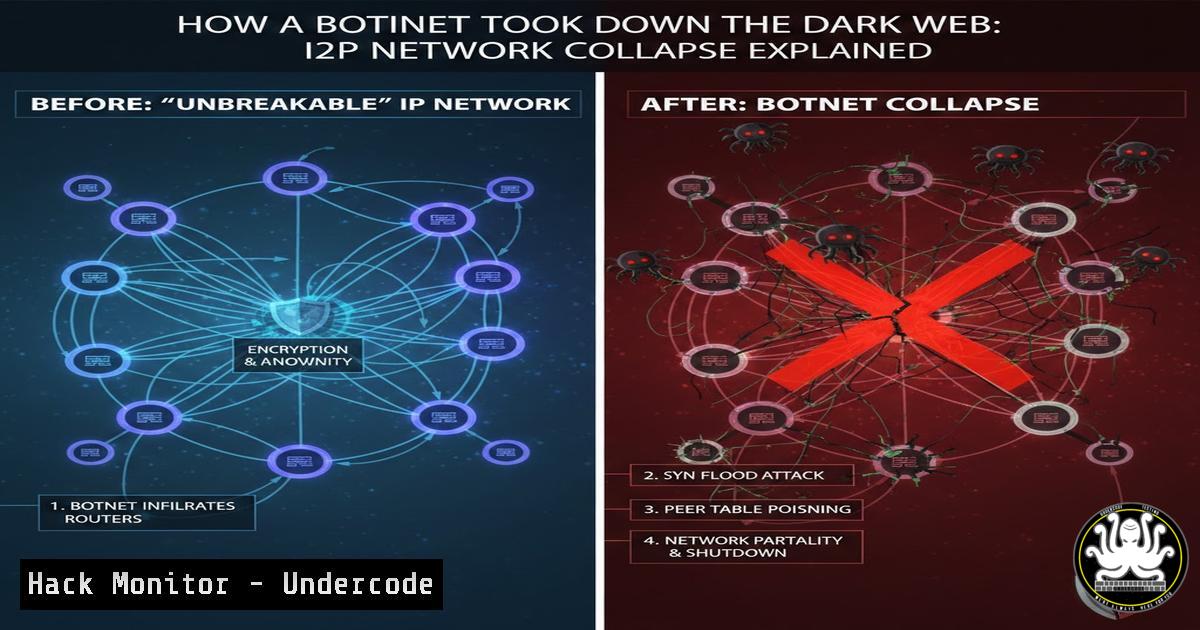
In a twist of digital irony, a botnet—a network of enslaved computers typically used to launch attacks—accidentally caused the catastrophic failure of the Invisible Internet Project (I2P) network. I2P is a privacy-focused layer often used to host “Eepsites” (anonymous websites) and is considered a more resilient alternative to Tor for certain peer-to-peer applications. However, a massive flood of malformed traffic from a widespread malware campaign inadvertently exploited a vulnerability in I2P’s floodfill logic, leading to a network-wide database corruption and forcing a hard reset of the entire darknet infrastructure.
Learning Objectives:
- Understand the architecture of the I2P network and its vulnerability to “floodfill” attacks.
- Analyze how botnet traffic differs from standard DDoS attacks in causing data corruption.
- Learn to identify I2P traffic on a network and implement mitigation strategies for similar P2P protocol weaknesses.
You Should Know:
- Anatomy of the Accident: How a Botnet Broke I2P
The incident was not a targeted state-sponsored takedown but a byproduct of a large-scale malware campaign. The botnet, likely designed for crypto-mining or proxy selling, was programmed to route its command-and-control (C2) traffic through I2P to hide from law enforcement. However, due to a bug in the bot’s code, it began flooding the I2P network with malformed “floodfill” requests.
In I2P, “floodfill” routers are special nodes that store a distributed database of network contact information (netDB). The botnet’s massive volume of corrupted database updates caused the floodfill peers to enter an inconsistent state, leading to a “network split” where routers could no longer find each other. To mitigate this, I2P developers had to release a new version (0.9.50) that blacklisted the malicious router IDs and introduced a hard fork in the network.
Step‑by‑step guide: Identifying I2P Floodfill Traffic on Linux
To understand what happened, you need to know what abnormal I2P traffic looks like. The following commands help analyze PCAPs for I2P anomalies.
Check for excessive I2P control messages (using tshark):
 Capture traffic on port 8887 (standard I2P router port)
sudo tshark -i eth0 -Y "udp.port == 8887" -T fields -e data.data

Filter specifically for I2P Database Store messages (floodfill)
 Assuming you have a PCAP file 'capture.pcap'
tshark -r capture.pcap -Y "i2p.database_store" -T fields -e ip.src -e i2p.router_id
Explanation: This filters for the specific I2P protocol messages responsible for updating the network database. A sudden spike in unique source IPs sending these messages indicates a botnet infection attempting to update the I2P netDB.
2. The Exploit Mechanics: Exploiting P2P Trust Models
The botnet effectively executed a “spam” attack on a distributed hash table (DHT). I2P relies on a “Routers.inf” database. The botnet generated millions of fake router identities. Since the I2P software trusts floodfill updates by default (to maintain network speed), it accepted these identities, causing legitimate routers to time out while trying to connect to non-existent peers. This is a classic case of an Eclipse Attack combined with resource exhaustion.
Step‑by‑step guide: Simulating a Floodfill Warning on Windows
While you cannot easily launch this attack, you can test your I2P node’s resilience by monitoring log files for the specific errors seen during the takedown.
Check I2P logs for “floodfill” errors (PowerShell):
 Navigate to I2P log directory (default path)
cd "$env:USERPROFILE\AppData\Local\I2P\logs"

Search for the critical error indicating database corruption
Select-String -Path "router.log" -Pattern "Floodfill persistence error|NetDB: Corrupt"

Monitor live log for floodfill rejections
Get-Content -Path "router.log" -Wait | Select-String -Pattern "too many floodfill"
Explanation: During the attack, logs would have shown “too many floodfill” rejections as the router tried to discard the botnet’s garbage data, eventually leading to “NetDB: Corrupt” as the local database became inconsistent.
3. Mitigation: Hardening P2P Networks Against Malformed Data
The I2P takedown highlights a fundamental security flaw in many P2P networks: the lack of proof-of-work for database updates. Post-incident, I2P developers implemented stricter validation. System administrators and security engineers can apply similar logic to internal P2P services.
Step‑by‑step guide: Implementing Rate Limiting for P2P Traffic on pfSense
To prevent a local client from participating in such a takedown (or being overwhelmed), you can limit the rate of outbound UDP packets.
1. Navigate to Firewall > Rules.
- Edit the WAN or LAN rule that allows traffic to the I2P port (commonly UDP 8887).
3. Click Advanced Options and check “Advanced”.
4. Under “Limiters,” create a new limiter:
- Name: P2P_Limit
- Bandwidth: Set a low value (e.g., 100 Kb/s) for the specific IP address of the I2P client.
- Apply the limiter to the rule. This prevents a compromised internal machine from acting as a botnet node that floods the external network.
-
OSINT: Tracking the Fallout of a Darknet Collapse
When I2P went down, criminal marketplaces and forums hosted on I2P (Eepsites) were forced to migrate or announce new addresses via clearnet mirrors or Telegram channels. This is a prime opportunity for OSINT collection.
Step‑by‑step guide: Scraping Darknet Migration Announcements (Linux)
During the I2P outage, administrators posted updates on clearnet forums. Use `curl` and `grep` to find references to new I2P destinations or workarounds.
 Search for mentions of I2P replacement addresses on a specific forum (example)
curl -s "https://pastebin.com/raw/XYZ123" | grep -E "i2p|b32.i2p|floodfill"

Check if a specific site is back online using a public I2P HTTP proxy
 (You need a running I2P router with HTTP proxy on 127.0.0.1:4444)
curl -x http://127.0.0.1:4444 -I "http://someforum.i2p/?timeout=60"
Explanation: The `curl` command probes the I2P network through your local proxy. If the site returns a 200 OK, the network stability is restored for that destination. A timeout or 404 indicates the site is still unreachable due to the database corruption.
- Forensics: Analyzing the Botnet Binary for I2P Strings
The botnet accidentally destroyed I2P because its configuration was hardcoded. Analyzing the malware sample reveals the specific I2P router IDs that were blacklisted.
Step‑by‑step guide: Extracting I2P Configs from Malware (Linux)
Assuming you have a malware sample (hash: e3b0c44298fc1c149afbf4c8996fb92427ae41e4649b934ca495991b7852b855)
 Use strings to find embedded I2P configuration
strings malware_sample.exe | grep -i "i2p" -A 5 -B 5

Look for the Router ID (a 516-byte key) or the destination port
 Output example: "i2p.routerId=abcdefghijklmnop..."

Check for hardcoded floodfill routers
strings malware_sample.exe | grep -E "[a-zA-Z0-9]{50,}" --color
Explanation: This extraction helps security researchers identify which routers were “poisoned” by the botnet, allowing network administrators to block those specific IDs at the application layer.
What Undercode Say:
- Resilience of Anonymity Networks: The I2P takedown proves that anonymity networks are not invincible; they are software with bugs. A sufficiently large, misconfigured botnet can cause more damage through unintentional protocol violations than through brute-force DDoS.
- The P2P Paradox: The very feature that makes I2P strong—decentralized trust—became its downfall. The “accidental” nature of the attack highlights that in cybersecurity, intent is irrelevant to impact; a faulty driver update or a misconfigured script can achieve what state-sponsored actors cannot.
- Lessons for Defenders: This incident underscores the need for input validation in all network layers. If a P2P protocol accepts data without authentication or proof-of-work, it will eventually be exploited, either intentionally or by accident. For blue teams, this means monitoring baseline P2P traffic volume to detect anomalies caused by botnets co-opting the protocol.
Prediction:
This incident will likely trigger a wave of “proof-of-concept” attacks against other low-profile P2P and anonymity networks (like Freenet or Yggdrasil). Threat actors will study the I2P failure not to copy the malware, but to weaponize the method of database corruption. Future botnets will be programmed specifically to exploit DHT vulnerabilities, moving beyond simple bandwidth floods to causing persistent, hard-to-patch data corruption across decentralized networks. This shifts the DDoS landscape from availability attacks to integrity attacks.
▶️ Related Video (80% Match):
🎯Let’s Practice For Free:
IT/Security Reporter URL:
Reported By: Sam Bent – Hackers Feeds
Extra Hub: Undercode MoN
Basic Verification: Pass ✅


