Listen to this Post
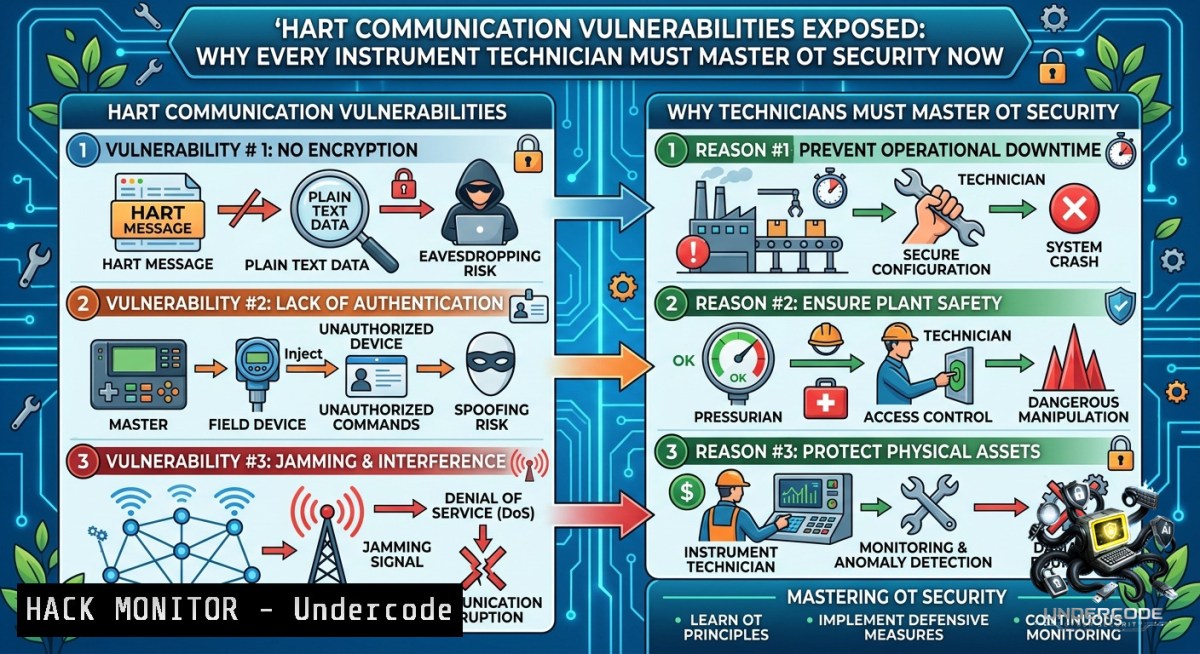
Introduction:
Industrial control systems (ICS) and operational technology (OT) environments, such as Sewage Treatment Plants and Oil & Gas facilities, rely heavily on field instruments like pressure, temperature, flow, and level transmitters, as well as control valves and HART communication protocols. While job postings for Instrument Technicians emphasize calibration and preventive maintenance, they rarely highlight the growing cyber-physical threat: attackers can exploit unsecured HART interfaces and poorly maintained instrumentation to manipulate physical processes, causing overflow, pressure spikes, or even explosions. This article bridges traditional instrumentation skills with essential OT cybersecurity practices, providing hands-on commands, configuration hardening steps, and training pathways.
Learning Objectives:
– Understand how HART communication and control valves can be exploited by adversaries to alter process readings or actuator states.
– Learn to identify insecure instrumentation configurations using both Windows and Linux tools for network and serial-based OT environments.
– Implement step-by-step hardening measures for field devices, including access control, segmentation, and monitoring, aligned with IEC 62443 standards.
You Should Know:
1. HART Protocol Attack Surface: From Calibration to Compromise
The job requirements above list “knowledge of pressure, temperature, flow, and level transmitters” and “hands-on experience with control valves and HART communication.” In unsecured deployments, HART (Highway Addressable Remote Transmitter) operates over 4-20 mA analog loops with digital frequency shift keying (FSK). Attackers with physical or limited network access (e.g., through a compromised engineering workstation or a rogue device plugged into a junction box) can issue HART commands to override transmitter output, change device configuration (e.g., scaling factors, tag names, damping values), or even force control valves to fully open/close.
Step‑by‑step guide to simulating and detecting HART manipulation:
Linux – Using `hart-tool` (requires `libhart` or `pySerial` based tools)
 Install necessary libraries
sudo apt-get install python3-serial python3-crcmod
git clone https://github.com/owlink/hart-tools.git
cd hart-tools

 List serial ports (e.g., USB-to-RS232 converter connected to HART modem)
ls /dev/ttyUSB

 Read primary variable (PV) from a HART device at address 0
python3 hart_reader.py /dev/ttyUSB0 0 pv
 Expected output: PV = 12.34 mA / 100.0 °C

 Write a new PV scaling (Dangerous – for lab only)
python3 hart_writer.py /dev/ttyUSB0 0 pv_scale 0 500  Sets LRV=0, URV=500
Windows – Using HART Communicator Emulators (e.g., PACTware with HART modem)
 Install PACTware and Trex communicator drivers
 Open Device Manager → COM ports → Configure baud rate 1200, 8 data bits, odd parity

 Using command-line via HartComm DLL (example with custom script)
HartComm.exe /COM3 /ADDR 1 /CMD 3  Read dynamic variables
 CMD 3 returns PV, SV, TV, FV in mA and engineering units

 Detect configuration changes via Windows Event Log (enable audit for COM port access)
auditpol /set /subcategory:"Detailed File Share" /success:enable
 Monitor for unauthorized HartComm.exe executions
Get-WinEvent -LogName Security | Where-Object {$_.Message -like "HartComm"}
Mitigation: Enable HART write protection via device hardware jumper or software lock (e.g., set `LOCK_DEVICE` command 775). Segment HART multiplexers into separate OT VLANs with strict ACLs.
2. Calibration Tools as a Pivot Point for OT Lateral Movement
The job mentions “experience in calibration tools and maintenance of instruments.” Modern calibrators (e.g., Fluke 754, Beamex MC6) often have Bluetooth, USB, or Wi-Fi capabilities and run embedded operating systems. If an attacker compromises a calibrator (via malicious firmware update or stolen device), they can use it to inject malicious HART commands or sniff credentials from a technician’s laptop.
Step‑by‑step guide to securing calibration workflows:
Linux – Scan for rogue Bluetooth calibrators
 Install Bluetooth scanning tools
sudo apt-get install bluez bluez-tools

 Discover nearby devices (many calibrators use default PINs)
sudo hcitool scan
 Look for "Fluke", "Beamex", "Druck" in device names

 Attempt to connect to a discovered device (testing only)
sudo bluetoothctl
power on
scan on
connect <MAC_ADDRESS>
 If paired without authentication, risk is high

 Use nmap to detect open mDNS or HTTP services on the calibrator's Wi-Fi subnet
nmap -p 80,443,8080,5353 192.168.1.0/24
Windows – USB device control and whitelisting
 Disable automatic installation of unapproved USB devices (Group Policy)
Set-ItemProperty -Path "HKLM:\SOFTWARE\Policies\Microsoft\Windows\DeviceInstall\Restrictions" -1ame "DenyUnspecified" -Value 1

 Log USB device connections (requires audit policy)
auditpol /set /subcategory:"Plug and Play Events" /success:enable

 Query recent calibration tool connections (example: Fluke VID=0x0698)
Get-WinEvent -LogName "Microsoft-Windows-DriverFrameworks-UserMode/Operational" | Where-Object {$_.Message -match "0698"}
Hardening recommendation: Implement a one‑time password (OTP) scheme for calibrator connections to control systems. Maintain a log of all calibration activities using a signed hash of the device configuration before and after.
3. Preventive Maintenance for Cyber Resilience – Patch & Access Management
The post requires ability to “conduct the preventive maintenance individually.” In an OT context, preventive maintenance must include firmware updates for smart transmitters, reviewing HART device security flags, and rotating passwords for any web‑based instrument interfaces.
Step‑by‑step guide to preventive maintenance with a security lens:
For HART devices (generic commands using any HART master tool):
1. Read device status (Command 48) – check for active errors or write‑protect status.
2. Verify unique identifier (Command 0) – ensure no rogue device has been swapped.
3. Review event logs if supported (Command 105 – extended device info).
4. Update firmware via HART DD (Device Description) files – always verify digital signature.
Linux example using `hartctl` (open source):
 Dump all HART devices on the loop
hartctl --port /dev/ttyUSB0 discover

 Read status bytes (0=normal, non‑zero indicates alarm or configuration change)
hartctl --port /dev/ttyUSB0 --address 1 read status

 Perform a secure firmware upgrade (requires signed .bin)
hartctl --port /dev/ttyUSB0 --address 1 upgrade --verify signature.bin firmware.hart
Windows PowerShell – automating device inventory and baseline configuration:
 Create a CSV baseline of all HART device tags and PV ranges
$baseline = @()
$comPort = "COM3"
for ($addr=0; $addr -le 15; $addr++) {
$pv = HartRead($comPort, $addr, "PV")
$lrv = HartRead($comPort, $addr, "LRV")
$urv = HartRead($comPort, $addr, "URV")
$baseline += [bash]@{Address=$addr; PV=$pv; LRV=$lrv; URV=$urv}
}
$baseline | Export-Csv -Path "hart_baseline_$(Get-Date -Format yyyyMMdd).csv" -1oTypeInformation

 Compare with previous baseline
$old = Import-Csv "hart_baseline_20260101.csv"
Compare-Object $baseline $old -Property PV, LRV, URV
If differences appear without a maintenance record, investigate possible tampering.
4. Cloud Hardening for Remote Instrument Monitoring (IIoT)
Many Oil & Gas plants now integrate HART multiplexers with cloud SCADA (e.g., Siemens MindSphere, Honeywell Forge). The job location is Qatar, where remote monitoring is common. Improperly secured APIs can expose real‑time process data or allow command injection.
Step‑by‑step guide to testing and hardening cloud APIs for instrument data:
API security test using `curl` and `jq` (Linux):
 Enumerate exposed endpoints (example: predictably named API for transmitter data)
curl -X GET "https://scada.madre-me.com/api/v1/instruments?plant=sewage" -H "Authorization: Bearer eyJhbGciOiJIUzI1NiIs..." -v

 Attempt IDOR (Insecure Direct Object Reference) by changing instrument ID
curl -X GET "https://scada.madre-me.com/api/v1/instrument/9999/config" -H "Authorization: Bearer ..."
 If returns data for unauthorized device, vulnerability exists

 Fuzz HART command injection via API parameter
curl -X POST "https://scada.madre-me.com/api/v1/hart/write" -d '{"address":1,"command":3,"value":"1e3"}' -H "Content-Type: application/json"
Windows – using Postman for API security testing:
 Install Postman CLI for automated tests
winget install Postman.Postman

 Run a collection to verify authentication and rate limiting
newman run hart_api_security_tests.json --env-var "baseUrl=https://scada.madre-me.com"
 Look for HTTP 401, 403, or 429 responses indicating proper controls
Cloud hardening checklist:
– Enforce mutual TLS (mTLS) between field gateways and cloud.
– Implement API rate limiting and request signing for HART write commands.
– Store HART device master passwords in a vault (e.g., HashiCorp Vault) with rotation every 90 days.
What Undercode Say:
– Key Takeaway 1: Traditional instrument technician skills (calibration, HART, valve maintenance) are incomplete without OT security awareness. A single unauthenticated HART command can alter a level transmitter reading, leading to an overflow or pump cavitation in a sewage treatment plant.
– Key Takeaway 2: Preventive maintenance must now include digital hygiene: verifying device write‑protect status, auditing USB calibration tools, and comparing HART configuration baselines. Employers like Madre Integrated Engineering should require cybersecurity training for freelancers joining high‑risk environments like Qatar’s oil and gas sector.
+ Analysis: The job post reflects a real demand for hands‑on technicians, but it conspicuously omits any security qualifications. Given that HART and 4‑20 mA loops are increasingly bridged to IP networks and cloud SCADA, an attacker who compromises a single instrument or calibration laptop can cause safety incidents and operational shutdowns. Future hiring should prioritize candidates with IEC 62443 or GICSP certification. Additionally, freelance technicians working on 2‑3 month contracts (as mentioned in the post) pose a higher risk if they bring unvetted laptops or devices. Companies must enforce short‑term OT onboarding security checks, including device scanning and mandatory VPN usage.
Prediction:
+1 The growing integration of HART‑IP and wirelessHART will drive demand for OT security tooling, leading to automated configuration baseline products and specialized training courses for instrument technicians within the next 18 months.
-1 Without mandatory security modules in instrumentation training, the number of reported OT intrusions via field devices (especially in Middle East oil & gas) will increase by at least 40% by 2027, causing physical damage and environmental releases.
▶️ Related Video (82% Match):
🎯Let’s Practice For Free:
🎓 Live Courses & Certifications:
[Join Undercode Academy for Verified Certifications](https://undercode.co.uk/certifications/)
🚀 Request a Custom Project:
Secure, high-velocity infrastructure and disruptive technological engineering. Contact our engineering team for high-tier development and proprietary systems:
[[email protected]](mailto:[email protected])
💎 Smart Architecture | 🛡️ Secure by Design | ⭐ Trusted by Thousands
IT/Security Reporter URL:
Reported By: [The Talent](https://www.linkedin.com/posts/the-talent-engine-of-middle-east-is-hiring-share-7468229464649535488-wizE/) – Hackers Feeds
Extra Hub: Undercode MoN
Basic Verification: Pass ✅
🔐JOIN OUR CYBER WORLD [ CVE News • HackMonitor • UndercodeNews ]
[💬 Whatsapp](https://undercode.help/whatsapp) | [💬 Telegram](https://t.me/UndercodeCommunity)
📢 Follow UndercodeTesting & Stay Tuned:
[𝕏 formerly Twitter 🐦](https://x.com/undercodeupdate) | [@ Threads](https://www.threads.net/@undercodetesting) | [🔗 Linkedin](https://www.linkedin.com/company/undercodetesting/) | [🦋BlueSky](https://bsky.app/profile/undercode.bsky.social)


