
Listen to this Post
Introduction:
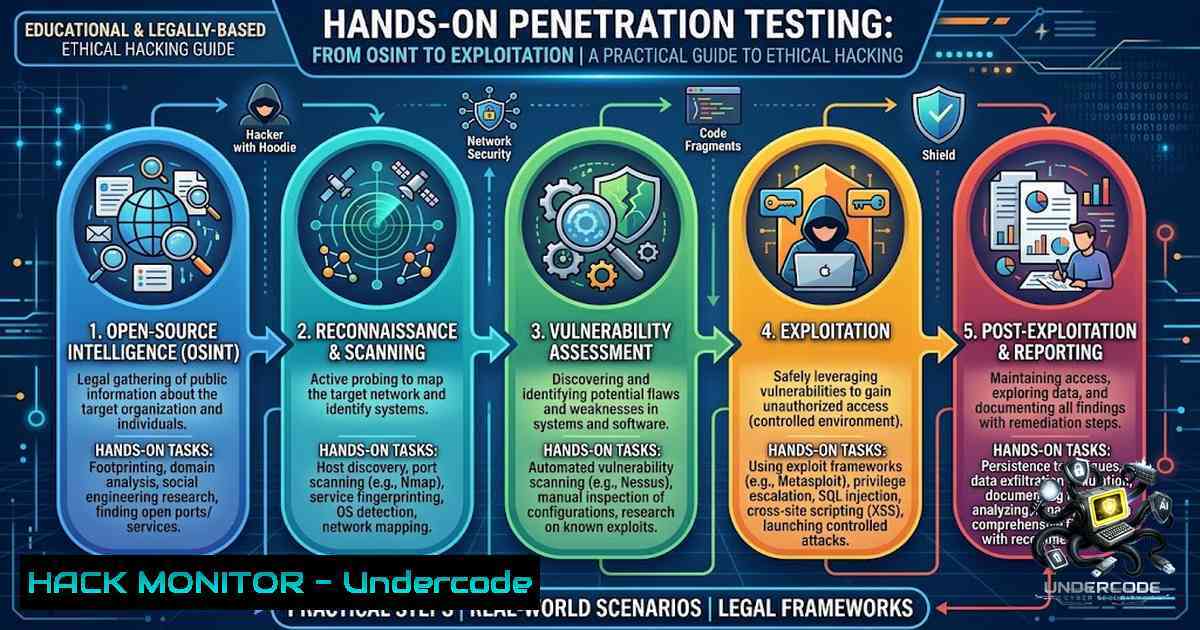
In the rapidly evolving landscape of cybersecurity, the transition from theoretical knowledge to practical offensive security skills is critical. The recent completion of the ITI Cybersecurity Summer Training, led by Eng. Mark Francis, highlights a comprehensive journey through the core pillars of ethical hacking. This article breaks down the technical components of that training, providing a step-by-step guide to mastering reconnaissance, network scanning, web application testing, password cracking, and professional reporting, bridging the gap between classroom learning and real-world penetration testing.
Learning Objectives & Secrets:
- Objective 1: Master Open-Source Intelligence (OSINT) – Learn to passively gather critical information about a target using publicly available sources, search engines, and specialized databases.
- Objective 2: Execute Network and Application Exploitation – Understand how to identify live hosts, enumerate services, and exploit common vulnerabilities using tools like Nmap and Metasploit.
- Objective 3: Perform Web Application and Credential Attacks – Gain hands-on experience intercepting web traffic, injecting SQL payloads, and cracking password hashes using industry-standard utilities.
You Should Know:
- OSINT Reconnaissance: The Art of Passive Information Gathering
OSINT is the foundation of any penetration test, allowing you to map an organization’s digital footprint without direct interaction. The training focused on several key tools:
- Google Dorking: Using advanced search operators to find exposed files, login portals, and sensitive data. For example, using `site:example.com filetype:pdf` or `intitle:”index of” “parent directory”` to discover directory listings.
- DNS Analysis & WHOIS: Extracting domain registration details and DNS records (A, MX, TXT) to identify potential attack vectors. You can use command-line tools like `nslookup` or `dig` to query DNS records.
- Shodan & theHarvester: Shodan scans the entire internet for connected devices, revealing open ports and services. theHarvester gathers emails, subdomains, and hosts from public sources.
Step‑by‑Step Guide:
- Gather DNS Info: `nslookup example.com` or
dig example.com ANY. - WHOIS Lookup: `whois example.com` (Linux) to get registrar and owner details.
- Use theHarvester: `theharvester -d example.com -l 500 -b google,linkedin` to collect email addresses.
- Analyze with Shodan: Use the Shodan CLI or web interface to query IPs and associated vulnerabilities.
2. Network Scanning and Vulnerability Discovery
Active scanning involves interacting with the target to identify live systems, open ports, and running services. The course emphasized Nmap and banner grabbing.
Step‑by‑Step Guide:
- Ping Sweep: `nmap -sn 192.168.1.0/24` to discover live hosts.
- Port Scanning: `nmap -sS -T4 -A -p- 192.168.1.10` (SYN scan, OS/version detection, all ports).
- Banner Grabbing: Connect to a service to read its banner, e.g., `nc -v 192.168.1.10 80` then send
HEAD / HTTP/1.0. - Directory Busting: Use `gobuster dir -u http://192.168.1.10 -w /usr/share/wordlists/dirb/common.txt` to find hidden web directories.
- Exploitation: Launch Metasploit:
msfconsole, search for vulnerabilities, and run exploits likeuse exploit/windows/smb/ms17_010_eternalblue.
3. Web Application Security: Interception and Injection
Web applications are prime targets. The training covered Burp Suite for proxy interception and manual SQL injection testing.
Step‑by‑Step Guide:
- Configure Burp Suite: Set your browser to use Burp as a proxy (127.0.0.1:8080). Turn on interception to capture requests.
- Test for SQLi: Manually inject `’ OR ‘1’=’1` into login forms or URL parameters. Look for error messages or unexpected behavior.
- Automate with sqlmap: `sqlmap -u “http://example.com/page?id=1” –dbs` to enumerate databases, or `–tables` to list tables.
- Test for XSS: Inject `` into input fields. If an alert box appears, the site is vulnerable to stored or reflected XSS.
- Burp Repeater: Use Repeater to modify and resend requests to test different payloads.
4. Password Cracking: Hashes and Dictionary Attacks
Understanding password hashing and cracking is essential for assessing authentication security.
Step‑by‑Step Guide:
- Identify Hash Type: Use `hash-identifier` or `hashid` to determine the hash algorithm (e.g., MD5, SHA-1, NTLM).
- John the Ripper: `john –wordlist=/usr/share/wordlists/rockyou.txt hash.txt` to crack the hash.
- Hashcat (GPU-based): `hashcat -m 0 -a 0 hash.txt /usr/share/wordlists/rockyou.txt –force` (MD5).
- Rainbow Tables: Pre-computed tables for faster cracking, but less common due to salting.
- Linux Password Files: `/etc/shadow` stores hashed passwords; use `unshadow` to combine with `/etc/passwd` for cracking.
5. Reporting: Writing a Professional Penetration Test Report
The final step is to document findings in a clear, actionable manner. A good report includes:
– Executive Summary: High-level overview for management.
– Methodology: Tools and techniques used.
– Findings: Detailed vulnerabilities with proof of concept (PoC), severity ratings (CVSS), and recommended mitigations.
– Screenshots: Evidence of exploitation.
– Appendices: Raw scan data and logs.
Step‑by‑Step Guide:
- Structure: Use a template (e.g., from Offensive Security or SANS).
- Prioritize: Rank vulnerabilities by risk (Critical, High, Medium, Low).
- Remediation: Provide clear, actionable fixes (e.g., “Apply patch KBxxx”, “Sanitize user inputs”).
- Review: Have a peer review the report for accuracy and clarity.
6. Additional Security Hardening and Mitigation
As a defender, understanding attacks helps in hardening systems.
Linux Hardening Commands:
– `sudo ufw enable` – Enable firewall.
– `sudo apt-get install fail2ban` – Protect against brute force.
– `chmod 600 /etc/shadow` – Restrict access to password file.
Windows Hardening:
– `Set-MpPreference -DisableRealtimeMonitoring $false` – Enable Defender.
– `Set-ItemProperty -Path “HKLM:\SYSTEM\CurrentControlSet\Control\Lsa” -1ame “RestrictAnonymous” -Value 1` – Restrict anonymous access.
Cloud/API Security:
- Use API keys with least privilege and rotate them regularly.
- Implement rate limiting and input validation on all endpoints.
What Undercode Say:
- Key Takeaway 1: The true value of an ethical hacking course lies not just in learning tools but in understanding the methodology—reconnaissance, scanning, exploitation, and reporting—as a cohesive workflow.
- Key Takeaway 2: Practical, hands-on experience with tools like Metasploit, Burp Suite, and Hashcat is irreplaceable. However, the “secret” to success is knowing how and when to use each tool, and more importantly, how to interpret and document the results for technical and non-technical audiences.
Analysis: The training provided by Eng. Mark Francis at ITI represents a standard, well-rounded penetration testing curriculum. While it covers essential areas, the field demands continuous learning, especially with the rise of AI-driven attacks and cloud-1ative architectures. The inclusion of reporting is a crucial, often-overlooked skill that separates a technician from a professional ethical hacker. The practical nature of the exercises, from Google Dorking to Hashcat, ensures that students can apply these skills immediately in a lab environment or a real-world assessment.
Prediction:
- +1: The skills acquired in this course will be in high demand as organizations continue to prioritize cybersecurity, especially in the Middle East and North Africa region where digital transformation is accelerating.
- +1: Hands-on training like this will become a prerequisite for entry-level security roles, with employers valuing practical certifications over purely theoretical degrees.
- -1: The rapid evolution of AI-powered defenses and attacks means that traditional tools like Nmap and Metasploit will require frequent updates and adaptation to remain effective against sophisticated adversaries.
- +1: The emphasis on reporting and communication will lead to a more mature cybersecurity industry where findings are clearly understood and acted upon by leadership.
- -1: There is a risk that students may focus solely on tool usage without mastering the underlying concepts, potentially leading to “script-kiddie” behavior. Continuous education and critical thinking are essential to avoid this pitfall.
- +1: With the growing importance of OSINT, professionals skilled in this area will be pivotal in proactive threat hunting and vulnerability discovery before malicious actors exploit them.
- -1: However, the sheer volume of data from OSINT sources can be overwhelming, and effective filtering and analysis skills will be necessary to avoid information paralysis.
- +1: The community-driven nature of platforms like LinkedIn sharing such milestones fosters a collaborative environment that benefits the entire cybersecurity ecosystem.
▶️ Related Video (80% Match):
🎯Let’s Practice For Free:
🎓 Live Courses & Certifications:
Join Undercode Academy for Verified Certifications
🚀 Request a Custom Project:
Secure, high-velocity infrastructure and disruptive technological engineering. Contact our engineering team for high-tier development and proprietary systems:
[email protected]
💎 Smart Architecture | 🛡️ Secure by Design | ⭐ Trusted by Thousands
IT/Security Reporter URL:
Reported By: https://lnkd.in/p/eyv22tY4 – Hackers Feeds
Extra Hub: Undercode MoN
Basic Verification: Pass ✅


