
Listen to this Post
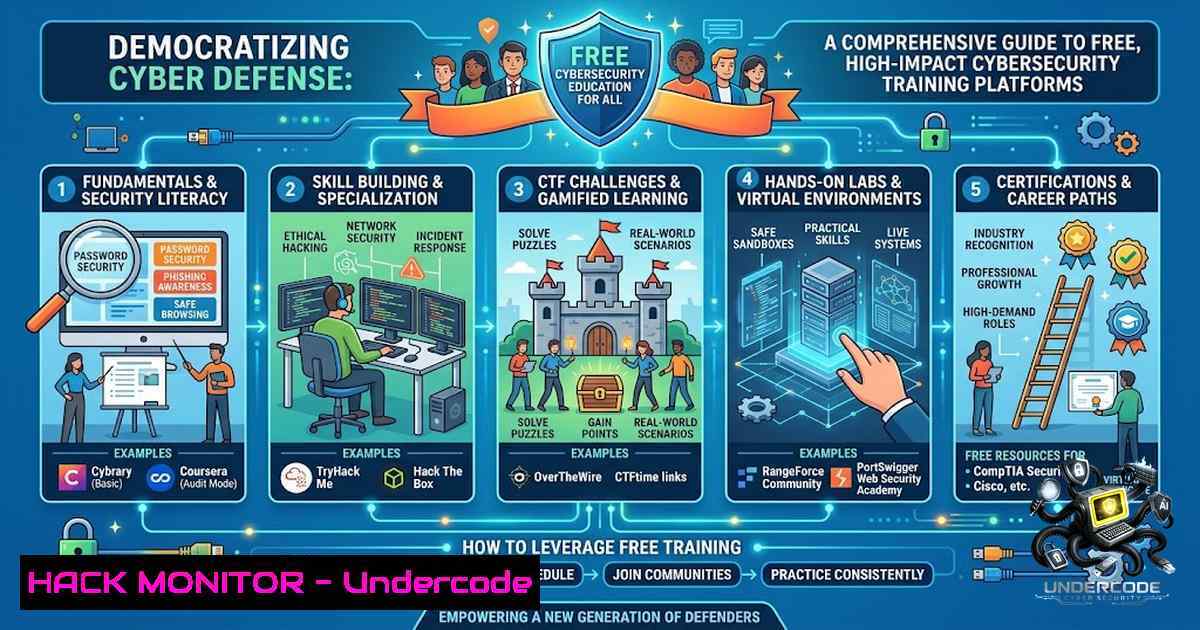
Introduction:
The cybersecurity skills gap continues to widen, with millions of unfilled positions globally as threat actors leverage increasingly sophisticated AI-driven attacks. While traditional university degrees and expensive bootcamps remain out of reach for many aspiring professionals, a robust ecosystem of free, enterprise-grade training platforms has emerged, offering pathways from absolute beginner to advanced penetration testing. This article curates the most effective no-cost resources available today, providing a structured roadmap that transforms theoretical knowledge into practical, portfolio-ready skills essential for modern Security Operations Centers (SOCs) and Red Team operations.
Learning Objectives & Secrets:
- Objective 1: Master Core Network & System Fundamentals – Establish a rock-solid foundation in TCP/IP, subnetting, and operating system internals using Cisco’s interactive simulations.
- Objective 2 (Secret Tip): Weaponize Web Application Labs – Go beyond passive video consumption; actively exploit stored XSS and SQLi vulnerabilities in PortSwigger’s labs while documenting each payload for your GitHub portfolio.
- Objective 3 (Secret Tip): Build a Home SOC Lab – Combine TryHackMe’s Windows event logging modules with Sysmon to create a miniature SIEM environment, practicing threat hunting without expensive cloud infrastructure.
You Should Know:
1. Cisco Skills for All: The Networking Pillar
Many analysts fail not because they lack hacking skills, but because they don’t understand packet flow. Cisco’s Skills for All initiative provides a comprehensive, gamified curriculum covering network fundamentals, cybersecurity essentials, and even Python for network automation. Unlike generic theory, this platform uses Packet Tracer integrations, allowing you to configure OSPF routing and ACLs in a virtual environment.
– How to use it: Focus on the “Network Defense” course. After completing a module, immediately apply the ACL concepts to a virtual Linux VM using iptables.
– Step-by-step:
1. Enroll in the “Introduction to Cybersecurity” track.
- During the networking section, open a terminal in the embedded simulation.
- Practice the command: `sudo tcpdump -i eth0 -1 -c 5` to capture live traffic and correlate it with the theory.
- Document common ports (22, 443, 3389) and map them to potential attack surfaces.
-
Fortinet Training Institute: Cloud and Zero Trust Hardening
As organizations migrate to hybrid environments, Zero Trust Network Access (ZTNA) has become non-1egotiable. Fortinet’s Institute offers NSE-level certifications free of charge, covering next-generation firewall policies, SD-WAN, and public cloud security (AWS/Azure). The advanced modules delve into protecting against SSL/TLS decryption attacks and configuring WAF rules to block OWASP Top 10 vulnerabilities.
– How to use it: Leverage the “Cloud Security” track to harden a simulated AWS environment.
– Step-by-step:
1. Complete the “Cloud Security for AWS” course.
- Download the FortiGate VM trial and deploy it in a local hypervisor.
- Configure a policy to block traffic from high-risk countries using the command line: `config firewall addrgrp` to create object groups.
- Test the configuration by running an Nmap scan from a Kali VM to see the drop in responses.
-
PortSwigger Web Security Academy: API and SSRF Exploitation
Web APIs are the number one attack vector in modern applications. The PortSwigger Academy is the gold standard for offensive web security, offering over 200 labs specifically targeting GraphQL injections, rate-limiting bypasses, and Server-Side Request Forgery (SSRF). The platform teaches you to manipulate JSON structures and exploit business logic flaws that vulnerability scanners typically miss.
– How to use it: For the SSRF lab, you will need to chain vulnerabilities.
– Step-by-step:
1. Access the “SSRF” lab section.
- Intercept the stock check request using Burp Suite Community Edition.
- Modify the URL parameter to `http://169.254.169.254/latest/meta-data/` to exfiltrate AWS cloud metadata.
4. Mitigate this in a real environment by restricting outbound HTTP traffic via egress firewalls using the Windows command: `netsh advfirewall firewall add rule name=”Block Metadata” dir=out action=block remoteip=169.254.169.254`.
4. TryHackMe: SOC Analytics and Windows Forensics
Blue Team operations require a deep understanding of Windows Event Logs (IDs 4624, 4688) and Sysinternals tools. TryHackMe offers structured “Blue Team” rooms that simulate a compromised Active Directory environment. You will learn to identify persistence mechanisms like scheduled tasks and registry run keys.
– How to use it: Focus on the “Investigating Windows” room.
– Step-by-step:
1. Deploy the Windows 10 machine in the TryHackMe network.
2. Open PowerShell and query the security logs for brute-force attempts: Get-WinEvent -LogName Security -FilterXPath "[System[EventID=4625]]".
3. Use `Autoruns.exe` to find malicious startup entries.
- For Linux, practice using `grep` to parse auth logs:
grep "Failed password" /var/log/auth.log.
5. IBM SkillsBuild and Fundação Bradesco: Professional Development
Beyond technical exploits, cybersecurity is about communication and risk management. IBM SkillsBuild offers modules on AI ethics, data privacy (GDPR/LGPD compliance), and professional soft skills crucial for report writing. Fundação Bradesco’s Escola Virtual provides foundational IT courses—Windows Server administration and database management—that are prerequisites for understanding how data is stored and attacked.
– How to use it: Enroll in the “Introduction to Data Science” to understand how machine learning models can be poisoned.
– Step-by-step:
1. Complete the “AI Fundamentals” course.
2. Research prompt injection attacks against LLMs.
- Create a risk assessment matrix explaining the financial impact of a data breach to non-technical stakeholders.
6. Building Your Active Portfolio
The post emphasized not focusing merely on certificates. Practical experience is king. Create a GitHub repository documenting your Burp Suite extensions, custom NSE scripts, or Python parsers for log files.
– How to use it: Automate log analysis for the PortSwigger labs.
– Step-by-step:
1. Write a Python script using the `requests` library to automate the detection of blind XSS using a callback server.
2. Push this to GitHub alongside a detailed README explaining the script’s methodology.
3. Host the script on a Linux VPS and schedule it with `cron` to run weekly vulnerability scans.
What Undercode Say:
- Key Takeaway 1: Certification fatigue is real; hiring managers value practical lab walkthroughs and detailed write-ups over a stack of unattested course completion badges.
- Key Takeaway 2: The community-driven approach of these platforms fosters a growth mindset, allowing professionals to shift from “script kiddie” to “vulnerability researcher” by analyzing how attackers chain multiple low-severity bugs for maximum impact.
Prediction:
- +1 The proliferation of free, high-quality training will continue to lower the barrier to entry, significantly reducing the global talent shortage by 2030.
- +1 Hands-on platforms like TryHackMe are increasingly being adopted by universities as official curricula, standardizing practical assessments over theoretical rote memorization.
- -1 As defensive tools become more accessible, the volume of “script kiddie” level attacks will surge, requiring defenders to focus on log analysis and threat hunting rather than just firewall rule management.
- +1 The integration of AI co-pilots in these training platforms will accelerate learning by providing real-time feedback on exploit attempts, shortening the learning curve from months to weeks.
- -1 There is a risk of “tick-box” training where users complete labs mechanically. A shift towards project-based assessments (e.g., “Hack this custom webapp”) will be necessary to filter genuine talent.
- +1 Collaboration between platforms (e.g., Cisco integrating TryHackMe rooms) will create a unified skills matrix, making it easier for recruiters to verify candidate proficiency.
- -1 Dependency on cloud-based labs may limit learning for individuals in regions with poor internet connectivity, emphasizing the need for offline virtual machine snapshots.
- +1 The open-source nature of these platforms’ curriculums will force expensive commercial training vendors to innovate and lower prices, creating a healthier market.
- +1 Continuous learning will become a core KPI for cybersecurity roles, with organizations budgeting paid “Lab Time” for employees to explore these free resources during work hours.
▶️ Related Video (84% Match):
🎯Let’s Practice For Free:
🎓 Live Courses & Certifications:
Join Undercode Academy for Verified Certifications
🚀 Request a Custom Project:
Secure, high-velocity infrastructure and disruptive technological engineering. Contact our engineering team for high-tier development and proprietary systems:
[email protected]
💎 Smart Architecture | 🛡️ Secure by Design | ⭐ Trusted by Thousands
IT/Security Reporter URL:
Reported By: https://lnkd.in/p/e4A6yD-t – Hackers Feeds
Extra Hub: Undercode MoN
Basic Verification: Pass ✅


