Listen to this Post
Introduction:
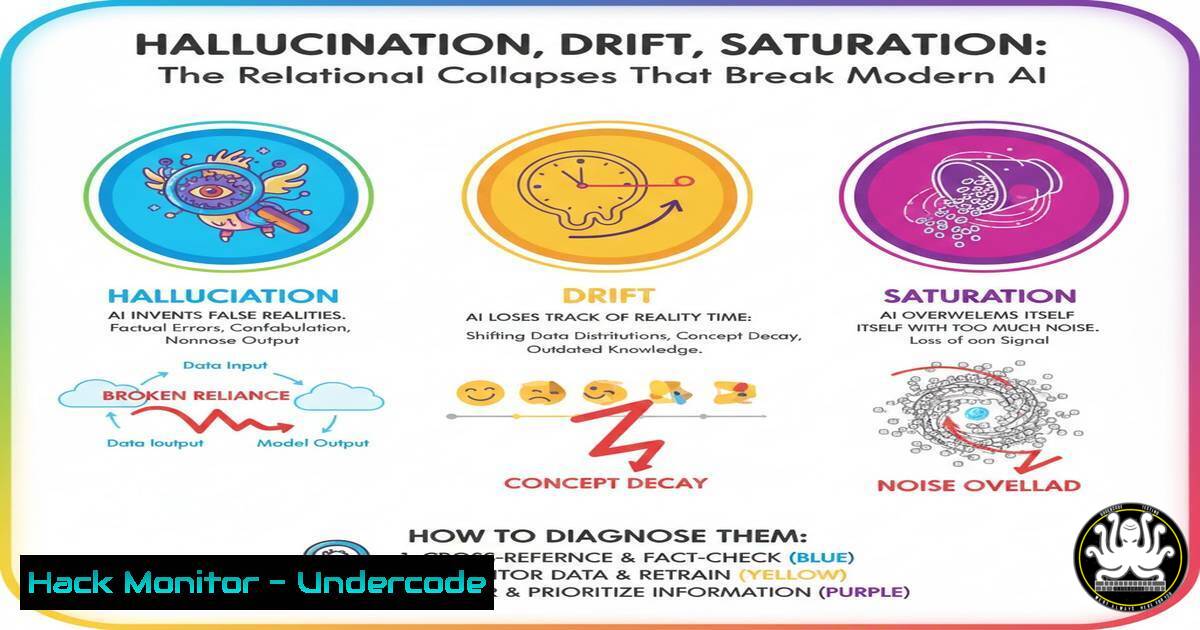
The prevailing narrative in artificial intelligence equates fluent output with genuine understanding, treating hallucinations and model drift as mere representational bugs to be patched. Groundbreaking research, crystallized in the CIITR framework, challenges this fundamentally, reclassifying these failures as relational collapses—breakdowns in the structural integration, rhythmic grounding, and energy-bounded inference required for true comprehension. This shift moves the governance conversation from trusting black-box outputs to verifying the explicit, auditable conditions under which understanding can occur.
Learning Objectives:
- Deconstruct the CIITR framework’s core components: Structural Integration (Φᵢ), Rhythmic Grounding (Rᵍ), and Energy-Bounded Inference (CPJ).
- Learn to diagnostically distinguish between representational errors and relational failures in AI system behavior.
- Apply practical auditing and monitoring techniques to measure relational integrity and preempt failures like hallucination and drift.
You Should Know:
- Understanding is an Event, Not a State: The CIITR Framework Explained
The CIITR framework posits that understanding is not a static property stored within a model’s weights. It is a transient event that occurs only under specific relational conditions. This reframing is operationally critical, moving evaluation from “what” the system outputs to “under what conditions” it produced it.Structural Integration (Φᵢ): This measures the degree of coherent, context-aware connection between concepts within a specific inference. High Φᵢ indicates that an output is not just statistically plausible but structurally consistent with the provided context and the system’s internal knowledge graph.
Rhythmic Grounding (Rᵍ): AI operates in iterative cycles (training, inference, feedback). Rᵍ refers to the synchronization of these cycles with stable, real-world data rhythms and constraints. Desynchronization—where the model’s internal “rhythm” diverges from reality—leads to drift and compounding error.
Energy-Bounded Inference (CPJ – Comprehension per Joule): Understanding has a metabolic cost. CPJ measures the computational energy required to achieve a unit of reliable comprehension. The framework warns that scaling models can increase raw output fluency while drastically degrading CPJ, masking a collapse in efficient understanding.
2. Diagnosing Hallucination as Rhythmic and Energetic Collapse
Hallucination is not simply “making things up.” It is a diagnostic symptom of a breakdown in Rᵍ and an exhaustion of CPJ. When a model is pushed beyond its energetically bounded capacity for grounded inference, or when its iterative process loses rhythmic tie to factual anchors, it defaults to fluent pattern-matching without structural integrity.
Step-by-Step Guide for Diagnosing Relational Collapse:
- Establish a Baseline Rhythm: For a given task (e.g., technical summarization), define the expected “rhythm” of inputs: source veracity, data freshness, logical structure. Use tools to profile this.
Linux Command for Data Stream Profiling: `tshark -i eth0 -Y “http.request” -T fields -e http.host -e http.request.uri | awk ‘{print $1}’ | sort | uniq -c | sort -nr` can help analyze query patterns and sources feeding an AI system. - Monitor for Desynchronization: Implement guardrails that check outputs against this rhythm. A sudden spike in citations to non-existent sources (hallucination) is a rhythmic break.
Python Snippet for Output Anchoring:
import re
def check_factual_anchor(response, trusted_entities):
"""Checks if key claims are anchored to provided or trusted entities."""
found_anchors = []
for entity in trusted_entities:
if re.search(rf'\b{entity}\b', response, re.IGNORECASE):
found_anchors.append(entity)
anchor_ratio = len(found_anchors) / len(trusted_entities) if trusted_entities else 0
return anchor_ratio < 0.2  Flag if less than 20% anchoring
3. Audit CPJ: Profile the computational cost (inference time, GPU memory, joules) of queries that produce correct vs. hallucinated outputs. A lower CPJ for hallucinated outputs suggests the system is taking an “easy,” ungrounded fluency path.
3. Combating Model Drift Through Active Rhythmic Grounding
Drift occurs when Rᵍ degrades over time as the world changes but the model’s operational context does not. Mitigation requires active re-synchronization.
Step-by-Step Guide for Rhythmic Maintenance:
- Implement a Change Detection Sentinel: Use a lightweight model or rule-based system to monitor input data streams for statistical drift in key metrics (e.g., new terminology, emerging event references).
Bash Script for Log Monitoring:
 Monitor log for new, frequent unknown tokens
tail -f ai_system.log | grep "OUTPUT" | awk '{print $4}' | \
while read token; do
if ! grep -q "$token" known_lexicon.txt; then
echo "$(date) - DRIFT ALERT: Unanchored token '$token'" >> drift_alerts.log
fi
done
2. Trigger Calibration Cycles: Upon alert, initiate a targeted, energy-bounded (high-CPJ) retraining or prompt-engineering cycle focused solely on the desynchronized domain, using freshly grounded data.
3. Validate Φᵢ Restoration: After calibration, verify that outputs related to the updated domain show restored structural integration with the broader knowledge base.
4. Auditing for Governance: From Trust to Verification
Governance based on output scoring alone is obsolete. The CIITR framework demands auditing the conditions (Φᵢ, Rᵍ, CPJ) that enable understanding.
Step-by-Step Audit Protocol:
- Define Relational Benchmarks: For a critical use case (e.g., medical triage AI), define minimum thresholds for Φᵢ (logical coherence score), Rᵍ (data freshness < 24 hrs), and CPJ (max energy per query).
- Instrument the Inference Pipeline: Deploy probes to measure these metrics in real-time or per-batch.
- Enforce Conditional Operation: Implement circuit breakers that halt or flag operations falling outside benchmark conditions. Governance is embedded in the system’s operational parameters, not in post-hoc human review.
-
The Scale Trap: Measuring the Trade-off Between Fluency and CPJ
Larger models exhibit emergent fluency but risk catastrophic declines in Comprehension per Joule. This is a critical infrastructure and security risk, as it creates systems that are massively expensive and fluent in their errors.
Step-by-Step CPJ Profiling:
- Task-Specific Joule Metering: Use hardware performance counters (e.g., `nvidia-smi –query-gpu=power.draw –format=csv -l 1` for NVIDIA GPUs) to measure energy consumption for a standardized set of comprehension tasks (e.g., multi-step reasoning, anomaly detection).
- Benchmark Against Simpler Models: Compare the CPJ of a giant model to a smaller, specially-trained model for the same task. A significantly lower CPJ for the smaller model indicates a scale-induced efficiency collapse.
- Architect for Efficiency: Use the CIITR audit to identify where relational conditions break down, and consider hybrid systems where a small, high-CPJ “overseer” model validates the outputs of a larger, fluent “generator” model.
What Undercode Say:
Governance is Shifted to the Left: The pivotal insight is that AI governance must move from auditing outputs to governing the input conditions and operational parameters (Φᵢ, Rᵍ, CPJ) that make reliable outputs possible. This is a seismic shift akin to moving from pen-testing to secure development lifecycle (SDL) mandates.
The Energy-Security Nexus: The CPJ metric formalizes the link between AI security and infrastructure security. A model experiencing a low-CPJ collapse is not just “wrong”—it is wastefully consuming critical compute resources to produce dangerously fluent nonsense, creating a new denial-of-service vector against your own analytical capability.
Prediction:
Within the next 2-3 years, leading regulatory frameworks for high-stakes AI deployment (in finance, defense, critical infrastructure) will move beyond algorithmic impact assessments to mandate CIITR-like relational audits. Procurement contracts will specify minimum Φᵢ and CPJ benchmarks, not just accuracy scores. This will spur a new market for “Relational Integrity as a Service” (RIaaS) tooling and force a architectural renaissance focused on efficient, bounded, and verifiable understanding over unbounded, inscrutable fluency. The organizations that master measuring and maintaining the relational conditions for understanding will gain a decisive strategic advantage, turning AI governance from a compliance cost into a source of robust, trustworthy capability.
▶️ Related Video (78% Match):
🎯Let’s Practice For Free:
IT/Security Reporter URL:
Reported By: Stuart Wood – Hackers Feeds
Extra Hub: Undercode MoN
Basic Verification: Pass ✅


